


 MSI Logo PNG
The MSI logo hints at the project’s eastern roots. The corporation’s success rests on the strength, knowledge, and perseverance that have enabled it to stand on its own and protect its technologies from attacks. The emblem’s energy allows the manufacturer to remain a leader.
On August 4, 1986, five former Sony engineers founded Micro-Star International in Zhonghe, Taipei. Joseph Hsu, Jeans Huang, Frank Lin, Kenny Yu, and Henry Lu left after the 1985 layoffs and focused on PC motherboards and expansion cards as the company grew rapidly.
In 1986, MSI released an overclockable motherboard for the Intel 286 processor. By 1989, it had a board for the 486; in 1993, for the 586; and in 1995, a dual-processor solution for the Pentium Pro. Early products targeted technical users interested in performance tuning.
Through the 1990s, MSI operated between ASUS and Gigabyte, expanding output and product range. In 1997, it entered the graphics cards market and introduced a barebone PC. In 1998, the company went public on the Taiwan Stock Exchange, followed by manufacturing in Shenzhen in 2000, an R&D center in Kunshan in 2001, and a European logistics hub in the Netherlands in 2002.
In 2003, MSI launched Mega PC, combining a desktop with a stereo system. In 2004, it released its first laptop, the M510C. In 2008, MSI shifted gears by sponsoring Fnatic and launching the Gaming line. In 2010, MSI launched the Beat IT tournament, later known as MSI Masters Gaming Arena, with Evil Geniuses as the first champion.
In 2015, MSI partnered with Tobii on eye-tracking laptops, and in 2016, supported HTC Vive systems. In 2018, it entered the content-creation laptop market and later introduced the Modern, Prestige, and Summit lines. In May 2023, at Computex, MSI presented a gaming laptop in collaboration with Mercedes-AMG.
Meaning and History
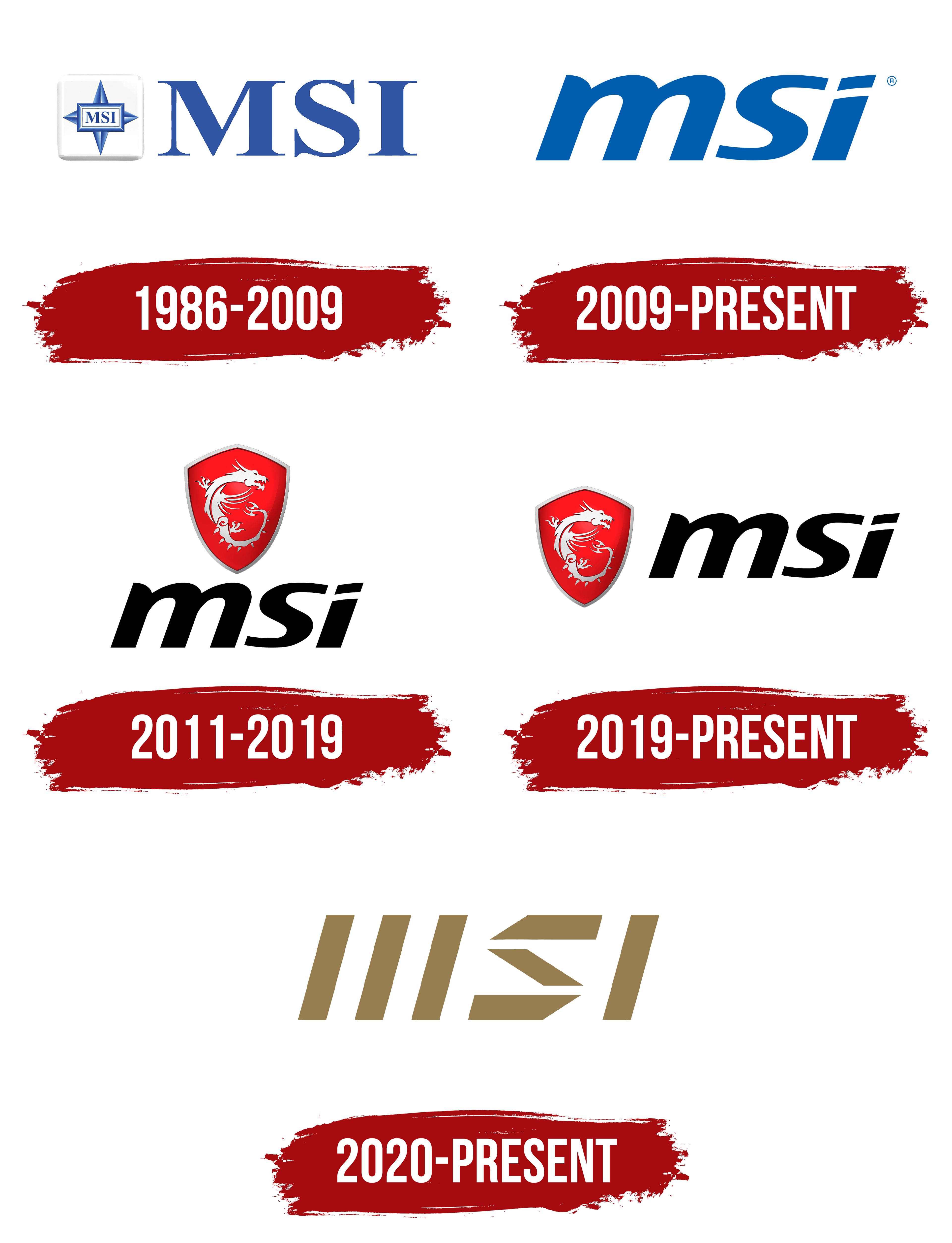
Throughout its existence, the company has had several logos. The latest is minimalistic. All of them are based on an abbreviation derived from the corporation’s full name, Micro-Star International. The first version appeared when it was founded.
What is MSI?
MSI is an abbreviation for the high-tech corporation Micro-Star International, which specializes in computer equipment and related products. Its product range includes PCs, laptops, graphics cards, motherboards, servers, and much more. The company was founded in 1986. Its headquarters are in New Taipei, Taiwan.
1986 – 2009
The debut emblem consists of a four-pointed star used in compasses. It epitomizes the manufacturer’s geographic diversity, emphasizing that it targets consumers from all parts of the world – another meaning: striving to become a star in the computer industry. The company name sits atop the star sign.
In 1997, the corporation opened its first plant (in Jung-He), so it updated the brand name. Its form and structure remained the same. The changes affected the color: the logo turned from black-and-white to blue. Management conceived this shade to epitomize innovation, vitality, and modernity.
The 2004 emblem was transitional, combining the word and the star symbol.
2009 – today
There is nothing superfluous in this time’s brand name – only a short version of the name. “Msi” is in italics, lowercase, with a beveled dot above the “i.”
2011 – 2019
The year 2011 brought significant changes to the Taiwanese company, which were reflected in the logo design. In addition to the MSI abbreviation from Micro-Star International, it also uses a shield with the national symbol, a dragon. It has a distinctly spiky tail with a double-ended tip, stylized wings, a clawed paw, tousled withers, and a mouth full of sharp teeth.
Moreover, the mythical animal figure consists of four separate fragments: the tail, trunk, paws, and head with withers. The white writhing dragon is evenly positioned on the red shield, occupying the entire center. At the bottom is a large inscription, “MSI,” in italicized lowercase letters.
2019 – today
In this version, the designers have fully preserved the number of elements, their sizes, and their styles. The changes were minimal: the developers moved the shield with the dragon to the left and added brightness. As a result, scarlet replaced red and burgundy.
2020 – today

The coronavirus pandemic and related restrictions influenced the corporate logo update, including self-isolation and remote work. To make users feel like they are in the office, Micro-Star International introduced a new generation of professional notebooks by the end of the year. Moreover, she marked them with a conceptual emblem corresponding to the spirit of modernity.
MSI’s current logo is styled after the Roman numeral III, as the line includes three models. For the experiment, the designers chose the letter “M,” which lends itself to a convenient transformation. The other characters visually align with the standard spelling while still looking progressive. “S” consists of three pointed segments that resemble a narrow rectangle.
Font and Colors
For half of its existence, the logo featured a four-pointed star. It sits to the left of the word; that is, it starts at the beginning, clearly recalling typographic compass symbols. But as the gaming industry grew, it abandoned this symbolism.
Until 2009, developers used a typeface with expressive serifs; after that, they used a smooth one. Both versions made the emblem recognizable, since the work’s specifics don’t lend themselves to an exquisite monogram. Everything in the computer sphere should be strict, clear, and understandable, as the logo reflects. Therefore, the company’s corporate colors are black, red, blue, and white.