Nice Logo PNG
The Nice logo presents a restrained image that symbolizes stability and loyalty to the football club’s traditions. The simplicity and clarity of its design reflect the team’s results-oriented approach, competitive spirit, and respect for the club’s history, rather than its outward appearance.
OGC Nice began on July 9, 1904, when Marquis de Massengy d’Auzac founded Gymnaste Club de Nice in Les Baumettes. Initially devoted to gymnastics and athletics, it added football in 1908. A 1919 merger with Gallia Football Athletic Club brought the black-and-red colors, while another union in 1924 produced the name Olympique Gymnaste Club de Nice.
The team moved to Stade Municipal du Ray in 1927 and became one of 20 founders of France’s professional Division 1 in 1932. Relegated in 1934, Nice spent nearly 15 years below the top tier. Promotion returned in 1948 after a second-division title and 109 goals, opening the club’s strongest period.
Nice won its first French championship in 1951, then completed a league-and-cup double in 1952. An international squad included Hector De Bourgoing, Pancho Gonzales and record scorer Joaquín Valle. Just Fontaine joined in 1953 and helped secure a third title in 1956. The club reached the European Cup quarter-finals before losing to Real Madrid, then claimed its fourth league crown in 1959.
Runner-up finishes followed in 1973 and 1976, before relegation in 1982 and promotion in 1985. Nice won the 1997 French Cup but dropped divisions days later, returning to Ligue 1 in 2001. After 85 years at Stade du Ray, the club entered the 36,178-seat Allianz Riviera in 2013. It hosted Euro 2016 and football at the 2024 Olympics. Jim Ratcliffe’s INEOS bought control in 2019, and Nice finished fifth in 2021-22, reaching the Europa League group stage.
Meaning and History

What is Nice?
It is a soccer club based in southern France that regularly competes in Ligue 1. The team has won the French Championship and the National Cup multiple times. Renowned players who have represented the club include Hector De Bourgoing, Just Fontaine, and Hugo Lloris. The team’s home stadium is the Allianz Riviera, which accommodates around 35,000 spectators.
1948 – 1992

The OGC Nice emblem represents an original interpretation of classic heraldry, executed in a modern style for its time. Appearing in the late 1940s, the logo coincided with the club’s peak achievements in the first half of the 1950s and became a symbol of brand maturity and identity.
The emblem’s configuration features a gold shield with an elongated, geometrically simplified shape, topped by a crown with sleek, curved points. Stylistically, the composition evokes a royal coat of arms yet is rendered in a modern, minimalist style. The shield’s form, smooth and streamlined, with an emphasis on vertical proportions, visually conveys confidence and grandeur.
The interior space is filled with a stylized red eagle, the traditional symbol of Savoy, outlined in fine gold trim. The eagle’s form is abstract and elegant, with simplified geometry and smooth wing curves symbolizing the club’s power and ambition. Beneath it is a group of three green triangles resembling mountain peaks, metaphorically representing the team’s growth and development.
Above the red eagle is a black horizontal banner with the abbreviation “OGCN” in a simple, restrained gold typeface. The contrast between black and gold emphasizes prestige and importance, associating the club with authority and respect. Below the eagle is a black triangle, visually balancing the upper banner and adding stability to the entire emblem.
The emblem’s palette, comprising gold, red, black, and green, carries strong symbolic meaning: red and gold signify strength, courage, and the drive for victory; black conveys formality and status; green highlights loyalty to tradition and steady development. Emotionally, the palette presents the club as ambitious and confident, with a rich history and strong ties to Savoy traditions.
This version of the logo became iconic for the era, blending archaic and futuristic elements to clearly express the club’s character and spirit.
1992 – 2013

The OGC Nice logo, adopted in 1992 and used until 2013, marked a significant shift in the club’s visual identity, moving from a heraldic tradition to a more restrained, functional emblem grounded in football symbolism. The composition adopted a strict circular format, allowing the design to revolve around strong geometry and clean shapes.
The central element is a black eagle rendered in a flat silhouette, with broad wings and a static stance. It is placed over a classic soccer ball rendered in a black-and-white hexagonal pattern and is perceived as the club’s guardian, standing at the core of the sport. The eagle references the nickname Les Aiglons and the city of Nice’s traditional association with this symbol. A small red crown atop the eagle’s head serves as a hereditary marker of continuity, retaining a link to the monarchical symbolism of the previous emblem but in a minimalist form.
The ring surrounding the ball is filled with red and bears the inscription “OGCN CÔTE D’AZUR” along the arc. The type’s geometry is uniform: all uppercase, sans serif, with even stroke thickness and no decorative features. It is functional, strong, and unemotional, underscoring the team’s character: disciplined, focused, and results-driven. The use of geometric sans serif enhances the impression of a confident visual structure and reflects the 1990s’ technological style.
The color palette is based on black, white, and red. Black symbolizes strength, stability, and dominance. Red, rich and active, conveys energy, determination, and passion. White provides visual balance and structural clarity, preventing the mark from becoming overloaded. This palette creates strong visual contrast and reinforces the club’s regional identity, including textual references to the Côte d’Azur that emphasize Nice’s geographic and cultural identity within the Alpes-Maritimes.
The logo functioned as the club’s visual transformation into a new era, an era of football commercialization, professional branding, and regional marketing. The simplification of form, the strengthening of the eagle symbol, and the emphasis on the Côte d’Azur represented a stylistic shift and reflected the club’s strategic positioning during this period.
2013 – today

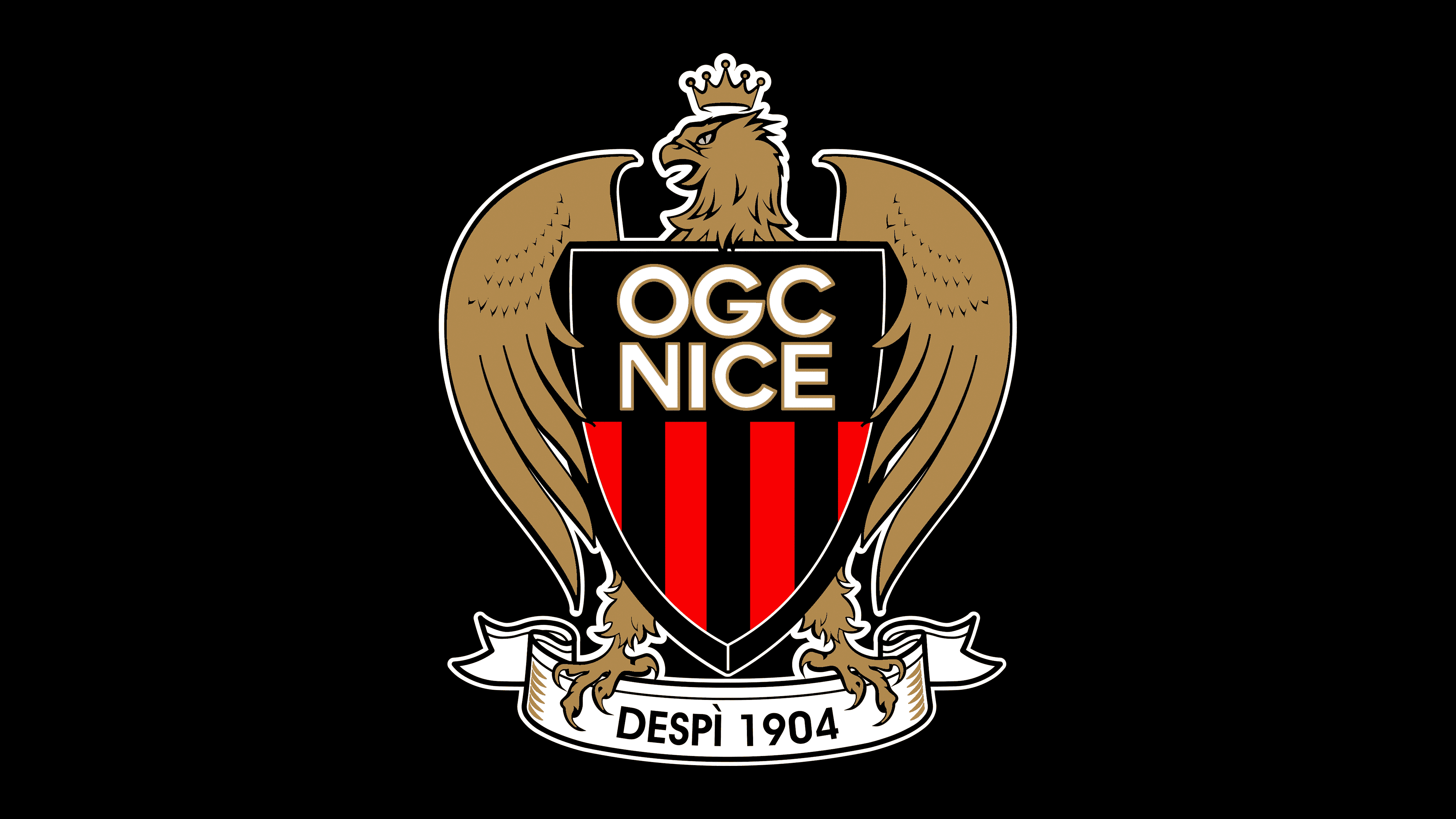
The redesign of the OGC Nice club emblem, officially unveiled on May 19, 2013, during the last home match at Stade du Ray, became a symbolic marker of the transition between two eras: the departure from the historic arena and the beginning of a new chapter at Allianz Riviera Stadium. Visually, the logo reverted to a classic heraldic system but was reinterpreted through modern aesthetics and brand standards.
Composed of a large eagle facing right, the emblem aligns with the heraldic norms of the Sardinian duchy and the historical symbolism of Nice. The eagle is rendered in a detailed illustrative style, with wide, slightly spread wings, a carefully shaped head silhouette with an open beak, and a cascade of stylized feathers. It is topped with a modestly sized yet precisely shaped crown, executed in the same warm golden-brown tone as the rest of the bird’s figure. This approach preserves visual unity of form and color without disrupting the mark’s hierarchy.
Instead of the eagle’s body, an elongated shield with vertical red-and-black stripes is featured, stylistically referencing the traditional club palette. The stripe proportions are arranged in a rhythmic sequence, enhancing a sense of stability and confidence. At the top of the shield is the “OGC NICE” wordmark, split into two lines. The lettering is set in clean, uppercase sans serif, with solid geometric proportions and well-spaced tracking, rendered in white on a black background. The minimalist, functional style of the typeface underscores the relevance of the club’s visual language in the 21st-century context.
Beneath the eagle’s talons is a white ribbon inscribed “Despì 1904,” a reference to the year the club was founded. The use of the local Niçard dialect signals respect for historical roots and emphasizes local identity as the foundation of the club brand. The ribbon is outlined with a thin black stroke, and its curved form visually closes the composition, balancing the eagle’s mass.
The color scheme is based on black, red, and gold. The contrast between black and red is associated with dynamism, ambition, and the club’s historical heritage. The golden tone of the eagle conveys nobility, authority, and continuity. White accents act as structural balance, adding clarity and confidence to the lettering.
The decision to drop the “Côte d’Azur” phrase in favor of the concise “OGC Nice” marks a deliberate shift in identity strategy: the focus moves from regional reach to a specific connection with the city, thereby strengthening ties with the territory, supporters, and urban culture.