 Nuclear Regulatory Commission (NRC) Logo PNG
The Nuclear Regulatory Commission (NRC) logo represents an agency responsible for ensuring the safe use of radioactive materials. It licenses, inspects, and establishes strict regulations to oversee the operation of facilities related to nuclear energy and radiation technologies.
In 1974, President Gerald Ford signed the Energy Reorganization Act, creating the Nuclear Regulatory Commission (NRC). This act split the Atomic Energy Commission, assigning oversight duties to the NRC and research responsibilities to what later became the Department of Energy.
The NRC officially began operations in January 1975, initially focusing on safety frameworks for nuclear facilities. The Three Mile Island accident in 1979 prompted significant revisions of safety regulations, introducing stricter controls and improved emergency procedures.
In the 1980s, the NRC strengthened licensing and monitoring practices, prioritizing a culture of safety in nuclear plant operations. During the 1990s, the commission adopted a risk-based approach, efficiently allocating resources to address critical safety concerns and extend reactor lifespans.
Security measures intensified after September 11, 2001, introducing stringent protocols to safeguard nuclear facilities. From 2005 onward, NRC began developing licensing procedures for next-generation reactors.
The Fukushima disaster in 2011 led to a further reassessment, resulting in regulations that protect plants from extreme events. By 2016, cybersecurity and technological integration became central to regulatory oversight.
Between 2018 and 2019, the NRC streamlined administrative processes without compromising safety. From 2020 to 2023, the commission developed frameworks for small modular reactors and integrated digital technologies to modernize regulation.
As of early 2024, the NRC continues adapting regulatory practices to technological advancements while maintaining rigorous safety standards.
Meaning and History
What is Nuclear Regulatory Commission (NRC)?
This independent federal agency regulates nuclear materials and energy use in the United States. It oversees licensing, safety controls, radiation monitoring, and supervision of nuclear power plants, research reactors, and other nuclear facilities. The agency develops and enforces strict regulations, conducts inspections, grants permits, and ensures compliance. It also provides training for nuclear safety specialists and engages with the public to maintain transparency in its operations.
1975 – today
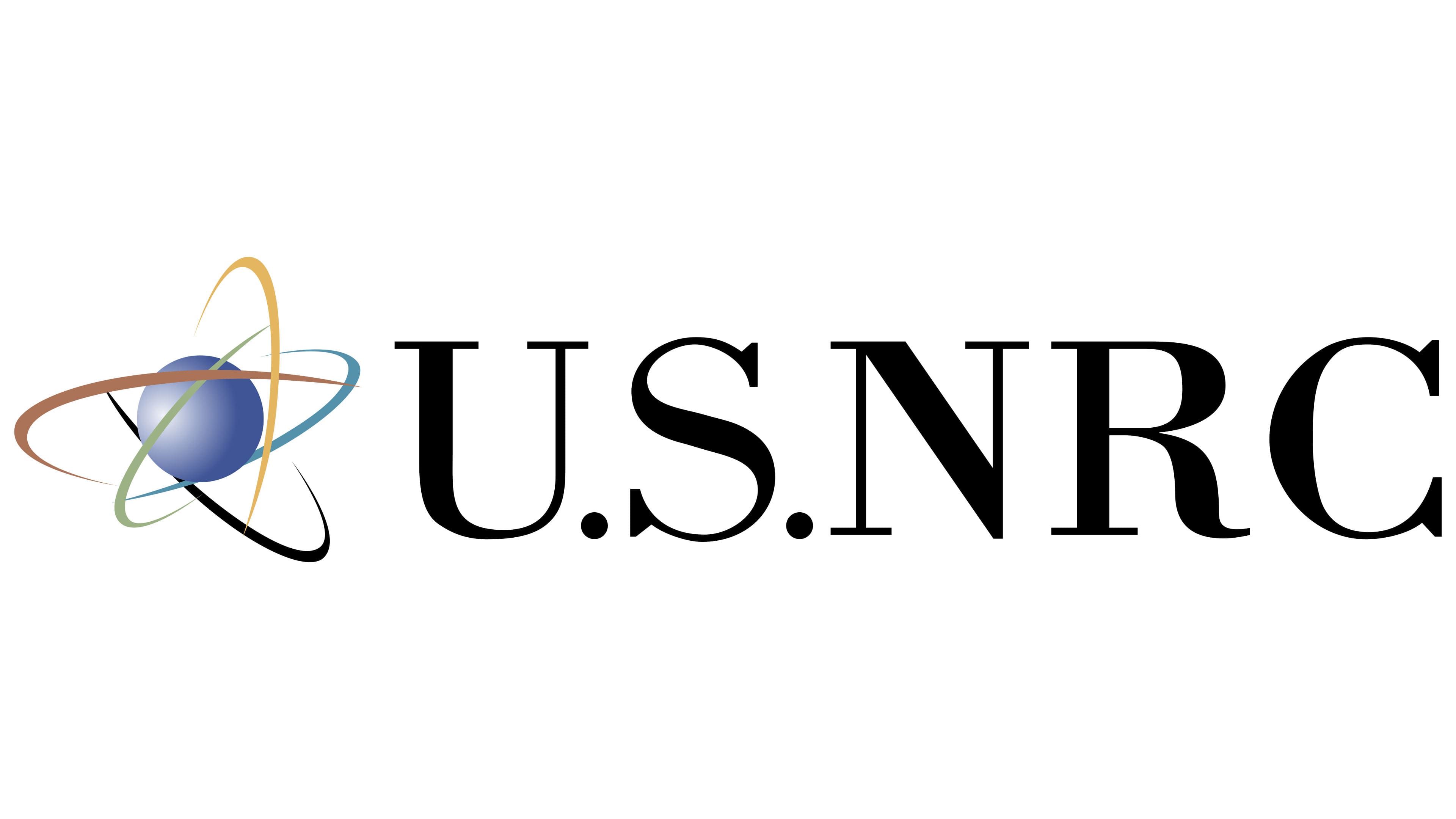
The visual system of the federal agency, the Nuclear Regulatory Commission, is built around the image of an atom. The artistic part of the logo is concentrated on the left and expressed as a spherical blue object with a smooth transition of shades. The gradient accentuates the shape’s contours, creating a three-dimensional effect. Around the sphere are five multicolored orbits. The lines intersect and overlap, forming a conditional model of atomic structure. The orbits are colored brown, black, green, yellow, and blue, reinforcing their association with the multilayered, complex tasks the organization addresses.
The text part is placed in the right block. The abbreviation “U.S. NRC” is typed in uppercase serif characters. In terms of proportions, the typeface is similar to classic systems, such as Times New Roman. Strict lines, clarity of forms, and moderate letter spacing distinguish the design.
The black text color reflects the commission’s official status and conveys the seriousness of its work. The sphere, on the other hand, is perceived as the more dynamic part of the composition due to the saturated blue and additional color accents of the orbits. Blue symbolizes reliability and stability. The other shades convey the idea of diversity in areas of activity, ranging from research initiatives to regulatory procedures.
The Nuclear Regulatory Commission (NRC) logo emphasizes the agency’s scientific and technical profile, establishing its image as the organization responsible for overseeing nuclear energy and the use of nuclear materials in the United States.