


 Partito Democratico Logo PNG
The Partito Democratico logo looks fresh and vibrant. The emblem demonstrates the movement’s growth and flourishing, highlighting the party’s historical roots. The color scheme represents a commitment to Italy’s well-being.
The Democratic Party, Partito Democratico, PD, was officially formed on October 14, 2007, through the merger of the Democrats of the Left, DS, and La Margherita. The project followed years of talks inside Italy’s center-left camp. Romano Prodi, Walter Veltroni, and Francesco Rutelli were among the figures who backed a single party capable of competing with the dominant right-wing forces.
The first leadership primary was held on the same day in 2007, and Walter Veltroni became the party’s first leader. In the 2008 general election, PD ran with other center-left groups but lost to Silvio Berlusconi’s center-right coalition. After weak regional and European election results, Veltroni resigned in 2009, and Pier Luigi Bersani took over as part of a period of internal reorganization.
In 2013, the PD-led coalition won a majority in the Chamber of Deputies but failed to control the Senate. The deadlock led to a coalition government headed by Enrico Letta, a member of the party. In December 2013, Matteo Renzi became PD leader, and in February 2014 he replaced Letta as prime minister. Under Renzi, the party won over 40 percent in the 2014 European Parliament election.
Renzi’s government introduced the Jobs Act and a constitutional reform package. Still, he resigned as prime minister after losing the 2016 referendum. Paolo Gentiloni led the government until the 2018 election, when PD fell to about 19 percent. Maurizio Martina served as interim leader before Nicola Zingaretti was elected in March 2019. Under Zingaretti, PD formed a government with the Five Star Movement in September 2019. In 2021, after Giuseppe Conte’s government collapsed, the party supported Mario Draghi’s national unity government.
Meaning and History
What is Partito Democratico?
It is an Italian center-left political party adhering to social-democratic and progressive ideals. It was formed from several center-left groups, and its goals include social justice, protection of workers’ rights, equality, and economic growth. Party members actively participate in Italy’s political life and have connections with European social-democratic parties.
2007 – today
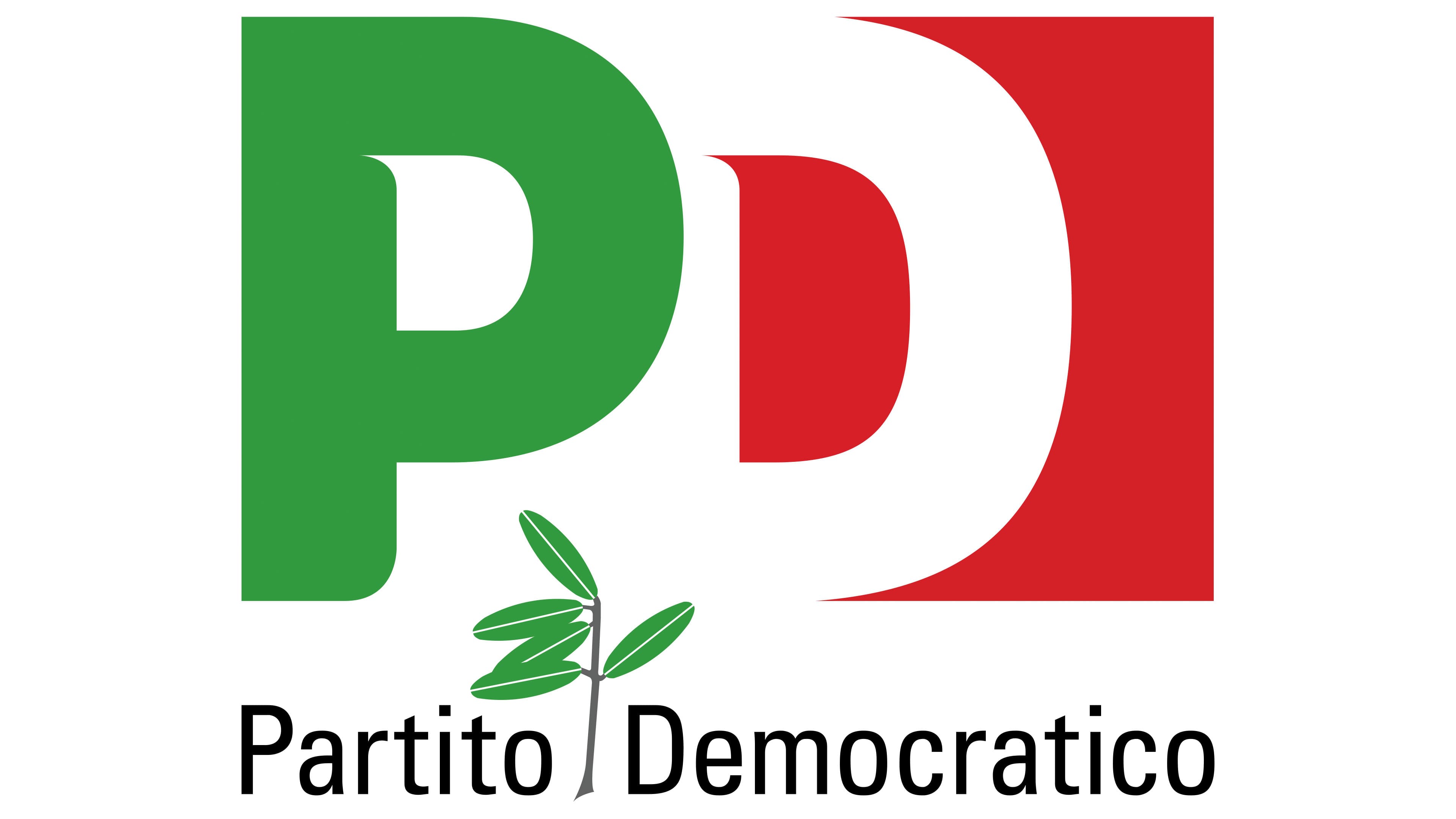
The logo was created in line with the legacy of the “Olive Tree” coalition, formed in 1995 under Romano Prodi’s leadership. This coalition brought together various political forces, including socialists, liberals, and environmentalists. The use of symbols and colors in the logo underscores the significance of this union. It emphasizes the “Partito Democratico” party’s commitment to continuing work for the country’s benefit, considering the interests of all societal layers.
The “Partito Democratico” logo features large letters of the abbreviation “PD” in green and red, symbolizing the Italian flag. An olive branch is depicted between the words “Partito” and “Democratico.”
The green “P” and red “D” highlight Italy’s national identity. The olive branch symbolizes peace and progress, the legacy of the “Olive Tree,” a coalition of center-left parties.
The logo demonstrates the party’s commitment to national values and their integration into the political program. The olive branch indicates the goal of uniting various political forces to achieve common objectives.
The font used in the logo is simple and clear, emphasizing the party’s openness and transparency. The inscription “Partito Democratico” is rendered in a neat, rounded style, adding an element of friendliness and accessibility.
Green represents environmental and progressive forces; red symbolizes socialist and communist ideals; white represents liberal and Christian values. Together, these colors symbolize the Italian flag and national unity.