


 US Conservative Party Logo PNG
The US Conservative Party logo unites supporters of minimal government intervention, personal freedom, and traditional values. The party emerged as an alternative for those who see a departure from conservative ideals, advocating for self-reliance, stable governance, and the reinforcement of citizens’ rights.
The Conservative Party USA (CP-USA) was established in 2009 by political activists dissatisfied with the direction of both major U.S. political parties. The founders aimed to restore principles like individual liberties, fiscal responsibility, limited government, and traditional family values.
Initially, CP-USA focused on building its membership and clearly defined its mission to uphold limits on government power as originally intended by the US Founding Fathers. In 2010, it began actively recruiting through online and social media campaigns.
In 2012, the party entered local politics, fielding candidates in municipal elections. Despite limited electoral success, these campaigns helped raise the party’s public visibility.
At its first national convention in 2016, CP-USA members established strategies to increase national influence by expanding ties with similar conservative groups. In 2020, the party participated in the presidential election, primarily to present an alternative platform rather than to realistically win office.
Over the subsequent years, CP-USA established new chapters nationwide and continued to advocate for tax cuts, limited federal authority, and the protection of individual freedoms, openly criticizing both major parties for straying from conservative ideals.
As of 2025, the party continues its grassroots efforts, participating in elections at various levels of government to promote conservative policy positions in American politics.
Meaning and History
What is US Conservative Party?
This political party in the United States advocates for a free market, reduced government intervention, and the preservation of traditional values. Its core principles include defending individual freedoms and constitutional rights, and upholding economic conservatism. The party supports small businesses, advocates for lower taxes, and prioritizes national security and cultural heritage. Political campaigns, educational programs, and public events are conducted to promote and uphold these views. Activities take place at both local and national levels.
2009 – today
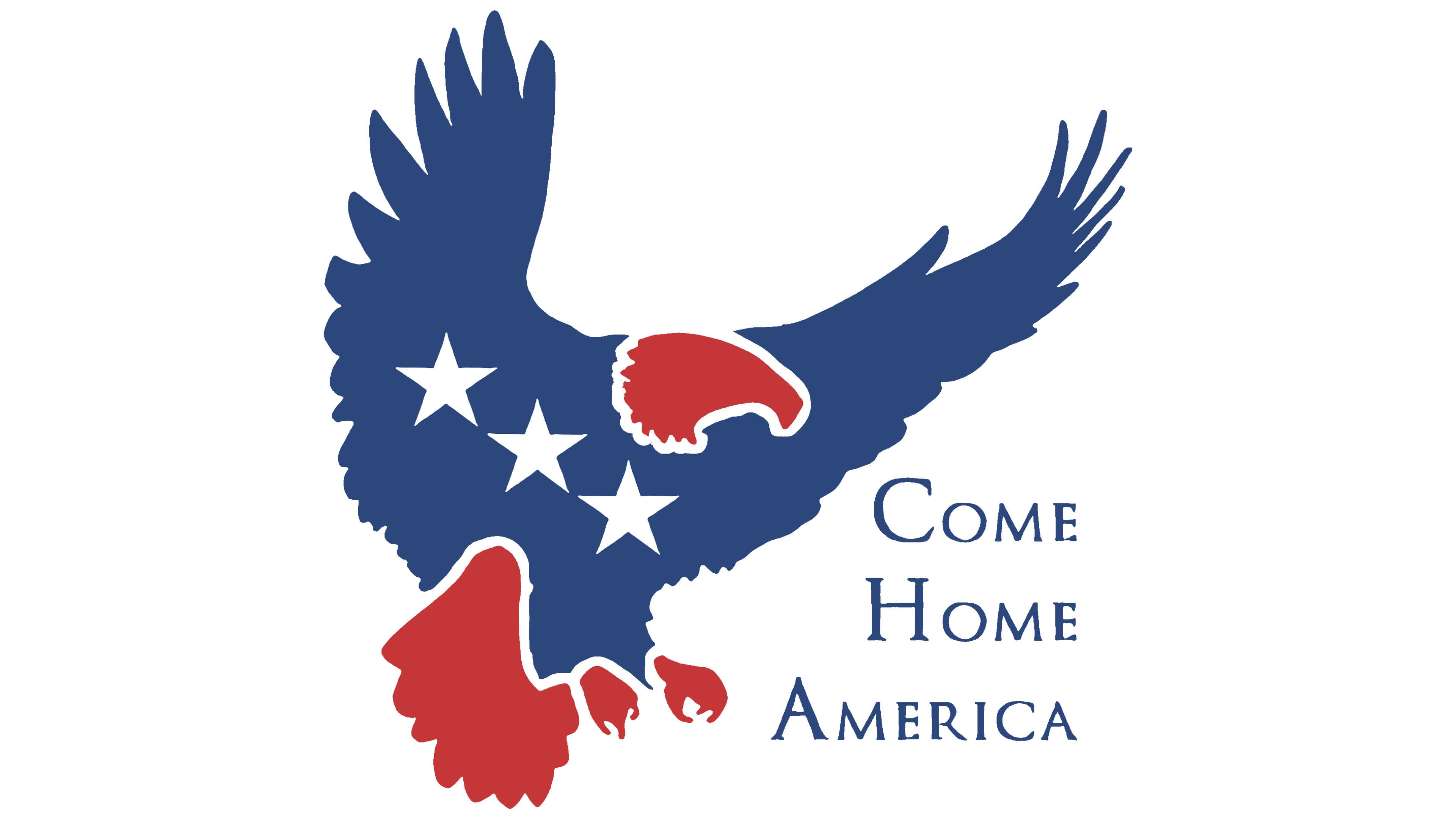
When forming its visual identity, the Come Home America movement aimed to convey a nationwide reach and express its rejection of interventionist policies. In 2009, the coalition introduced the US Conservative Party logo, which became a reflection of its political mission.
The main element of the composition is an eagle, inspired by the US state symbols. Unlike classical heraldry, it is executed in a simplified flat manner without small details. The bird’s silhouette is directed downward, which, in the context of its movement, is interpreted as a sign of returning home and renouncing external aggression. The body of the eagle is painted deep blue, with three white stars, recalling the US flag and symbolizing the country’s federal structure. The head, claws, and part of the tail are highlighted in red, creating accents and strengthening the perception of the figure. The combination of colors emphasizes the patriotic foundation and visually connects the mark with American tradition.
The text block “Come Home America” is placed to the right of the symbol and is arranged in three lines. A serif font, similar in style to Sabon or Adobe Garamond, is used. The vertical structure of the composition is balanced; all lines are strictly aligned, and the first letters of the words are highlighted with a larger size. The design lends the inscription a solemn character and references the aesthetics of the mid-20th century, which aligns with the historical roots of the slogan.
The phrase “Come Home America” has a special history. It was first voiced in George McGovern’s 1972 presidential campaign as an appeal to renounce military expansion. In 2009, the movement revived the slogan, transforming it into a symbol of the antiwar agenda and a call to reorient foreign policy toward the country’s internal priorities.
The palette is based on red, white, and blue; its combination demonstrates a national character and enhances emotional response. Together, the eagle symbol and the text block create a balanced and expressive composition that connects patriotic codes to the movement’s political message.
The Seal

2009 – today

In 2009, with the party’s formation, a logo was introduced in the form of a circular seal that stylistically resembles the official marks of US federal institutions. It allowed the new political association to emphasize seriousness and authority.
The composition is multilayered. In the center is a large white star with the abbreviation “USA” placed on it. The star is set against a dark blue background, making the central symbol dominant. Around the star runs a red ring decorated with thirteen white five-pointed stars. It refers to the first colonies and the symbolism of the American flag, forming a historical parallel. The outer ring is executed in blue and bears the inscription “CONSERVATIVE PARTY.” The text is arranged along the circle’s upper and lower arcs and evenly fills the space.
For the text on the outer ring, a serif font close to Times New Roman or Georgia is used. Uppercase letters with clear proportions give the inscription weight and an official character. The central abbreviation “USA” is set in a more elongated typeface, which adds nuance and refinement to the composition.
The color scheme is based on national shades. White, red, and blue correspond to the national flag, securing for the party the image of a patriotic movement. An additional golden color is used for outlines, serving as a sign of officiality and completeness, emphasizing status and ideological orientation.
The US Conservative Party emblem demonstrates the movement’s aspiration to rely on historical roots and use the language of official heraldry to establish political authority.