


 Rexona Logo PNG
The Rexona logo shows movement and expression. The tool hits the target precisely, eliminating unpleasant odor. The emblem conveys freshness, and the more active the user’s day, the more intensely the antiperspirant works.
In 1908, in Melbourne, Alice Sheffer created Rexona while working with Samuel Fuller Sheffer and his Sheldon Drug Company. Existing hygiene products irritated or had no effect. Her antiseptic-based ointment with a mild scent became the company’s top seller.
Early growth relied on aggressive promotion across Australia. Newspapers, billboards, and local contests like “Miss Rexona” built brand recognition. Distribution soon expanded to New Zealand, South Africa, and parts of the Asia-Pacific. After Samuel Sheffer died in 1929, ownership changed.
Around 1930, Lever Brothers acquired Rexona. Shortly after, Lever Brothers merged with Margarine Unie to form Unilever. International rollout progressed slowly, with launches in markets such as Finland beginning in the 1960s. During the 1980s, global expansion required multiple brand names. In the US and Canada, products were sold under the Degree brand following the 1996 acquisition of Helene Curtis. In the UK, Ireland, and India, the name Sure was used; in South Africa, Shield; in Japan and South Korea, “Rexena”. All variants shared the same product line.
Competition in Europe included Beiersdorf with Nivea Deo, while Procter & Gamble promoted Old Spice and Secret in North America. In the 2000s, Rexona introduced MotionSense, a microcapsule system releasing fragrance through friction.
From the late 1990s, the brand aligned with sports. Endorsements included Steffi Graf, the New Zealand national rugby union team, and the South Africa national rugby union team. In 2018, Rexona partnered with La Liga and clubs like Manchester City, Wolverhampton, and Chelsea.
In 2021, Degree launched Degree Inclusive, an adaptive deodorant developed with disabled users. In 2026, the brand became an official partner of the FIFA World Cup.
Meaning and History
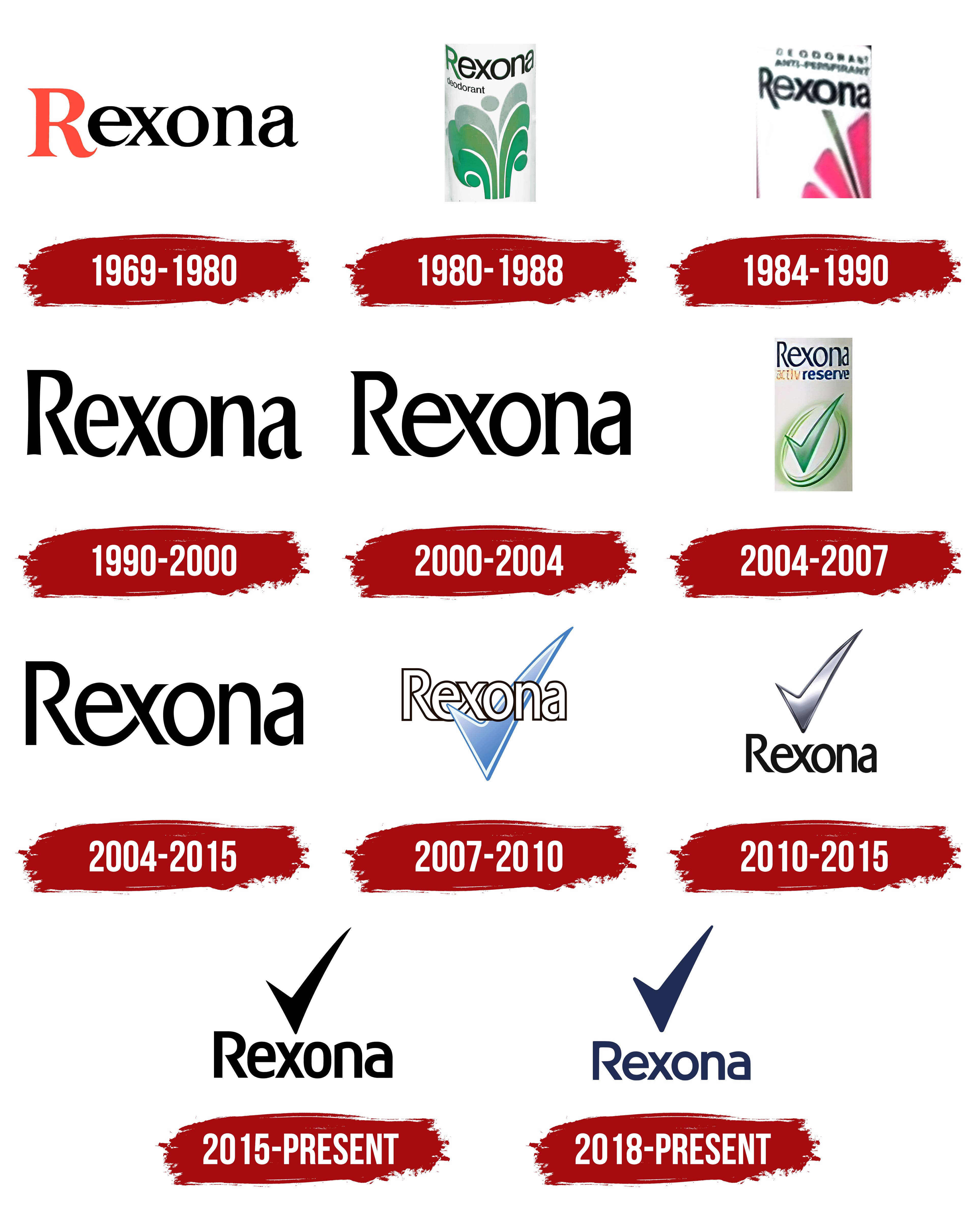
For more than a century, the trademark has had many emblems. They all share the same spelling style for the word “Rexona.” In total, the brand has about eleven logos.
What is Rexona?
Rexona is a brand of antiperspirants and deodorants launched in 1908. Unilever, an international company, owns it and produces food products, cleaning agents, and other consumer goods. Rexona products are designed for both women and men and are positioned as effective protection against perspiration. They are sold in more than 100 countries under different names, including Shield, “Rexena”, Degree, and Sure.
1969 – 1980
By that time, a version with a classic inscription resembling the Times New Roman font had emerged. The emphasis is on the first letter, so “R” is highlighted in size and color: it is larger than the other characters and colored bright red.
1980 – 1988
In this version, the designers lengthened the right leg of the capital “R” but kept it on the name’s lower border. They also removed the serifs and made the letters bold.
1984 – 1990
During this period, a variant with an elongated “R” in the right leg appeared. It goes beyond the lower word limit.
1990 – 2000
A fundamentally new emblem with neat, elongated signs has been approved. The letters are closely spaced, and the middle “R” stroke is not connected closely to the left sidewall.
2000 – 2004
The designers played with the transition from “e” to “x” in an interesting way: they lengthened the leg of the “e,” making it part of the “x.”
2004 – 2007
After redesigning the Rexona logo, the serifs at the tops of the letters were turned to the right. The sharpening on the transition line between the “e” and “x” disappeared; instead, a smooth stroke appeared, and the thickness became uniform along the entire length.
2007 – 2010
The designers shortened the “R” leg, contoured the letters, and reduced the distance between them. A checkmark also appeared on the emblem for the first time. It is wide and blue, with dark blue edging.
2004 – 2015
The connection line between “e” and “x” is much wider. The serifs have disappeared, making the characters look thinner and more precise.
2010 – 2015

The transition between “e” and “x” has become continuous. In addition, the developers returned the signature checkmark to the logo and had originally placed it above the name. They painted it silver with a gradient and added a raised hem.
2015 – today
The current emblem consists of a graphic and text part: the trademark name and a large checkmark next to the word “Rexona.”
2018 – today
The modern Rexona logo is a toned-down version of the previous one. First, all corners are rounded, and second, the letters are shorter. The designers also changed the inscription color to dark purple.
Font and Colors
Regardless of the year it was introduced, the brand symbol has one common element: the word “Rexona.” In 2015, a checkmark was added to it to confirm the slogan “It won’t let you down.”
The logo uses a custom typeface with a capital “R” and a unique transition from “e” to “x,” which has now been removed. The color scheme is monochrome: white (background) and black (text). The opening inscription also featured red.