


 Skillet Logo PNG
The Skillet logo is sharp and modern. The emblem embodies sin and profound events. It speaks of pressing issues people face and the answers God has prepared in contrast to pain and experiences.
Skillet’s history began in 1996 in Memphis at Covenant Community Church, where John Cooper and Ken Steorts, both former members of Seraph and Urgent Cry, were encouraged by a pastor to form a new project. The name Skillet reflected a mixed approach to style. Trey McClurkin joined on drums. Soon after, the band signed with ForeFront Records and released their self-titled debut album on 29 October 1996.
In 1998, the second album, Hey You, I Love Your Soul, shifted toward industrial and alternative rock. In 1999, Ken Steorts left the group. Korey Cooper joined the same year, adding keyboards and rhythm guitar. In 2001, guitarist Ben Kasica entered the lineup, and the album Alien Youth reached the Billboard 200 for the first time. In 2003, Collide marked a heavier sound shift and was later reissued in 2004 by Lava Records and Atlantic Records, earning a Grammy nomination and touring with Saliva and Shinedown.
In 2006, Comatose expanded its radio presence with singles Rebirthing and Whispers in the Dark, both of which entered rock charts and gained RIAA platinum status. In 2008, Jen Ledger joined on drums and backing vocals.
In 2009, Awake reached number two on the Billboard 200. The single “Monster” achieved multi-platinum certification, and “Hero” was used in promotional campaigns for NBC’s NFL broadcasts. The album sold over two million copies. In 2011, Ben Kasica left, and Seth Morrison joined. Later releases included Rise in 2013 and Unleashed in 2016, both of which were certified gold.
Meaning and History
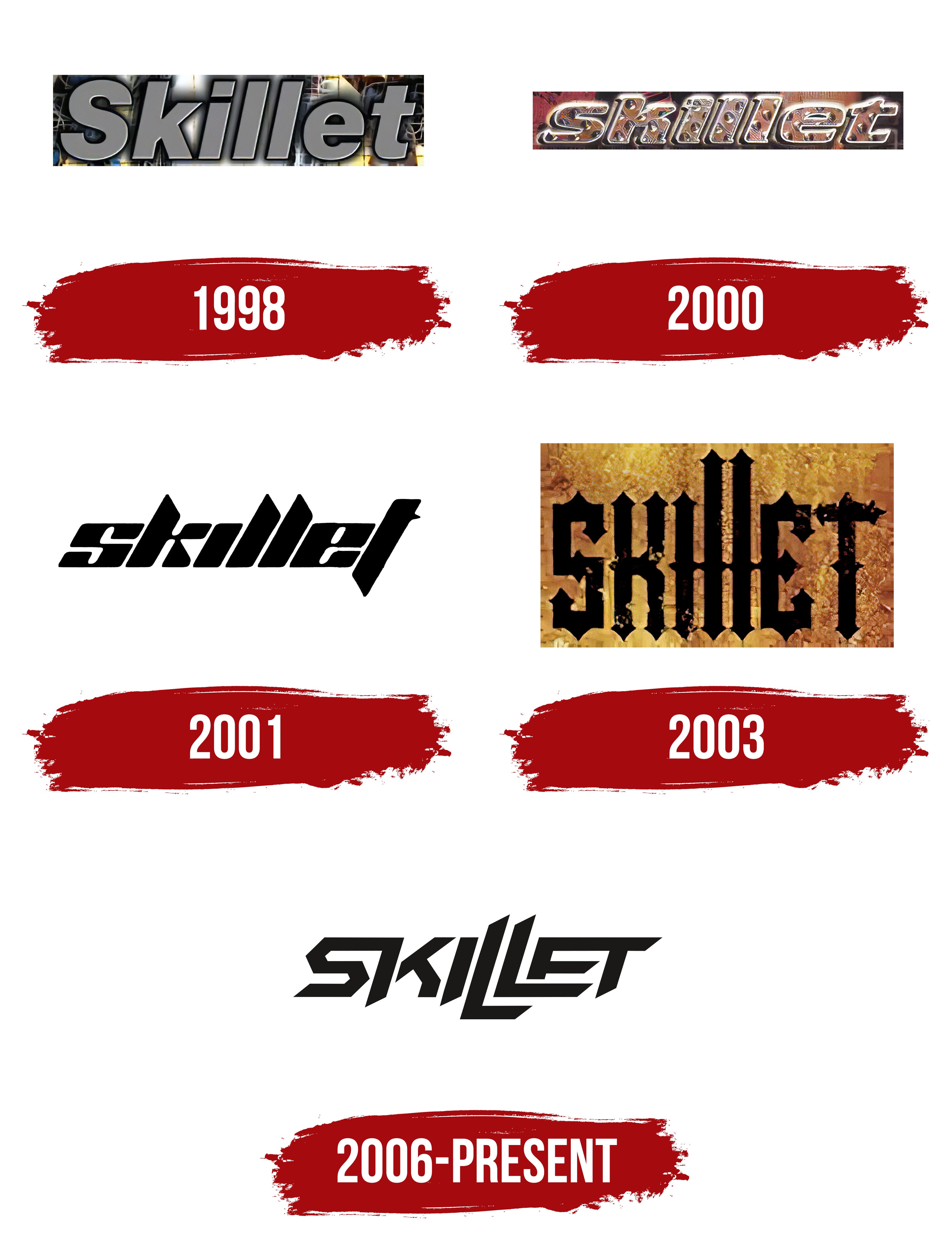
The band’s identity has always consisted of its name, set in various fonts for stylistic effect. Transformations occurred with album releases and reflected shifts in musical genres due to frequent lineup changes. New artists infused the band with vitality and their understanding of its evolution. However, the musicians’ commitment to Christ remained constant, reflected in logos that hint at the crucifixion and in harmonious inscriptions with a slight slant.
What is Skillet?
Devout Christians sing Christian rock songs and are released under Christian labels. They’ve been on stage for over 25 years and actively tour to promote their values. One of the few religiously oriented bands to achieve fame, with multi-platinum albums and singles and twice-nominated for Grammys.
1998
The first emblem consists of the name in gray metallic letters, slightly protruding above the surface. The name “Skillet” was suggested by the musicians’ pastor. It was chosen as a light and cheerful name, signifying mixing.
- Before forming the band, the two founders were members of two disbanded Christian groups. A pastor advised the artists to come together and establish a new joint band.
- The name suggests a mix of various musical styles, resulting in an excellent “dish” that is “cooked.” The group began as a grunge band, then moved to industrial, and gradually transitioned to alternative rock.
The skillet also symbolizes the fires of hell, which the band’s musicians try to protect their listeners from.
The metallic letters correspond to the material the skillets are made of, hinting at the band’s musical style and unwavering beliefs.
The logo appears on the band’s second album cover, “Hey You, I Love Your Soul.”
2000
For the third album, “Invincible,” the emblem shifted towards heavy rock. The voluminous inscription is studded with images of metallic rivets. This style conveys a more aggressive sound, linked to the replacement of two musicians in the lineup. The design hints at the nails of the crucifixion, emphasizing the album’s dedication to God’s glory.
2001
The 2001 emblem resembles rounded blades, akin to an attempt to counteract assaults on Christianity that struck the frontman at a Marilyn Manson concert. Songs are written in Manson’s style to reach out to youth obsessed with his art. Hence, the beveled ends of the glyphs are similar to the Weimar eagle in MM’s logo.
The sharp, forward-leaning letters reflect the musicians’ organized, harmonious worldview, emphasizing progress and care for the future.
The album under this emblem is titled “Alien Youth,” representing a call to the non-believing youth.
2003

The “Collide” album logo is in a Gothic style, alluding to the daily darkness of emotions and the challenges of faith. The glyphs, sharp like spears, appear menacing, representing diabolical attacks and arrows of fear countered by faith and love. The spiky, straight lettering evokes a fence or barrier, resonating with the heavy nu-metal tracks.
2006 – today
Slightly avant-garde notes are evident in the logo for the album “Comatose.” The disc is the band’s best compilation: Grammy-nominated, with three music videos, eight singles, and a special gift edition.
The ‘L’ letters in the name interlock to form a solid angle. These elements are like the cornerstone: Jesus. He saves people on the brink, giving them hope and a second chance.
The first and last two characters are connected, symbolizing support and hope, even for the most desperate individuals.
Font and Colors
The band hasn’t emphasized the color diversity of their symbols, which are rendered in black or resemble metal. These shades reflect the heavy sound of most compositions. The band’s songs highlight issues and sin, also associated with black people.
The font of the inscription is unique due to the transformation of glyphs and their combination. The segmented S points to a complex, “broken” destiny. Sharp ends depict painful and difficult situations.