


 Talbot Logo PNG
The Talbot logo is full of grandeur, scope, and power. The emblem reflects the company’s leadership position and the strength of its machines. The mark uses techniques that link the brand to symbols of larger organizations to increase buyers’ sense of reliability.
Talbot began in 1903, when Charles Chetwynd-Talbot, the 20th Earl of Shrewsbury, partnered with French engineer Adolphe Clément-Bayard to form Clément-Talbot. From 1905, the company assembled French components at its North Kensington factory in London. It sold the cars under the Talbot name. By 1906, British-designed models had appeared, and by 1910, output reached 50-60 cars a month.
Before World War I, Talbot built a strong record of competition in British hill climbs, beach races, and circuit events. In February 1913, Percy Lambert drove a 25 hp Talbot around Brooklands. He became the first person to cover 100 miles in one hour, reaching 103 miles and 1,470 yards. He died later that year at the same track while trying to improve the record.
In 1916, Georges Roesch became chief engineer after earlier work with Gregoire, Renault, and Daimler. In 1919, Darracq acquired Clément-Talbot, and in 1920, it joined Sunbeam-Talbot-Darracq (STD Motors). Roesch’s Talbot 90 and Talbot 105 became major cars of the early 1930s, with strong results at Le Mans and an outright win at the 1932 Alpine Rally without penalty points.
Debt broke the STD in 1935. Rootes Group bought Clément-Talbot, while Anthony Lago took the French side and continued as Talbot-Lago. Under Rootes, Talbot was folded into Sunbeam-Talbot and disappeared in 1955. PSA Peugeot revived the name after buying Chrysler Europe in 1979. Talbot Sport then won the 1981 World Rally Championship manufacturers’ title with the Sunbeam Lotus. The Tagora of 1981 and Samba of 1982 followed, but by the mid-1980s, Talbot production had ended.
Meaning and History
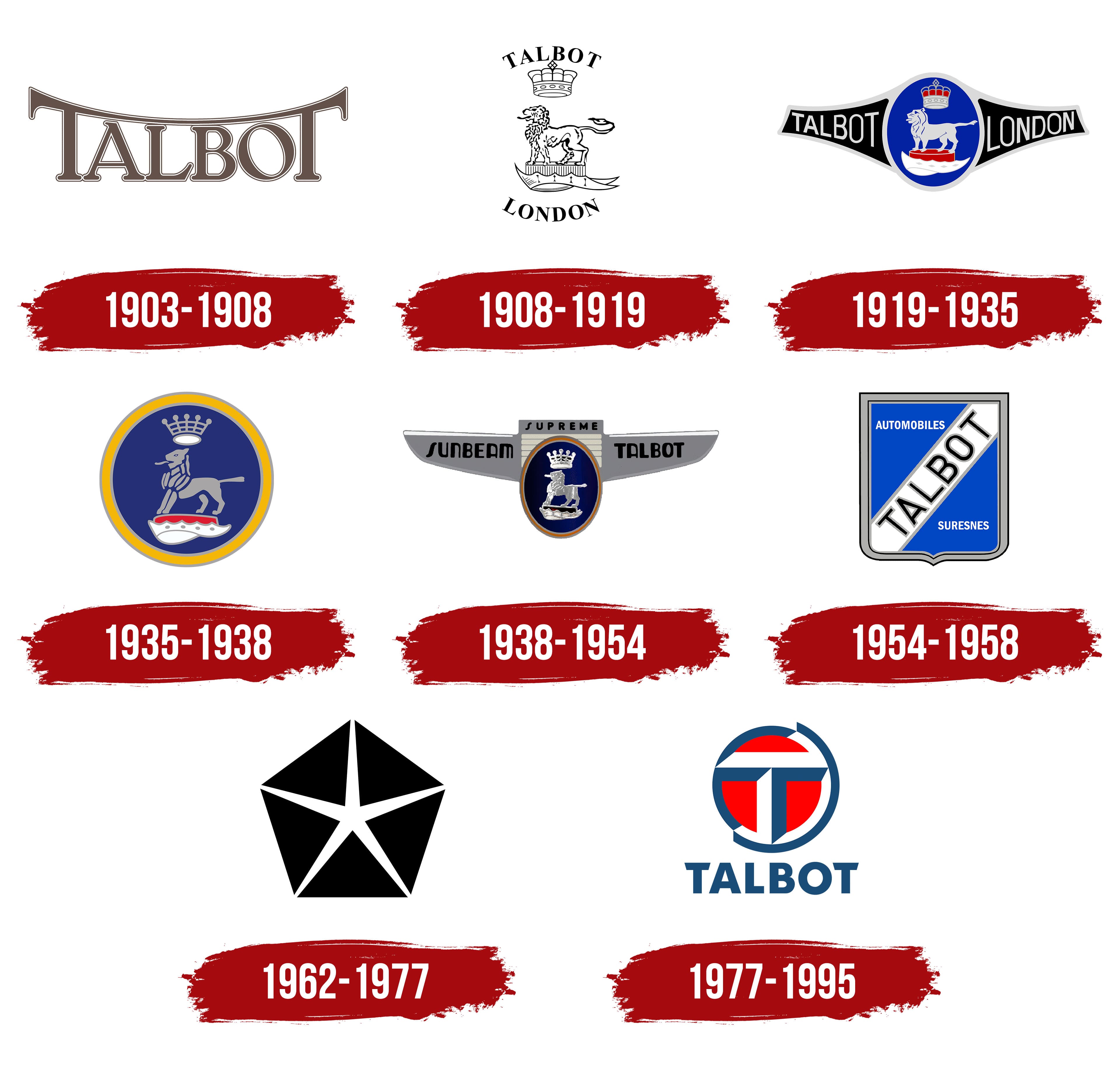
The whole history of the English company is inextricably linked with France. Therefore, the company’s signs feature many royal symbols from both countries. For most of its existence, the brand was not independent. Changed owners and merged with other brands. This was reflected in the transformation of the identity and appearance of elements of other companies, such as Chrysler. Despite this, the visual sign retained the image of strength and power in each incarnation.
What is Talbot?
A European car brand that was produced at various times by Clement-Talbot, STD, Rootes, Simca, Chrysler, and Peugeot. The latest popular models are Talbot Alpine, Rapier, Tagora, and Sunbeam. The headquarters of the English division was located in Kensington, then in London.
1903 – 1908

By 1904, a factory in England was ready, where, using the French parts from a partner, they began producing cars under the Talbot brand. The logo emphasized the new brand. Two letters, T, are connected above the rest of the word and represent the car’s bumper. The uppercase and white stroke reveal the new unit’s pretentiousness.
1908 – 1919

Talbot specifically hires a specialist to develop the design and construction of machines that are not similar to the company’s French models. The brand name has been changed to Talbot London. An additional accent is made in the logo, where the symbols of England are combined with the name.
The brand’s name and the factory’s London location are written in a semicircle above and below the semicircle. In the center is the royal crown, and below it is the majestic image of a lion standing on a count’s cap from the Second French Empire, since Sir Talbot was a count.
The monarchical symbol personified the court’s patronage of new cars and the development of England’s automobile industry.
The lion is considered the symbol of strength and courage and is featured on the country’s shield as a symbol of unification. The founder will develop the company to glorify the COUNTRY. In 1907, the cars of his assembly won more than 100 prizes in various competitions.
1919 – 1935

By the 20th year, Earl Talbot, having lost an heir, sells his company to the French company Darracq and Co Ltd, which soon buys Sunbeam Motor Car Co, forming the STD concern. Interestingly, all cars in it receive the Talbot brand, so the logo retains the main features of the previous sign.
The lion and the crown are placed in a blue oval, with Talbot and London written on two branches, since the London division is developing new models for the brand. The badge resembles a champion’s belt. And the blue, white, and red colors indicate the French flag of the new owner’s homeland.
1935 – 1938
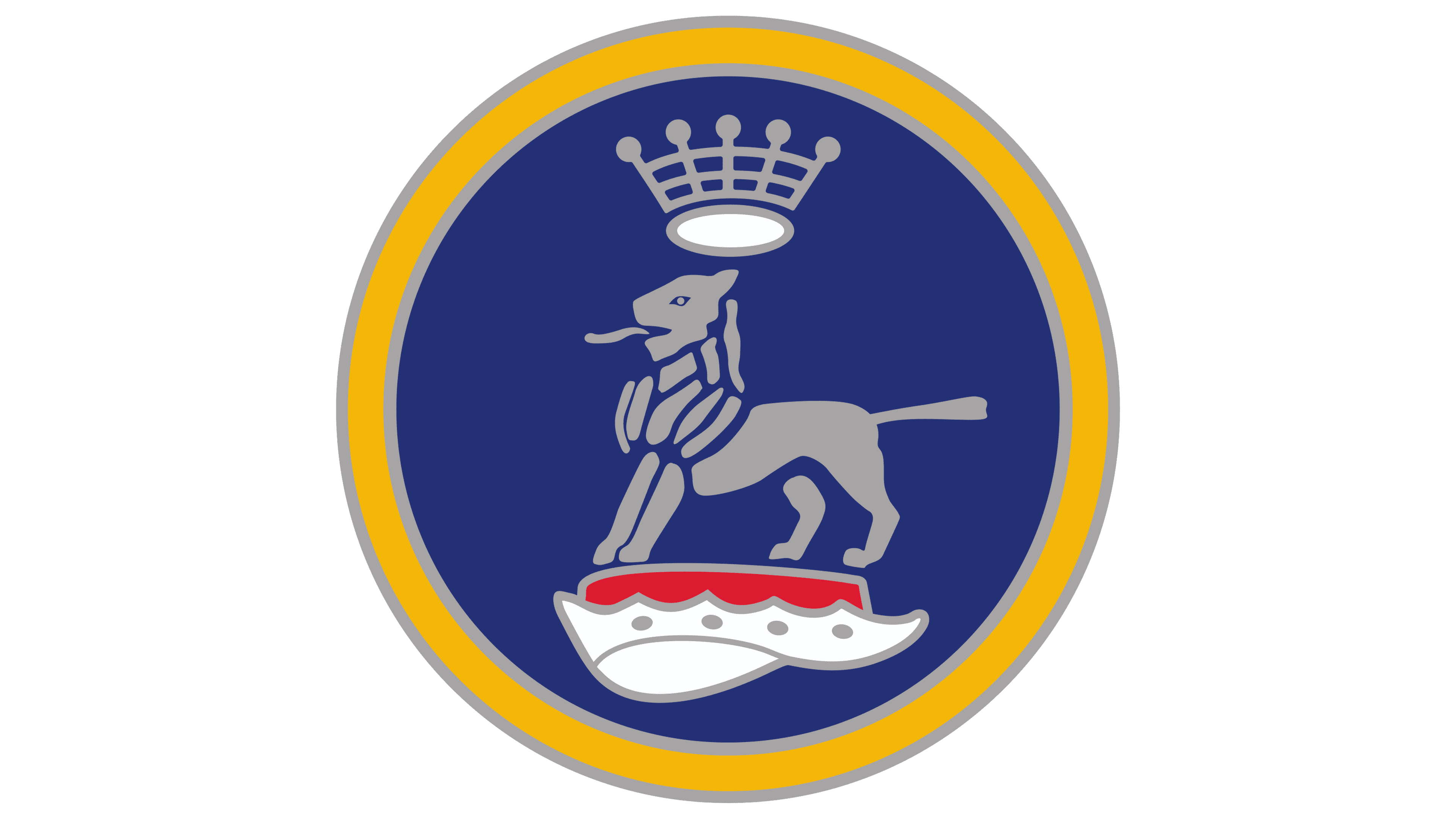
STD, due to bankruptcy, is being put up for auction. Talbot buys out Rootes. The brothers retain their visual identity, but the crown is changed to the French one. The lion’s mane is almost removed, demonstrating the loss of grandeur and independence. A yellow outline around the blue emblem symbolizes care: the brand is in good hands.
1938 – 1954
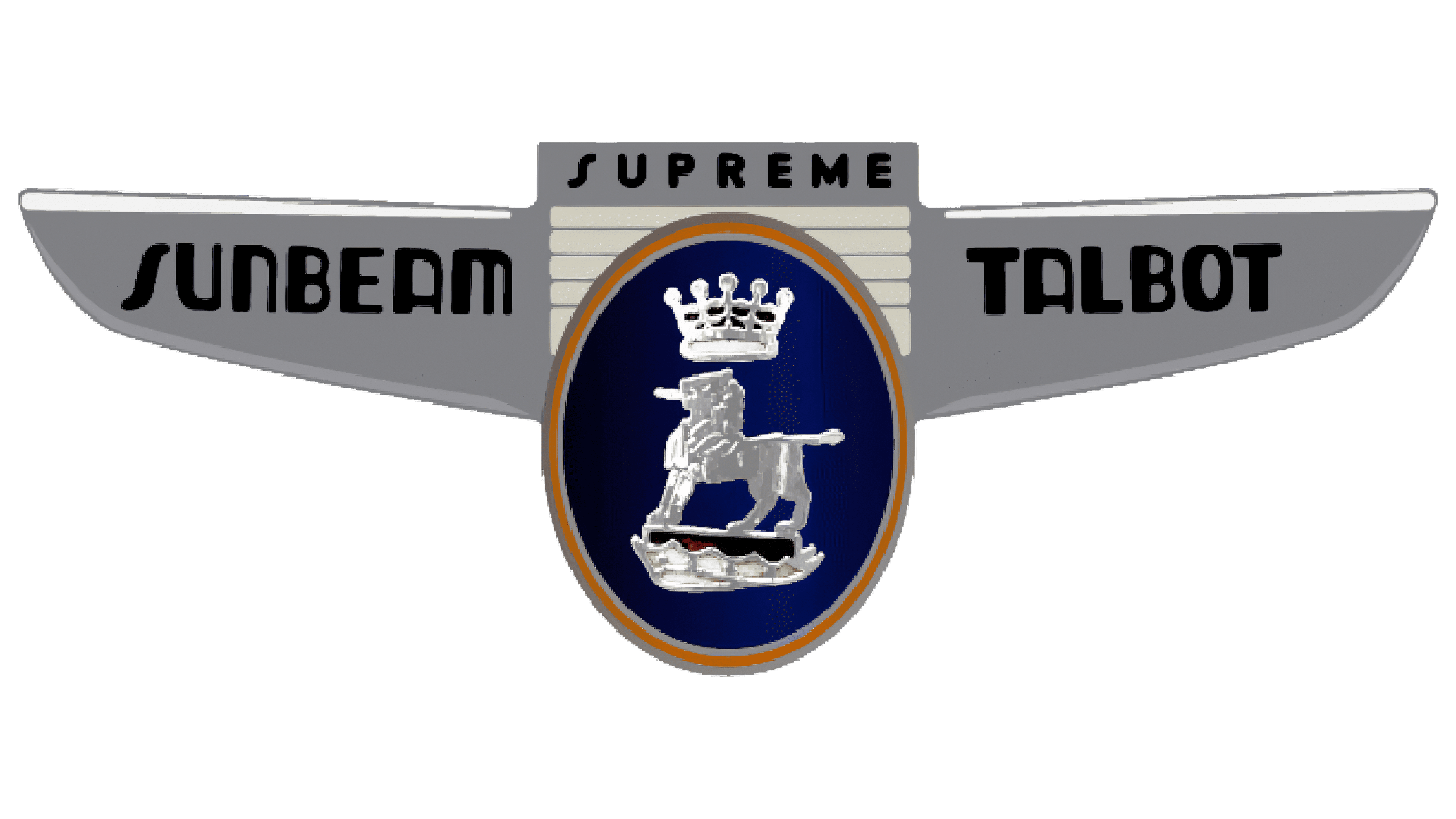
Rootes, which also bought Sunbeam, closed its production and transferred production to Talbot facilities, creating the Sunbeam-Talbot brand, as reflected in the logo of this period.
The emblem takes the form of an airplane or a bird spreading its wings, each with a part of the brand name. The symbol predicts the rise and active promotion of new cars. The nose of the aircraft is the STD sign placed in an oval.
The image also resembles the car’s bumper, which the owners likely intended to convey. In the center is a schematic radiator grille. On top of the grille is the “supreme” inscription, which underscores the idea of greatness and excellence, as the Rootes brothers were meticulous about assembly.
The logo is intended to show that, despite the bankruptcy experienced, brands remain afloat and will continue to offer their products.
1954 – 1958
The concern renames the brand Sunbeam, abandoning the Talbot name, which was actively used in France as Talbot-Lago (in 1938, during STD’s bankruptcy, Anthony Lago bought the French enterprises).
The logo is shaped like a blue shield with a wide gray border. The brand name is written diagonally on a white stripe. Above, it indicates that cars are produced, and below is the location of Suresnes (a suburb of Paris).
The shape of the shield and the blue background correspond to the heraldry of the commune where the production facilities are located. The white stripe alludes to the French flag. This conveys the company’s patriotic spirit. Represents the majestic and famous brand. Territorial landmarks were particularly important to avoid confusion with the English unit.
The logo remained in use until 1958, when Simca acquired the brand.
1962 – 1977

Chrysler bought 30% of Rootes and served on the board of directors; in 1967, it acquired the concern outright and renamed it Chrysler UK (1970), adding the French Simca, with its Talbot-Lago, to become Chrysler France.
The logo of this period corresponds to the American company, a star in a pentagon. The image resembles a star that breaks through the darkness, lighting everything around it. The image shows the development of the concern and its gradual rise into the sky, lighting up the world with new technologies developed by Chrysler and its brands. The five petals of the black flower symbolize the corporation’s five brands.
1977 – 1995
Chrysler France is sold to Peugeot-Citroën, which revives the Talbot brand and produces all former Simca models under it.
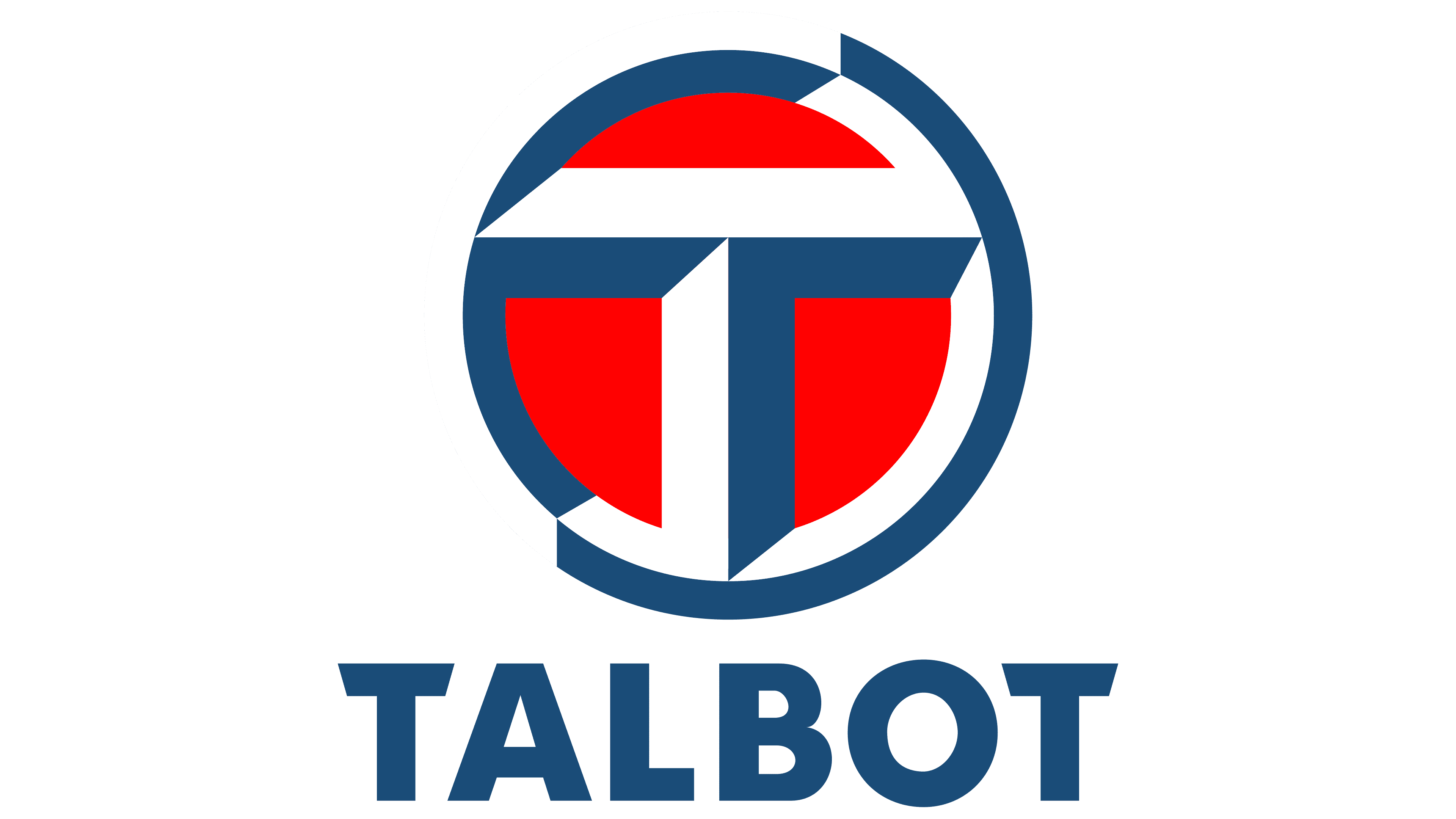
The new owner creates a stylish, massive logo resembling a wheel. The sign is three-dimensional, drawn as if it consists of bent metal corners. Two of them form a circle, in the center of which the letter T is formed from the same corners.
The circle is a symbol of completion. Throughout its existence, the brand has developed the best models and optimal strategies. The two parts of the figure indicate permanent existence in two countries, each with two owners.
The red background is a revival and a great power given to the brand by the new owners.
The symbol is illuminated from the upper-left corner, as indicated by the shadows in the figure. The sun is in this position at sunset. This shows the brand’s impressive age and prophetically predicts its closure in 1992.
Trucks of the brand were produced after the abolition until 1994.
Font and Colors
Primary colors of the visual sign: white, red, and blue. They indicate France, where part of the production facilities and most of the brand’s owners were located.
- Red – leadership.
- Blue – professionalism.
- White – the need to often start from scratch.
The lettering font is sharp, and the Ornitons TS Bold is sharp. It seems you could cut yourself on its sharp edges. It shows that the company is ready to defend its position.