


 Tesco Logo PNG
The emblem emphasizes the network’s scale. Shows the presence of many departments in a hypermarket and the distribution of stores worldwide. The Tesco logo reflects the tangible benefits the giant provides through its products.
Tesco began in 1919 at Well Street Market in Hackney, East London. Jack Cohen, a former Royal Flying Corps soldier and the son of Polish Jewish immigrants from Łódź, used £30 of demobilization pay to buy surplus army food stock. His early trading idea was blunt: “pile it high and sell it cheap.”
The Tesco name appeared in 1924, after Cohen bought tea from Thomas Edward Stockwell. He combined TES from Stockwell with CO from Cohen to create TESCO for the labels. In 1929, he opened the first permanent store in Burnt Oak. By 1939, Tesco had over 100 shops, and in 1948 it opened its first self-service store in St Albans.
Tesco Stores (Holdings) Limited was listed on the London Stock Exchange in 1947. During the 1950s and 1960s, the chain grew through acquisitions, including Williamson’s, Harrow Stores, Irwin’s, and Charles Phillips. In 1963, Tesco launched Green Shield trading stamps, and in 1968, opened its first hypermarket in Crawley. In 1977, “Operation Checkout” ended the stamps system and cut prices across the range.
The modern Tesco took shape in the 1990s. Tesco Value launched in 1993, William Low was acquired in 1994, and Clubcard arrived in 1995, the same year Tesco overtook Sainsbury’s as Britain’s largest food retailer. Terry Leahy became CEO in 1997 and drove international expansion, including Ireland and, later, the U.S. Fresh & Easy failed and was sold in 2013. In 2014, Tesco admitted it had overstated profit by £250 million. Dave Lewis replaced Philip Clarke, and in 2018, regulators approved Tesco’s £3.7 billion merger with Booker Group.
Meaning and History
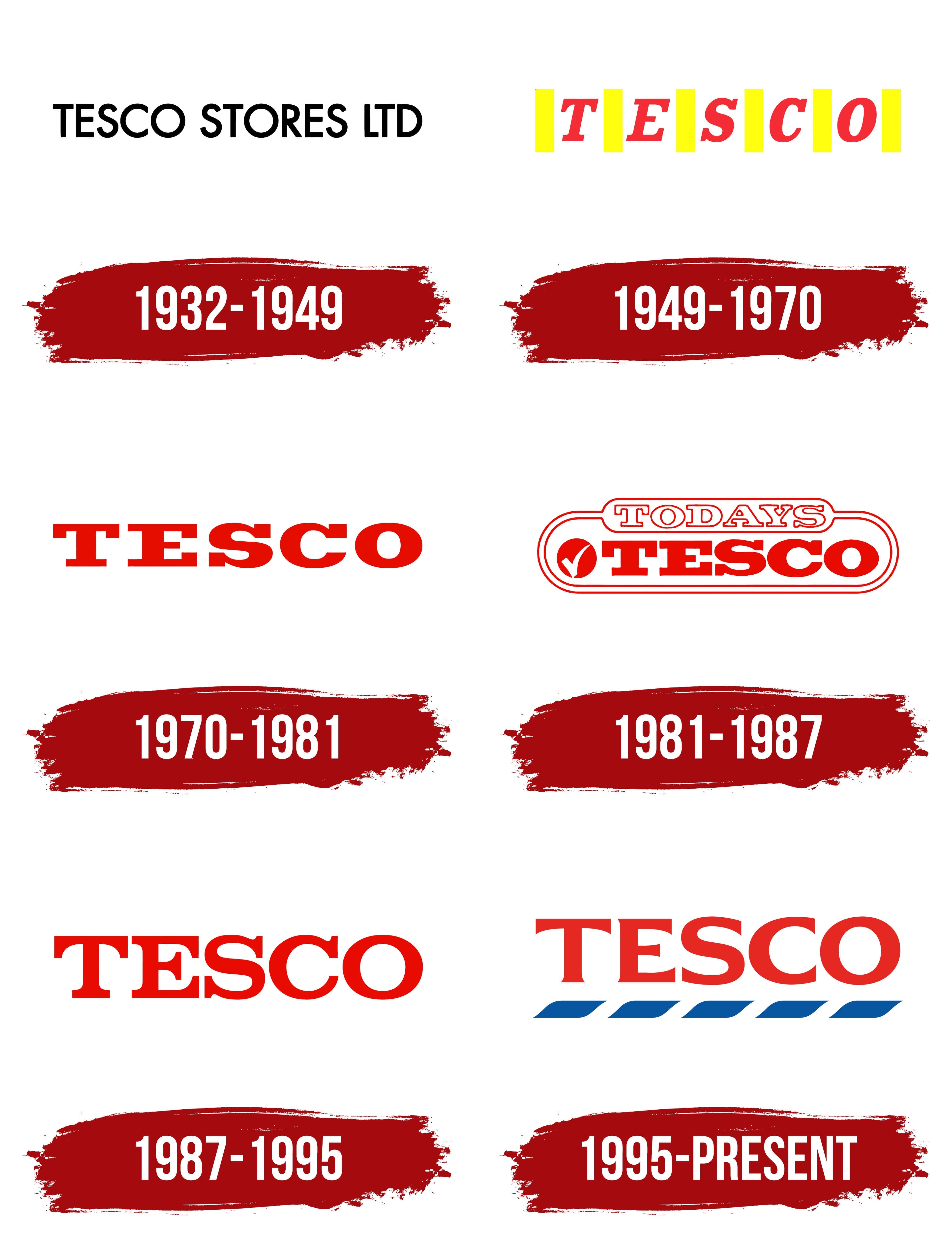
For more than 100 years, the brand has changed many times. Each new version replaced the previous one, adding new elements that conveyed the desired retailer’s message. For example, in the early years, the company used a classic black logo featuring the name “Tesco Stores LTD.” It had a simple font with all capital letters. As the brand grew rapidly, management began using typographic logos. At the same time, the color scheme changed, with red becoming the predominant color in the logo since 1970. The last Tesco variation was introduced in 1995; in addition to the classic red name, there are five blue horizontal stripes beneath each letter.
If we disregard the original logo, the key color has always been red, which most people associate with strength and passion. Tesco avoided additional details, placing the main emphasis on minimalism and brevity. The author’s main task was to make the logo recognizable not only in Great Britain but also beyond its borders.
What is Tesco?
The leader in U.K. grocery sales is ranked among the world’s top 10 most successful retailers by revenue. The company’s assets exceed 80 billion U.S. dollars, and the total number of employees across all network stores (2700) approaches 500,000.
1932 – 1949

The first version was presented in 1932 and lasted for 17 years. The company chose not to use a bright color scheme, presenting concise, sans-serif black lettering in large capital letters to the general public. The neat lines and the distance between the characters conveyed the company’s strength and ambition.
1949 – 1970

In 1949, the company decided to fundamentally change the logo’s appearance. The gloomy shades were replaced with a bright red-and-yellow color palette. The company name was done in red, with a vertical yellow line between each symbol. The letters in the name “Tesco” were set in a bold serif font. This update was intended to convey happiness and energy to the company’s customers.
1970 – 1981

In 1970, the company removed the yellow stripes between the letters in the name. The red company name on a white background became the only element of the logo. Each symbol was written in bold, serif capital letters. Removing the yellow stripes greatly reduced the spacing between the characters.
1981 – 1987

The most noticeable changes in the logo occurred in 1981. The main name remained unchanged, written in bold red letters. However, the logo itself was enclosed in a double red frame. Its corners were slightly rounded. “Todays” was added at the top of the name to indicate the network’s relevance. Additional lettering was circled in red and used an outline font. The letters themselves were white. In addition, a white “checkmark” image was added to the left of the company name, inside a red circle.
1987 – 1995

In 1987, the company returned to a variant with only the brand name. The letters in the lines were much thinner, while the serifs became lighter and clearer. The distance between the letters became much larger than in the 1970-1981 version. In this way, Tesco management sought to make the lettering stylish, conveying a sense of power for the brand. As a result, it created a timeless feel.
1995 – today
The company introduced the current version of the logo in 1995. It used a sans-serif font. Compared to the previous variation, the letter lines were slightly wider at the ends, with the edges cropped straighter. Below the main name, five bold, blue horizontal lines appeared. At the same time, customers were meant to get the impression that the white space between the blue blocks separated the symbols.
Font and Colors
The latest variations of the Tesco logo are close to the Aviano Flare Black and Arpona Semi Bold fonts. The authors made only minimal changes to the line structure. Using a bold font makes the logo look modern and stylish. Thus, the company signals to the target audience that it is ready to address all components of a successful business, including identity.
The current Tesco logo features a color palette of red, blue, and white. These same colors also appear on the flag of Great Britain, which serves as a reference for the state and shows the company’s strength and ambition. Previously, black and yellow were also relevant, used in earlier versions.