


 Tide Logo PNG
The Tide logo represents a powder that hits the target, giving users the joy of perfectly laundered clothes. As the emblem shows, it emphasizes a scientific approach to formula development.
Procter & Gamble developed Tide after years of research into synthetic detergents. In the 1930s, the company sought an alternative to soap, which left residue in hard water.
In 1933, P&G introduced Dreft, a mild detergent that worked on light fabrics but failed on heavily soiled fabrics. Research continued, focusing on combining synthetic agents with water-softening “builders.”
By 1943, the formula was ready, but wartime shortages delayed production. Tide launched in 1946, first in test markets and then nationwide, with a bright orange package designed to stand out.
Consumers responded quickly. Tide removed stains traditional powders couldn’t handle and avoided residue. By 1949, it had become the top-selling detergent in the US, surpassing Rinso from Lever Brothers, which was part of Unilever.
In 1950, Tide exceeded 30 percent market share. In 1952, P&G introduced an updated formula, starting a pattern of continuous improvements. By 1996, the product had undergone dozens of reformulations.
Expansion followed with entry into Canada in 1955 and the United Kingdom in 1959. In Europe, the brand competed with Henkel’s Persil and, in some markets, was replaced by Ariel.
In 1984, Liquid Tide launched as the first liquid version. In 1987, Tide with Bleach integrated whitening agents, and in 1991, Tide Ultra introduced a concentrated formula.
In 2012, Tide Pods entered the market as pre-measured capsules and became a major seller. In 2018, the “Tide Pod Challenge” led to safety concerns, prompting packaging changes and public warnings.
Meaning and History
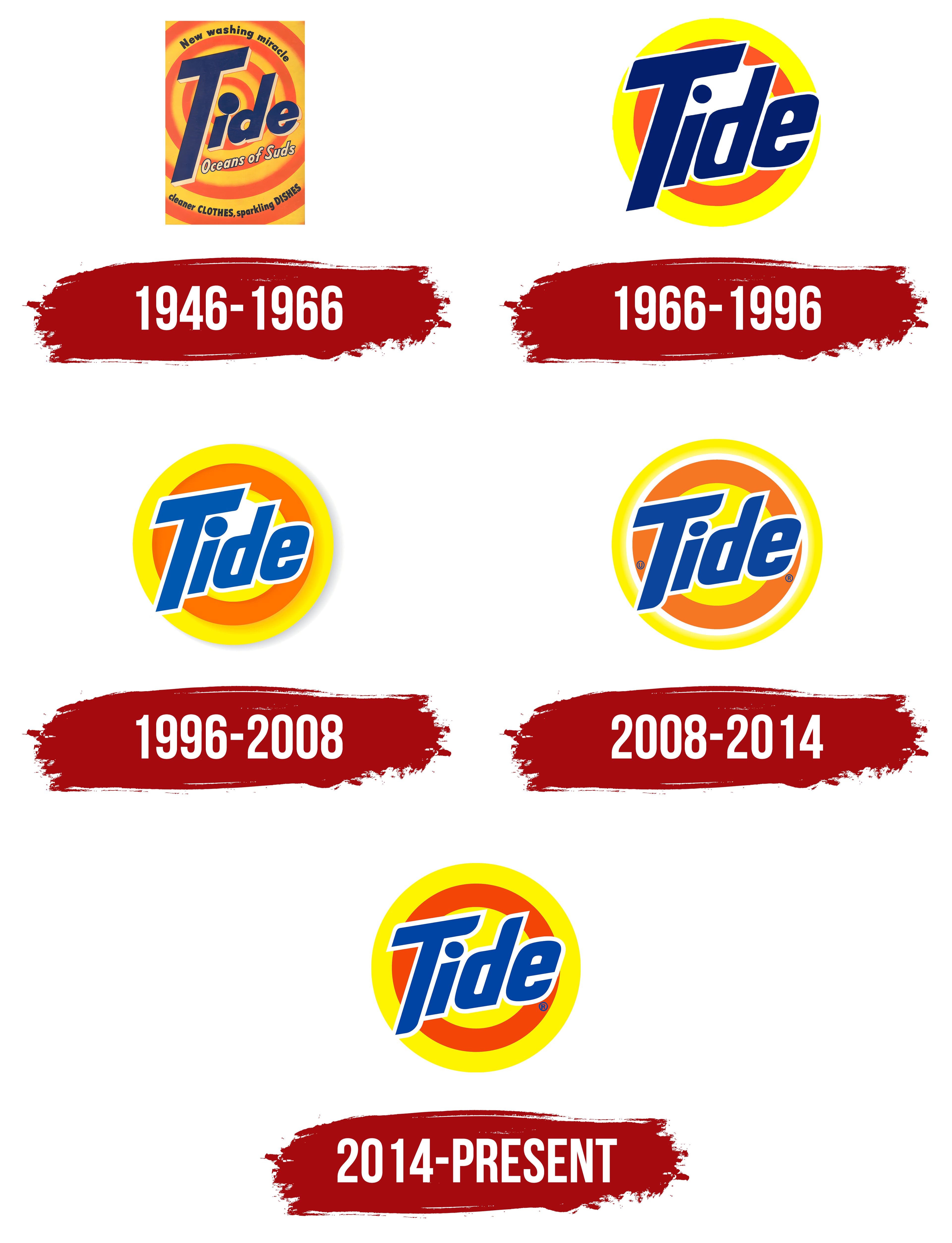
The line, which gained worldwide recognition thanks to its successful logo, has undergone several identity changes. Donald Deskey, an industrial designer, architect, and artist, created the first version of the logo, which served as a prototype for later versions. He worked on it through his agency, which specialized in graphic design.
What is Tide?
Tide is an American laundry detergent brand. It was introduced in 1946 and is part of Procter & Gamble. Over time, the brand became the world’s best-selling detergent, surpassing its competitors. In 2020, it received the Environmental Possibility Award.
1946 – 1966
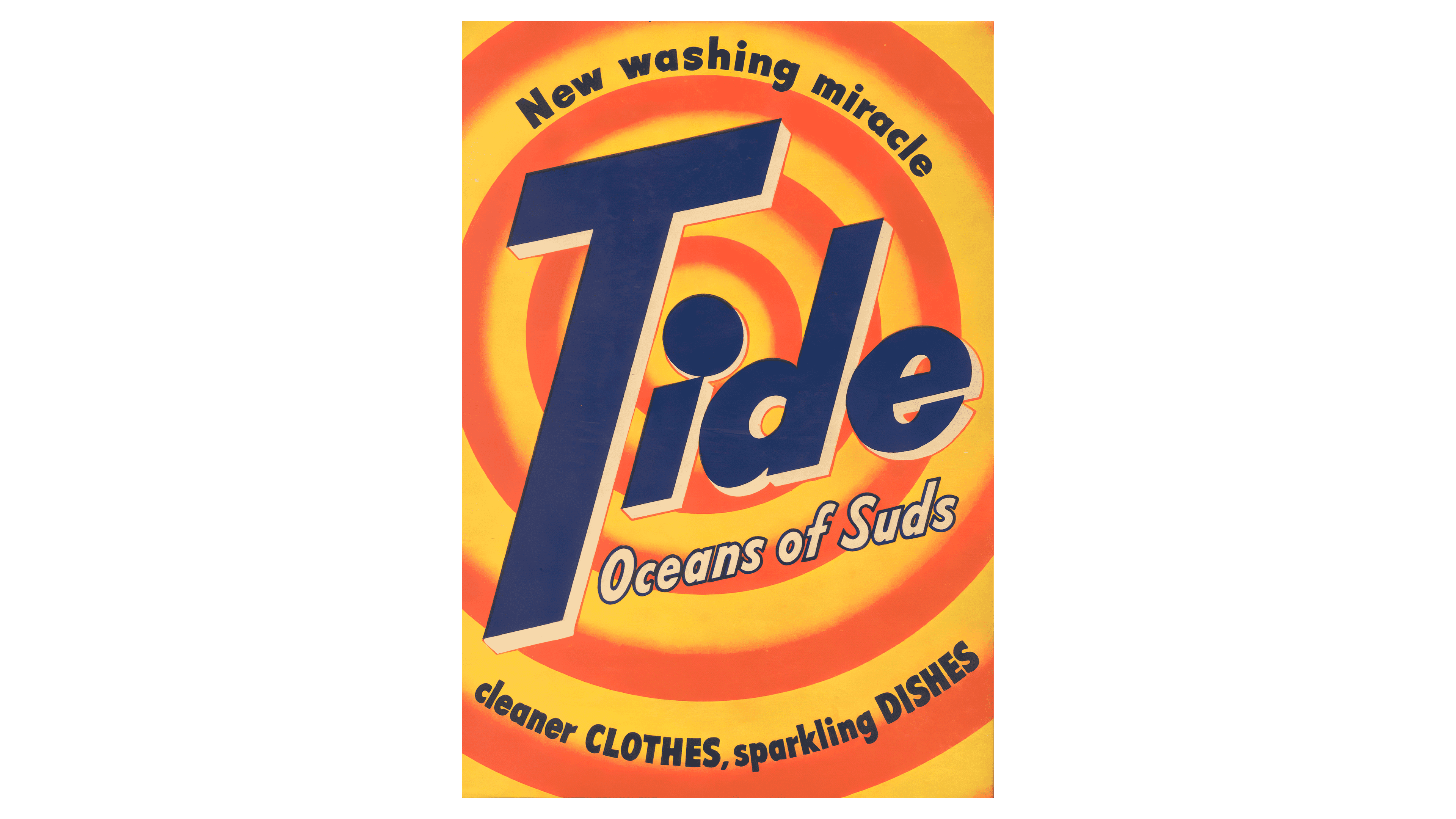
The debut emblem sparked a furor in the advertising field because its creator took an innovative approach, expanding the scope of traditional visual signs. He created something like a target, with wide, contrasting circles running from the center to the edge. Some of them were labeled with basic product information. The “apple” (in the middle) was the dot above the dark blue “i.” Then there was an alternation of yellow and red stripes with a gradient transition between them.
A third of the logo space was occupied by the word “Tide.” It was located diagonally and was made with printed signs. To make room next to the “i” point, the designer made the letter “T” incredibly large: because of its long leg, the upper bar does not cover the adjacent symbol. Thanks to this technique, the author created the effect of a target with concentric circles. The letters also received light strokes on the right side, which gave them volume.
1966 – 1996
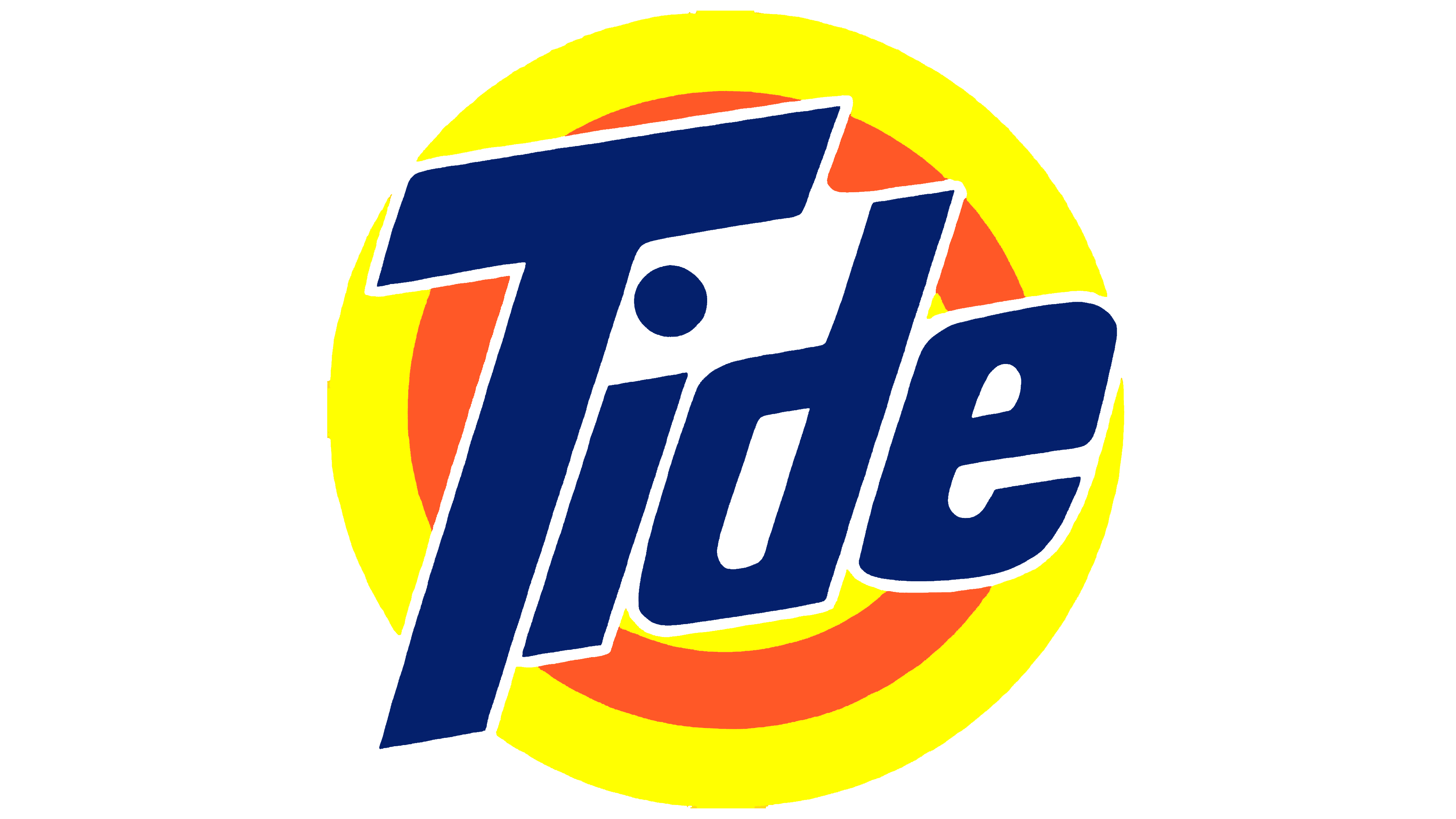
In 1966, the management approved an updated version, in which the dot above the “i” is no longer the “bull’s-eye.” The developers slightly changed the target’s center: instead of a dark circle, they used a neutral white spot. Overall, they simplified the design by removing many rings and leaving only two: one yellow and one red. The color palette was also changed; it became much brighter and more expressive.
The inscription also changed. The uppercase “T” had a shortened leg, the “i” had a reduced point, the “d” increased its internal clearance, and the “e” was made slightly larger. Also, “d” and “e” are now rectangular.
1996 – 2008
After the redesign, the emblem looked more accurate and closer to the debut version. The designers added an inner ring, so the logo once again took the shape of a target, with a white circle at its center. They also enlarged the dot above the “i.” The color palette shifted to pastel shades, making the colors look faded, as if powdered with white.
2008 – 2014
This version introduces additional circles to enhance the target’s effect. The developers painted the center yellow and divided the outer circle into two yellow-and-white sections with a gradient transition. The remaining rings stayed the same. The developers also corrected the text. The adjustments resulted in slightly elongated, pointed ends on the “T” and “d.” The word “Tide” is now the same dark blue color.
2014 – today
The logo now uses a retouched palette of muted, dusty colors. The navy blue is now just blue, and the double outer ring is solid (yellow). A white dividing border still surrounds the inscription.
Font and Colors
In the logo design, the brand owners have always followed the concept presented at the very beginning by architect-artist Donald Deskey. This variant has been used throughout, which is why the emblem used for the fiftieth anniversary of the original product’s launch is still in use. It echoes the debut version. The Day-Glo palette was also used on Tide packaging for the first time in the industry’s history.
The text receives the same attention as the graphics, so it reflects the product’s idea equally. The inscription style changed several times but always stayed within the usual framework. The main emphasis is on the capital “T,” which the designers have lengthened, then shortened. The rest of the letters are lowercase. In general, the word “Tide” is in a custom sans-serif font, with slightly pointed ends on two characters. Signature colors include yellow, red, white, and blue.