


 Wella Logo PNG
After using products under the Wella logo, hair will flow into silky, strong strands. The emblem conveys the beauty of the result and invites you to try the effectiveness of care and styling from a cosmetic brand.
Wella was founded in 1880 in Bavaria, when Franz Ströher opened a workshop to produce hair tools, starting with wooden combs. The business remained small until 1924, when Karl Ströher introduced Wellaform. This chemical perm product shifted the company toward hair cosmetics.
In 1927, the headquarters moved to Darmstadt, and by 1930, Wella developed a cold perm method that made the process more accessible. In 1956, the company launched a tube-based professional hair dye, replacing manual mixing and standardizing salon results.
During the 1960s and 1970s, Wella expanded into the United States, Brazil, Japan, and Europe, building a global salon network. Professional products such as dyes and perm solutions became the main revenue source, while retail lines supported brand recognition.
In 1978, the Ströher family sold its controlling stake to investors, and in 1989, Wella went public on the Frankfurt Stock Exchange. In the 1990s, it competed with L’Oréal Professionnel and Schwarzkopf, relying on salon distribution and product specialization.
In 2003, Procter & Gamble acquired Wella for €6.9 billion to strengthen its professional haircare position alongside Pantene. In 2004, Wella updated Koleston Perfect and expanded the System Professional line.
In 2015, P&G sold Wella to Coty as part of a restructuring that included CoverGirl, Max Factor, and Clairol. In 2020, Coty separated its professional division through an investment from KKR, forming Wella Company, which includes brands such as Wella Professionals, Nioxin, Sebastian Professional, and OPI.
Meaning and History
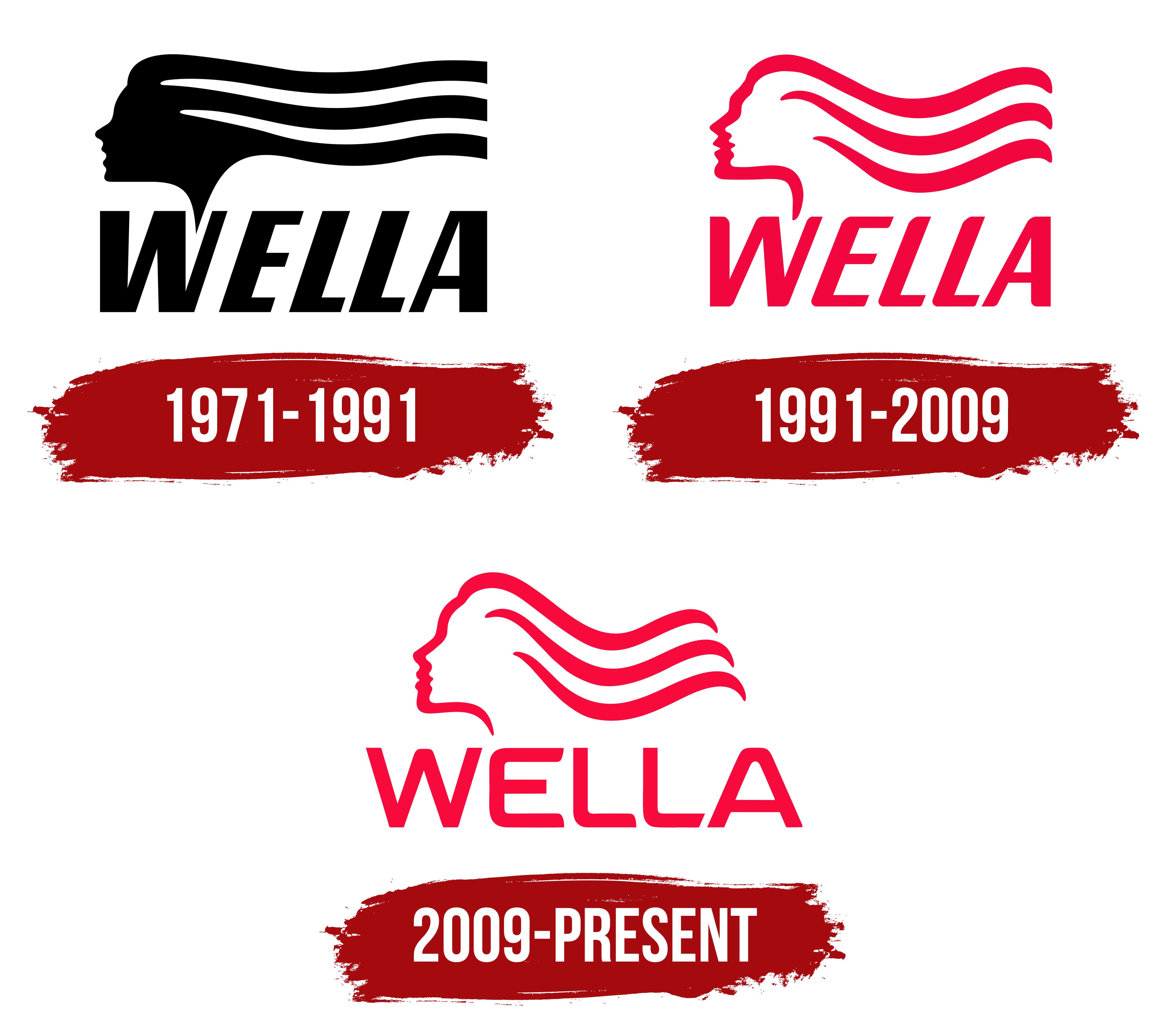
In its early years, the company produced breathable wigs and later shifted to hair-curling accessories. It then received its current name, derived from the German phrase “Dauerwellenapparat,” which translates as “device for a permanent wave.” In the post-war years, the range expanded to include balms, conditioners, and shampoos for hairdressing salons. A logo redesign accompanied each stage. The modern version has three.
What is Wella?
Wella is a hair care cosmetics brand offering everything from hair dye to styling products. It was founded by Franz Ströher in Germany in 1880, but its current headquarters is in Geneva, Switzerland. In 2020, the American corporation KKR acquired the company and now holds a majority stake. Coty Inc. is a minority owner.
1971 – 1991

The emblem features a profile photo of a woman’s head with wavy hair fluttering in the wind. Below is the brand name.
1991 – 2009

The designers made the waves curvier, added a double shadow to the face, and repainted the logo red.
2009 – today

Now all the strokes are much thinner than before. The “two faces” effect disappeared. The spelling style of the word “Wella” has been changed.
Font and Colors

The logo has always played on the meaning of “wave,” which first referred to permanent perms and later to hair-care products. It shows a female head in profile with long hair. Below is the brand name.

The first two emblems used an oblique sans-serif typeface with thicker letters. In the current version, the symbols are thin and vertical. The main palette consists of white and red.