


 Bolt Logo PNG
Bolt logo: it couldn’t be simpler. But that may only seem true at first glance; on a second look, you see depth and concept. The logo promotes the company’s car-sharing, car rental, and two-wheeler services.
Markus Villig was born on December 17, 1993, on Saaremaa Island in Estonia. He grew up in a country building a digital economy after independence, while his brother Martin worked at Skype. After school, Markus enrolled at the University of Tartu to study computer science, but left after one semester.
The idea came from Tallinn’s weak taxi market. Customers had to call several companies; drivers were often late, picked up other passengers, and refused card payments. In 2013, Villig borrowed €5,000 from his parents and, with Martin Villig and developer Oliver Leisalu, founded Taxify. Markus wrote the prototype and recruited drivers himself at the airport and train station.
Taxify launched in Tallinn in August 2013. The first months were difficult, but by 2014, the service had established a strong position in Estonia and expanded into Latvia and Lithuania. Rather than compete with Uber in Western Europe, Taxify entered markets with weaker ride-hailing coverage. By 2016, it was working in South Africa, Kenya, and Nigeria. In 2017, it launched in Baku and Malta, while Transport for London paused its London entry until 2019.
Didi Chuxing invested in 2017, and in 2018, Daimler, Didi, and other funds joined a $175 million round. Taxify reached a $1 billion valuation, and 24-year-old Villig became Europe’s youngest unicorn founder. In 2018, the company renamed itself Bolt. Later, it added Bolt Food, electric scooters, and Bolt Drive. By 2021, after backing from Sequoia Capital, Bolt’s valuation had passed $4.7 billion.
Meaning and History
The company was originally called mTakso, but it was quickly renamed Taxify. A 19-year-old student founded it to bring together local taxi services (mainly in Riga and Tallinn) on a single website. The young man borrowed 5,000 euros from his parents and hired a specialist who helped him develop and launch the website. The father and mother also supported the son, contributing to the influx of customers. As a result, the service launched in the summer of 2013 and, in 2014, reached international status. Offices opened in London, Paris, and other European cities.
Actions soon intensified in other areas, both in the service sector and in regional coverage. Subdivisions were opened in Africa. The new organization worked hard to understand each market’s demands. These efforts yielded tangible results: Bolt entered the top 3 of the FT1000 rankings for 2019 and 2020. The list ranks Europe’s fastest-growing companies, according to the Financial Times.
The platform has about 1.5 million drivers and serves about 75 million people. The Bolt service is available in 300 cities worldwide and is well recognized by its logo. It is at once catchy, practical, and simple. The company has two visual identities: an old one and a new one.
What is Bolt?
Bolt is an Estonian transport service with a website and a mobile app under the same name. It rents bicycles, scooters, and electric scooters, and also offers car sharing, food delivery, and car rental. It has branches in 300 cities worldwide, including Europe, Africa, Latin America, and Western Asia. The head office is located in Tallinn (Estonia). Markus Villig founded the company in 2013.
2013 – 2019

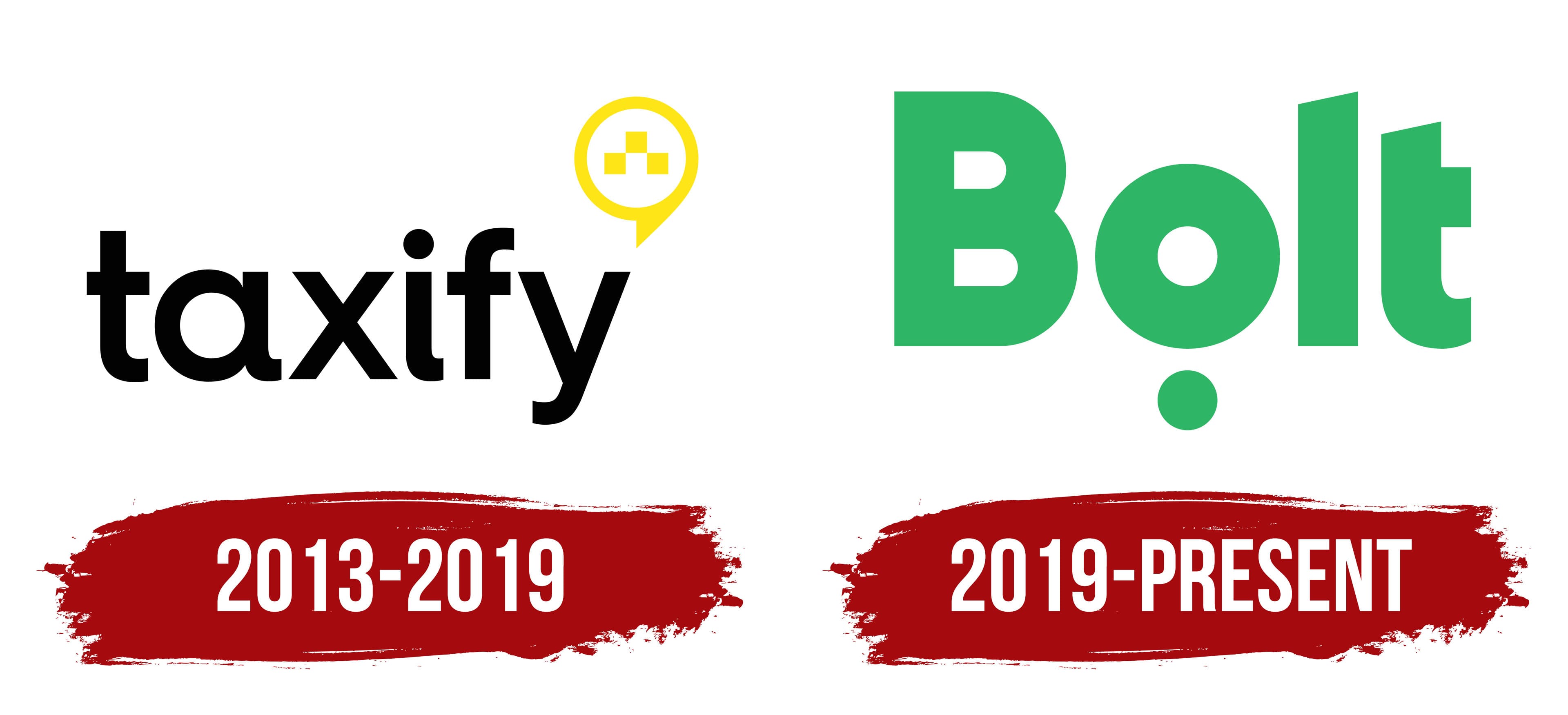
The debut logo consists of two parts: graphics and text. The first is the dialogue bubble, which is located to the right of the caption. A yellow line outlines it. The checkers on the white inner space are painted the same color: three identical squares arranged in a checkerboard pattern. A muted, sunny hue is extremely important for a car rental service, as it is classic for taxis in any country. The second is the platform’s very name. It is printed in black lowercase letters. The inscription is set in an even, smooth sans-serif font.
2019 – today
After the rebranding, Bolt has a modern emblem that balances modernity and practicality. It is not as conceptually innovative because the designers focused on transport dynamics. The movement conveys the lower element: a solid-filled wheel in light emerald. The name is set in lowercase letters in the same shade, except for the first letter, which is capitalized according to the spelling.
The inscription’s characters are massive, bold, and even. They have no serifs, and the lines are extremely clear, strict, and short. This is shown by the missing left half of the crossbar of the “t.” The design emphasizes the vertical columns of the “l” and “t,” whose tops are cut diagonally.
Font and Colors
Both logos use the wheel theme. In the first, it appears as a taxi (speech bubble); in the second, as a thick dot under the letter “o,” which resembles a steering wheel. In the current Bolt logo, the road direction is also represented by letters resembling road-sign elements.
The earliest version of the logo uses the Hurme Geometric Sans 4 SemiBold typeface, designed by Hurme Design. In the current version, the service name is set in a font almost identical to Bw Modelica SS01 Condensed Black from Branding With Type. The only difference is that the “o” in the logo is rounder, while the tops of the “l” and “t” are cut at an angle.
The modern corporate palette includes a pastel shade of emerald green. Previously, a black-and-yellow combination was used, which has long symbolized the taxi service. The shift to a new color scheme reflects Bolt’s expanded services.