


 Bradesco Logo PNG
The Bradesco logo burns like an Olympic flame, conveying the bank’s leadership and innovative approach to customer service. The bank offers investors the latest technologies. As the emblem shows, the bank won’t stop.
Bradesco began with Amador Aguiar, born on February 14, 1904, in Ribeirão Preto, São Paulo, in a family of coffee plantation workers. He was the twelfth of fourteen children, left school at 13 to work in the fields, and ran away to Bebedouro at 16. After losing a finger in a printing-press accident, he became a banking clerk at Banco Noroeste.
On March 10, 1943, Aguiar and several partners took over Casa Bancária Almeida e Companhia in Marília. The institution had six branches and 10 million cruzeiros in capital. When the appointed president died on opening day, Aguiar took over, bought a third of the shares, and renamed the company Banco Brasileiro de Descontos S.A. The shortened name became Bradesco.
Aguiar built the bank for customers major Brazilian lenders ignored: workers, small traders, farmers, and modest savers. His idea resembled Amadeo Giannini’s Bank of America, which served ordinary clients rather than only wealthy borrowers. Bradesco accepted small deposits, issued small loans, and opened branches in towns where Itaú and Banco do Brasil had weaker coverage. By 1951, it was Brazil’s largest private bank.
In 1953, the headquarters moved to Cidade de Deus in Osasco. In 1956, Aguiar created Fundação Bradesco to provide free education. In 1962, the bank bought an IBM-based computing center, and in 1968, it issued Brazil’s first credit card. Later growth came through acquisitions, including Banco do Estado da Bahia in 2000, Banco do Estado do Maranhão in 2004, Banco do Estado do Ceará in 2005, and HSBC Brazil in 2015 for about $5.2 billion.
Meaning and History
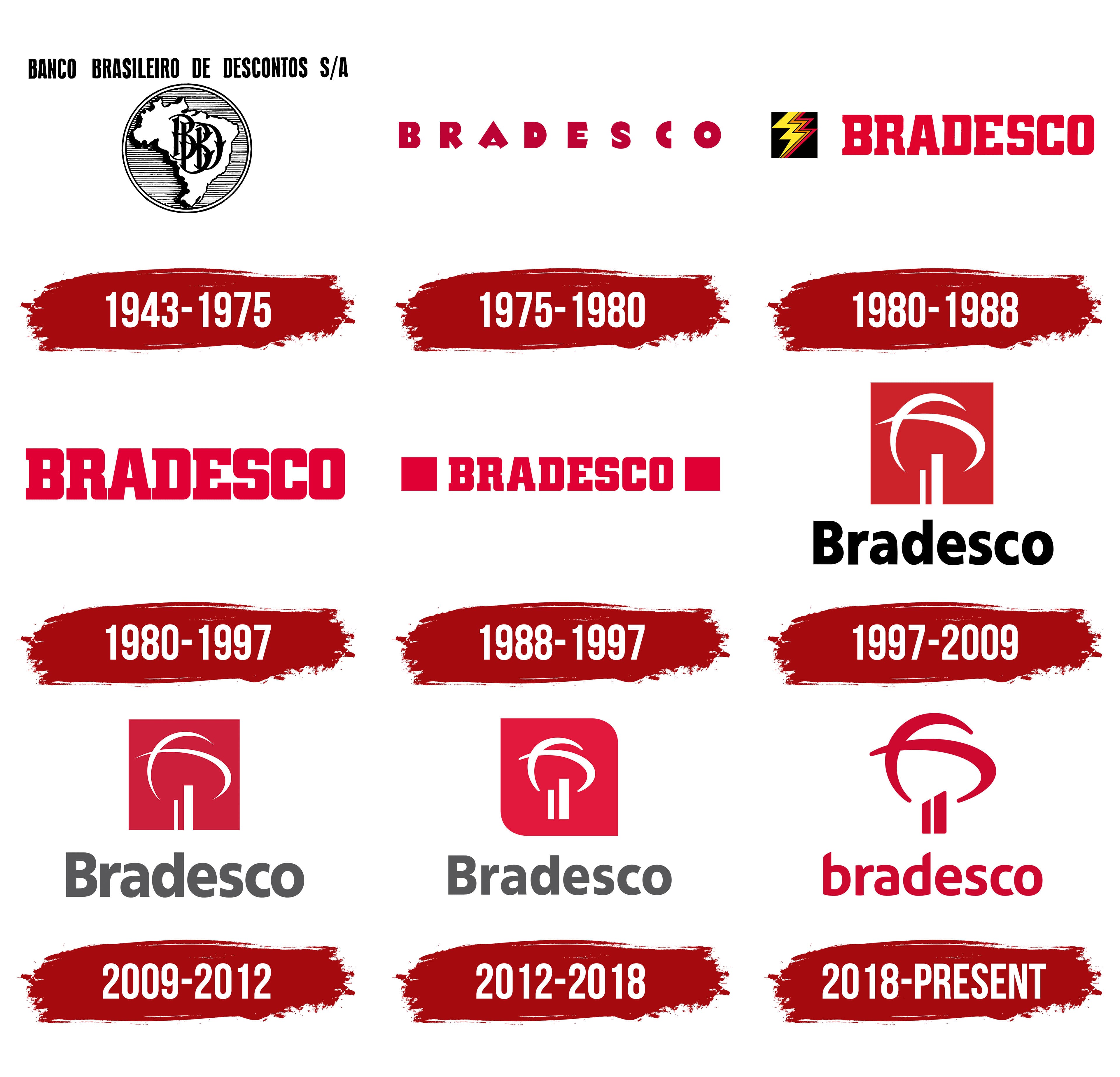
The company’s logo has changed many times, marking new milestones of prosperity and growth. The consistent red color has adorned all emblems, evoking Brazilian passion and the bank’s love for its work.
What is Bradesco?
Brazil’s largest financial institution has a net income of $23.4 billion. There are 53,000 ATMs and about 5,000 branches across the country, with headquarters in São Paulo.
1943 – 1975

The first logo featured an inscription and a coin depicting a map of Brazil, with the name’s monogram intertwined.
The inscription above the coin reads Banco Brasileiro de Descontos S.A. The combination translates to “Brazilian discount,” reflecting the organization’s commitment to ordinary contributors. At the dawn of banking, financial institutions did business only with wealthy citizens. The middle class and the poor were not served. Therefore, Aguiarom’s chosen name was revolutionary and attracted many clients.
The coin personified prosperity and signaled the organization’s direction. The silhouette of Brazil showed that the bank would serve all of the country’s inhabitants and planned to expand its branches nationwide.
1975 – 1980

From the 1960s to the 1970s, the bank grew enormously. It introduced computer technology, doubled its number of offices, and acquired less successful ones. As a result of the Brazilian Miracle, the company updated its logo to modernize it.
The new emblem featured the word Bradesco in medium-sized capital letters, with generous spacing between letters. Another distinctive feature, along with the inter-letter spacing, was a cherry. color
The name itself is a compound word from parts of the bank’s full name: Brasileiro de Descontos. The abbreviation emphasized the bank’s individuality and was easier to remember.
The intervals hinted at the structure’s expansion as it spread throughout the country. At the same time, the preservation of the medium and small letter sizes indicates that the bank works with medium and small businesses.
The logo’s hue reflects growth, increased activity, and innovation.
1980 – 1988

The founder resigned as CEO, and the era of the new leader, Lázaro de Mello Brandão, began, who grew up in a bank as a simple clerk.
Brandão initiated a larger, more compact logo than the previous one. It expanded by opening branches, a trend that continued rapidly. Bradesco was everywhere. At the same time, service, efficiency, and professionalism improved. The bank launched a customer support telephone line.
At the time, the logo featured a black square pierced by lightning, with the name before it. It discussed the speed and quality of service enabled by computerization and the telephone line. It showed that the bank was growing and developing, cutting through the darkness of inflation.
1988 – 1997

The financial sector underwent global changes. A new currency was introduced in the country. Banks were limited to working no more than 5 hours a day to curb inflation. As a result, Bradesco had to lay off many employees, close branches, modernize its operations, and outsource certain areas to other organizations.
The new logo is the name surrounded by red squares on both sides. The image said: “Even in a period of trouble when circumstances beyond the bank’s control hit the wallet, the institution continues to work, trying to preserve and increase the income of depositors. All finances are securely protected.
The bank persevered and ranked first among Brazilian banks in 1993-94.
1997 – 2009

In 1997, Bradesco acquired one of Brazil’s largest banks, Banco de Crédito Nacional. After the merger and rebranding, the company’s logo concept changed dramatically.
The name is in a new font, black, with one capital letter. The square moved up. It ignited a schematic torch.
The bank celebrated victory and prosperity. It was the country’s best financial institution. As a result, a torch appeared atop the emblem, symbolizing leadership. The flame showed that Bradesco set the industry’s tone and led the other banks. The institution introduced new technologies, opened new offices, and offered new services.
The bright scarlet color conveyed energy, like a beating heart. The company is the country’s pulse, and others adapt to it.
2009 – 2012

In 2009, the company closed another major deal to buy competitor Banco Ibi. The conglomerate’s scale has increased even more. The updated logo demonstrates the dilution of the original Bradesco and the infusion of other employees, corporate culture, and capital. The process is shown by changing the name from black to grey. But this mixing makes the organization’s fire burn even brighter. The red square becomes much larger, and the torch’s white lines become clearer.
2012 – 2018

The bank received a state contract and became an organization entrusted with paying salaries to the country’s civil servants. The new badge is softer and conveys Bradesco’s stability and confidence. The inscription’s darker color reflects the conglomerate’s gradual adoption of a common structure and policy. Loyalty is shown by the two rounded corners of a square with a torch.
2018 – today

At the beginning of the year, Octavio de Lazari joined the bank’s management, and in 2018, Bradesco increased its financial value by half thanks to him. Rebranding has become part of the modernization process.
The company’s latest sign is simple and elegant; all elements of the inscription stretch upward. The torch is still burning above the name, but without the red square. The missing capital letter signals a return to a customer-first policy. The emblem reads as more freedom and leadership.
Font and Colors

The main color that has accompanied Bradesco throughout its history is red. It symbolizes the bank’s founder’s dedication. Customer care, reliability, and a love of work are among the organization’s values and goals. As a result, the institution enjoys the trust of the country’s inhabitants.
The hue also signals pioneering mission leadership among Brazil’s banks.

The font resembles Chypre Cond Extra Bold.