


 Breyer’s Logo PNG
The Breyer’s logo symbolizes reliable, high-quality ice cream with a rich history. It reflects the brand’s traditions, which remained loyal to original recipes despite significant production changes.
Breyers began in Philadelphia in 1866, when 26-year-old William Breyer made ice cream at home from cream, cane sugar, fresh fruit, and vanilla. He first sold it to neighbors on Girard Avenue, then delivered it around the district by horse-drawn cart. A branded shop opened in 1882, and the business became Breyer Ice Cream Company in 1908. By then, it operated several stores and a factory. His sons continued the company after his death.
National Dairy Products Corporation acquired Breyers in 1926, expanding production beyond Pennsylvania and New York. The parent company later became Kraft, Inc., while the brand kept its reputation for simple ingredients and natural flavoring. During the 1970s, the range expanded to frozen yogurt, then a relatively new category in the United States.
Unilever bought Breyers in 1993 through a larger deal with Kraft General Foods. The brand joined a portfolio that included Good Humor. At the same time, Unilever consolidated much of its production at a large plant in Frankfort, Indiana. Breyers then competed nationally with Häagen-Dazs, a Nestlé-owned brand.
In 2013, several flavors were reformulated with too little milk fat to meet the FDA definition of ice cream. They were labeled “frozen dairy dessert.” The change lowered production costs but drew criticism from longtime buyers. In February 2024, the owner announced plans to spin off its ice cream division, including Breyers, Magnum, Ben & Jerry’s, and Wall’s, as a public company by the end of 2025.
Meaning and History
What is Breyer’s?
An American ice cream brand known for natural ingredients and traditional recipes. Its products have a simple formulation, making them popular among fans of natural desserts. The assortment includes classic flavors and varieties with caramel or nuts. The brand targets family audiences, offering quality ice cream at reasonable prices.
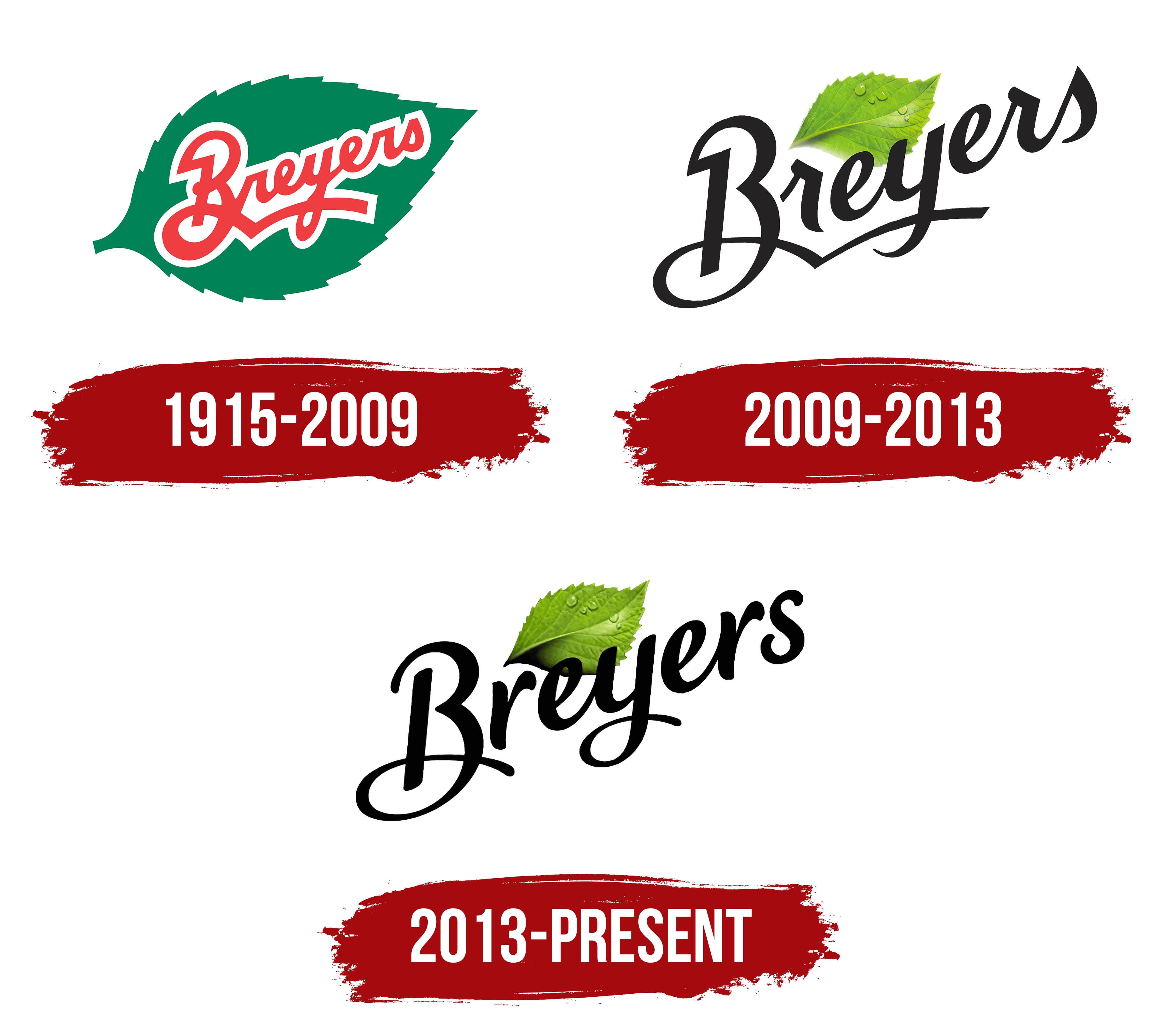
1915 – 2009
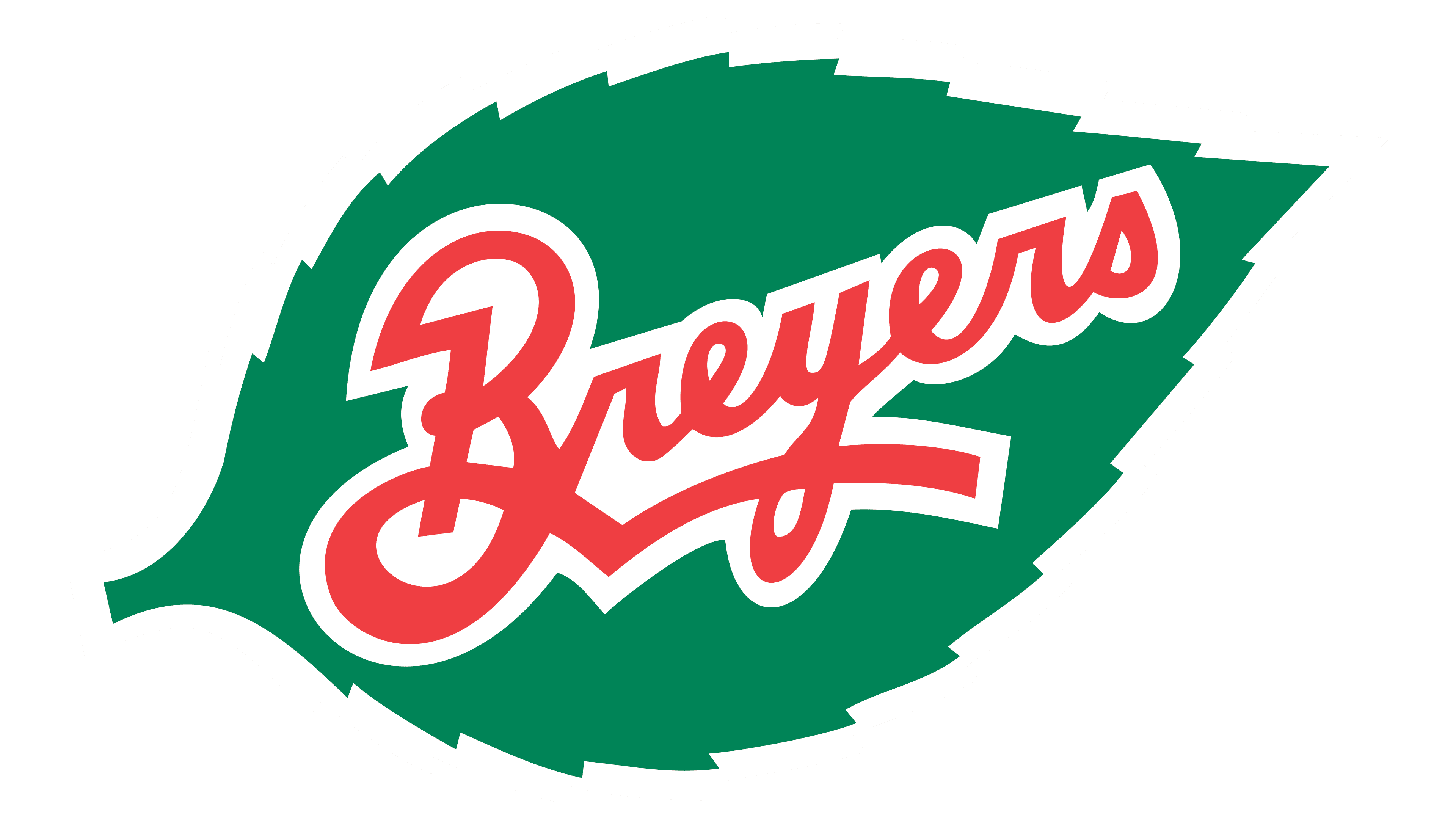
The old logo conveyed the product’s naturalness through typography set against a leaf. The name appeared in red cursive letters with smooth lines, set over a green leaf with jagged edges that resembled real foliage.
The typography conveyed liveliness, matching the company’s ice cream, made from natural ingredients. The red lettering contrasted with the green background, together creating a vivid impression of flavor.
The leaf shape indicated the ingredients’ natural origin, reinforcing the brand’s primary principle: making products from natural materials.
2009 – 2013

In 2009, the Breyers logo adopted refined lettering with minimal background elements. A mint leaf with realistic droplets served as a small accent above the name. The text was written in cursive with a handwritten style and smooth line transitions.
The name appeared in monochrome black, emphasizing simplicity. The realistic leaf pointed directly to the natural ingredients used in the company’s ice cream.
The shift away from the larger leaf motif toward a minimalist design reflected the brand’s goal of achieving a modern appearance. Visual simplification highlighted the updated style, maintaining the natural aspect of its products.
2013 – today

The Breyers logo, introduced in 2013 as part of Unilever’s visual identity update, combines new calligraphic lettering with a realistic green leaf. The design references the heritage established by the brand’s founder, Henry Breyer, who first used the “briar leaf” in the early 20th century as a symbol of naturalness and premium quality. The modern version of the logo retains this historical symbolism while enhancing its realism.
The bright green leaf features a realistic texture and small water droplets, lending it a natural, fresh appearance. The use of gradient shades of green adds depth and dynamism, emphasizing the natural ingredients and freshness that the brand highlights.
The font is custom-made, executed in a handwritten style with flowing, elegant lines. The glyphs feature contrasting strokes and gentle curves, reflecting the traditional artisanal production of ice cream. The letter thickness was slightly reduced in the 2013 version to improve readability, while the smoothness of their shapes underscores product quality and premium positioning. The slant and connection between glyphs evoke the impression of natural handwriting, associating the brand with careful preparation and attention to ingredients.
The introduction of the new logo coincided with a revision of the company’s product line and the launch of a category of reduced-fat “frozen dairy desserts,” which sparked some debate among consumers. Nevertheless, the updated design composition, emphasizing the leaf’s freshness and realism, reinforced the brand’s new direction, promoting the perception of its products as light and natural.
