 BRF Logo PNG
Food production includes meat processing, manufacturing semi-finished products, and delivering finished goods to retail chains. Such operations require large-scale logistics and quality control at every stage. The BRF logo is associated with a Brazilian company that produces poultry, pork, and ready-to-eat products, supplying them to domestic and international markets.
The history of BRF began in 1934, when Italian immigrants Brandalise and Ponzoni opened a shop called “Ponzoni, Brandalise & Co.” in Santa Catarina. In 1939, the partners launched a slaughterhouse and meat processing plant. In 1944, Attilio Fontana founded Sadia, which became Perdigão’s main competitor. For decades, both companies strengthened their positions in meat production and frozen foods.
In 1998, Perdigão implemented a corporate information system. In 2006, Sadia attempted to acquire Perdigão for 3.9 billion reais, but the deal did not take place. In 2007, Perdigão acquired Eleva Alimentos, reinforcing its position in the domestic market. In 2008, Sadia suffered losses of 2.3 billion reais due to currency fluctuations.
In May 2009, Perdigão and Sadia announced a merger. As a result, Brasil Foods SA was created. The expected sales volume of the new company ranged from $10.5 billion to $11 billion. In 2011, BRF acquired the Argentine companies Avex and Dánica for $ 150 million. In 2012, the brand integration was completed. That same year, the company purchased a 49 percent stake in Federal Foods in Abu Dhabi for $ 36 million.
In 2013, the company adopted the new name BRF S.A. In 2015, three deals were completed, totaling $ 496 million. The acquisitions included Thailand’s Golden Foods Siam and the British company Universal Meats.
In 2016, the company acquired Oman-based Al Khan Foodstuff. That same year, the Sadia Halal brand was launched, and the OneFoods division was established to focus on halal production.
BRF purchased a 26 percent stake in Addoha Poultry Company for $ 84.3 million. In January of the same year, the company invested 149 million euros in projects in Saudi Arabia and China. On September 22, 2025, BRF completed its merger with Marfrig Global Foods. As a result, MBRF Global Foods Company S.A. was created, with a projected annual synergy of 805 million reais.
Meaning and History
What is BRF?
An international agribusiness corporation from Brazil, and one of the world’s largest producers and exporters of meat products. It produces poultry, pork, semi-finished, and ready-to-eat foods under the brands Sadia, Perdigão, Qualy, and Chester. Its structure includes farms, hatcheries, feed mills, and processing plants. The product range includes frozen and ready meals, canned foods, and pizza. Among the company’s shareholders are Salic and Marfrig Global Foods.
2009 – 2013
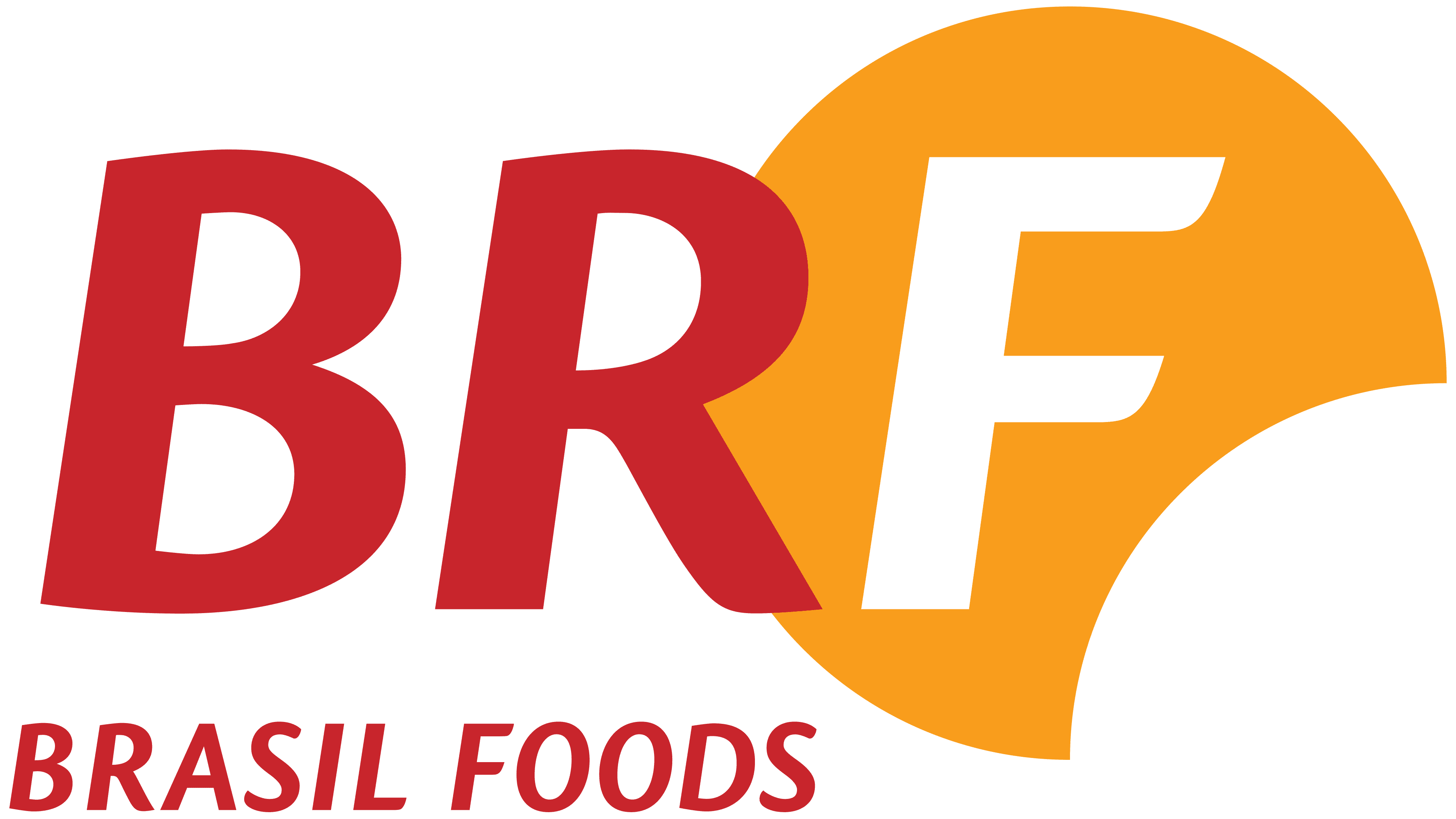
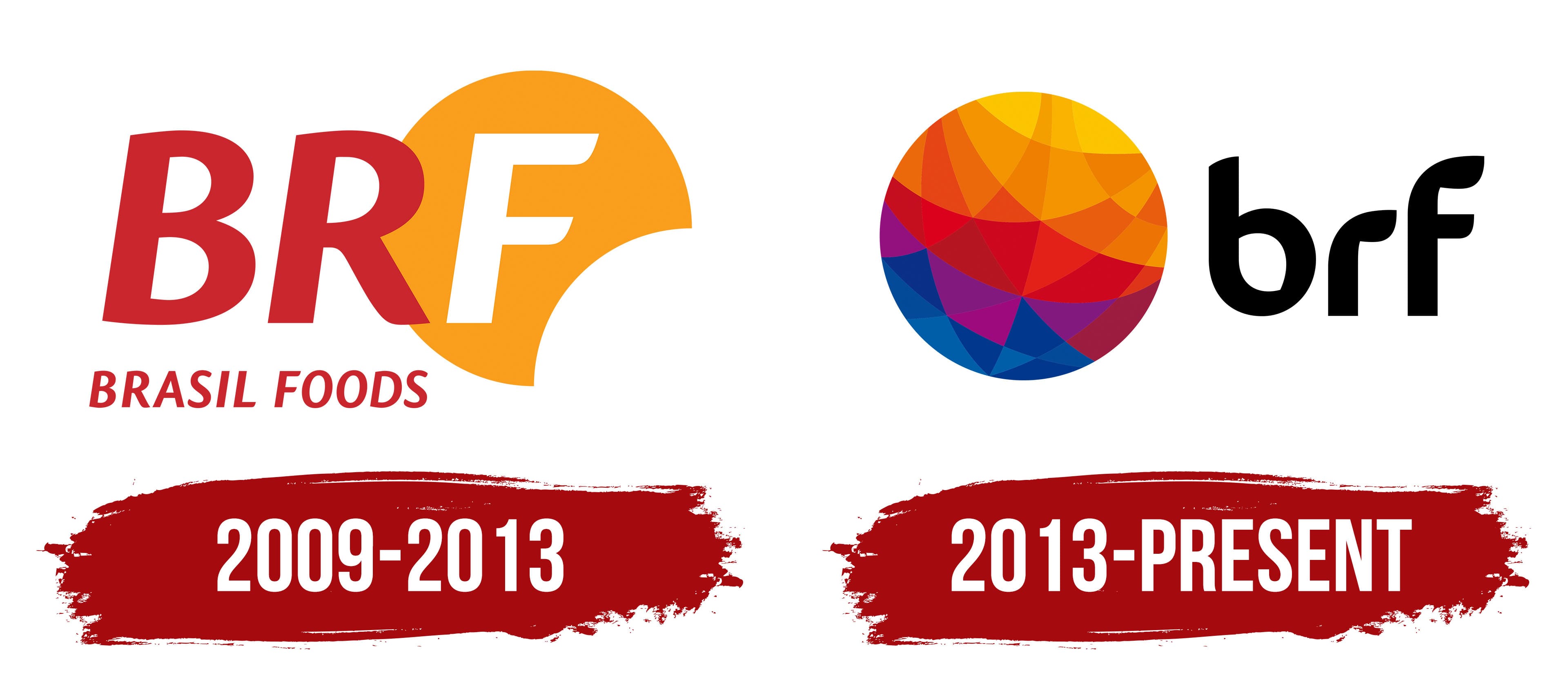
The abbreviation BRF appeared following the merger of two major Brazilian food companies. Sadia and Perdigão announced their combination in 2009. After antitrust procedures were completed in 2012, the BRF Brasil Foods group began operations. The first logo was built around the full name and represented the formation of the new company.
BRF’s history is connected to two businesses. In 1934, the Brandalise and Ponzoni families, Italian immigrants, established Ponzoni, Brandalise & Cia. in Videira, Santa Catarina. The company processed pork and sold agricultural products. It later adopted the name Perdigão.
Attilio Fontana founded Sadia in the neighboring city of Concórdia in 1944. Sadia and Perdigão operated separately for many years and gradually became two of Brazil’s leading food producers.
A large BRF abbreviation appeared in the upper section of the logo. The words BRASIL FOODS appeared beneath it and were aligned to the left. The upper wordmark served as the group’s shortened name. At the same time, the lower line identified its field of business and Brazilian origins.
The letters “B” and “R” used a red-orange color with a brick undertone. They appeared in a heavy sans-serif typeface with broad strokes and a slight rightward slant. The white letter “F” appeared inside a yellow-orange figure resembling part of a circle with its lower corner cut away.
The words BRASIL FOODS used the same red-orange color, while the letters were thinner and shorter. The difference in size directed the main emphasis toward BRF, while the lower descriptor completed the group’s name.
2013 – today
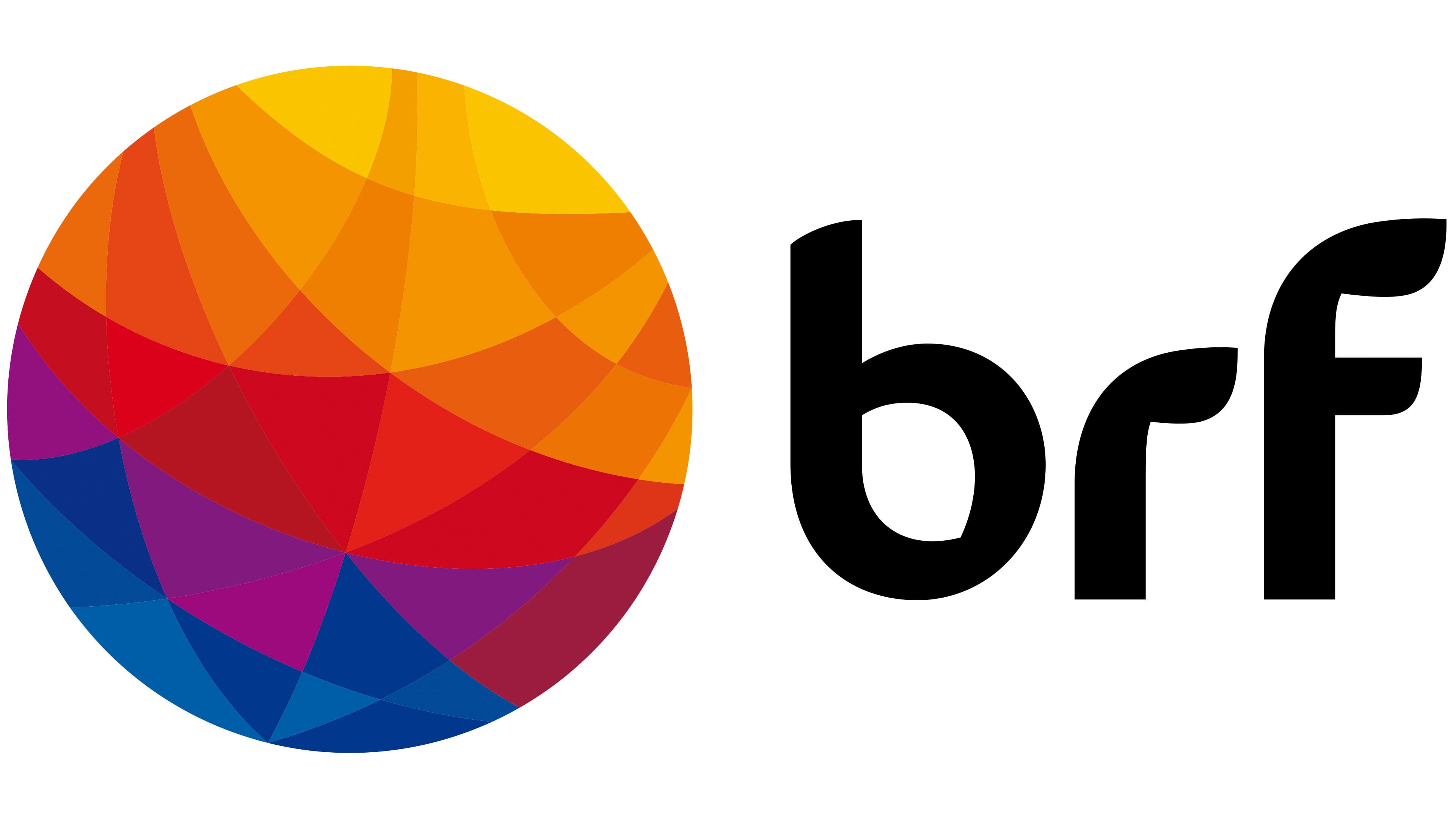
The new BRF logo was introduced on January 16, 2013, when the legal name changed to BRF S.A. The abbreviation had previously stood for Brasil Foods. After the company entered international markets, the full version disappeared from corporate materials. BRF became a standalone name suited to use in different countries.
Before the update, the company spent two years studying the opinions of employees, customers, investors, and business partners. The research helped define the image of an international food group created through the combination of Sadia and Perdigão. Interbrand and A10 developed the project. It included a new name, emblem, color system, and guidelines for using the brand outside Brazil.
A circle composed of numerous rounded colored fragments appears on the left. Curved stripes intersect and divide the surface into small sections. Yellow and orange shades appear at the top, followed by red, purple, and dark blue below. The figure resembles a solar disc, while the company associates it with the globe.
The individual sections of the circle represent the diversity of countries, cultures, and communities connected with BRF. The multicolored emblem replaced the previous identity centered on the company’s Brazilian origins. The new image suited communications with consumers and partners in international markets.
The black lowercase word BRF appears on the right. All letters have smooth terminals and rounded edges. The typeface resembles Avenir Next Rounded. The compact wordmark gives the colored circle the main visual role, and together they form a horizontal logo.