


 Brita Logo PNG
The logo’s basic theme is water. The Brita logo conveys its purity in detail because the company is associated with filter production. The abstract style emphasizes the products’ transparency, safety, and affordability. It is expressed through light lines that symbolize water. The graphics are perfectly balanced with clear glyphs. The dynamics of the flowing fluid are felt everywhere.
Brita began in 1966 in Taunusstein, near Wiesbaden, when Heinz Hankammer, a former photographer and self-taught inventor, founded a small company on his garden plot. He named it after his daughter, Britta, while the first commercial name was AquaDeMat. The first product was a compact filter for demineralizing water used in car batteries at gas stations, created in response to hard water across Central Europe. Small-scale production began in 1967.
At first, Hankammer worked with his wife and relatives, assembling parts by hand. Sales moved through regional distributors, while retailers treated the product with caution. In the early 1970s, the company introduced the Haushaltswasserfilter I, the first household water filter jug. Its cartridge combined an ion-exchange resin, which softened water and removed heavy-metal ions, with activated carbon to remove chlorine odor and organic impurities. The replaceable cartridge became the business model behind Brita’s long-term sales.
By the late 1970s, Brita had moved beyond Germany into Austria, Switzerland, and other European markets. In the 1980s, it expanded into the United Kingdom and Scandinavia. In 1988, Clorox received the license to market and distribute Brita in the U.S. and Canada. In 2000, Clorox bought the North American brand rights for $122 million and created Brita LP, while Brita GmbH kept the rest of the world.
In 1999, Heinz Hankammer handed over operational control to his son, Markus, and became chairman of the supervisory board. In the 2000s, Brita entered Asian markets, including Taiwan, Japan, and South Korea, and launched PURITY filters for professional coffee machines. Its competitors included Pur from Spectrum Brands in the U.S. and Franke in built-in filtration systems. Hankammer died in 2016, shortly before the company’s 50th anniversary.
Meaning and History

Brand recognition is high because the company’s logo has changed only slightly since 1966. Millions of Brita customers worldwide associate the brand with its traditional white-and-blue color palette. During this time, four versions of the logo were presented. Each redesign complemented the previous one, making the logo more attractive to the target audience.
What is Brita?
Brita offers high-quality water filters from a leading German company with many years of market experience and authority.
1966 – 2010

The company introduced the original logo almost immediately after its founding. It consisted of a wordmark and an emblem to the left. The brand name used an elegant, bold serif typeface with tall letters. All symbols are uppercase, adding confidence and strength. The emblem consists of 25 round balls, which together form a square. Each ball his a different shade of blue. As a result, the Brita logo visually communicates the company’s main purpose. Blue is the color most people associate with water.
2010 – 2014

Interestingly, the first logo version lasted 44 years. The 2010 redesign made minimal changes to the image’s elements, but updated it to look more modern. The letters in the word “name” were now white on a blue background. At the same time, the biggest changes were to the emblem. Thanks to the use of shadows, it seems that all 25 circles are shown in three dimensions.
2014 – 2022

Visually, this version of the logo is very similar to the original, with modern updates. The company returned to a white background and blue letters. It uses the same exquisite sans-serif font, with slight changes to the lettering style. For example, the upper horizontal line in the letter “i” is shorter and no longer touches the next letter “t.” The white background also makes the 3D circles more prominent and more likely to attract potential buyers’ attention. Overall, the logo looks professional and modern.
2015 – 2022

In addition to the previous version, another logo is used in parallel. The main elements remain unchanged, except that the white letters are reused on a blue background. However, the background- two triangles with strongly rounded corners- is striking: blue and light blue. Looks very intriguing and interesting.
2022 – today

The Brita logo’s meaning has become clearer: the drop now looks like a drop, not abstract dots. Its triple shape symbolizes the filtration process: the liquid seeps through the purification system, removing impurities. Dark blue and white represent purity, freshness, and thirst-quenching.
The wordmark on the right has a slim design that matches Brita’s ergonomic filter jugs and filter bottles. Elegant letters with sharp triangular serifs and different stroke thicknesses were clearly designed to order. Moreover, the adjacent “R” and “I” touch at the bottom, creating an imbalance in kerning.
Font and Colors
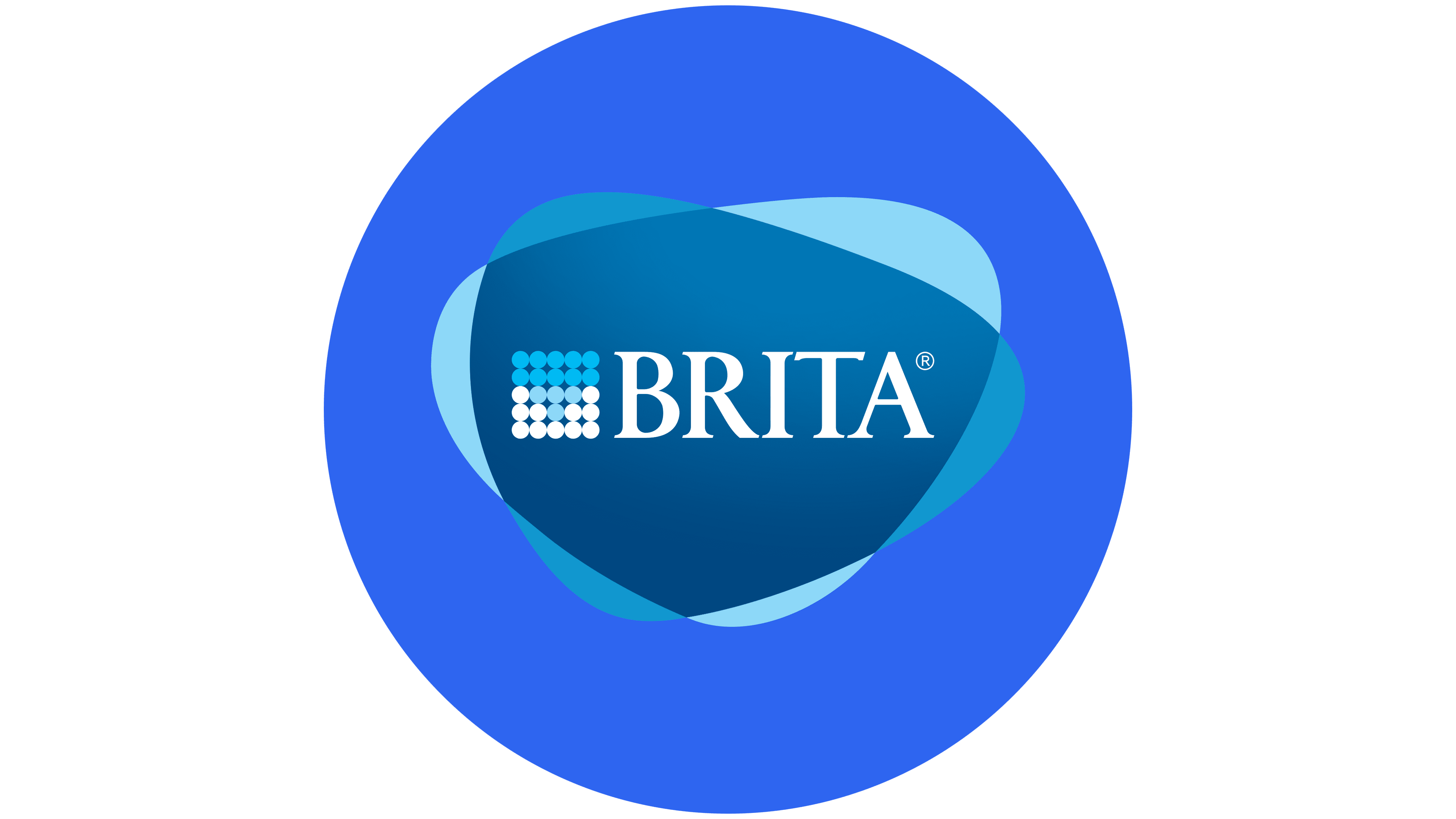
The Brita wordmark across all logo variations is set in capital letters in an elegant serif typeface. The main attention should be paid to the diagonal serif in the letter “T.” As a result, the elegant yet classic typeface feels unique and progressive. Throughout the brand’s history, the way the name is written has not changed much.
The color palette is based on white and blue. Moreover, it uses a blue gradient, from dark to light blue. As a result, the emblem’s 25 circles look mysterious and interesting. Thus, the company shows potential buyers its water filtration process. The chosen color range reflects the company’s professionalism and growth. Thanks to the right palette, the Brita logo looks sharp and sophisticated, staying in the target audience’s minds for a long time.