


 Comerica Logo PNG
The Comerica logo reflects the qualities of one of America’s largest banks: reliability, resilience, and a commitment to growth. Its design combines tradition and modern style, creating an image that inspires trust. The color palette and font emphasize the brand’s confidence in stability. Minimalism and classic elements make the emblem appealing, while the details add depth and symbolize the diversity of services offered.
Comerica traces its history to March 5, 1849, when Michigan governor Epaphroditus Ransom signed the act creating the Detroit Savings Fund Institute. The bank was built for Detroit workers after a wave of bank failures left ordinary residents without a safe place to keep their savings. It opened on August 17, 1849, serving six depositors and taking in $41 on its first day.
In 1871, the institution became The Detroit Savings Bank. By 1900, its assets reached $6 million. The name changed to The Detroit Bank in 1936, and in 1956 it merged with Birmingham National Bank, Detroit Wabeek Bank and Trust Company, and Ferndale National Bank to form The Detroit Bank & Trust Company. In 1973, DetroitBank Corporation was created as its holding company.
A major shift came in 1982, when DetroitBank Corporation became Comerica Incorporated, a name designed for expansion beyond Michigan. The same year, it created Comerica Trust Company of Florida. In 1983, it acquired Bank of the Commonwealth of Michigan and entered California and Texas through auto lending. In 1988, the purchase of Grand Bancshares began a series of Texas bank acquisitions.
In 1992, Comerica merged with Manufacturers National Corporation, a Detroit rival founded in 1933 with Edsel Ford among its founders. The deal made Comerica one of the 25 largest US bank holding companies. In 1998, it bought naming rights to Comerica Park, which opened in 2000. In 2001, it acquired Imperial Bank of California. In 2007, the headquarters moved from Detroit to Dallas, and in 2011, Comerica bought Sterling Bancshares for $1.03 billion. In October 2025, Comerica announced a merger with Fifth Third Bank for about $10.9 billion.
Meaning and History
What is Comerica?
This financial services firm combines modern banking methods with a strong history. It is well known in the Midwest and the Southern United States and serves as an important economic conduit for these regions. The company specializes in asset management, retail banking, and commercial business. The bank is renowned for its expertise in manufacturing, life sciences, and technology, and provides these industries with specialized financial solutions.
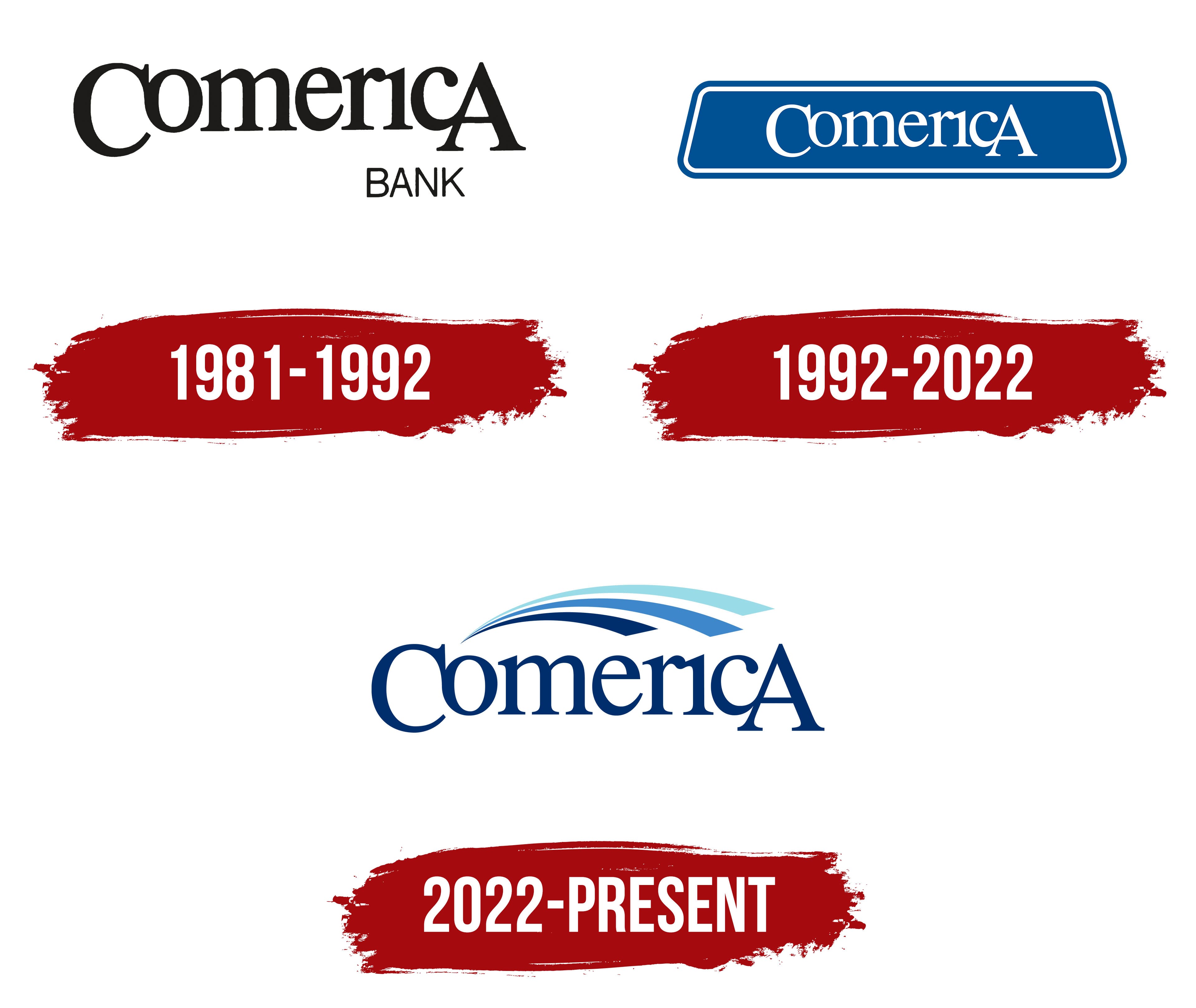
1981 – 1992
The financial services company initially chose black for its logo, aligning with the classic style that underpins the brand’s identity. The monochrome palette symbolized stability and reliability, emphasizing the company’s seriousness and conservatism. The visual execution enhanced Comerica’s perceived status as a reputable financial institution.
The company name was the design’s centerpiece. The font differed from standard solutions. Each letter appeared as part of a cohesive composition, assembled in the viewer’s mind. Some characters connected, while others stood apart. The first letter, “C,” and the last letter, “A,” stood out in larger type, while the remaining letters maintained a uniform scale. The serifs and rounded edges added expressiveness, making them functional and memorable brand identity details. The text elements featured refinement and elegance, adding charm to the logo.
On the second horizontal line, to the right of the word “Comerica,” the word “bank” was positioned. This element clarified the company’s business focus. The tall uppercase letters of the word “bank,” rendered in a simple, striking design, stood out for their clarity and concision. They complemented the logo’s overall concept, reinforcing its structure and professional appearance.
1992 – 2022
The second version of Comerica’s emblem differs from its predecessor. In 1992, the bank significantly changed its identity, focusing on a new visual approach. The updated design took the form of a banner or sign, enhancing its perceived informativeness and significance. The design is based on an elongated rectangle with rounded corners, highlighting the text block inside. A double border draws attention to the text, making it the logo’s central element. The color palette is dominated by blue and white: a dark shade serves as the background, while a lighter shade highlights the text.
True to tradition, the company retained the previous font and elevated letter style. Beautiful letters with diverse shapes and sizes appear expressive and solid. Their extravagance harmonizes with conservative elements, creating a visual balance. Sharp lines, carefully crafted serifs, and soft, rounded edges give the text block strength and confidence.
The logo is perceived as a powerful, concise symbol that reflects the status and reliability of one of the largest commercial banks in the United States. Its structure and details emphasize the company’s confidence in its capabilities and stability, giving the overall design precision and professionalism.
2022 – today
The bank’s logo, introduced in 2022, has become a benchmark for aesthetics and visual appeal. The new identity seemed unusual and unexpected to many, leading some to see it as an experimental decision. However, the update reflected the company’s rapid growth and the need to adapt to modern demands.
The company, which offers a wide range of financial services, created a unique emblem that emphasizes its innovative approach. The color palette became more diverse. While earlier versions used two or three shades, the new version introduced a more complex spectrum, adding greater expressiveness.
The company name, in dark blue and centered, was marked by precise alignment: all characters were placed on a single horizontal line. As in previous versions, the first and last letters stood out in height, adding structure to the text block and drawing attention. Each letter featured a precise geometric shape, with individuality added through fonts and serifs that complemented the overall style.
Three semi-circular lines above the name drew attention. These elements, reminiscent of a rainbow, originated from a single point and spread outward, creating a sense of movement. Each line was rendered in a different shade of blue, adding depth and reflecting the company’s wide range of possibilities.