


 Evian Logo PNG
The Evian logo underscores the mineral water’s unique origin. The drink is refreshing and energizing. The snowy mountain peaks of the Alps on the emblem create a sense of cold purity that sets the brand’s water apart.
Evian’s history began in 1789 in Évian, a small town on Lake Geneva in southern France. The Marquis de Lessert drank from a spring on Monsieur Cachat’s land and found the water light and pleasant. After he claimed his kidney problems had improved, local doctors began recommending the spring water. Cachat fenced off the source and began selling it as Source Cachat.
The first thermal bath opened in 1806, and the first bottling workshop appeared in 1826. In 1829, Société des Eaux Minérales was created to manage the spring and sales. In 1859, the business became Société anonyme des eaux minérales de Cachat. After Savoy joined France in 1860, the spring became French, and in 1878, the French Ministry of Health approved industrial bottling.
In 1908, Evian began using glass bottles made by Souchon-Neuvesel, replacing clay jugs and wooden barrels. The format made transport easier and helped the brand compete with Perrier, which was already growing in Europe. New bottling plants followed in 1954 at Evian-Gare and in 1965 at Amphion-les-Bains.
BSN bought a 25% stake in Evian in 1964 and took full control in 1970, as Antoine Riboud turned the glass group toward food and drink. Evian launched PVC bottles in 1969, entered the U.S. market in 1978 through premium hotels and restaurants, and moved to PET bottles in 1995. After BSN became Groupe Danone in 1994, Evian grew as Danone’s flagship water brand and later used limited-edition bottles by Jean Paul Gaultier, Christian Lacroix, Diane von Fürstenberg, and Alexander Wang.
Meaning and History
People noticed the benefits of water and its healing abilities at the end of the 18th century. The springs began to attract tourists and residents who came to drink and bathe in the water. Therefore, at the beginning of the 19th century, a spa was opened, a factory was built to bottle the valuable liquid, and an anonymous company, the Société des Eaux Minérales (1829), was organized to manage the business.
In 1970, the parent company Danone (Boussois-Souchon-Neuvesel) took over the sale of Evian water by acquiring the Evian Mineral Water Company, which owned the springs at the time. BSN organized mineral water exports and helped popularize the brand abroad.
The brand name comes from the Celtic word uva (water). A small settlement at the springs on the shores of Lake Geneva was also called Evian (the commune of Évian-les-Bains). Now it is an elite vacation spot with luxurious villas and sanatoriums. Royals and celebrities get well here.
The brand positions itself as an elite, expensive water. From its first export to America, mineral water was served in luxury restaurants, and Hollywood cemented its reputation as a star drink. To support this image, Evian produces limited-edition designer bottles and runs expensive advertising campaigns featuring stars.
The springs are believed to originate in the Alps from snow and rain. After passing through the ancient rocks for fifteen years, the water is filtered and saturated with minerals, then poured in its natural form. Therefore, the main emphasis in advertising and the brand’s visual identity is on naturalness and benefits.
What is Evian?
This premium natural mineral water is owned by Danone and is sourced exclusively from a spring in Évian-les-Bains in the heart of the French Alps. As it flows through layers of glacial rock, the water naturally becomes enriched with minerals, giving it a characteristic smooth taste, a balanced pH, and ideal mineral content. The brand offers various formats from small bottles for personal use to larger ones for home consumption, preserving the water’s purity from source to bottle. Inspired by the mountains, the bottle design highlights the brand’s connection to its alpine origins.
1973 – 1994
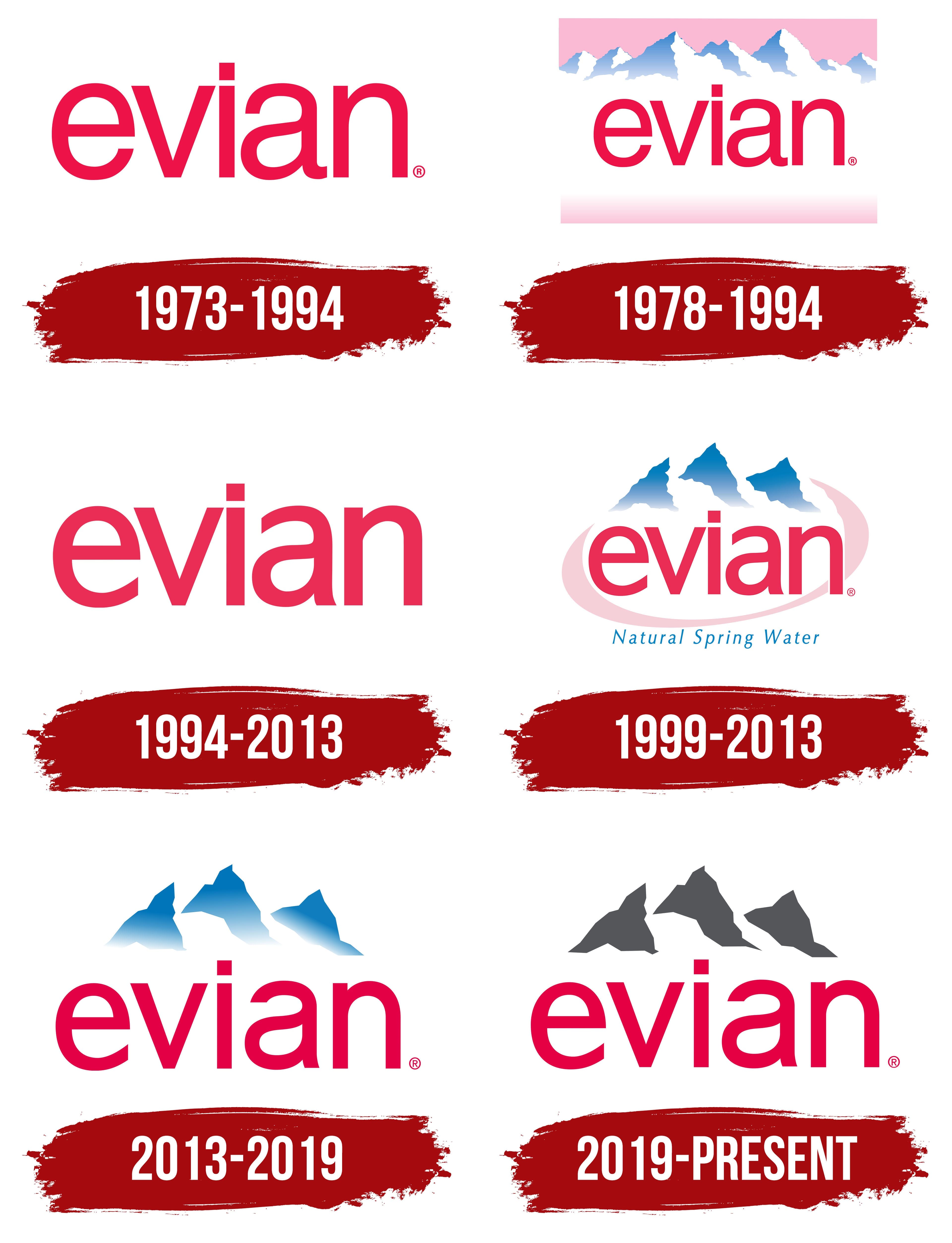
The brand’s main sign is alphabetical. The brand’s name is written in small, bright scarlet letters. Soft, curved lines of varying thicknesses, without serifs, symbolize the mild taste of mineral water and the absence of an unpleasant aftertaste. One distinguishing feature is a drop enclosed in the lower part of the letter “a.” It suggests the brand is connected to water. Red symbolizes power and health. It attracts attention and emphasizes the brand’s importance. It also suggests the water’s pH aligns with the blood’s pH, improving the liquid’s absorption.
1978 – 1994
Starting with the year the mineral water was exported to the USA (1978), the image of the snowy peaks of the French Alps began appearing alongside the capital logo. This introduced foreign buyers to the product’s essence. It pointed to the water’s birthplace and linked it to coolness, cleanliness, and freshness. A foggy white stripe in the center of the emblem enhanced these sensations and housed the brand name. The logo’s background is pink. It looks like dawn against a mountain backdrop; this morning light, which complements the impression of purity, lightness, and cold, reflects the brand’s heyday.
1994 – 2013

Since 1993, water has been supplied to maternity hospitals in France and is recommended for women in childbirth; babies and young children also appear in brand advertising. The logo reflects all this. The lettering remained unchanged, and the color scheme became crimson. More childish and tender. This color symbolizes creativity, dreams, and imagination.
1999 – 2013
The visual identity of this period changed its form. The emblem’s pink background was limited to an oval strip, inside which three mountain peaks with bright blue shadows rise against a white background. The word “Evian” is at the top of the image, extending beyond the oval on the right. It shows the brand’s drive forward. It suggests expansion beyond its place of origin and worldwide distribution (the product is popular in 120 countries).
The oval shape alludes to Lake Geneva, whose banks have springs. It indicates the Earth’s movement trajectory, constant and unchanging, like the composition of water and the spread of the mark. Few permanent, stable products in the world have more than 200 years of history. And despite active use, nature repeatedly replenishes the sources.
The oval also creates a sense of harmony and completeness. After all, Evian contains the necessary minerals for health and well-being. Nothing needs to be added to the composition. Water is perfect in itself.
The oval line surrounding the brand name also signals protection. In the nineties, the Association for the Protection of the Evian Water was founded. It regulates agricultural and local enterprises to prevent pollution of water sources.
The three peaks may point to the three most famous ski resorts in the French Alps and to the three continents where water is sold. Another version says it depicts a real mountain landscape in the Chamonix valley.
The blue appearance on the tops is not accidental. Blue appears on the coat of arms of the commune of Evian-les-Bains, home to the balneological resort. This is the color of Lake Geneva and streams. It is associated with the water element, depth, and purity. Blue also nods to the parent company. In the 90s, the BSN group was renamed Danone. Its logo uses blue tones. The logo’s white background evokes the snowy coolness of mountain-peak water.
2013 – 2019
In 2005, Danone set its main goal: to bring health through food and water to as many people as possible. In the mineral water logo from this period, only the main elements remain: the brand name and three mountain peaks with blue shadows. These symbols represent water, purity, health, and the Alps. Key message: Evian is pure water that cares about health.
2019 – today
In 2018, Danone set 9 goals to improve the health of the planet and people. For Evian, this means the start of a journey towards safe packaging and a zero carbon footprint:
- Use of bottles made from recycled materials
- Removal of labels
- Production of dispensers with minimal plastic content
- A new modern eco-friendly platform for bottling mineral water
- Transportation only by railway tracks.
The new brand logo is concise, clear, and minimalist. It features only three mountain peaks, with the brand name at their base. The rising mountains symbolize that nature is more significant than anything a person does. At the same time, the brand name appears to stand on water, and the lower part of the letters is slightly rippled. This suggests the brand was born from the mountain stream water. The peaks are marked in gray, embodying constancy, maturity, and a long history of existence (the mineral water is 230 years old). The company is stable, firmly on its feet, and mature enough to take responsibility for keeping the planet clean.
Font and Colors
The brand’s main colors are scarlet, white, blue, and gray.
- Scarlet – the unity of mineral water and blood; the benefits of water for health.
- White – snow from which water is formed.
- Blue – purity and coolness of the springs.
- Gray – stability and reliability.
The logo font is Arial.