


 Figma Logo PNG
The Figma logo conveys the creative process, which involves interaction between team members. The simplicity of the lines reflects the web application’s accessibility to everyone who needs convenient tools for interface design.
Figma began in 2012, when Dylan Field and Evan Wallace, students at Brown University, explored a browser-based design tool with live collaboration. Field received a $100,000 Thiel Fellowship in 2013 and left college to focus on the project. Wallace joined full-time in 2015, when the company raised $3.8 million, opened a closed beta, and later secured a $14 million Series A round.
The product launched publicly in 2016 with real-time editing inside a browser. A vector editor followed in 2017, allowing designers to create complex graphics without switching tools. A $25 million Series B round in 2018 supported team growth and the Figma Platform, where developers could build plugins and extensions. Auto Layout arrived in 2019 for responsive interface work.
FigJam launched in 2020 for brainstorming, planning, and team workshops. During 2021 and 2022, Figma expanded prototyping, developer collaboration, automatic layer naming, and component variants. The first in-person Config conference took place in April 2022, while FigJam gained tools for sprint planning, retrospectives, and more realistic interactive prototypes.
In September 2022, Adobe announced a proposed $20 billion acquisition, while Figma said product development would continue independently during the agreement. By 2023, the company had added project-management integrations, educational courses, certification programs and enterprise features for large design systems, complex product teams and corporate clients.
Meaning and History
What is Figma?
This cloud-based design platform has completely transformed how teams and designers collaborate on digital projects. With multiple users able to work on a single file in real time, this tool combines powerful design features with the convenience of teamwork. The platform operates in the browser, making it accessible from any device without additional installations or updates. It offers many tools for creating vector graphics, prototypes, and user interfaces. Additionally, it supports a plugin system that extends its capabilities. With component libraries and design systems, teams can easily maintain consistency in large projects.
2012 – 2013
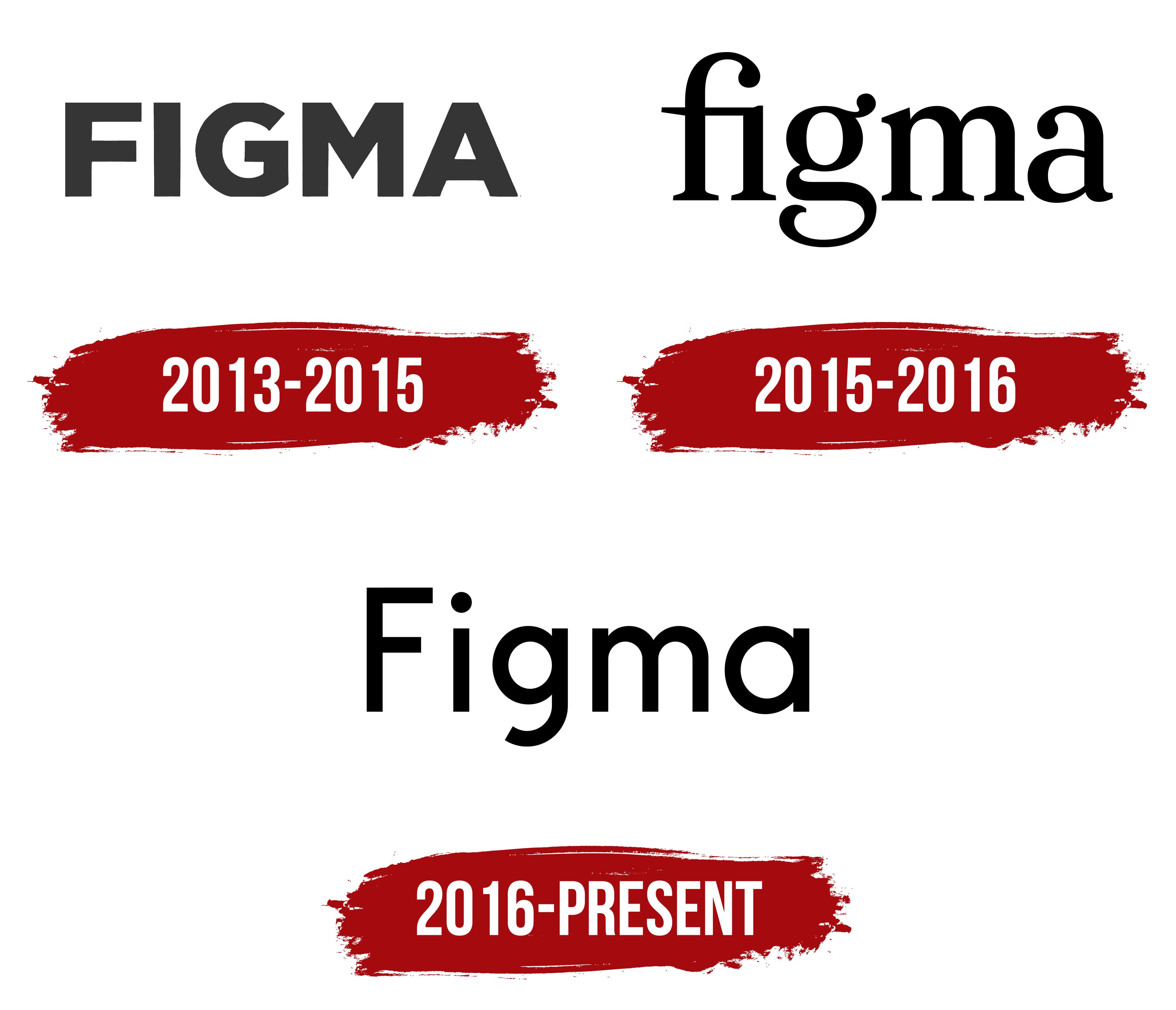
Figma was founded in 2012, but did not have an official logo until 2013. The company was entirely focused on developing the application of the same name, so it had no time to consider its visual identity or branding.
2013 – 2015
Although Figma had not yet been released in 2013, users were already interested in it, as this revolutionary development was expected to simplify the interface design process. The company introduced its debut logo to attract more attention to the new product. It looks very plain because it consists of a single black inscription.
The word “FIGMA” is set in a standard bold sans-serif font, whose restrained severity underscores the startup’s seriousness. The symmetrical shape of the letters creates a sense of balance, reflecting a pursuit of equilibrium. All lines have the same thickness, yet this does not diminish the emblem’s dynamism in this form; the glyphs still appear to move. The internal energy is expressed in subtle details, from the swift curve of the “G” to the angular center of the “M.”
Designers chose a standard font for the logo, with many analogs, such as Hurme Geometric Sans 4 Black by Hurme Design or Azo Sans Black by Rui Abreu. The inscription’s style is formal and unsuited for a progressive startup on the brink of discoveries. The black capital letters look conservative and generic, as if the brand had not fully defined its visual identity.
2015 – 2016
In December 2015, a preview version of the Figma web application was released by invitation only. The company updated its emblem for its debut, as the previous wordmark failed to generate interest and did not reflect the brand’s essence. The designers kept the inscription but completely changed it, creating the opposite of what had been before.
The logo now consists only of lowercase letters, meant to convey the software’s accessibility. As Figma simplifies interface design, soft, curving lines symbolize ease and comfort. The contrasting thickness of the strokes adds dynamism to the logo, hinting at faster processes. This visual movement is present in other elements of the inscription:
- Tapering serifs;
- Bold droplets at the ends of “g,” “a,” and “f”;
- Smooth arched curves of “m”;
- Rings and half-rings of “a” and “g.”
All these details highlight the brand’s uniqueness, commitment to growth, and modern technologies. Another interesting emblem feature is the merged “f” and “i.” A horizontal line connects them, and the top of the “f” also overlaps the dot above the “i.” This close connection symbolizes project teamwork, as Figma enables real-time collaboration.
The designers chose a graceful font to help the newly established company stand out among competitors. Yet the logo still does not fully convey the software’s concept, leaving it a mystery. The monochrome color scheme, combined with the standard inscription, suggests the brand’s immaturity, as it simultaneously tries to appear original and minimalist.
2016 – today
In 2016, Figma was publicly released. Along with the web application, the final version of its emblem was introduced, marking the end of a long search for a visual identity. The company had matured, as its logo finally took on meaning: a colorful icon was added to the simple black inscription, composed of multicolored geometric shapes.
The elements are arranged in pairs in three rows, resembling a cell division diagram. At the top is a red, pink capsule; in the middle are a purple half-oval and a blue circle; and at the bottom is a turquoise drop. They symbolize small building blocks that make up a larger design project. The bright colors and unusual shapes evoke associations with children’s games, where creativity is key. The multi-component structure of the icon represents the expanded possibilities for those developing user interfaces.
The brand could not part with the black wordmark, but it managed to make it more expressive. Now, the inscription combines uppercase (the initial “F”) and lowercase letters, creating a sense of correctness and balance. The font resembles Pitchland Regular by JC Design Studio, a simple sans-serif without unnecessary decorative elements. Its restrained design emphasizes the company’s authority and confidence, while the black color reinforces this visual effect, as it is associated with aristocratic calm.
The glyphs comprise basic geometric shapes: circles, quadrilaterals, and straight and curved lines. This looks very simple, especially with uniform stroke thickness, but minimalism helps the brand remain noticeable. With such a serious logo, Figma creates the impression of a professional assistant in interface design.