


 Fine Gael Logo PNG
Fine Gael’s logo shines like a constellation of bright stars in the Irish sky. The emblem represents the leading party. An ideology that touches hearts. The symbol points the way, leading the Irish into the future.
Fine Gael, translated from Irish as “Tribe of the Irish,” has deep roots in Ireland’s history. The story begins in the early 1920s during the country’s struggle for independence from Britain. Officially established on September 8, 1933, Fine Gael emerged from a merger of several political groups. These included Cumann na nGaedheal, the National Guard known as the “Blueshirts,” and the National Center, a small faction of former Fianna Fáil members.
The party’s first leader, General Eoin O’Duffy, former police chief and leader of the Blueshirts, had a brief tenure. In 1934, W.T. Cosgrave, the former president of the Irish Free State Executive Council, succeeded him. In its early years, the party positioned itself as the defender of law and order, advocating for maintaining ties with Britain and opposing Fianna Fáil’s economic nationalism. The party spent much of this period in opposition.
Ireland’s first significant political victory came in 1948 when it formed a coalition government with the “Labour Party” and several smaller parties. John A. Costello became the Taoiseach (Prime Minister). In 1949, during this administration, Ireland declared itself a republic and exited the British Commonwealth.
Throughout the 1950s and 60s, it alternated between governing and opposition roles, participating in governments from 1954-1957 and 1973-1977. Over time, the party shifted from its conservative roots towards more liberal and centrist positions.
The party under the leadership of Garret FitzGerald (1977-1987) experienced a transformative period. FitzGerald modernized the party, steering it towards social liberalism and a pro-European stance. Under his leadership, the party formed governments in 1981-1982 and 1982-1987.
The 1990s and 2000s were challenging for the party, with it mostly in opposition, except during the “Rainbow Coalition” government led by John Bruton from 1994 to 1997.
A resurgence began under Enda Kenny, who took over party leadership in 2002. Under Kenny’s leadership, the party significantly improved its standing. In 2011, it formed a government after winning a record number of parliamentary seats. Kenny served as Taoiseach during a challenging period following the 2008 financial crisis.
In 2017, Leo Varadkar succeeded Kenny as party leader and Taoiseach, becoming the first openly gay person and the first individual of Indian heritage to hold the position. This leadership change reflected Ireland’s evolving societal values and the party’s commitment to social progress.
Meaning and History
What is Fine Gael?
It is a political party in Ireland, one of the largest and most influential in the country. It adheres to centrist and center-right views, advocating for a market economy, social reforms, and European integration. The party traditionally supports initiatives to promote economic growth, reduce the tax burden, and improve social infrastructure.
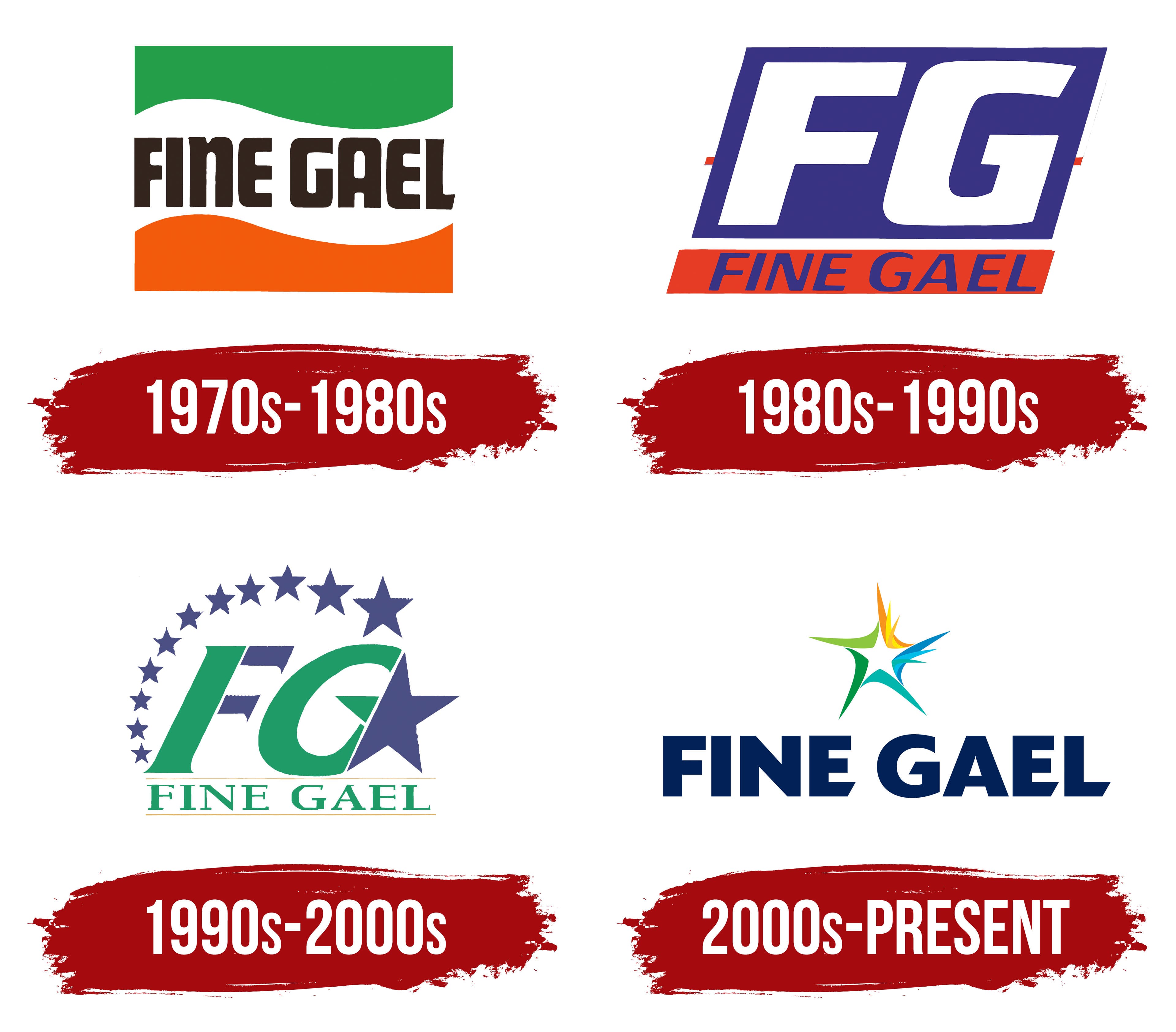
1970s – 1980s
The first logo features the Irish flag. The image emphasizes that the party aims to promote the country’s development and prosperity and to defend its interests. The three stripes represent the three forces at the party’s core.
The waves symbolize movement. The rectangular frame that hides the flag’s edges conveys a conservative idea: development within defined boundaries, adherence to established views, and a lack of flexibility.
The party’s name is centered on a white background in the image. Bold black font draws attention to the inscription. A consolidated force is created to shift focus from the political leader and make a strong statement.
1980s – 1990s
The updated emblem reflects the movement’s scale and development. The large blue banner represents conservatism. Calmness, logic, and calculation help the movement maintain a confident position in the political sphere.
The replacement of green in the tricolor reflects the conservatives’ convictions. Blue is the shade of the European Union, toward which the party supports a move.
The giant white capital letters of the name reflect the growing number of followers and the political force’s honesty and openness. Below, on the orange stripe, is the party’s full name. Fine Gael frequently appears in the news and remains on voters’ minds.
The large and small figures hint at the birth of the movement’s youth wing.
1990s – 2000s
The updated 90s logo vividly represented Fine Gael’s commitment to the European Union.
A series of stars arcs across the sky, growing in size. The brightest and largest star illuminates the emblem’s center.
The design reflects the movement’s development and the increasing number of leaders. Repeating motifs from the EU flag emphasize Fine Gael’s political stance.
2000s – today
The emblem was created during significant political changes and reforms in Ireland. It reflects Fine Gael’s commitment to modernization and to uniting the nation around shared values and principles. At this time, the party actively promoted unity and collaboration for the country’s benefit, as reflected in the new visual style.
The logo’s central element is a star with sharp, multicolored edges. The new rays appearing on the sides symbolize the movement’s branches. The gradient transitions highlight the union of people with common views and interests within the political system. The sharp rays emphasize the country’s firm stance on key issues of its development.
The star in the emblem represents the aspiration for a bright future and progress. The multicolored rays symbolize the diversity and variety of ideas and approaches united by a common goal. This reflects the principles of democracy and collective development.
The logo’s large, blue font gives the text weight and significance. This style underscores the authority and influence of the political force that opponents must acknowledge. The text’s straight, strict lines convey a sense of stability and determination.
The logo’s color palette includes blue, green, yellow, and light blue. The blue text symbolizes trust and reliability. The multicolored rays of the star represent the diversity of opinions and approaches, as well as the bright future the party strives for.