


 Grand Canyon University Logo PNG
Grand Canyon University’s logo has become a symbol of unity among students, teachers, and alumni, reflecting its evolution from a small educational community into a large center where everyone finds opportunities for growth and self-realization.
Grand Canyon University opened as Grand Canyon College in Prescott, Arizona, on August 1, 1949. The Arizona Southern Baptist Convention created the school after three pastors donated one silver dollar each in 1946. About 100 students studied in a former National Guard armory under 16 instructors. In October 1951, the college moved to a 90-acre site in western Phoenix, where nine buildings rose on former cotton fields.
Accreditation arrived in 1968, followed by new programs in education, science, nursing, business, music, and fine arts. In 1989, the institution adopted the Grand Canyon University name and gained authority to award master’s degrees. It left Southern Baptist control during the 1999–2000 academic year, yet heavy debt placed it near closure.
Significant Education LLC bought the university in January 2004 and converted it into a for-profit institution, using online education to support recovery. Grand Canyon Education entered NASDAQ under LOPE in November 2008 and raised about $230 million. Campus construction and enrollment then expanded under Brian Mueller.
On July 1, 2018, academic assets were sold to a new nonprofit entity for $875 million, while Grand Canyon Education remained its service provider. Federal disputes continued, with an appellate ruling favoring GCU in November 2024 and an FTC case dismissed in August 2025. By 2023, enrollment exceeded 100,000 across campus and online. The Grand Canyon Antelopes had competed in NCAA Division I since 2013.
Meaning and History
What is Grand Canyon University?
It is a private Christian university in Phoenix, Arizona, offering traditional on-campus and online education. The areas include business, education, healthcare, technology, and theology. The educational institution offers bachelor’s and master’s programs and provides opportunities for an active student life. The institution has modern sports facilities, including an arena for the NCAA Division I basketball team, and students can combine study, spiritual development, and participation in various clubs and sports activities.
Old

The Grand Canyon University logo is structured as two lines of text, each with a different design approach. The upper part, “GRAND CANYON,” is rendered in a classic serif font and colored in deep purple. This shade is traditionally associated with wisdom and knowledge, emphasizing the university’s academic nature.
The lower line, “UNIVERSITY,” differs from the first. It is written in a strict sans-serif font with perfectly straight lines and a more modern design. The black color of the lower line enhances the institution’s formality and seriousness. Founded in 1949, the university started as a Christian college and later expanded its academic scope and format.
The combination of two completely different fonts logically reflects the university’s history. On the one hand, it preserves traditions and classical educational approaches; on the other, it strives to stay current by developing modern fields and innovative teaching technologies. The spacing between the upper and lower lines is small and precise, visually uniting them into a single whole.
The logo plays with contrasting colors, styles, and even historical elements. The university, located in Arizona, has evolved from a small Christian college into the largest private university with tens of thousands of students. The typography reflects this blend of old and new, tradition and modernity.
New
The new Grand Canyon University logo is different from its previous version. While it was once calm and classic, it now has a more athletic character. The letters have become slanted, angular, and sharp, as if the university aims to showcase its dynamism and energy, shifting away from traditional academic fonts toward a more active and powerful style.
The name is still split into two lines. The upper line, “GRAND CANYON,” stands out with a large, bold typeface. All letters are uppercase, featuring angular edges and sharp lines. The lower line, “UNIVERSITY,” is narrower and more elongated, while maintaining the same overall style as the first line. The purple color dominates the visual identity, with no contrast from other shades.
These changes are intentional. The university has long been known for its athletic team, the Lopes, which has competed successfully in NCAA championships. The school’s athletic success has partially influenced the evolution of its branding. The logo update coincided with the university’s growing focus on athletics and the increasing popularity of its teams among students and fans.
The university’s traditional purple remains unchanged. It has always been associated with academics and knowledge, but now it also represents the energy of athletic competition. The lettering style resembles sports uniforms; sharp, angular lines make the font look energetic and aggressive, fitting perfectly into the atmosphere of modern college sports.
The Seal
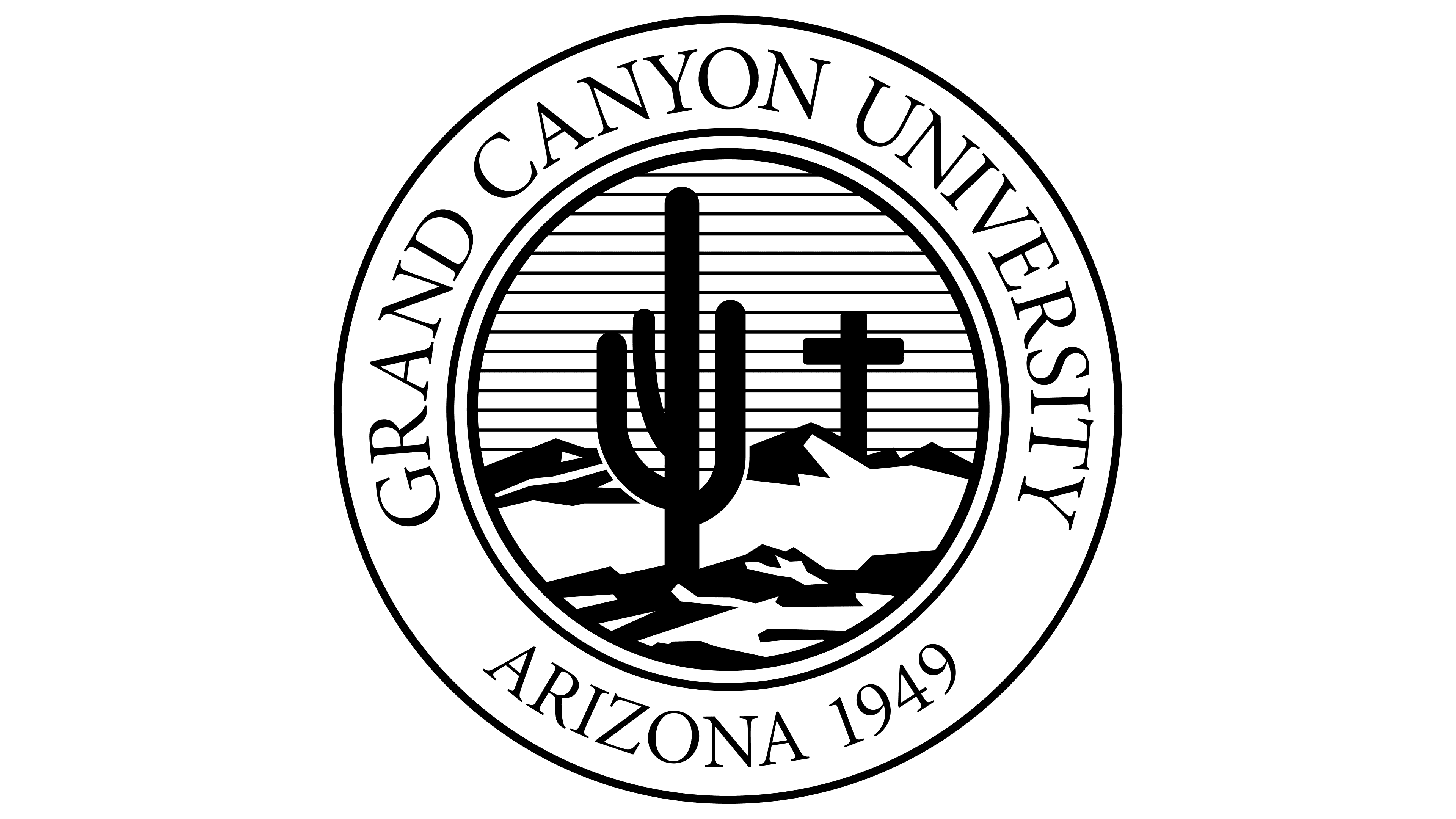
At the center of the seal is an Arizona desert motif, a mountain and a cactus, with a cross standing nearby. The cross serves as a reminder of the university’s origins as a small Christian educational institution. The year of its founding is displayed at the bottom of the emblem, next to the word “ARIZONA.”
The ring surrounding the central part contains the university’s name: “GRAND CANYON UNIVERSITY.” The text is written in a clear, classic font with all capital letters and precise serifs. There is ample spacing between the words, making the information easy to read. The symbol in the center is enclosed by two thin circles, creating a distinct border and emphasizing the seal’s official nature.
The image inside features a stylized view of Arizona’s rocky landscape and mountains, with a cactus in the center, adding local recognition. The desert scenery and proximity to the Grand Canyon inspired the university’s name and visual identity. Horizontal lines behind the image create a sense of depth and dimension.
The seal is primarily presented in black and white, maintaining a strict, official, and universal appearance. At times, the university incorporates shades of purple, which have become a signature color in its branding. However, in official documents, the seal is commonly used in its standard black-and-white version.