 James Hardie Industries Logo PNG
Building materials clad and protect buildings from external conditions, including moisture, temperature, and mechanical stress. Fiber cement panels are used in facades and façadesres where durability and consistent performance are required. The James Hardie Industries logo is associated with a company that manufactures exterior building materials and supplies them to markets in various countries.
James Hardie Industries was founded in 1888 by the Scotsman James Hardie. He emigrated to Melbourne and imported oils and leather. In 1892, Andrew Reid joined him. By 1895, he had become a full partner of Hardie. In 1903, the entrepreneur began supplying a new material, fiber cement, to France. Later, this product brought the company wide recognition.
After the founder’s departure in 1911, the Reid family took over management. In 1951, the company was listed on the Sydney Stock Exchange. It became Australia’s largest manufacturer of building materials. In the 1960s, James Hardie began producing asbestos-cement products and braking systems.
In the 1980s, the company completely abandoned asbestos and switched to a safer fiber-cement product. In the 1990s, it began its expansion into the United States market. James Hardie built plants in Georgia, Nevada, Louisiana, and Texas. In 1997, the company acquired the American drywall manufacturer Briar Gypsum. The deal was valued at 121 million Australian dollars.
Since 2001, the company’s headquarters have moved successively from the Netherlands to Ireland. Despite disagreements with tax authorities, James Hardie continued its expansion in the North American market.
In 2020, the company marked twenty years of presence in the United States. It invested $ 187 million to expand production capacity. In 2024, construction began on a new plant in Alabama. The project aimed to create jobs and support the regional economy.
James Hardie concluded a deal with AZEK. However, in August of the same year, shares fell by 34%. Reduced sales and excess inventory in North America drove the decline.
Meaning and History
What is James Hardie Industries?
An international manufacturer of building materials, with Irish registration and Australian origins, specializes in fiber-cement products for building exteriors. The range includes siding, panels, and boards under the brands HardiePlank, HardiePanel, and HardieTrim, which are known for their resistance to moisture, fire, and temperature fluctuations. The company operates in North America, Asia-Pacific, and Europe. A recent agreement was signed to acquire the American company AZEK to expand in the façade solutfaçadeegment.
before 2019
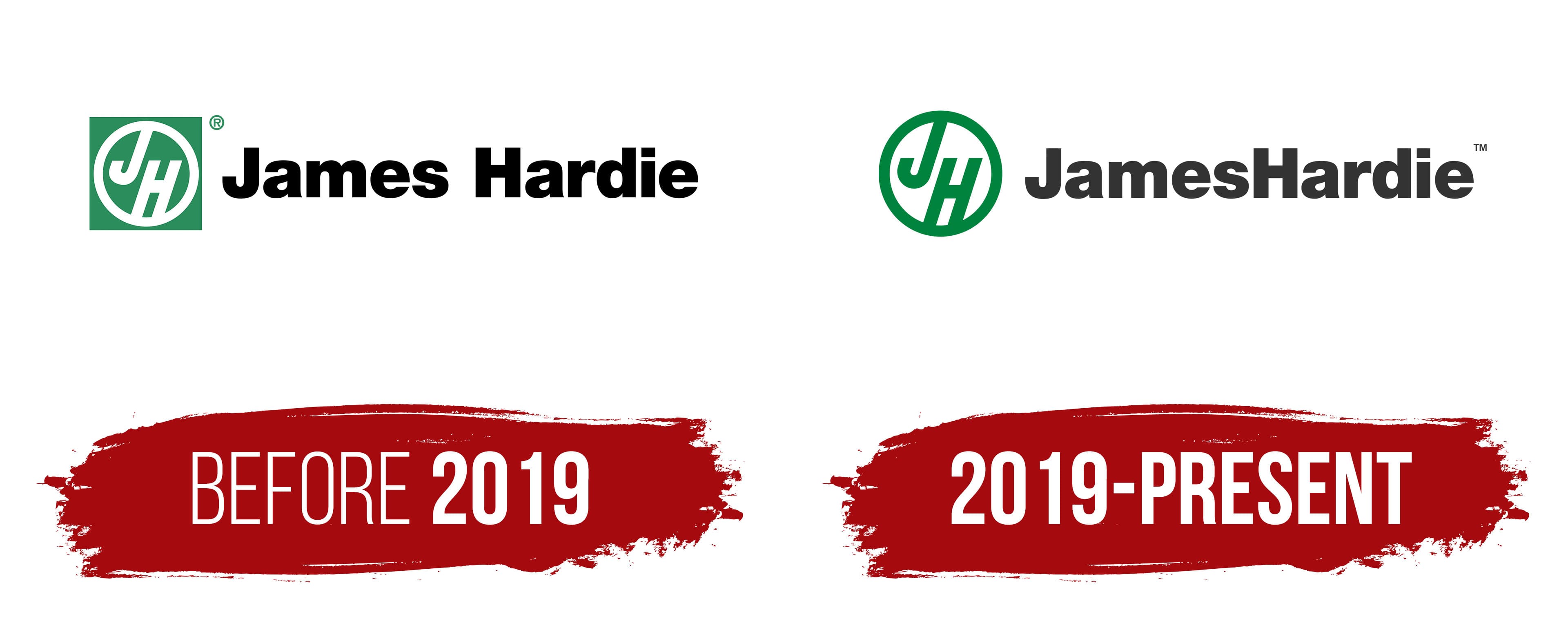
The “JH” monogram, used for building materials beginning in May 1986, consisted of the initials of founder James Hardie. White letters and a circle appeared on a green square. The slanted “J” and “H” followed a diagonal line descending to the right. The upper part of the “J” and the lower part of the “H” extended into the circle. The letter strokes and the circular outline had equal thickness, giving the monogram a unified appearance.
A black “James Hardie” wordmark appeared on the right. Both words began with capital letters followed by lowercase letters. The name used a bold, condensed sans-serif typeface with rounded forms and uniform stroke widths. The letters stood upright, while the initials in the emblem were slanted. The logo combined the company’s full name with its abbreviated form.
The company was named after Scotsman James Hardie. In 1888, after leaving his family’s leather tanning business, he founded a company in Melbourne that imported oils and materials for leather treatment. His fellow Scotsman Andrew Reid joined the business in 1892. Three years later, in 1895, Reid became a full partner. Hardie later left the company, while Reid continued operating it under the founder’s first and last name.
The company entered the building materials industry after Hardie traveled to London in 1903. There he learned about a new cement-based material and arranged for it to be imported into Australia. In 1917, the company began producing sheet products locally. During the 20th century, the importing firm gradually developed into a manufacturer of construction and industrial materials. It became a publicly traded Australian company in 1951. In the late 1970s, the company began developing asbestos-free fiber cement technology, and by the early 1980s it was producing a range of fiber cement building products.
Fiber cement production grew as the company expanded into international markets. In February 1990, James Hardie opened its first American fiber cement plant in Fontana, California. During the 1990s and 2000s, the “JH” monogram appeared on HardiePlank products and other product lines. The shared emblem identified those brands as part of James Hardie, which retained the founder’s name as the group’s primary brand.
In 2006, the company prepared a unified identity for its North American product range. Several building product categories were brought together under the James Hardie brand and the slogan “A Better Way To Build.” The name and the “JH” monogram remained the foundation of the product identity.
In 2014, the North American division updated its brand materials again. The company sought to explain fiber cement’s technical properties, its architectural applications, and the range of available product colors. It continued to use the James Hardie brand, and the green-and-white “JH” emblem inside a square remained legally protected through the mid-2010s.
2019 – today
In the “JamesHardie” wordmark, the founder’s first and last name were joined without a space. The uppercase “J” and “H” helped distinguish the two parts of the name. The black wordmark used a bold sans-serif typeface with rounded forms and uniform stroke widths. The letters stood upright, while the absence of a space made the name more compact. It preserved the memory of James Hardie, who had left the company in the early 20th century.
A green “JH” monogram appeared on the left. The square background was removed, while the slanted initials and circle were retained. The letters followed a diagonal line descending to the right. The upper part of the “J” and the lower part of the “H” extended into the circular outline. White gaps separated the strokes at their intersections, making the letterforms distinguishable. The monogram strokes and the circular outline were nearly the same thickness. The green color matched Pantone 348. The emblem and black wordmark formed a horizontal logo.
The version featuring the circular “JH” monogram and joined “JamesHardie” name was already in use by October 2018. During that period, the group was undergoing a series of changes. James Hardie acquired Fermacell in 2018, and Jack Truong became CEO in January 2019. During 2019, company leadership announced the beginning of a large-scale transformation of the global business. The company later described its new direction as a shift toward becoming a consumer brand. The updated logo appeared during this period of change while continuing the established monogram tradition.