


 Goodyear Logo PNG
The Goodyear logo is iconic and light. It evokes associations with motion and draws an analogy with footwear for wheels. The emblem appears harmonious and well thought out, presenting the manufacturer as a professional friend to car enthusiasts.
Goodyear was founded on August 29, 1898, in Akron, Ohio, after Frank Seiberling bought an empty cardboard factory for $13,500, including borrowed money secured by an insurance policy. With his brother Charles, he named the company after Charles Goodyear, the inventor of rubber vulcanization. The first thirteen employees made bicycle tires, horseshoe pads, and carriage tires.
In 1899, Goodyear began producing automobile tires. In 1901, it introduced a straight-sided tire, allowing tire replacement without removing the whole wheel. That year, Goodyear tires were used on Henry Ford’s race car at the Detroit Automobile Club. By 1916, the company had become the world’s largest tire maker by sales.
During World War I, Goodyear produced airships and balloons for the US Army. In 1924, it formed Goodyear-Zeppelin Corporation with Germany’s Zeppelin, and in 1925 launched the Pilgrim advertising blimp. In 1926, Goodyear became the world’s largest rubber company by sales, entered the New York Stock Exchange in 1927, joined the Dow Jones Industrial Average in 1930, and acquired Kelly-Springfield in 1935. During World War II, its plants made gas masks, aircraft tires, and F4U Corsair fighters.
Goodyear later faced the shift to radial tires, a technology introduced by Michelin in 1948. Under Charles Pilliod, president from 1972, the company rebuilt production and launched the Tiempo radial tire in 1977. Goodyear became NASCAR’s official tire supplier in 1997 and left Formula 1 after 1998. In 1999, it formed a venture with Sumitomo Rubber Industries, adding Dunlop in key markets. In 2021, Goodyear acquired Cooper Tire & Rubber Company for $2.8 billion.
Meaning and History
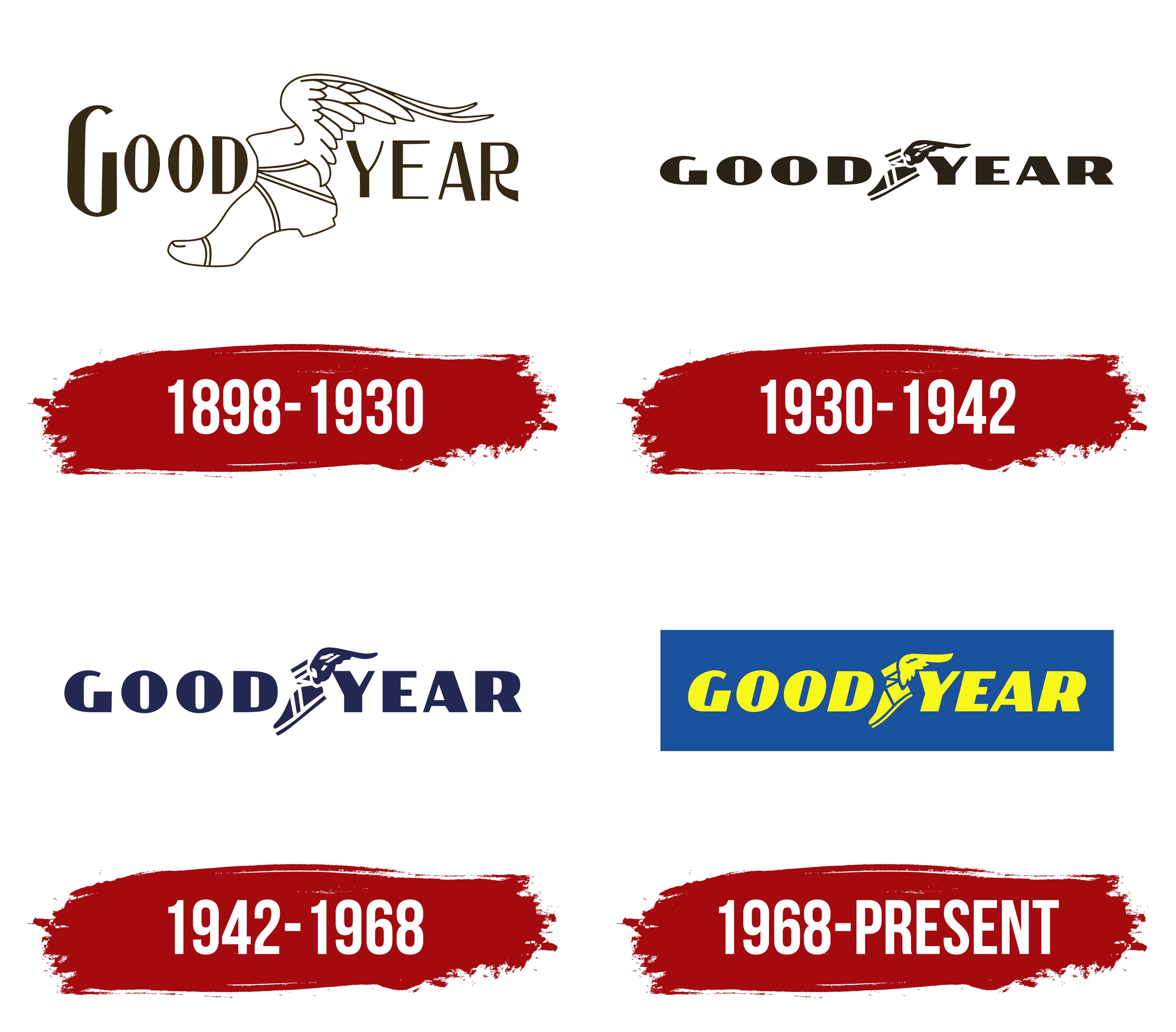
Since its first logo, the company has developed a distinctive visual and auditory identity that is both memorable and stands out among competitors. Therefore, each subsequent rebranding is focused on its design embodiment, including fonts, color schemes, and other elements. All logos evoke the right associations with speed, lightness, and the history of rubber development. Adding high-quality-associated words to the name helps build customer trust.
What is Goodyear?
An American corporation with a net profit of $760 million, specializing in automotive tires for equipment, aircraft, trucks, and passenger cars. In addition to the Goodyear brand, it produces goods under the Dunlop, Sava, and Kelly brands. The headquarters is located in Akron.
1898 – 1930

The company’s first logo consisted of a name and a symbol that has become the manufacturer’s calling card.
The word Goodyear has two meanings, and both work in the company’s favor.
- Charles Goodyear was an American inventor who contributed to the emergence and improvement of rubber products. He discovered the process of rubber vulcanization. His findings and developments are the basis for the industrial production of automobile and bicycle tires. Therefore, choosing the inventor’s name as the name of a company working with rubber is highly symbolic.
- In the emblem, the word is divided into two parts: “Good” and “year.” The phrase serves as a mantra, whose constant repetition leads to movement in the desired direction. Thanks to the name, every year is a good year for the manufacturer. For buyers, the expression creates a connection: Goodyear tires will enable excellent year-round driving. The phrase also reminds drivers who have purchased rubber from the manufacturer of a good year and the desire to meet again in the next one.
Hermes’ foot was chosen as the symbol of a deity from Greek mythology. As a messenger of the gods, he swiftly conveyed important news from the spiritual realm to the physical world. His speed was attributed to his sandals. Therefore, the symbol indicates rapid movement with Goodyear tires. The choice of winged footwear is also related to the theme of flight. The company briefly produced airships.
The name is written in a light, freestyle font, as is the sandal image. The technique uses analogies and mythical characters rather than real objects.
1930 – 1942

1942 – 1968

1968 – today
In the modern version of the emblem, the inscription and image are preserved. However, the composition is set against a blue rectangular background, evoking a seal of quality. The rectangle was chosen as a segment of the road or an image of the tire’s end. The background evokes a sense of compactness, protection, and reliability, which high-quality, durable tires provide to vehicle owners.
The yellow inscription lifts the mood and enhances the manufacturer’s friendly feeling.
The sandal resembles more modern footwear, looking more aesthetically pleasing and neat.
Font and Colors
The main colors of the modern emblem are blue and yellow, which convey the manufacturer’s professionalism and communicativeness.
- Blue is the color of technology, production, and computerization. Goodyear factories are modern and automated. Machines work accurately and without failures. The shade refers to the sky, the sensation of flight. It also hints at the production of airships.
- Yellow is friendly. Building effective communication with customers is a top priority in Goodyear’s work. The company continually develops technologies that make traveling easier and more enjoyable.
The font with thickened letters resembles Uptown JNL but with softer, smoother inner holes. The smoothing of angles and the roundness of elements hint at the shape of tires.