 Louisville Bats Logo PNG
The Louisville Bats logo represents the athletic and civic affiliation of the baseball team from Louisville. Its graphic image symbolizes the club’s identity, oriented toward local traditions and fan loyalty.
Louisville Bats trace their history to 1982, when a Triple-A franchise affiliated with the St. Louis Cardinals moved from Springfield to Louisville, Kentucky. Renamed the Louisville Redbirds, the club quickly built a loyal audience, set Minor League Baseball attendance records, and won consecutive American Association championships in 1984 and 1985. Its popularity remained strong throughout the following decade.
The partnership changed in 1998, when the team joined the International League as the Milwaukee Brewers‘ affiliate. A year later, it became the Louisville RiverBats, a name linked to the Ohio River. In 2000, the club entered the newly built Louisville Slugger Field in downtown Louisville. It began an affiliation with the Cincinnati Reds, the nearest Major League organization. The new arrangement produced an early result when Louisville won the Governors’ Cup in 2001.
In 2002, the team shortened its name to Louisville Bats. The bat image connected the franchise with Louisville Slugger and the city’s established baseball-equipment industry. A 2016 rebrand introduced red, navy, and white as the main colors, accompanied by revised logos, uniforms, and merchandise.
Diamond Baseball Holdings acquired a controlling stake in December 2023 after building a portfolio of other lower-league franchises. The ownership change left Louisville’s Triple-A status and Cincinnati affiliation intact, and the club continued preparing players for the major-league roster.
Meaning and History
What is Louisville Bats?
It is a Triple-A baseball club based in Louisville, Kentucky, competing in the International League as the farm team of the Cincinnati Reds. Founded after relocating from Springfield, Illinois, the team initially played in lower leagues before establishing itself at the Triple-A level. Over time, affiliations included MLB teams such as the Milwaukee Brewers and the St. Louis Cardinals. The club consistently ranks among minor league attendance leaders.
1982 – 1997

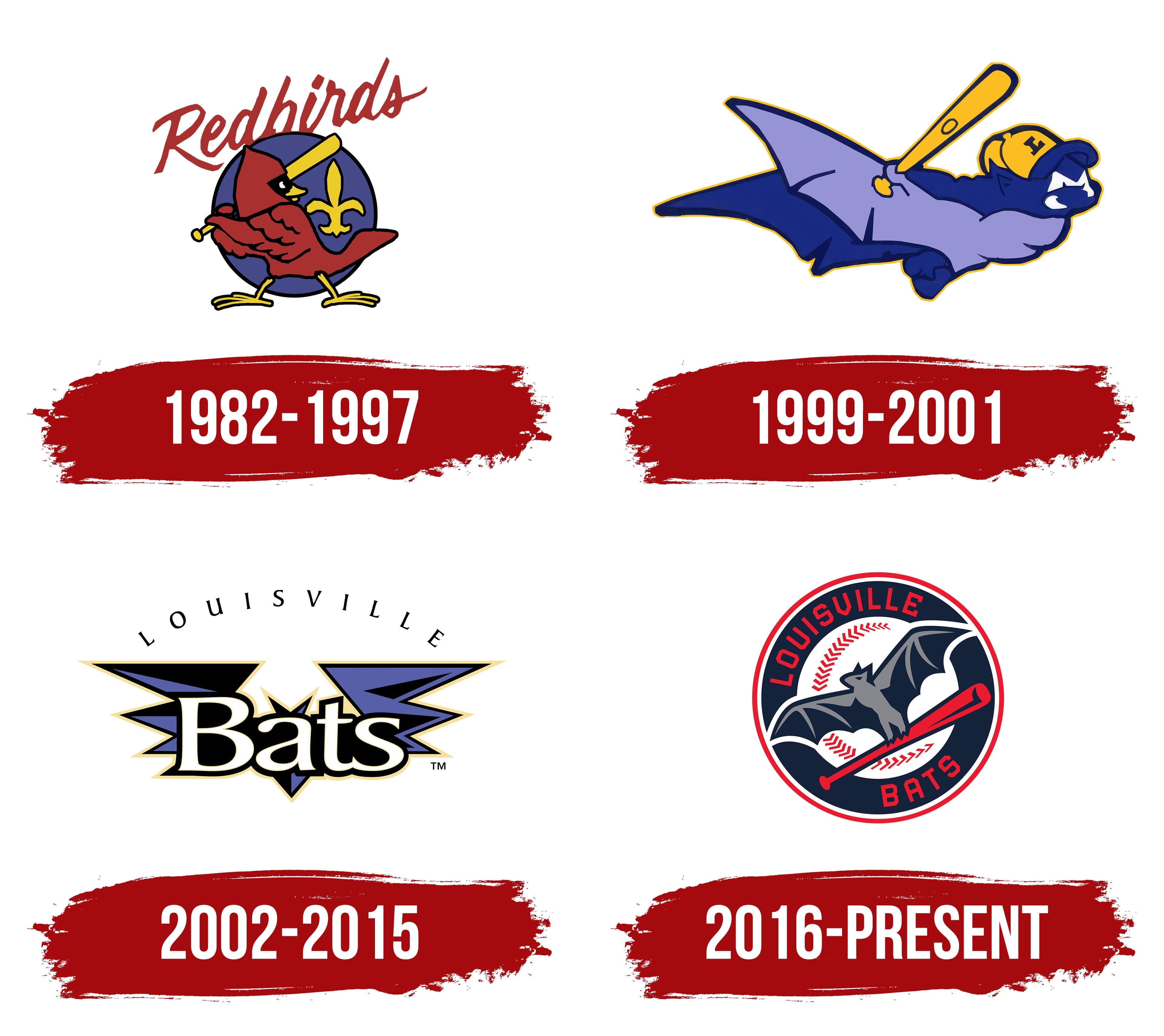
The Louisville Redbirds logo was introduced when the St. Louis Cardinals’ Triple-A club relocated to Louisville. The team’s visual identity was developed with close ties to the parent Cardinals franchise, as reflected in the choice of the primary palette, dominated by cardinal red. Purple and gold were added as secondary colors, creating a bright and dramatic combination that symbolized the athletic energy and dynamism of baseball games.
The design depicts a cardinal swinging a baseball bat, emphasizing the team’s sport and competitive character. The bird’s outlines are drawn with bold, expressive lines, conveying a sense of motion and confidence. Behind the bird is a circular purple medallion, and to its right is a gold fleur-de-lis, referencing Louisville’s French heritage and adding a cultural identity element.
The “Redbirds” lettering is set in custom script with a handwritten aesthetic and smooth slants, typical of 1980s baseball tradition. The letterforms feature fluid curves, elongated diagonal strokes, and no serifs, reinforcing the brand’s liveliness, ease, and elegance.
The color palette was chosen for emotional impact: the primary red symbolizes passion, energy, and baseball tradition; the purple background provides contrast and enhances the composition’s dramatic effect; the gold accents, the beak, feet, and fleur-de-lis, represent success and prestige. These colors created a memorable and vibrant sports image that combined elements of the parent St. Louis Cardinals’ style with Louisville’s unique traits.
Record attendance figures confirmed the logo’s popularity. In the first season, the club set the minor league attendance record, and the following year, it surpassed one million spectators for the season.
1999 – 2001

The Louisville RiverBats emblem marked a major rebrand of the Louisville Redbirds, highlighting the team’s new identity, a partnership with another MLB club, and a shift in visual style. The logo features a stylized cartoon bat in dynamic flight, holding a baseball bat in its claws. The character is rendered in an exaggerated, playful cartoon style, with simplified yet expressive lines and proportions that lend it a humorous, lighthearted quality.
The color palette consists of two contrasting shades of purple, accented with the bright yellow of the bat and cap. This palette was chosen to align with the new RiverBats name and the change in major league affiliation, first with the Milwaukee Brewers and then with the Cincinnati Reds. Purple symbolically reflects the nocturnal nature of the bat. In contrast, the bright yellow of the baseball bat stands out visually against the figure, referencing Louisville’s historic production of the famous Louisville Slugger bats.
The emblem’s design follows the pop art style popular in the late 1990s, with a clear focus on television broadcasts and stadium visibility. This style is characterized by simplified shapes, exaggerated outlines, and bold colors, aligning with the broader sports industry trend of the time that emphasized the entertainment aspect of games and fan engagement.
The emblem includes strong outlines and sharp lines that enhance the sense of forward motion. The baseball bat is positioned diagonally, reinforcing a sense of speed and movement while emphasizing the character’s playful nature, portraying the bat as an active participant in the game rather than a passive observer.
The team’s move to the new Louisville Slugger Field in 2000, followed by its 2001 International League championship, made this logo a symbol of a transitional era for the franchise, combining the city’s local traditions with contemporary trends in sports branding.
2002 – 2015
The Louisville Bats emblem, introduced in 2002, accompanied the team’s decision to drop the “River” prefix from its name. The new design reflected the club’s aim of a more serious, professional brand perception. Unlike the previous cartoon-style character, the new identity was abstract, aimed at a mature audience, and underscored the team’s ambitions.
At the center of the logo is a typographic composition based on the team’s name, “Bats,” rendered in a mix of uppercase and lowercase letters with smooth, elegant serifs. The letter contours are rounded, with varying stroke thickness that adds both dynamism and refinement to the design. The letterforms are integrated into a stylized bat figure, suggested by abstract elements: wings on the sides, ears at the top, and a tail at the bottom of the composition. The sharp, elongated lines of the wings resemble lightning bolts, symbolically conveying speed, agility, and the club’s aggressive playing style.
The color palette includes purple, black, and gold, creating an image of confidence and sophistication. Black and purple evoke the bat’s nocturnal nature, reinforcing the brand’s symbolism, while gold outlines on the elements and lettering add a sense of prestige and visual impact. The palette was chosen to support the broader goal of strengthening the team’s status and projecting a more serious franchise image.
The symbolism of the emblem is built on the harmonious combination of typography and the stylized animal image. Its abstract form allows the emblem to be seen as a club mark or crest, making it easily recognizable both in the stadium and across media platforms. The abstract elements of the bat’s wings and ears serve decorative and symbolic purposes, evoking an emotional response from viewers and reinforcing the team name without literal depiction.
The emblem represents the club’s strategy to appeal to a more mature audience. It marks the Louisville Bats’ entry into a new era, emphasizing high-level professional baseball and aligning with early 21st-century sports branding trends.
2016 – today
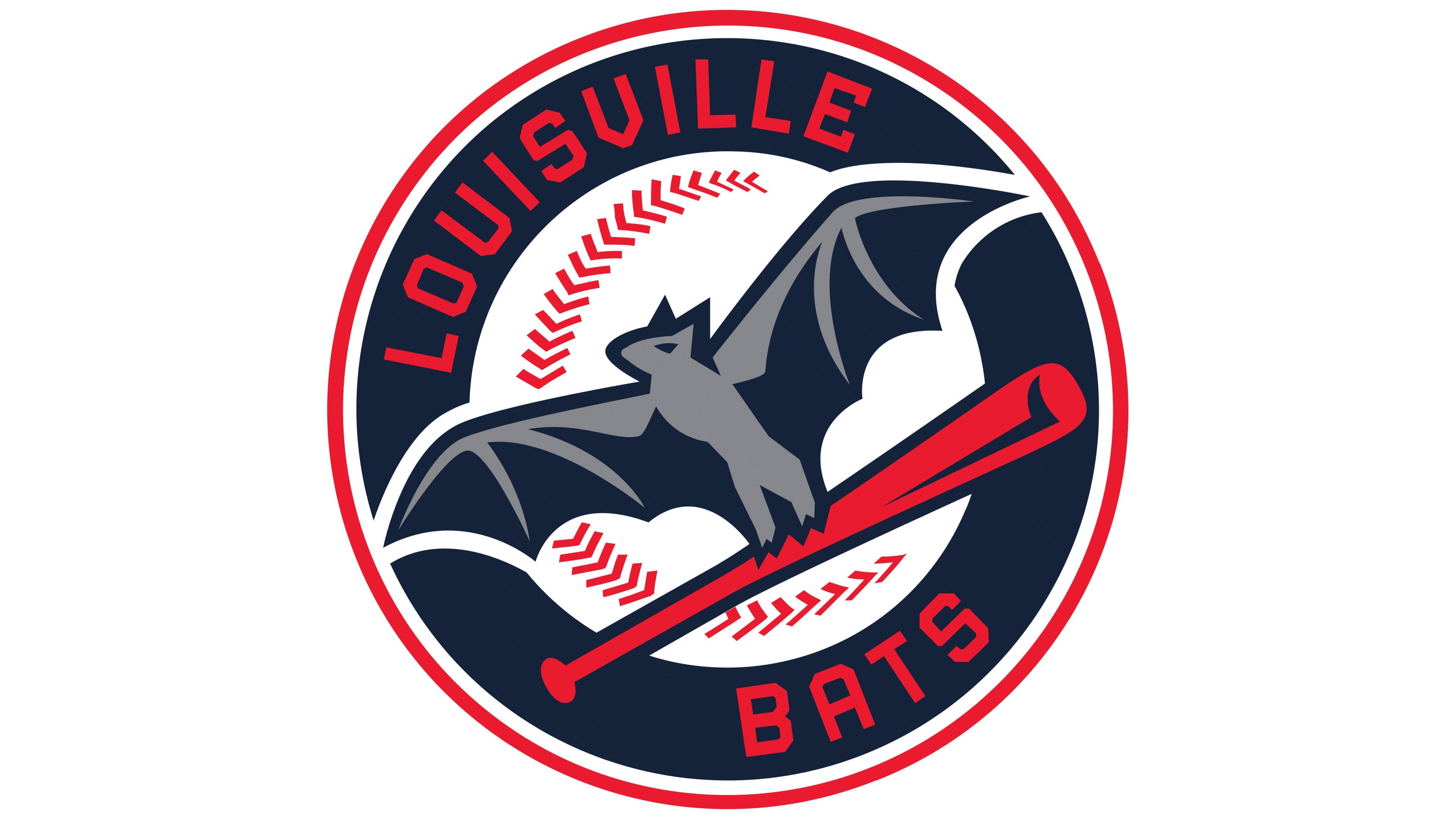
In late November 2015, the Louisville Bats unveiled an updated emblem and refreshed identity, which took effect at the start of the 2016 season. New York led the rebranding process, based on SME Branding, at the initiative of the team’s new owner, who had previously worked with the agency on other projects. Development of the new identity began in the spring of 2015.
The color palette underwent a complete transformation, with the previous colors of purple, black, and gold replaced by classic baseball colors: red, navy blue, and white. This palette directly connects to baseball tradition, referencing the historic colors of the Louisville Redbirds, while also visually linking the team to its MLB affiliate, the Cincinnati Reds.
The new emblem features a circular design. At the center is a bat in flight holding a red baseball in its claws. The animal’s silhouette is created with simplified geometric shapes and sharp, fast lines that emphasize dynamism and athleticism. Behind it is a white baseball, stylized as the moon, with its surface defined by signature red stitches that curve upward and downward, adding visual rhythm and depth.
The words “Louisville Bats” are placed inside a wide blue ring encircling the composition. The font is inspired by traditional 20th-century baseball typography, characterized by strict letter geometry, sans-serif angular glyphs, and balanced proportions. Its style also draws from the visual culture of Kentucky’s bourbon industry, giving the emblem an additional regional flavor.
Alongside the primary emblem, the team created a secondary logo, featuring a bat named “Buddy,” used as an additional brand element. In 2025, another alternate logo was introduced with two hidden symbols: the negative space between the wing and bat forms the silhouette of the state of Kentucky, and a fleur-de-lis in the animal’s claws represents Louisville’s historical heritage. This mark serves as a link to the team’s past, particularly the RiverBats era, while reinforcing the club’s local identity.
The emblem’s design and symbolism express the club’s comprehensive approach to branding, aimed at preserving Louisville’s baseball traditions, integrating with MLB, enhancing commercial appeal, and strengthening local ties.