 Monster Logo PNG
The Monster logo emphasizes the brand’s energy, aggressiveness, and expressiveness. Its style targets a young audience, highlighting the vibrancy and emotional strength characteristic of the company’s products.
Monster began in Boston in 1993, when Jeff Taylor developed an online job board while recruitment still relied on newspaper ads, paid phone directories, and employment agencies. Monsterboard.com launched in April 1994 with several hundred vacancies, letting employers post openings and applicants upload resumes and search at any hour.
TMP Worldwide acquired the service in 1995, adding corporate clients, advertising funds, and room for expansion. In 1999, Monsterboard merged with Online Career Center, founded in 1992, and became Monster.com. The combined business traded on NASDAQ under the ticker MNST as its vacancy database, resume tools, and search functions grew widely across America.
Public recognition surged after the 1999 Super Bowl commercial “When I Grow Up,” which showed children describing dull future careers. During the dot-com boom, Monster’s market value reached about $8 billion. The 2000 and 2001 crash cut that figure. Yet, the company remained profitable, acquired Jobs.com and regional platforms, and watched rival HotJobs go to Yahoo for $436 million in 2002.
Monster Worldwide became independent in 2003 but lost ground during the 2010s as LinkedIn reshaped professional recruiting. Revenue and staff declined, and Randstad bought the business for $429 million in 2016 while retaining it as a separate unit. In 2024, Monster combined with CareerBuilder under Apollo Global Management, bringing two long-running online recruitment brands into one structure.
Meaning and History
What is Monster?
It is one of the oldest online platforms for job and candidate searches worldwide. The platform helped shift employment listings from newspaper ads to the internet. It connects millions of employers and job seekers, hosting job postings and providing career advice. The service is known for its extensive resume database and international audience.
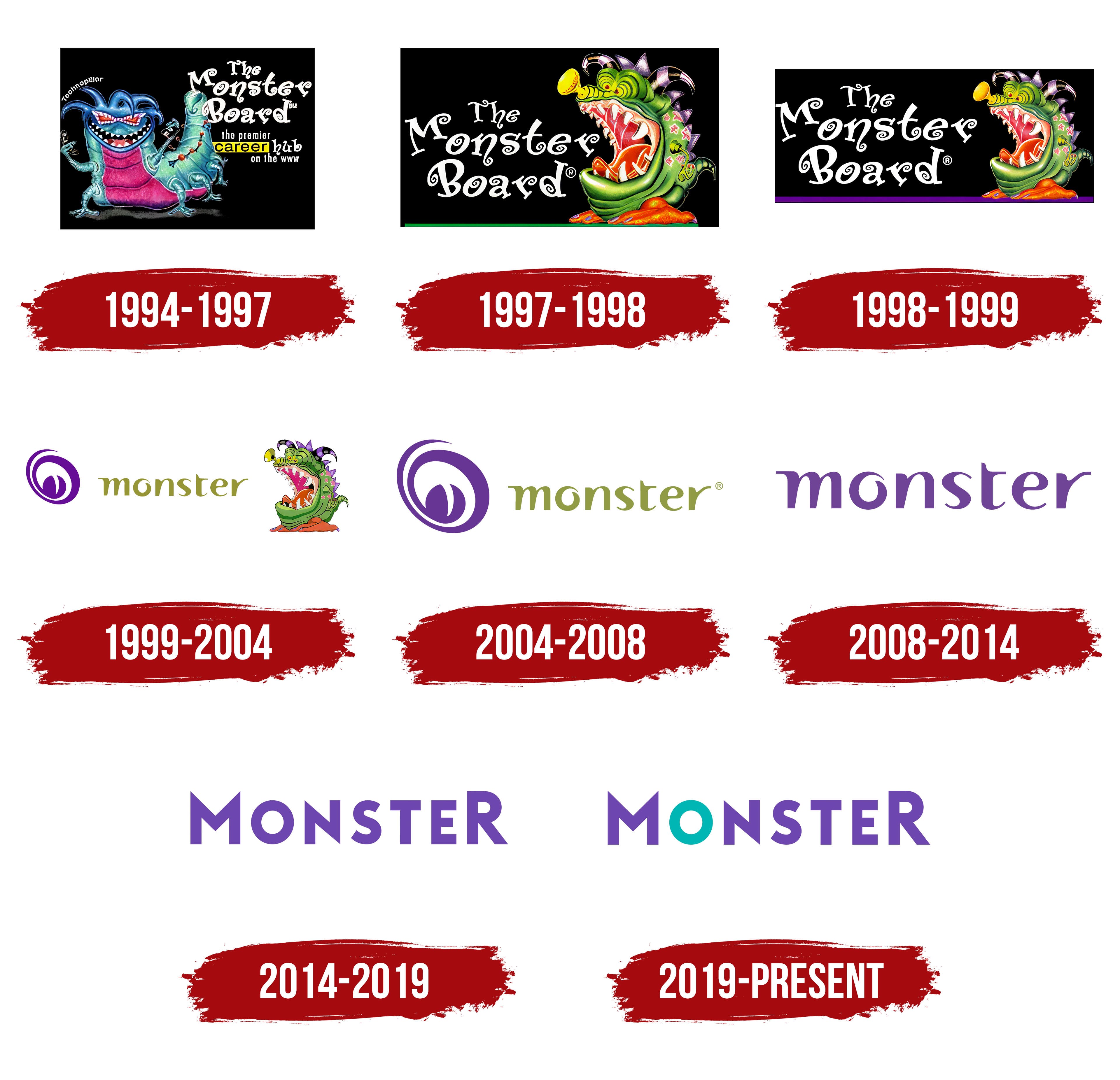
1994 – 1997
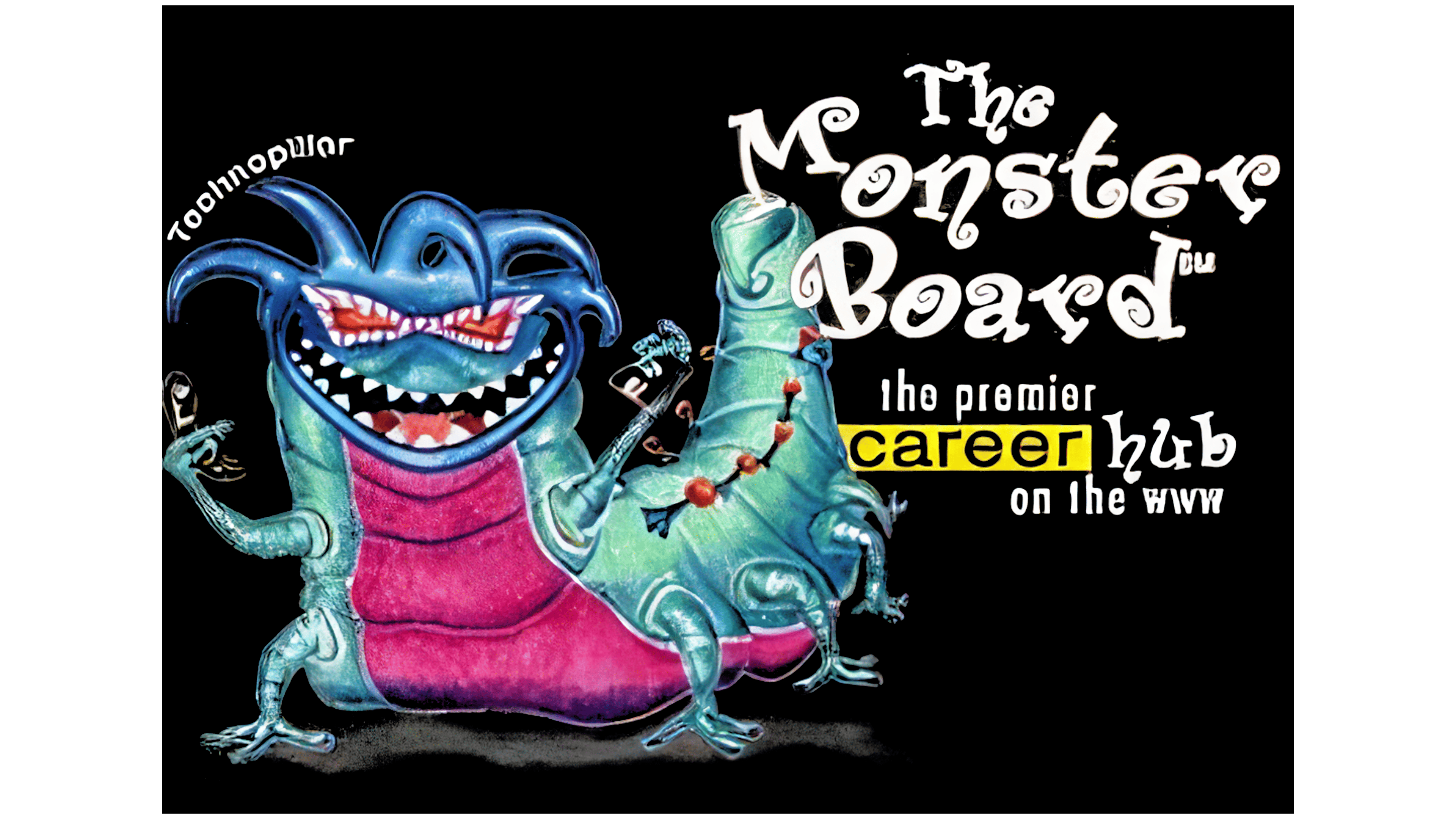
The Monster Board website was one of the first online job search resources, later becoming known as Monster.com. Its original image was created by TMP Worldwide’s internal team, laying the foundation for an experimental approach to branding in the early days of the internet.
The initial logo depicted a character that combined features of an amphibian and an insect: a cartoon-like creature with an exaggerated smile and sharp teeth. The monster appeared grotesque, showing disproportionate anatomy, exaggerated shapes, and bright colors. In its hands were keys and suspended objects, symbolizing access to career opportunities and to the internet as a whole.
The character was executed in the aesthetics of early pop culture, filled with references to mid-1990s flash animation. The contrast between colorful elements and a dark background emphasized the resource’s youth orientation, making the monster’s image friendly, approachable, and free of negative associations. In this way, the company visually redefined the very concept of a “monster,” giving it positive connotations and a playful tone.
The name “The Monster Board” was styled casually with eccentric hand-drawn typography. The letters had exaggerated decorative serifs and uneven stroke thickness, referencing the post-grunge visual culture of that time. The inscription appeared playful and slightly naive, standing in contrast to the serious theme of employment, creating a paradoxical effect aimed at the young IT audience.
A key element was the yellow rectangle with the word “career” written in black letters. It was stylized to resemble a marker highlight, emphasizing the resource’s primary purpose: job search. The slogan that described the service as “the premier career center on www” testified to the site’s innovative nature, underscoring its uniqueness against the backdrop of the growing World Wide Web.
The Monster Board stood out among other mid-90s internet projects, setting unconventional standards in the visual presentation of online employment resources.
1997 – 1998

The image used in The Monster Board logo, starting in 1997, continued the brand’s visual identity, maintaining thematic unity while differing in style from its predecessor. The new character took a more compact form and was colored green. It had a massive open mouth with long, sharp teeth sticking out, emphasizing the figure’s aggressive character. The monster’s body was covered with bright purple spikes, giving it an eccentric, punk-like appearance. Completing the look was a nose stylized as a large yellow button. This humorous detail referenced the internet theme in the overall theatrical design.
The monster was depicted as if breaking through the boundaries of the logo composition. It was perceived as a metaphor for disrupting traditional job search concepts, implying activity and challenging the established norms of late-1990s career services. Its pose conveyed movement and intensity that matched the overall style of visual culture dominating advertising and gaming media of that period.
Alongside the monster, a decorative font was used, which remained unchanged throughout the entire history of The Monster Board until its renaming to Monster.com. The lettering was executed in an antique style, featuring exaggerated serifs and variations in stroke thickness. Despite its traditional form, it stood in contrast to Monster’s avant-garde image.
The logo’s appearance in this form coincided with internal changes at TMP Worldwide and preparations for expansion beyond the United States under the new Monster.com brand. Although the character never had an official name, its image remained memorable to the audience, with vivid features that referenced popular subculture and late-post-grunge aesthetics. This reflected the brand’s ambition to stand out among the younger generation that was exploring the new possibilities of the internet.
1998 – 1999

An update of the visual identity accompanied the final stage of The Monster Board under this name during 1998. The monster retained the recognizability of the previous image.
The character was presented in a static, confident pose, demonstrating the brand’s stabilization and maturity before its renaming. The creature’s appearance was marked by a powerful mouth with red accents and massive, sharp fangs, which heightened the image’s theatrical expressiveness.
In the lower part of the composition, a horizontal purple stripe was added, forming the logo’s stylistic basis and emphasizing the design’s overall stability. The logo’s black background allowed the intense colors of the monster figure to stand out, enhancing the perception of its emotional richness.
The use of this monster image in late 1998 coincided with the company’s transformation into the international brand Monster.com. In the context of the transition, the logo served as a kind of culmination of development, reflecting a balance between visual continuity and the company’s pursuit of creative renewal.
1999 – 2004
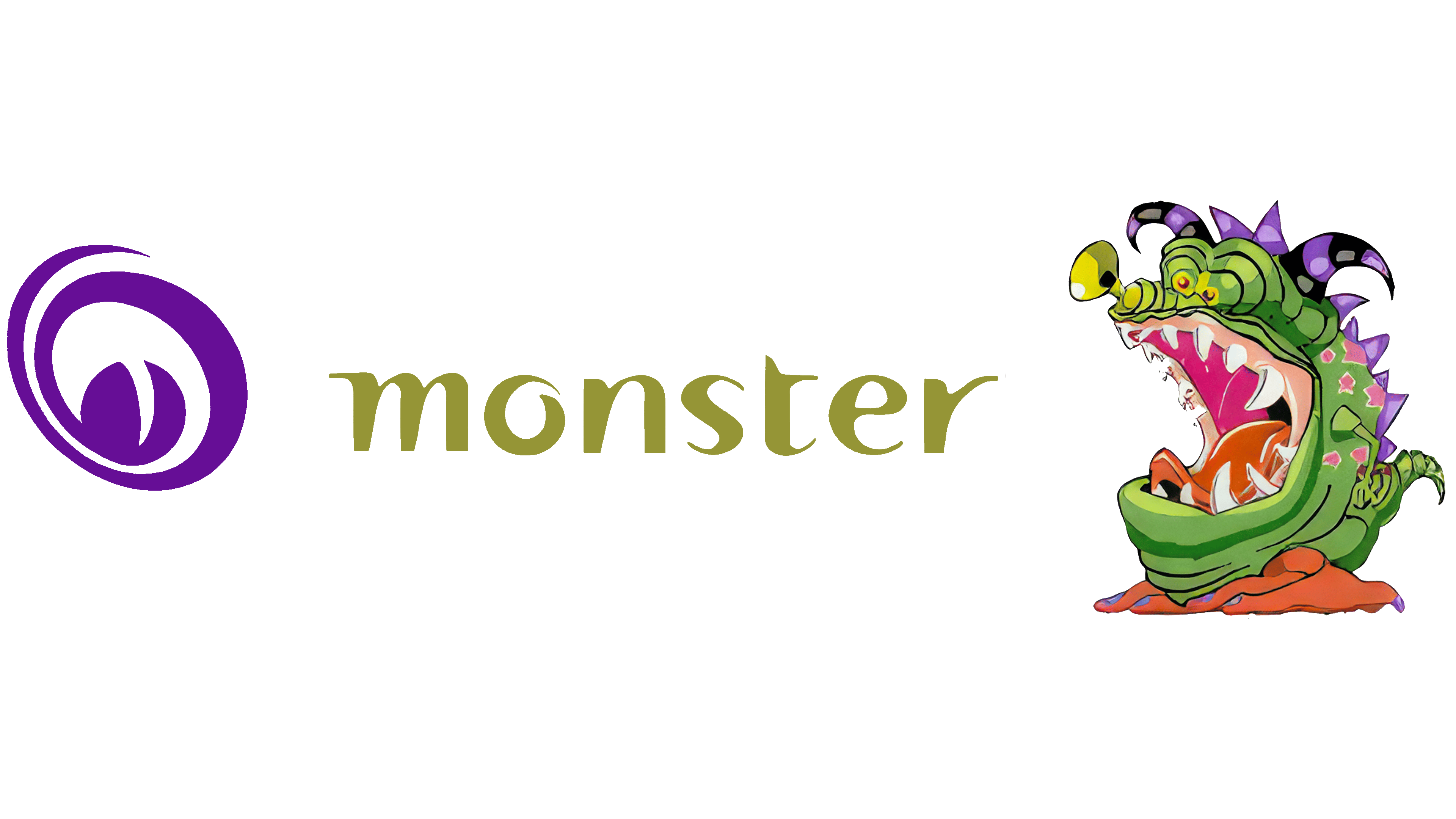
With the 1999 transition from The Monster Board to the shortened Monster.com, the company marked the beginning of a new era in its visual identity, adopting a concise style that contrasted with the colorful illustrations of previous years. The new logo initially featured the word “monster” in lowercase, along with a new symbol. The name was rendered in a humanist grotesque typeface, characterized by natural forms, smooth contours, and variable stroke thickness, evoking plant motifs. The color of the inscription, a restrained olive green, was associated with the company’s seriousness and reliability in online recruitment.
To the left of the name was a new symbol consisting of two intersecting purple oval shapes interpreted as a stylized eye. The emblem served as a metaphor for searching, observing, and communication, reflecting the primary objectives of the recruitment service: connecting employers and job seekers.
An interesting decision in 1999 was to retain the previous cartoon mascot, a snake-like creature with green skin, a red mouth, a yellow button-like nose, and purple spikes on its back. Despite the updated typography and symbolism, the character continued to be used to the right of the main wordmark, maintaining continuity with past stages of the brand’s visual history.
By the mid-2000s, Monster.com had abandoned the mascot, transitioning to a text-based logo and an abstract emblem, focusing on professionalism and visual simplicity.
2004 – 2008
From 2004 to 2008, Monster’s visual style completely abandoned its cartoon image, adopting a strict, minimalist logo. The company continued to develop the emblem, featuring two stylized purple ovals that form an abstract eye with a pupil. The image was associated with the functions of observation, searching, and selection. Compared to the previous version, the symbol gained graphic clarity, conciseness, and clean lines. The emblem was enlarged to match the wordmark.
The brand name, placed to the right of the emblem, was executed in the unchanged typeface, a humanist grotesque modified specifically for Monster’s needs. The font retained its main characteristics: smooth lines with organic curves, variable stroke thickness, and soft, slightly marked serifs that emphasized the inscription’s liveliness and accessibility. The wordmark was rendered in the same shade of olive green.
The logo created in the mid-2000s served as a metaphor for the company’s maturity, professional approach, and stability. The image of the eye, as a symbol of vigilant observation and attentiveness, reinforced associations with accurate candidate selection and the service’s reliability. The visual composition of the logo was balanced and unified, free of secondary details, which aligned with Monster’s goal of consolidating its position as a serious and reliable player in online recruitment.
2008 – 2014
After the 2008 rebranding, Monster’s visual identity entered a period of maximum minimalism, abandoning graphic symbols and focusing on a text-based foundation. The updated logo consisted of a single element: the company name, written in lowercase, in a rich purple shade. The purple color supported brand recognition and conveyed associations with confidence and reliability, characteristics of the corporate style of major technology platforms.
The typographic part of the logo featured a refined typeface that combined elements of humanist and geometric grotesque styles. Each character had individually adjusted glyphs with slight variations in stroke thickness and rounded letter shapes.
The abandonment of the previous purple eye symbol was attributed to the company’s shift toward a more universal, neutral visual identity, reflecting the industry trend toward simplicity and functional typography. In the digital era, the brand chose to rely on the strength of its name, demonstrating authority and stability in the online recruitment market.
2014 – 2019

With the next stage of identity renewal in 2014, Monster adopted a stricter, more geometric style, entrusting the design to Joe Finocchiaro of the agency Siegel+Gale. For the first time, the company name was written in uppercase letters, emphasizing the brand’s status and the platform’s positioning in a competitive environment. The Euclid Flex font was a geometric grotesque, characterized by sharp diagonals and clear horizontal lines. The letters were characterized by balanced proportions, angular glyphs, and a strict geometric structure, reflecting the company’s technological reliability and precision.
The color palette continued the evolution of the purple shade, which became more saturated and took on a cooler undertone, specifically adapted for the digital space.
The choice of uppercase lettering reflected the idea of scale, technological maturity, and stability, which were significant for Monster in the context of competition with new market participants, including LinkedIn and Indeed. This stage of brand development was part of a major marketing initiative aimed at regaining leadership positions lost in previous years.
Rejecting additional symbols and using only a text-based composition ensured maximum versatility of the logo. It was perceived as monolithic, resembling a stable architectural structure, thus emphasizing the company’s reliability.
2019 – today
The next stage of Monster’s development, beginning in 2019, was reflected in the company’s logo, which retained the full uppercase lettering of the name. However, it was given a new accent: the letter “O” was highlighted in turquoise. The other letters remained in purple, maintaining the brand’s established recognition. The color pairing divided the composition, adding emphasized contrast and visual dynamism, underscoring the company’s readiness for change, flexibility, and a refreshed perception of the service.
The logo’s typeface remained faithful to the geometric foundation of Euclid Flex, characterized by sharp diagonal cuts and precise proportions. The turquoise accent in the letter “O” carried its meaning, symbolically emphasizing the person, their path, and personal opportunities. This symbolism marked a step toward the platform’s focus on the personal aspect of users’ career development.
The possibility emerged of using the “O” autonomously as a standalone icon, mobile sign, or avatar in the digital environment. This gave the logo flexibility and modularity, necessary for effective promotion in a multi-format digital space. The turquoise letter referenced the company’s early history, when its identity featured an eye, and highlighted modern inclusivity and openness to new approaches.
The semantic interpretation of the palette was updated. Traditional purple is still associated with corporate maturity, authority, and stability. At the same time, the fresh turquoise symbolizes progressiveness, mobility, and readiness for innovation. The introduction of this color contrast enabled the brand to visually stand out from its competitors and underscore its renewed strategy for engaging with its audience.