


 Nerf Logo PNG
Flight and movement are read in the company logo. The Nerf logo looks like a bullet or ball flying toward a target. It points to toys for mobile entertainment that help children expend the energy they’ve accumulated. Complements the emblem with a message of joy and games.
Nerf began in Minnesota in 1969, when toy inventor Reyn Guyer pitched an idea for indoor sports games to Parker Brothers. The company ignored most of the concept but noticed one part: a 4-inch polyurethane foam ball that could be thrown safely indoors. Parker Brothers released it as the Nerf Ball and called it the first official indoor ball. By the end of 1970, more than 4 million had been sold.
The line expanded fast. Super Nerf Ball arrived in 1970, followed by “Nerfoop” and “Nerf Football” in 1972. The football required a new molding process using liquid polyurethane instead of cutting foam blocks. Through the 1970s and 1980s, Nerf Baseball, Nerf Ping Pong, and Nerf Table Hockey kept the brand focused on safe active play at home.
The major turn came in 1989 with Blast-a-Ball, the first Nerf product to shoot foam balls by pump action. Corporate ownership changed around the same period: Kenner bought Parker Brothers in 1985, Tonka bought Kenner in 1987, and Hasbro acquired Tonka in 1991. Under Hasbro, Nerf moved deeper into foam weapons with Bow N’Arrow in 1991 and the Sharpshooter dart blaster in 1992.
By 1995, Nerf had sold more than 100 million products. Hasbro launched N-Strike in 2004, Vulcan in 2008, and brought Super Soaker under Nerf in 2010. Later lines included N-Strike Elite in 2012, Rebelle in 2013, Laser Tag with iPhone and iPod Touch support, Rival in 2015, Nitro in 2017, and Ultra in 2019. Competitors such as Lanard Toys, Buzz Bee Toys, and Zuru’s X-Shot pushed Hasbro into repeated patent fights. Nerf marked its 50th anniversary in 2019.
Meaning and History
The Nerf brand name was taken from racing jargon. In drag racing, the term refers to special crossbars covered with polyurethane foam designed to protect vehicles. Racers attached them to the front of the trucks to reach the starting position.
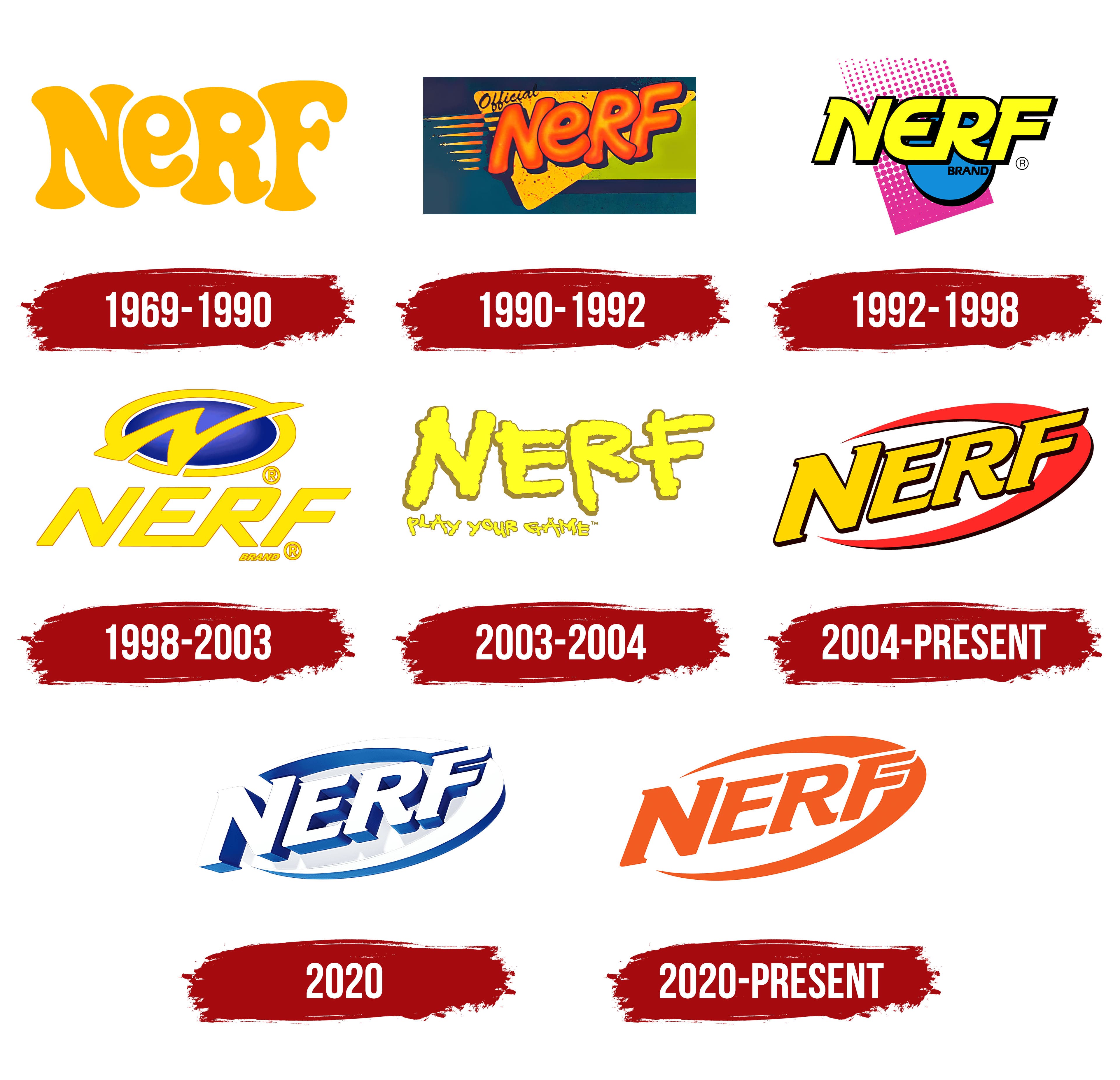
The designers used the original company name to design an entire series of logos. The first appeared in 1969, and the last in 2020. During this time, the inscription took on a modern look, featuring a 3D design and a gradient.
What is Nerf?
Nerf is an American toy brand known for its foam dart blasters and water guns. Hasbro owns it, but Parker Brothers created it in 1969. Initially, the brand produced indoor-safe balls, then expanded to foam-based weaponry with safe ammunition made of polyurethane foam.
1969 – 1990
From its inception until 1990, the toy manufacturer had a yellow wordmark with no additional elements. The short “NERF” lettering looked unusual thanks to the stylized font, which gave the letters a fantasy design. The uppercase “N,” “R,” and “F” combined with the lowercase “E” made the logo even more informal. Strong asymmetry, rounded corners, and wide lines emphasized the brand’s playfulness.
This symbol began to be used in 1969 when Reyn Guyer invented a safe polyurethane foam ball that could not break anything. Parker Brothers began selling it in 1970, advertising it as an indoor ball.
1990 – 1992
In the early 1990s, the brand had a new name. It had a more complex structure than before. The word “NERF” was dyed orange, but the inside retained a little yellow in the form of thin strips. Dark blue outlines of varying widths appeared along the edges. The letters crawled over each other and were lined up diagonally, so the “N” was lower than the “F.” The font remains round, although the glyphs have changed noticeably in shape.
The designers added additional geometric shapes in the background: a yellow triangle and a light green rectangle. To the left of the brand name, seven orange-yellow lines emphasized movement. The word “Official” was inscribed above the speed lines and partly above the letter “N.” The designers used a black font to imitate sloppy handwriting. All elements were set against a turquoise gradient background.
1992 – 1998
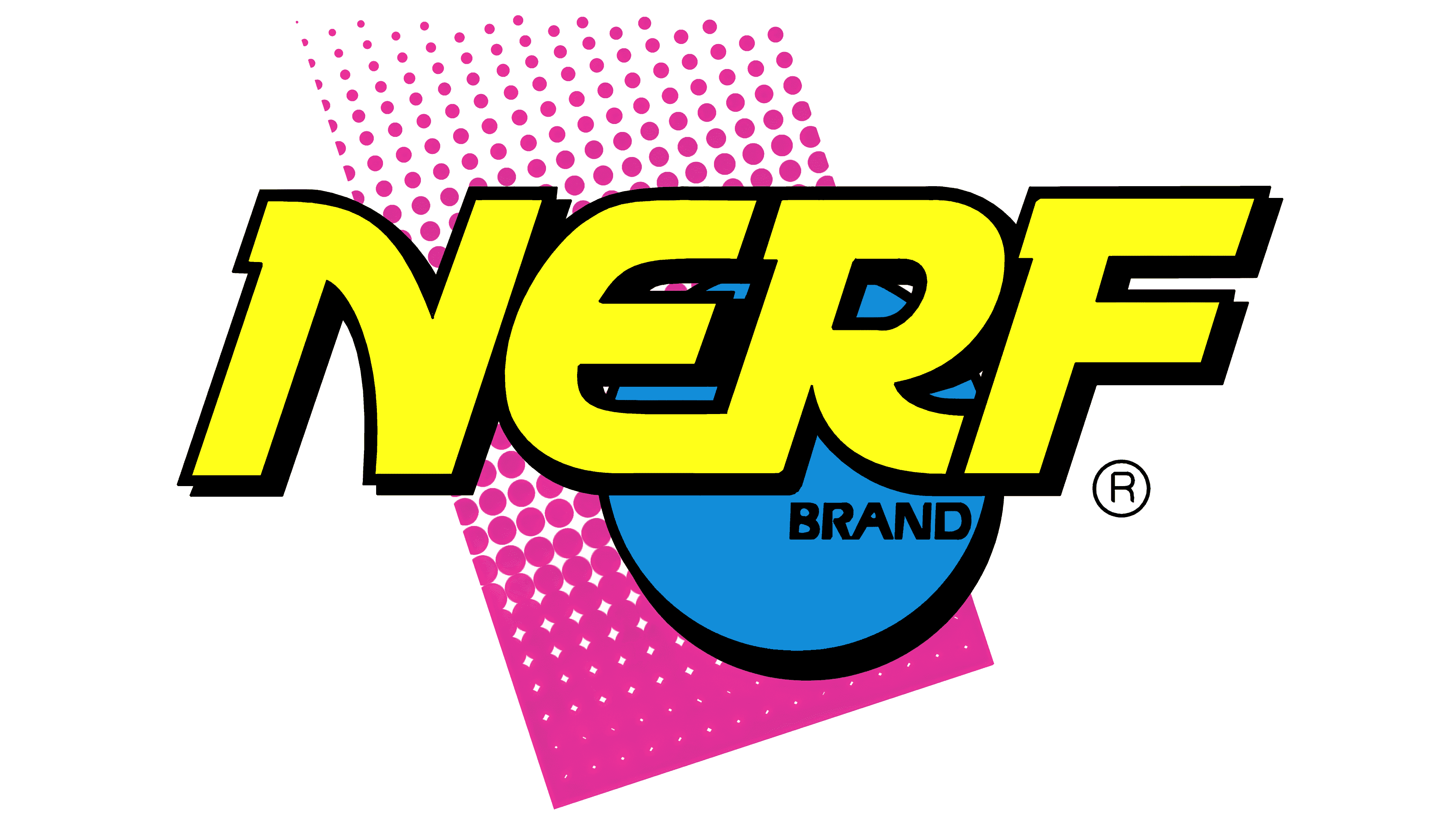
In 1992, Nerf launched its first dart blaster. An identity update marked this event. The brand name underwent another metamorphosis: the letters were repainted yellow, separated (except for “ER”), tilted to the right, and aligned horizontally. The typeface lost its streamlined shape as the designers chose a typeface with short, rectangular serifs. The dark outline of the lettering was paired with the black word “BRAND,” positioned just below.
Symbolic elements have replaced the nonsensical set of geometric shapes. The blue circle represented the first Nerf toy, a polyurethane foam ball. The dark pink rectangle with artistic perforation depicted a flying dart fired from a blaster.
1998 – 2003
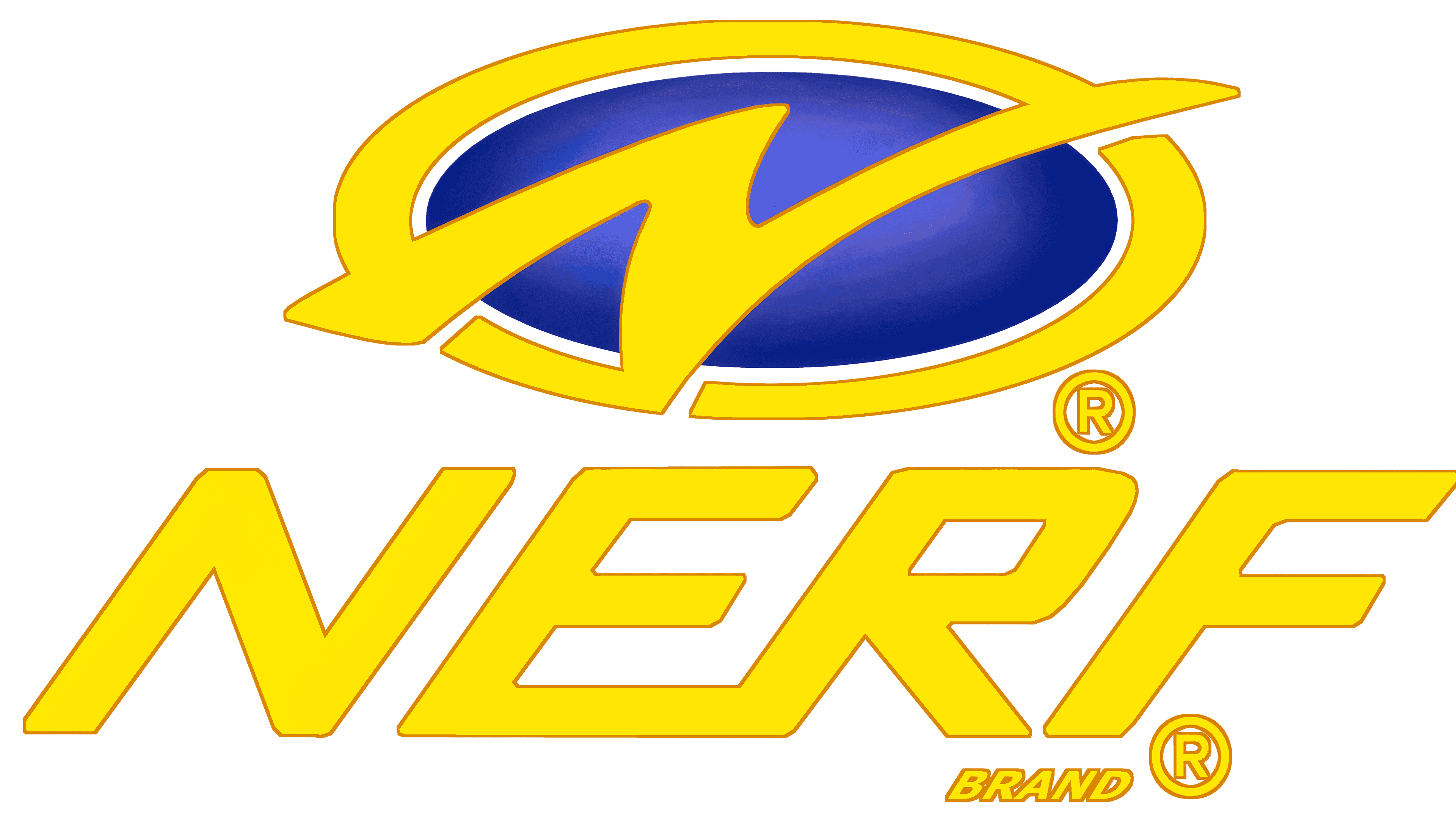
After another redesign, the pink rectangle disappeared, and the blue circle became an oval and moved up. It seemed convex because the shades transitioned smoothly from the light center to the dark edges. The logo’s creators used a radial gradient, which was the only bright spot in the graphic composition. The remaining elements, a gold-tone ring with a stylized letter “N” and the inscription “NERF BRAND” in the same color, looked monotonous. A new font for the company name was bold, sans serif, with rounded corners and a pronounced rightward slant.
2003 – 2004
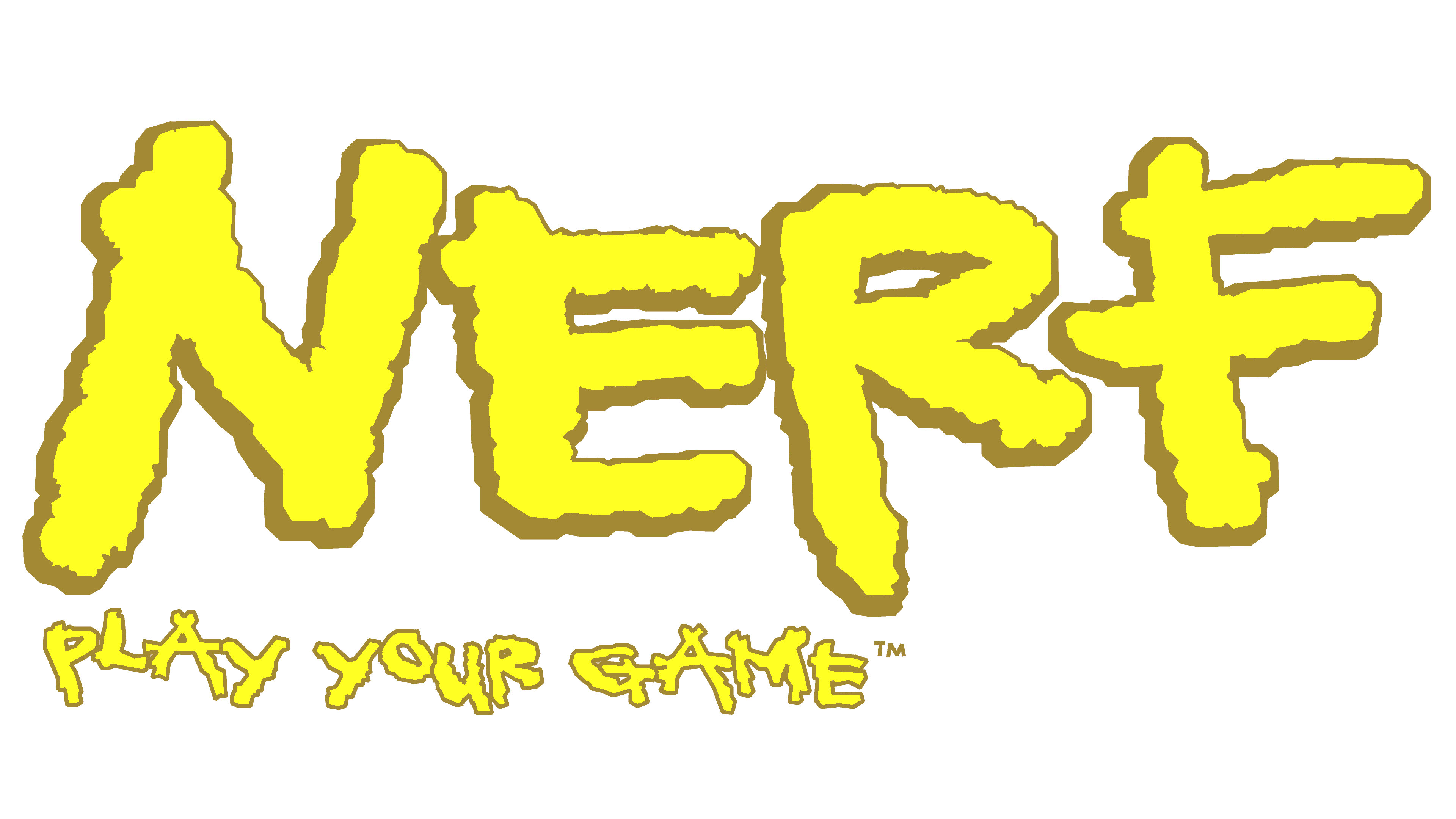
In 2003, the N-Strike Elite series of blasters debuted. The logo changed around the same time: as it was simplified, it lost the blue oval in the ring and became only inscriptions. The letters in “NERF” were like fluffy yellow clouds flying in different directions. And below, instead of the usual “BRAND,” there was an advertising phrase, “PLAY YOUR GAME.” It was also yellow and cloudy, but the designers used small print to emphasize the brand name.
2004 – today
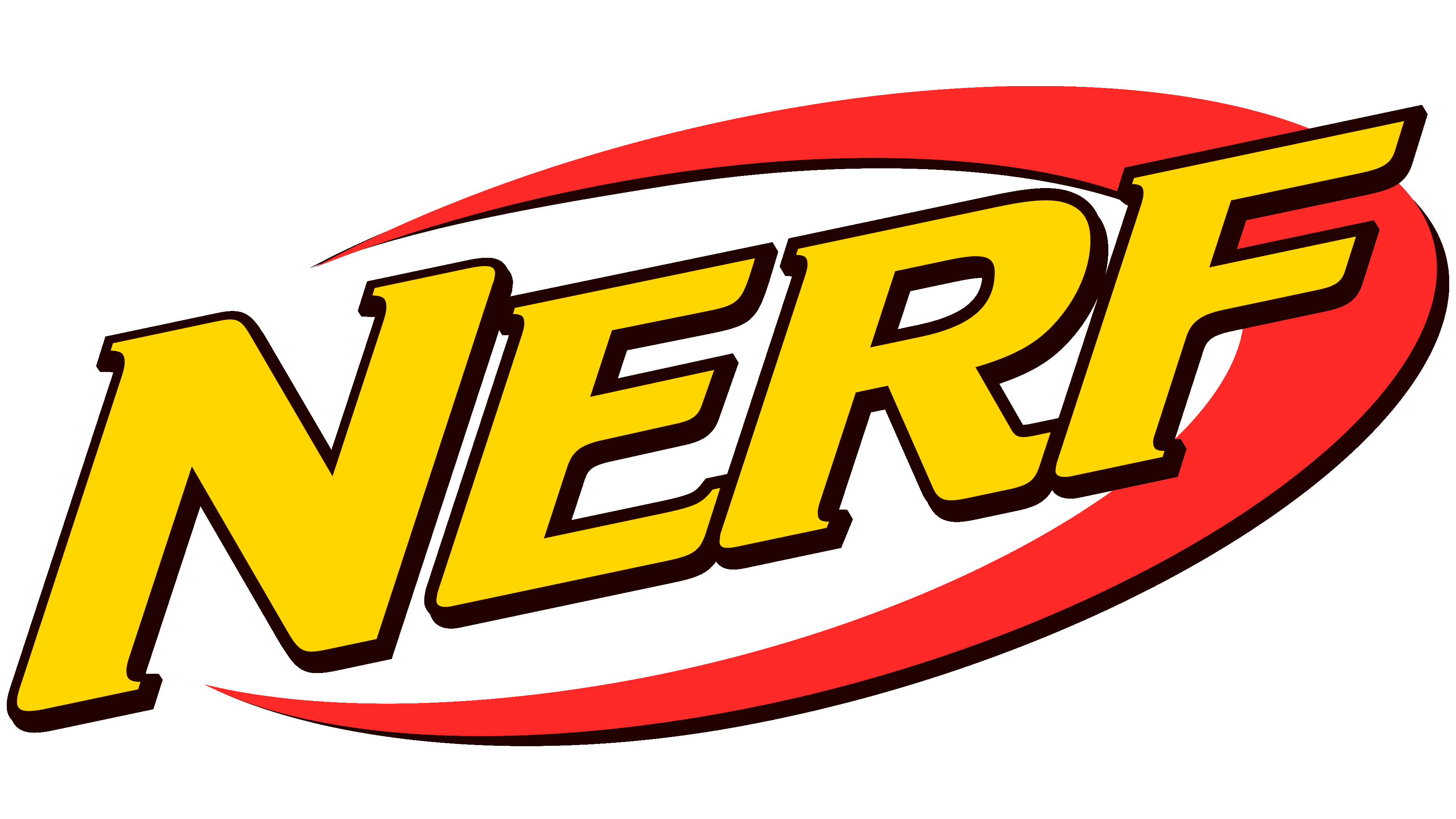
The release of the new “Dart Tag” line coincides with the emergence of the new Nerf brand name. As before, there was a brand name. It sits in the middle and is slightly beveled diagonally, reminiscent of the 1990-1992 version. The yellow-orange lettering is a tribute to the original 1969 design. The thin black outline matches the 1992-1998 logo. From the 1998-2003 graphic symbol, an oval ring was selected, which appears as a red half-ring in the modern interpretation. It sits behind the word “NERF” and is slightly raised, making it look like a flying boomerang.
2020
The company adopted a new logo with a 3D effect to refine its visual style. It is similar to the previous version, but the brand name and the surrounding arc are painted silver with a transition of shades. All paths are blue and gradient-filled. The letters and the boomerang cast translucent, light-gray shadows, further enhancing the three-dimensional design.
2020 – today
Font and Colors
The wordmark “Nerf” became more modern each year until it became a laconic inscription inside the ring. The old “playful” design is no longer relevant because the manufacturer has shifted its focus away from small children. Judging by the serious logo, he tried to broaden the target audience to include adults so they would buy dart blasters.
As is known, the font of the word “NERF” is bold, oblique, and with short triangular serifs. In appearance, it has a lot in common with Crillee Italic, which applies to both logos currently in use. They share the same typography but use different color schemes. In the first version, yellow is combined with red and black. In the second case, the designers made silver the main color, complemented by several shades of blue and light gray shadows.