


 Newcastle University Logo PNG
The Newcastle University logo is designed in the strict traditions of English heraldry, emphasizing the university’s commitment to a classical style and demonstrating the high level of its educational programs. These programs are built on a solid foundation of many years of experience, reflecting a serious approach to education and respect for tradition.
Newcastle University traces its history to 1834, when a medical school opened in Newcastle upon Tyne to train doctors for the fast-growing industrial region of North East England. In 1851, the School of Practical Science and Engineering was founded to prepare specialists for mining, engineering, coal production, and heavy industry, fields closely tied to the region’s economy.
In 1871, the medical school became part of Durham University as Durham College of Medicine. In 1883, the School of Practical Science and Engineering developed into Durham College of Science. The two academic lines were brought together in 1937 as King’s College in Newcastle, still connected with Durham University but operating with broader academic independence.
After World War II, King’s College expanded in response to new social and economic needs. Agriculture was added in 1947, dentistry followed in 1948, and the campus grew with new teaching buildings and laboratories. In 1963, King’s College separated from Durham University and became Newcastle University. Later growth included law in 1965, architecture in 1970, the Institute of Human Genetics in 1989, and the Center for Urban and Regional Development Studies in 1992.
From 2000, the university expanded abroad, opening campuses in Malaysia and Singapore in 2010, and in London in 2017. Its official name became Newcastle University in 2006. Later milestones included the “Life Sciences Centre” in 2008, Vision 2025 and the Center for Urban Science and Progress in 2019, digital infrastructure growth in 2020, a research and innovation plan in 2021, global partnerships and Helix work in 2022, and the “Centre for Advanced Materials”| in 2023.
Meaning and History
What is Newcastle University?
Newcastle upon Tyne, England, is home to the Newcastle Institute, an outstanding public research institution. Known for its research impact and the quality of its education, the university offers a wide range of undergraduate and postgraduate programs in the humanities, social sciences, engineering, natural sciences, health sciences, and other fields. It is particularly known for its achievements in digital technology, health, and sustainability. The University has a distinguished past and an exciting modern campus in Newcastle’s center. With a strong emphasis on industry contacts and employability, the university offers students real-world experience and career development opportunities. The university’s extensive international network and diverse international student body testify to its global outlook.
Before 1999

The institution’s first logo was closely associated with the lion symbol, depicted on the flag of the United Kingdom. The lion, which has accompanied national flags since before the reign of Richard the Lionheart, has emphasized the national identity embedded in the School of Medicine and Surgery’s foundation, which later became a college and university.
Above the lion image was the blue inscription “University of Newcastle upon Tyne,” indicating the city where the university is located. The institution was founded in 1963 after the separation of King’s College, Durham; thus, the emblem was created no earlier than this date. The combination of red and blue further strengthened the image’s association with England’s national symbols.
1999 – 2005
The university emblem retained the image of the lion, symbolizing national pride, and set it against a globe. Around the globe, the university’s name is positioned, emphasizing globalization and expansion. The university actively developed programs to attract international students and strengthen connections with global academic and scientific institutions. This process included creating exchange programs and collaborations with universities worldwide. The globe symbolizes the university’s ambition for a global presence and its goals. The traditional blue and red colors are also preserved in the emblem.
2005 – 2006
The emblem was transformed into a combination of an image and the university’s name. The shield symbolizes nobility and embodies global heraldic traditions. The image evokes associations with knighthood, pure intentions, and a readiness to defend the truth.
The university’s shield features two symbols of England: the lion and the cross of Saint George. The lion represents respect for the monarchy, highlighting the university’s historical heritage as a Royal College. The cross symbolizes faith and the pursuit of truth, and it is associated with Richard the Lionheart’s adoption during the Crusades.
The university’s name is placed on the right side of the emblem. A distinctive feature of the symbol is its black-and-white color scheme.
2006 – today
The Newcastle University logo was updated to include modern features and a brighter color scheme. The focus is now on the emblem, which features a shield with two main symbols: a red lion at the top and a white cross at the bottom. The shield represents strength and protection, while the red lion is associated with courage and bravery, rooted in the region’s heraldic traditions. The white cross on a blue background symbolizes a connection to Christianity and the historical role of this symbol in northeast England.
The university’s name was shortened to “Newcastle University” and split into two levels. The word “Newcastle” is in bold, emphasizing the city’s importance to the educational institution. The design’s predominance of blue shades highlights logic, science, and intellectual development, reflecting the university’s programs’ core values and focus areas.
This combination of elements and colors in the logo gives the university a modern and professional look while maintaining a connection to its historical heritage and traditions.
The Seal
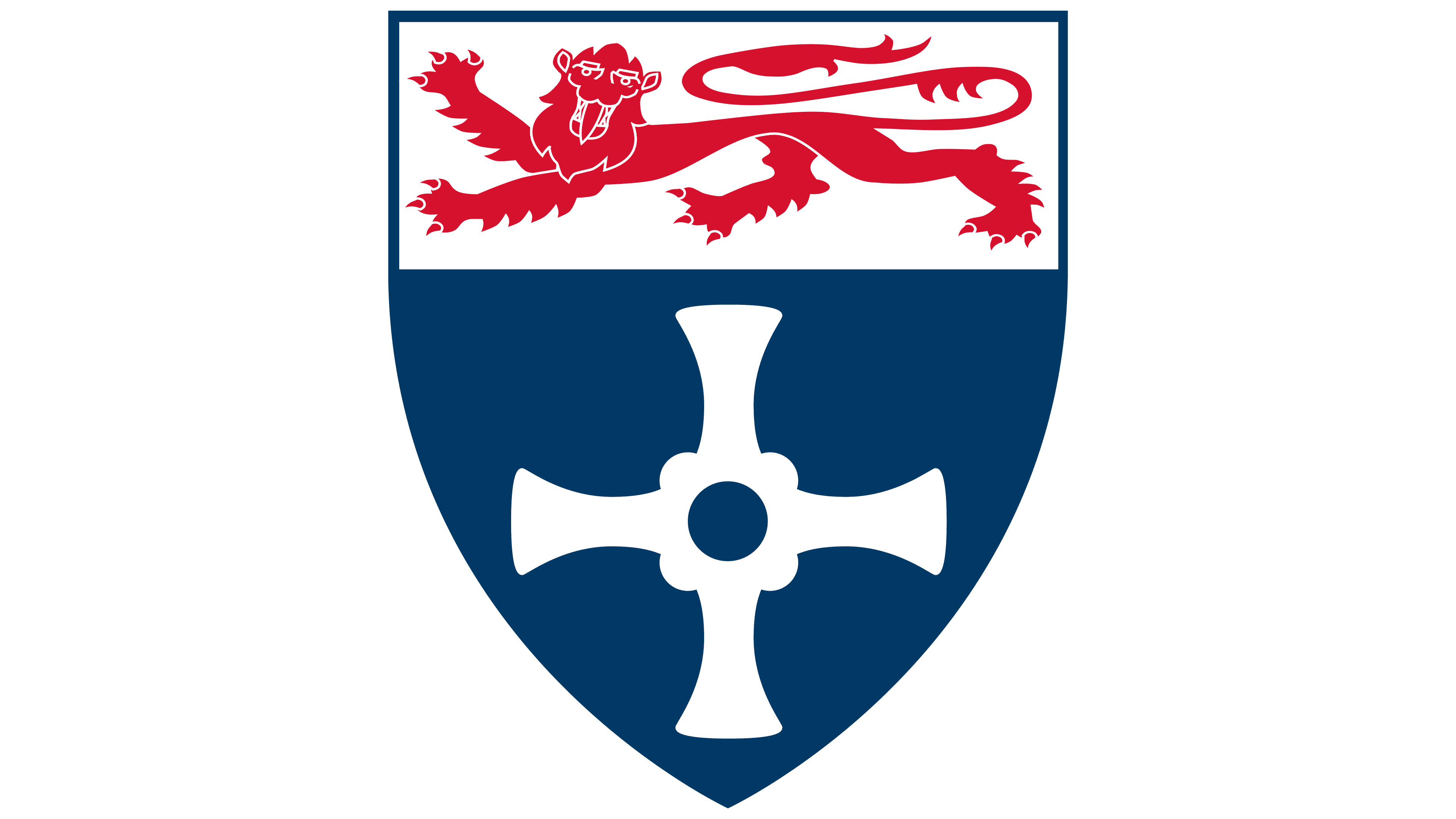
The Newcastle University seal is a more condensed version of the logo, embodying symbols significant to the university’s identity and mission. The central element of the seal is a triangular shield, symbolizing the strength of convictions and the fundamental truths taught at the university.
At the top of the shield is a red lion, echoing the image of the English flag. The lion represents strength, courage, and nobility, qualities the university prides itself on and aims to instill in its students.
The lower part of the shield contains a white cross on a blue background, resembling an award or order. This cross symbolizes the university’s contribution to advancing science and its role in promoting intellectual progress both in the UK and internationally.
Like the logo, the university seal combines historical symbols with modern values, emphasizing the pursuit of academic excellence and a commitment to tradition.