


 Oracle Logo PNG
As the Oracle logo shows, the manufacturer’s unique style distinguishes it from other technology companies. The products combine software excellence with a distinctive look to solve problems.
Oracle Corporation was founded in 1977 in California by Larry Ellison, Bob Miner, and Ed Oates as Software Development Laboratories with about $2,000 in capital. The idea came from Edgar Codd’s 1970 work at IBM on relational databases. Ellison also drew on experience from a CIA project called Oracle, which later gave the company its name.
In 1979, the firm became Relational Software Inc., and in 1982, it was renamed Oracle Corporation after its main product, Oracle Database. Early clients included US intelligence agencies. On March 12, 1986, Oracle went public, one day before Microsoft, with annual sales of $55 million.
In 1990, the company faced a crisis after its first sales decline and accounting issues. Ellison restructured operations, cut staff, and revised financial controls. Growth resumed in the early 1990s as the company expanded into enterprise applications and global markets.
During the late 1990s, Oracle added developer tools, ERP systems, and application servers. In 1997, Ellison introduced the concept of the network computer, anticipating later cloud models.
From 2005, the company shifted to acquisitions. It bought PeopleSoft for $10.3 billion, followed by Siebel Systems in 2005 and BEA Systems in 2008. By 2010, Oracle had acquired over 50 companies.
In 2010, Oracle purchased Sun Microsystems for $7.4 billion, gaining Java and Solaris and entering the hardware market. In 2013, it launched a public cloud platform. In 2014, Ellison stepped down as CEO, with Safra Catz and Mark Hurd taking leadership. In 2016, Oracle acquired NetSuite for $9.3 billion, expanding its cloud portfolio.
Meaning and History
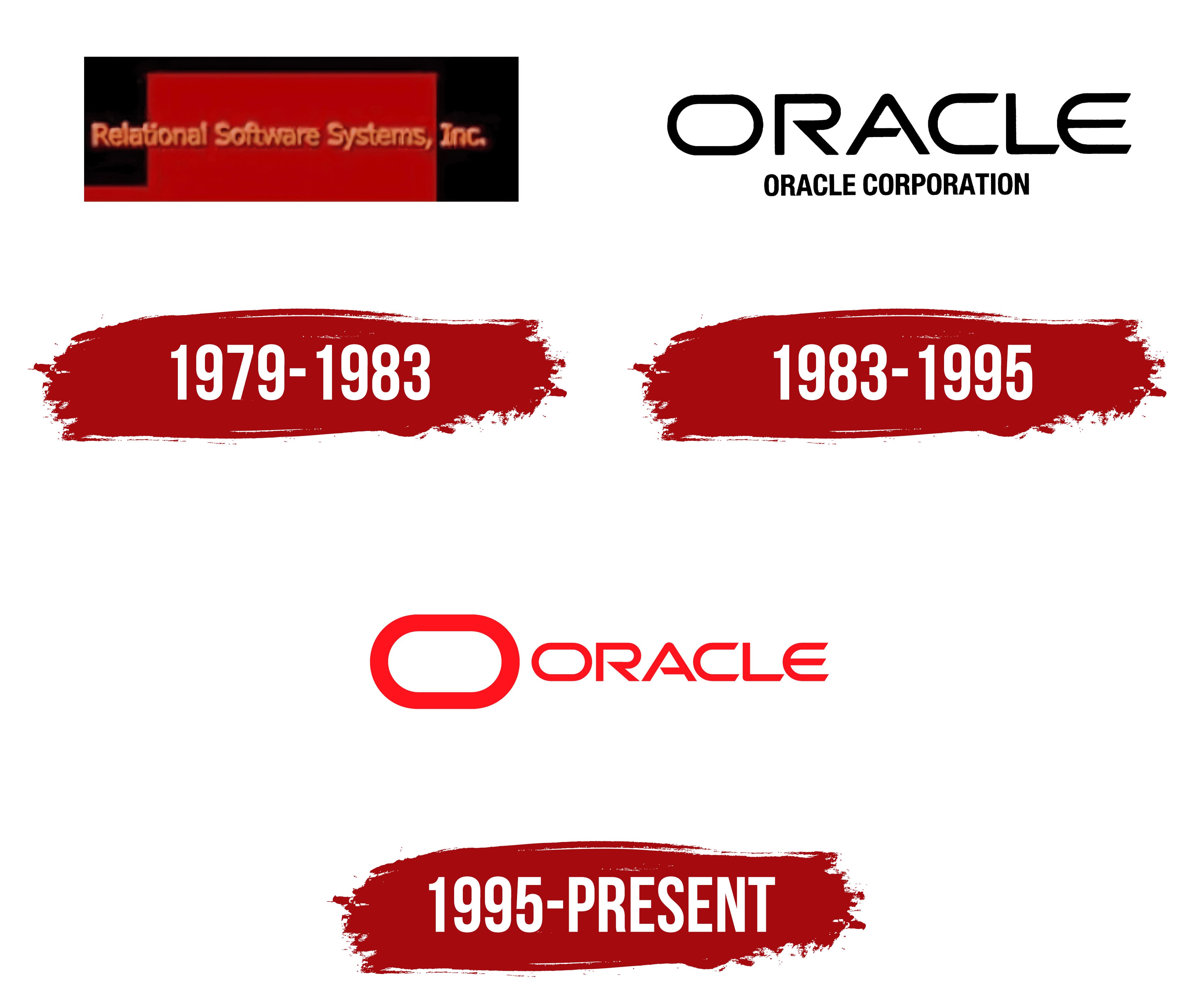
The current Oracle logo appeared after the 1982 rebranding. Before that, the organization was known as Software Development Laboratories and was owned by three entrepreneurs who worked on a secret CIA project codenamed Oracle. In mid-1979, the corporation was named Relational Software, and three years later, Oracle, in honor of the commercially successful Oracle v.2 database. At the same time, she had to update the logo to align with the new corporate identity.
What is Oracle?
Oracle is an American corporation and a direct competitor to Microsoft in software development. It specializes in business applications, DBMS, and middleware. Since 2008, Oracle has also offered server hardware.
1977 – 1979
In 1977, Oracle debuted as Software Development Laboratories, immediately defining its professional focus. It began with enterprise software and database technologies, then gradually expanded and complicated its product list. All subsequent logos convey the seriousness of its work.
1979 – 1983

Its minimalism and business approach distinguish this period’s emblem, with elements following a geometric progression upward. A stepped graph is placed against a black, borderless rectangle. A narrow red fragment on the left widens into a tall, wide rectangle. At the top is the company’s old name, Relational Software Systems Inc. The phrase is in beige letters with a slight shade at the bottom. The font is lowercase, except for the first characters, which are uppercase.
1983 – 1995
In 1983, the company rebranded as Oracle Systems Corporation. It changed its legal status and became a corporation. At the same time, the company updated its logo to match the new name. But it kept the same minimalist style. In this case, it became even more concise as management dropped the graphic element, leaving only the text. However, the designers introduced branded hand-drawn details: a horizontal “O” shaped like an oval, an “A” with an angled crossbar, and an elongated “E” with rounded ends that resembles the Ukrainian “Є.” The bottom line reads “Systems Corporation.” They contain thin, tall sans-serif letters.
1995 – today
Concerned about the lack of graphics, the software company decided to add them anyway. To do this, she used the first letter of the current name, Oracle Corporation. The designers enlarged the sign as much as possible and placed a large oval on the left side. They removed the bottom inscription and repainted the remaining text in red. The closed geometric shape represents the unity of software, hardware products, and digital services.
Font and Colors
The designers created two emblems for the company: one in white with red lettering and one in white with black lettering. They differ only in the “inverted” color arrangement; everything else, including proportions and font, is the same. In 2010, the corporation bought Sun Microsystems, which had acquired the rights to its visual identity, and decided to use it.
Professor Vaughan Pratt, who taught at Stanford University, created the original Sun Microsystems logo. Oracle designers kept only the diamond-shaped ambigram and the word “Sun” from the original version, and added a red rectangle with “ORACLE” below it.
The main emblem does not symbolize anything; it is simply the company’s name, rendered in an unusual font. However, the software manufacturer uses an icon on its website. The icon looks like an oval rectangle with a wide red border. You can see the inverted “O” from the full-size Oracle logo.
The corporation prefers a custom typeface that combines rounded and pointed elements. The letters have no serifs: all horizontal lines, including the stroke between the side portions of the “A,” are cut at an angle. This design makes the inscription stand out even without additional graphic elements.
The logo’s palette varies, although the developers used white and red colors (Pantone PMS 485). Depending on the visual context, the brand may use an RGB gradient or a black-and-white monochrome version.
FAQ
What does Oracle do?
Oracle is a multinational computer technology corporation that develops and markets database software, technology, cloud-engineered systems, and enterprise software products. The brand provides tools and solutions that help businesses manage, organize, and analyze their data more effectively.
One of Oracle’s main products is its database software, which allows businesses to store and retrieve large amounts of data efficiently. Companies of all sizes use these databases to manage customer information, financial records, and more.
The brand also offers cloud computing services that provide businesses with scalable, flexible computing resources. This allows companies to run applications and store data in the cloud, reducing the cost and complexity of managing their IT infrastructure.
Oracle develops enterprise software products like Enterprise Resource Planning (ERP), Customer Relationship Management (CRM), and Supply Chain Management (SCM) systems. These products help businesses streamline operations, improve customer relationships, and manage their supply chains more effectively.
What is the color code for Oracle Red?
Oracle Red’s color code is PMS 180C, with the hex code #C74634. In the CMYK color model, it is 3% cyan, 91% magenta, 86% yellow, and 12% black.
Oracle Red is a vibrant shade that represents the brand’s identity. This red creates a strong, recognizable visual presence across all marketing and branding materials. It conveys energy, passion, and strength, aligning with the brand’s values and mission.
What is the logo of Oracle?
The logo features the brand’s name in red letters. The designers created a custom font for the name, combining elongated and compressed lines, roundings, sharp corners, and symmetrical cuts.
This unique font makes the logo recognizable and helps establish a strong visual identity. The vibrant red color, Oracle Red, conveys energy, passion, and strength, matching the brand’s values and mission.
The custom font and red color work together to create a logo that stands out and represents the brand’s identity.
What systems are under Oracle?
Oracle’s portfolio includes various systems designed to meet different needs in data management, cloud computing, and data recovery.
- Oracle Private Cloud Appliance: This system lets businesses quickly set up private cloud environments. It integrates computing, storage, and network resources, offering a flexible and scalable solution for managing private clouds.
- Oracle Zero Data Loss Recovery Appliance: This appliance ensures that no data is lost in the event of a failure. It provides real-time data protection and recovery, making it ideal for businesses needing critical data security.
- Oracle Database Appliance: This system simplifies deploying, maintaining, and supporting database environments. Optimized for Oracle databases, it includes hardware, software, and support in a single package.
- Oracle Exadata: This system is built to deliver high performance and reliability for Oracle databases. It combines hardware and software into an optimized platform for large-scale, mission-critical applications.
Each product addresses specific challenges, helping businesses find the right solution for their unique requirements.
Is Oracle trademarked?
Yes, the company owns a registered trademark of the same name. This trademark protects the brand’s name and logo, ensuring that only the company can use them for its products and services. This legal protection helps maintain the brand’s uniqueness and prevents unauthorized use. The trademark covers various aspects of Oracle’s business, including software, hardware, cloud services, and other technology solutions.
Can I use the Oracle logo?
You cannot use the logo without permission from the copyright holders or a specially obtained license. The logo is a registered trademark, and unauthorized use may result in legal consequences. The trademark protects the brand’s identity and ensures that its name and logo are used correctly.
Contact the company to request permission or obtain a license to use the logo. This ensures you use the logo in accordance with the brand’s guidelines and legal requirements.
Using the logo without permission can result in legal action, including cease-and-desist orders, fines, or other penalties. Following the proper procedures is essential to avoid these issues and respect the brand’s intellectual property rights.