


 Adobe Acrobat Logo PNG
The Adobe Acrobat logo is associated with convenience and reliability in handling PDF documents. It conveys the practicality and stability of software that has become the global standard for digital document exchange.
Acrobat began in 1990 as Project Camelot, an internal initiative led by John Warnock, Adobe co-founder. He proposed a universal document system that would preserve the same appearance across computers, operating systems, and printers. By 1991, the team had developed Portable Document Format, or PDF, using technology derived from PostScript.
The first release arrived in June 1993 with paid tools for creating and editing files and a free Reader for viewing them. Early adoption was slow because documents were large and creation took time. Use expanded in the mid-1990s as Microsoft added support, PDF gained web integration, and the U.S. Internal Revenue Service began distributing tax forms in the format. Readers soon spread across the growing web.
During the 2000s, Acrobat added forms, electronic signatures, password protection, access controls, and archival tools. Acrobat 5.0 improved Office integration in 2001. PDF/A became the basis of ISO 19005, while PDF 1.7 was published as ISO 32000 in 2008. After Macromedia’s 2005 purchase, Flash video and interactive elements could be embedded in PDF files. Foxit Reader emerged as a lighter competitor.
Acrobat X appeared in 2010. In 2015, Acrobat DC joined Document Cloud and shifted toward subscriptions, cloud storage, mobile access, and cross-device synchronization. Liquid Mode followed in 2021 to adapt documents for phones and tablets. In 2023, AI Assistant added summaries and question-based analysis of document content.
Meaning and History
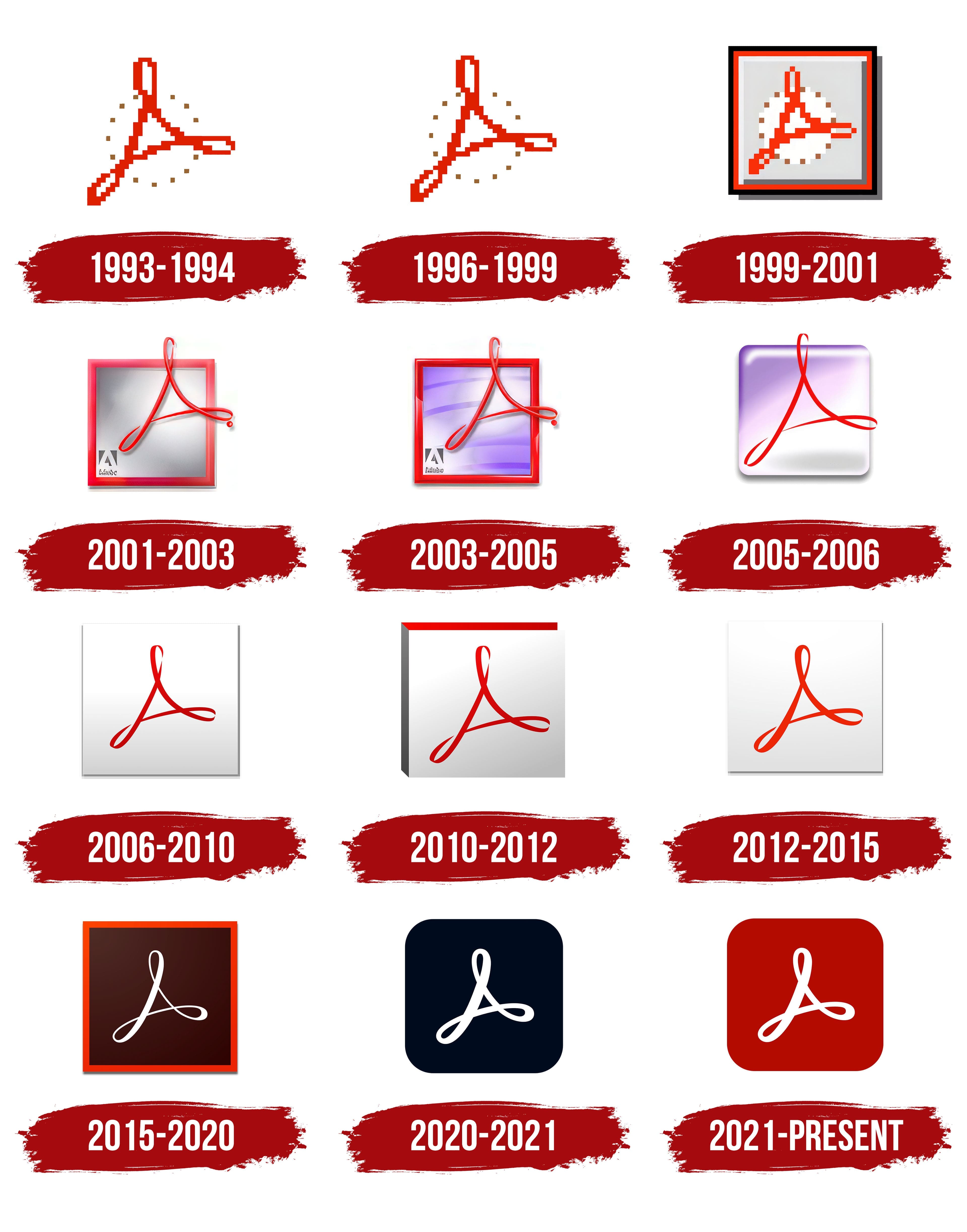
What is Adobe Acrobat?
Powerful software for creating and editing PDF documents. Features include commenting, merging and splitting files, form creation, and editing text and images directly in PDFs. Available in standard and professional versions, the latter includes document comparison, optical character recognition (OCR), and support for technical diagrams.
1993 – 1994

The Adobe Acrobat logo, first introduced in 1993, reflected the early stages of the digital age, expressed through the symbol’s pixelated style. The initial Adobe logo concept was created by Marva Warnock, the wife of the company’s co-founder, John Warnock. She conceived the iconic triangular letter “A,” which served as the starting point for Acrobat’s visual identity.
Graphically, the emblem consisted of a thin red line depicting a stylized letter “A” with three loops formed by smooth, slightly angular curves. Despite the pixelation, the lines maintained a flowing motion, reminiscent of hand-drawn contours, emphasizing the transition from paper documents to electronic ones. This style simultaneously demonstrated technological optimism and practical functionality.
The symbol’s background featured a white circle with brown markers arranged around its circumference, highlighting the stylized letter’s shape and symbolizing the unity and cyclical nature of information in digital form. The red color of the main line reflected Adobe’s innovative spirit and ambition to set standards in digital documentation. This shade was perceived as vibrant and dynamic, expressing boldness in technological experimentation.
The pixelated style of the logo was a deliberate decision, relevant to the early 1990s, that emphasized the digital essence of the new PDF format and software. The design highlighted Adobe’s transition to digital documentation, indicating the product’s novelty and technological advancement. The 1993 Acrobat logo served as a metaphor for the adaptability of a format that could transmit documents without quality loss across various devices and platforms.
1996 – 1999

At the intersection of analog perception and digital format, Adobe created the second version of Acrobat Reader. It was identical to the previous variant. The “trefoil” figure, resembling a twisted ribbon, remained central to the design.
With the figure of three interwoven loops, designers aimed to convey the essence of PDF as a unified, convenient, and universal standard.
1999 – 2001

Building on digital traditions, Adobe transformed the style of Acrobat. The “trefoil” was enclosed in a frame, like a virtual document in a virtual window. This design indicated the program’s readiness for integration with other Adobe family products.
Pixels became larger. The color scheme was enhanced with shades of gray. Gray emphasized the technological nature of the PDF format, while red remained Adobe’s brand symbol.
The accentuated frame around the symbol reminded users that digital documents easily fit into any work environment.
2001 – 2003

In the next version, the company took a step toward three-dimensionality. The new logo added volume, glossy shades, and shadow effects. Flat pixels were replaced by thin curves of a virtual ribbon resembling the softness of paper.
The interplay of light, shadow, and translucency highlighted everything. The red frame gained a gradient transition, enhancing the sense of depth and virtuality.
At the bottom left, the Adobe logo appeared, executed in gray-black tones. The developers modernized the symbol, showing its relevance to the era of dimensional design in application interfaces.
2003 – 2005

The company decided to experiment with colors, changing the gray inner background to a purple-silver gradient. The addition of the purple hue enhanced the logo’s expressiveness, making it stand out among the standard digital interfaces of the early 2000s.
The palette change was associated with positioning Acrobat as a creative program. Purple was considered the color of inspiration and digital comfort, hinting to users that PDF files were not boring documents but a space for ideas.
The brand symbol remained in the lower-left and appeared softer due to the new color scheme.
2005 – 2006

Adobe added smoothness by removing the frame and rounding the square’s corners. Purple became a gentle gradient, creating a glass-like effect. The visual style reflected the comfort of using PDF documents in daily work.
The ribbon of the symbol became thinner and more flexible. Smooth lines emphasized the software’s ease of use across tasks. The volume and glossy surface represented a step toward users expecting a modern approach from Adobe.
The new design conveyed Acrobat’s status as a key tool in digital document management.
2006 – 2010

In this version, the company simplified the logo’s style, removing the purple inner background. Instead, the company introduced a concise silver background with a slight gradient. The red “trefoil” became the sole bright accent.
Smooth lines replaced sharp corners. The symbol was slightly convex, creating a mild embossing effect.
The entire icon was designed in a minimalist style, with restraint highlighting the main idea of convenience for digital documents.
2010 – 2012

Adobe unexpectedly displayed the Acrobat symbol as a book, emphasizing its purpose. The volumetric shape was reminiscent of the analog heritage of the digital PDF format.
The red top symbolized the Adobe brand, emphasizing the program’s importance within the company’s lineup. The silver gradient background complemented the solidity and precision of this digital tool.
2012 – 2015

Adobe returned to simplicity, making the symbol flat and concise. The red letter “A” consisted of a single clear graphic line drawn over a light gray gradient.
The minimalist design was influenced by the flat design trend in applications during that period. Depth disappeared; clarity remained.
2015 – 2020

The company decided to surprise users with a dark theme featuring a brown background and a red frame that provided contrast. The white letter “A” on a dark background remained central to the visual image.
The brown background shade was associated with the solidity of business documentation. The red frame symbolized the connection to Adobe’s overall visual style.
The white lines of the “trefoil” became smoother and thinner, improving readability.
2020 – 2021

In the new version, the brand shifted toward absolute simplicity, removing the frame and brown shade and replacing them with a saturated black background.
The white stylized letter “A” inside had thicker lines. Its flexibility highlighted the ease of access when working with PDF documents.
The choice of a dark background highlighted visual comfort in dark interface mode. The design matched the era of mobile applications and workspaces.
2021 – today

The Adobe Acrobat logo, introduced in October 2021, is part of an overall redesign of Adobe’s product line that integrates Document Cloud and Creative Cloud into a unified visual brand system.
The symbol is based on a single-line, stylized letter “A” created with a continuous line that forms three distinctive loops. The geometry of the shape is carefully balanced; the loops have soft, uniform curves, and the line ends are visually closed. The design resembles a neat handwritten signature and is associated with precision and ease of electronic signing and digital document workflows.
The logo’s background is a rich red square with neatly rounded corners, making it suitable for use in mobile application interfaces and web platforms. The red color of the logo was deliberately chosen to match Adobe’s corporate color standard, traditionally associated with Acrobat and the PDF format. The bright red shade conveys confidence and emphasizes the document’s importance, underscoring its seriousness and official nature. The white letter contrasts against the background, facilitating quick perception and recognition across various devices and screens.
The logo was developed internally by the Adobe Brand Studio team in close collaboration with Document Cloud UX designers, achieving maximum functionality and versatility. During the redesign, Adobe entirely abandoned gradients, volumetric effects, and textures, adhering to modern flat design principles. This ensures flawless clarity of display on digital devices, regardless of resolution or size.
The Acrobat emblem showcases the brand’s core qualities of reliability and ease of document interaction, blending calligraphic aesthetics with digital functionality. The stylized “A,” based on the original design by Adobe co-founder John Warnock, has become a recognizable symbol of the PDF format, visually conveying precision, ease, and accessibility across all digital environments.
Font and color

Adobe Acrobat always stood out by refusing to use letter-based fonts in its emblem. Its signature stylized “A” is the result of manual design. The three loops highlight the versatility of the PDF format for various devices.
The color palette frequently changed, but it maintained a basic color palette. The main hue became a true red, named Adobe Red, which became the symbol of the company’s digital products.