


 Partido Socialista Logo PNG
The Partido Socialista logo represents a leader who fights for freedom and supports the working class. The strong and confident symbol is complemented by elements of flexibility and harmony, highlighting the party’s balanced policy.
The Portuguese Socialist Party was founded on April 19, 1973, in Bad Münstereifel, Germany, by Mário Soares, who was living in exile under Portugal’s Estado Novo dictatorship. Before its creation, much of the opposition worked underground or from abroad. Soares and his allies wanted a democratic organization capable of opposing the authoritarian regime and competing with the growing communist movement.
The Carnation Revolution of April 25, 1974, changed the political setting and allowed the party to operate legally in Portugal. Soares entered the provisional government as foreign minister. In 1975, the party received 37.9% of the vote in the Constituent Assembly election, becoming the largest force and participating in the drafting of the new constitution.
In 1976, the party won 34.9% of the vote in the first democratic parliamentary election. It formed a minority government led by Soares, Portugal’s first democratically elected prime minister. His cabinet worked on democratic institutions, economic stabilization, and the early path toward European integration. In 1983, Soares returned as prime minister in a coalition with the Social Democratic Party. Still, by 1985 the party moved into opposition.
Soares became president in 1986 and served until 1996. During the 1990s, António Guterres modernized the party, became prime minister in 1995, and continued Portugal’s integration into the European Union. After defeat in 2002, José Sócrates returned the party to power in 2005, but the financial crisis led to his resignation in 2011. António Costa opened a new phase in 2015 with a left-supported minority government and won again in 2019.
Meaning and History

What is Partido Socialista?
It is a political party known for its socialist and social-democratic ideologies. The party advocates for social justice, equality, and the provision of state welfare. It supports policies to redistribute economic resources, state ownership of key industries, and comprehensive social services such as healthcare and education. The Socialist Party operates within the framework of democratic socialism, striving to implement its principles through democratic means and participation in elections. The party often emphasizes workers’ rights, sustainable development, and international solidarity in its platform and policies.
1973 – 1974

The first emblem echoes the symbols of the Communist Party of the USSR. A fist, composed of many individual elements, emphasizes the strength and unity of the working class. Mutual support makes the global movement strong and capable of protecting ordinary people’s interests.
The fist is placed within a red circle, symbolizing leadership and energy. The color represents the bloodshed for socialist values. The image immediately attracts attention and demands respect for the political force.
At the bottom, next to the fist, are black elements of the hammer and sickle, indicating that the party represents the interests of workers and peasants.
1974 – 1992

The 1974 transformation preserved the emblem’s overall image. However, the fist is depicted in white, and the party name around the circle is in bold black font. This approach reflects the growth of the movement’s supporters.
The change from gold to white emphasizes rejecting imperialist wealth and pursuing simplicity and moderation. The color represents the party’s core values: honesty, openness, and equality.
The bold font indicated the strength of the SP’s position after the Carnation Revolution, marking the path to socialism’s triumph and a new milestone in the party’s development.
1992 – today

During its opposition, the Partido Socialista chose a monochromatic design for its new image. The dark red color emphasizes its shadow position and opposition to the PSD. The emblem signifies the party’s mature and confident stance during this period. The white fist appears freer and less rigid, softening its impact and conveying a more liberal attitude. The prominence of white in the emblem indicates a readiness for dialogue and cooperation.
The Partido Socialista logo features a circular emblem with a clenched fist in the center. Surrounding the fist is the inscription “Partido Socialista,” written along the circumference of the inner circle. The inner circle containing the fist is red, while the fist and the text are white.
The clenched fist traditionally symbolizes struggle, unity, and strength. In the context of the party’s logo, it represents readiness to fight for the people’s rights and interests and to pursue social equality. The circular shape of the logo emphasizes the integrity and collective efforts of all party members.
The logo underscores the party’s maturity and confidence during its opposition. The white clenched fist on a red background symbolizes the fight for justice and social change. The dominance of white in the first text highlights a willingness to engage in dialogue and cooperation despite opposition.
The font used for the “Partido Socialista” inscription is uppercase, giving the logo a sense of gravity and importance. The font style is simple and clear, without unnecessary decorative elements, emphasizing the party’s seriousness and determination.
Red and white are the dominant colors in the logo. Red symbolizes socialist ideals, the party’s energy, and determination to fight for its principles. The white color used for the fist and text symbolizes purity of intentions, openness, and readiness for cooperation.
1993 – 1997

The logo presents a completely new image. The red, white, and green colors correspond to the national flag, emphasizing the participants’ patriotism.
The symbol of the social-democratic rose, partially set against a red background, represents renewal, leading to the birth of a new viable political force, as indicated by the green rectangle with large white letters “SP.”
1997 – 2004

The emblem’s change of color scheme to red and white symbolizes victory in the elections. Merging two background elements into one red flag signifies leadership and dynamic activity, stimulating the country’s development and prosperity.
2004 – 2016

The design reflects a balance, embracing a third, centrist path, attempting to harmonize right and left politics. The design also indicates a purification within the party, resulting in the exclusion of many members.
The emblem shows the identity transformation, combining the original symbol, the fist in a circle, with the modern image of the flag and rose. The party maintains its fundamental principles but is moving in a new direction.
The logo marked victory in the European and later Portuguese elections.
2016 – today
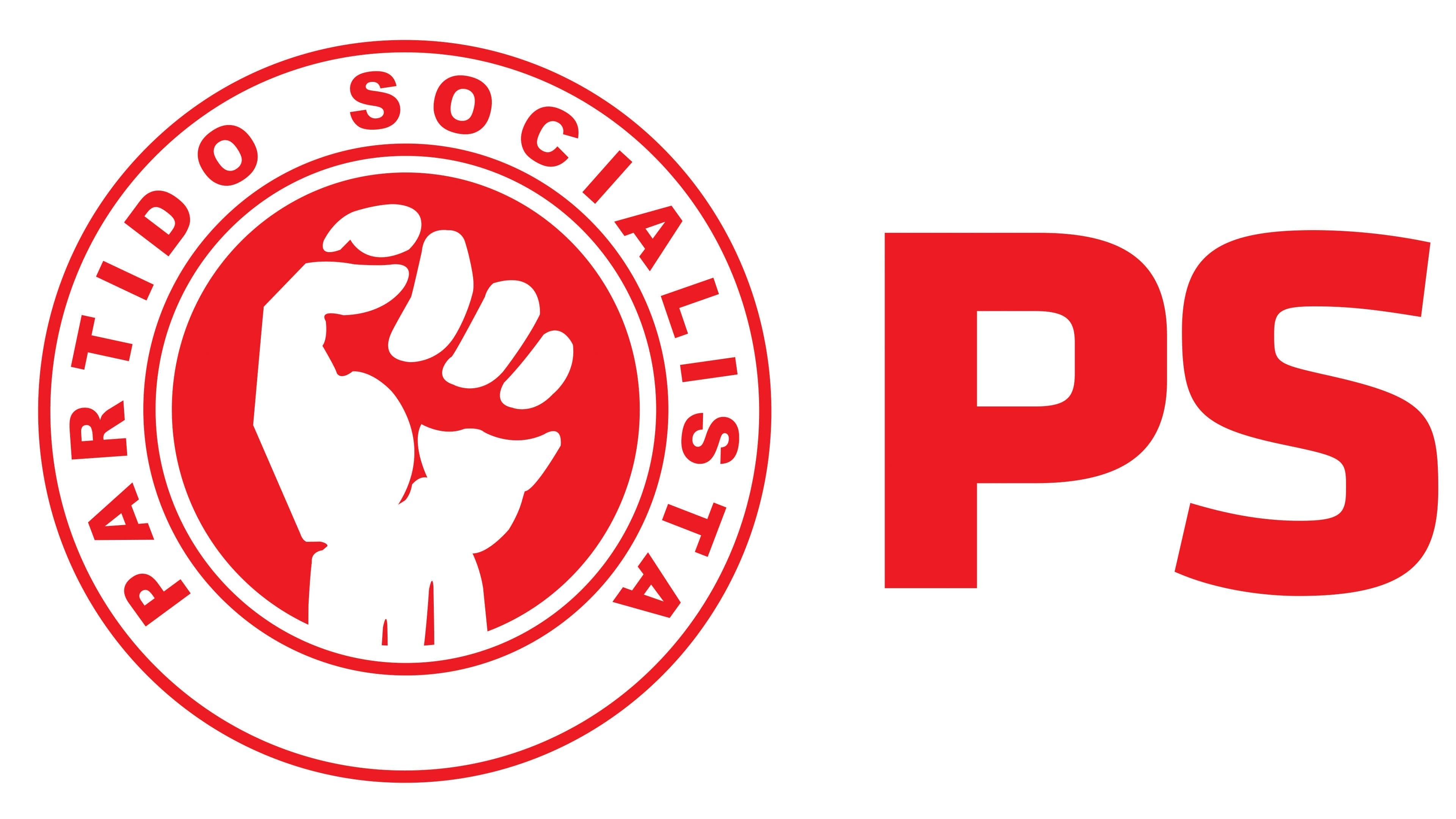
In recent years, the Partido Socialista has actively adapted to the changing conditions and challenges of the modern world. The logo, updated in 2018, reflects these changes, demonstrating the party’s readiness for new political and social realities. The fist within the circle represents the historical legacy of the struggle for the rights of workers and oppressed groups. At the same time, the large “PS” letters emphasize the drive for modernization and progress. This symbol serves as a reminder of the socialists’ resilience and determination to pursue a just and equal society.
The Partido Socialista logo combines harmony and compactness. The central element is an image of a fist inside a circle, reminiscent of a seal. This symbol embodies the socialists’ unwavering convictions regarding equality, unity, and strength.
The fist enclosed in a circle symbolizes the party’s power and determination in achieving its goals. It emphasizes the cohesion and unity necessary to advance socialist ideals.
The large red “PS” letters to the right of the main symbol highlight the party’s modernity and renewal. The simple, clear font reflects a confident, understandable policy aligned with current realities.
The emblem’s primary color is red, traditionally associated with socialist and leftist movements. This color symbolizes passion, energy, and the fight for justice.