


 Utah Jazz Logo PNG
The team chose the Utah Jazz’s iconic logo, making it instantly recognizable. Of course, what could be unclear about a basketball, especially when it’s the emblem’s central element? At the same time, sports virtuosos draw inspiration from music virtuosos to reach incredible heights and achieve brilliant victories.
The Utah Jazz story starts far from Utah. Mormons founded Salt Lake City, a strict religious community with its own customs and history. Against that backdrop, the idea of a team named “Jazz” in this environment always looked out of place.
The franchise began in 1974 in New Orleans, a city closely tied to jazz culture. The name and the original purple, yellow, and green colors came from that context. Pete Maravich became the face of the early years, spending five seasons with the New Orleans Jazz.
In 1979, the team moved to Salt Lake City. The market was smaller, yet the owner kept the name despite criticism and its weak connection to Utah. The identity remained intact, including colors and emblem, though green became dominant for road uniforms.
A shift came in 1984 with the arrival of John Stockton, after which purple took a leading role and “Utah” appeared on jerseys. In the 1990s, the team experimented with purple, turquoise, bronze, and black and introduced mountain imagery into the logo.
In 2004, the club switched to blue and white, simplifying the uniforms, a change that overlapped with Andrei Kirilenko’s tenure. The change did not last long. The team later returned to yellow and green with dark blue accents, while the main logo stayed structurally the same, with only color adjustments over time.
Meaning and History
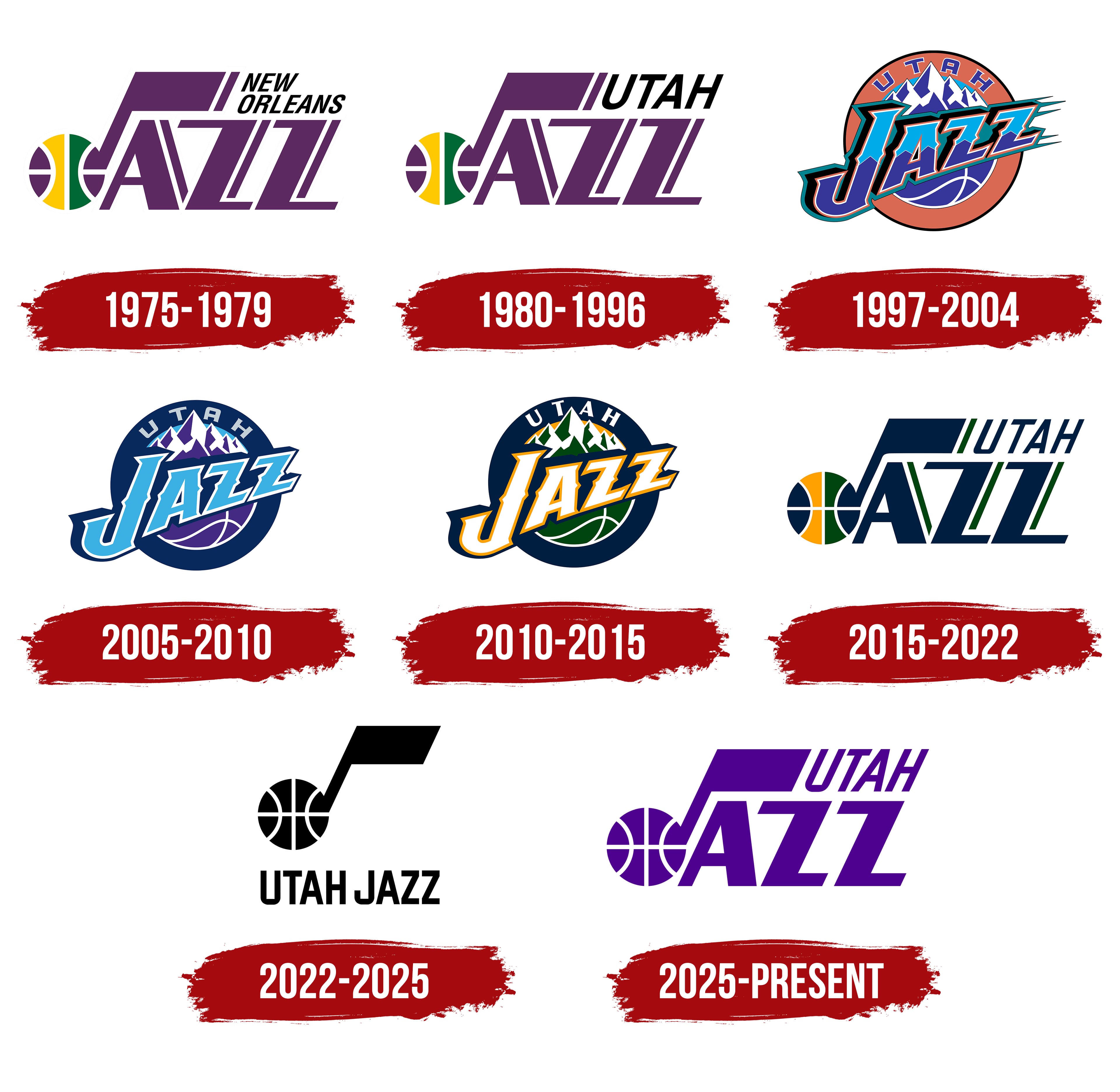
The basketball club’s logo is based on its nickname. The name Jazz came from the franchise’s time in New Orleans, the jazz capital of the world. The logo fits: an eighth note shaped like a large “J.” After moving to Utah, nothing changed: the team kept its old name and preserved the logo’s key elements.
What is Utah Jazz?
The Utah Jazz is the basketball team from Salt Lake City that has been in the NBA since 1974. It moved to Utah in 1979, and before that, it was based in New Orleans, Louisiana. As of 2021, it has not won a single championship, but it is considered one of the strongest NBA franchises of the 1990s.
1975 – 1979
1975 was the first year of “Utah JAZZ.” The famous basketball team was born in New Orleans, the heart of the jazz industry. The logo’s main symbol became the first letter of the word “Jazz”: “J.” It resembles an eighth musical note and also forms a ball at the base. The word “Jazz” was entirely in dark purple. Above it was a dim black inscription, “New Orleans.”
1980 – 1996

At the end of the 1970s, the team moved to Utah. It didn’t have time to get permission for a rebrand, so it had to enter the 1979-1980 season under the old name. The only change was the city’s name.
1997 – 2004
Despite Salt Lake City’s lack of a jazz heritage, the club continued to develop the concept. Artists redesigned the logo, making the letter “J” look like a saxophone rather than an eighth note. In the background, they placed a ball with mountain peaks and surrounded it with a brown ring inscribed “UTAH.”
2005 – 2010

In 2005, designers changed the color palette. The ball and mountains turned purple, the ring turned navy blue, and the word “JAZZ” turned blue with a thin white border.
2010 – 2015

Another palette change brought Mardi Gras colors back to their former place. This is evidenced by the green ball and the gold stroke around the club’s nickname.
2015 – 2022

In 2015, the team’s owners delighted fans by returning the old logo, reminiscent of the Utah JAZZ’s early years in Louisiana.
The latest redesign is a tribute to long-gone classics. Developers restored the logo adopted in 1980 and used it through 1996. However, they made the inscriptions navy blue and repainted the decorative lines dark green.
2022 – 2025

2025 – today
Font and Colors
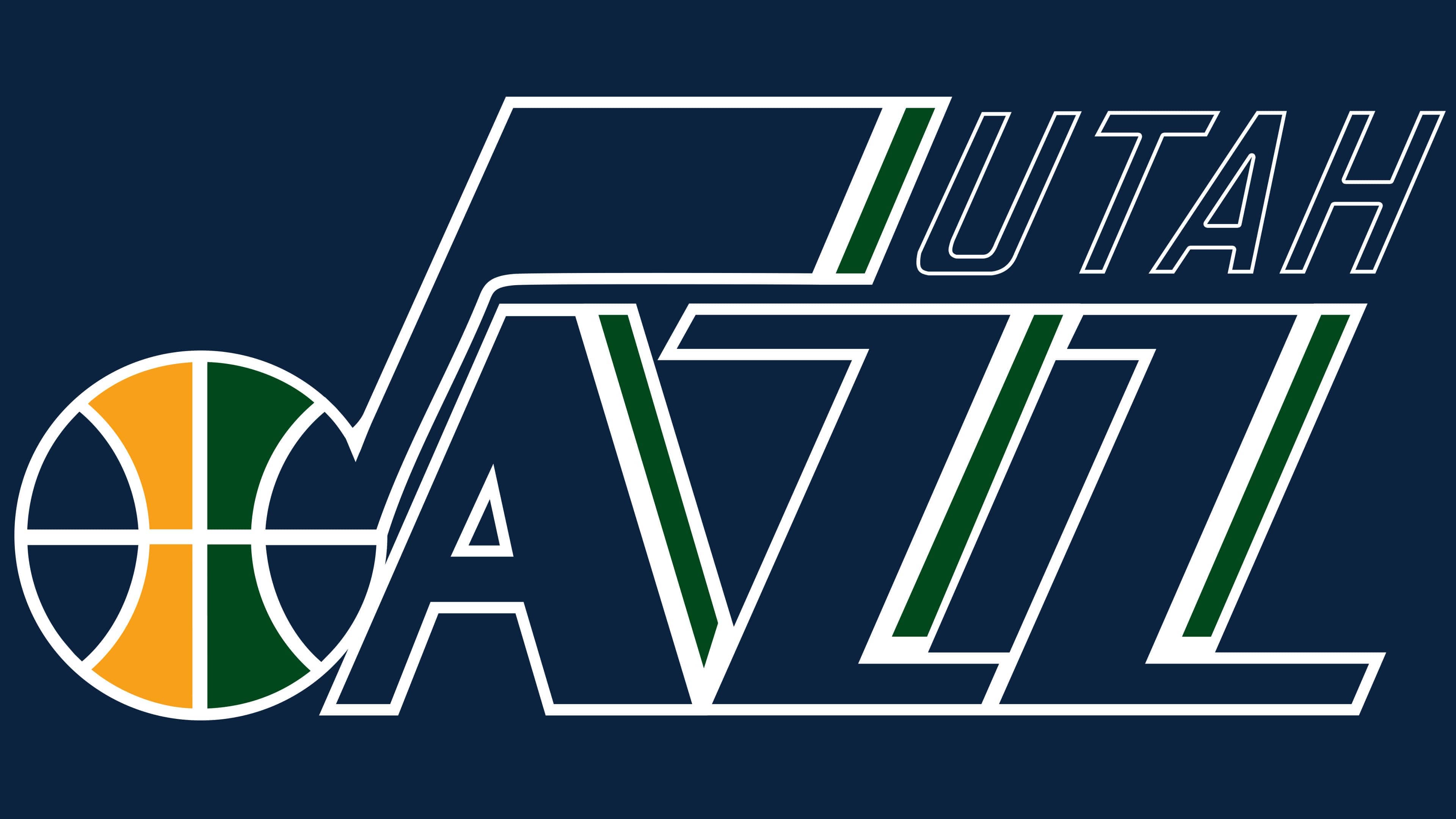
The word “Jazz” in the logo and the team’s name conveys the idea of “collective improvisation.” This definition came from the dictionary used by those who chose the nickname New Orleans Jazz. Therefore, the emblem developers decided not to abandon the musical theme and linked it to sports, combining basketball and the letter “J” into a single drawing, first as a note and then as a saxophone.

The club’s emblems use two unique fonts. The first (and the last) is a proprietary font with a note instead of “J” and asymmetrical letters with an additional straight line on the right side. The second version (used from 1997 to 2015) looks completely different. It’s a stylized font with serifs at the edges and triangular protrusions in the center. In this form, the letter “J” clearly resembles a wind musical instrument.

The classic Utah Jazz palette corresponds to traditional Mardi Gras colors. It combines green, gold, and navy blue, whereas the original used purple.