


 Veterans Affairs Logo PNG
The Veterans Affairs logo represents the care and support provided to those who have dedicated themselves to serving their country. The organization helps veterans and their families by creating programs and initiatives that have become integral to the public assistance system.
The U.S. Department of Veterans Affairs (VA) traces its roots back to 1776 when the Continental Congress first established pensions for soldiers wounded during the Revolutionary War. Official care for veterans expanded after 1811, with dedicated federal facilities opening to accommodate former sailors.
Following the Civil War, in 1865, President Abraham Lincoln famously urged the nation to care for its veterans, creating an enduring motto that the VA continues to adopt. In 1873, veterans began receiving regular pensions, and by 1890, Congress expanded eligibility to include veterans who were unable to serve due to factors unrelated to their military service.
World War I significantly reshaped veteran support, with the War Risk Insurance Act (1917) providing disability compensation and vocational training. These services were consolidated under the Bureau of Veterans Affairs in 1921. Later, in 1930, President Herbert Hoover established the Veterans Administration by merging multiple veteran agencies.
The landmark GI Bill, passed in 1944, extended education benefits, housing loans, and unemployment aid to returning World War II veterans, significantly impacting American society. Two years later, in 1946, the department began collaborating with medical schools to establish academic medical centers nationwide.
In 1988, President Ronald Reagan elevated the Veterans Administration to cabinet-level status, renaming it the Department of Veterans Affairs. Throughout the 1990s and 2000s, the VA introduced specialized programs targeting PTSD, homelessness, and women veterans, alongside modernizing medical record systems.
Following controversies over medical wait times in 2014, significant reforms were implemented to improve access to healthcare. The MISSION Act of 2018 expanded veterans’ access to external healthcare providers. More recently, the VA has focused on upgrading medical facilities and strengthening suicide prevention programs.
Meaning and History
What is Veterans Affairs?
This is a government agency in the United States that provides support to military veterans and their families. It offers medical care, rehabilitation, and psychological assistance through one of the largest healthcare systems in the country. Additionally, the organization provides support for insurance, housing, employment, and education. Its structure includes specialized medical centers, clinics, nursing homes for elderly veterans, and national cemeteries where burials with military honors take place.
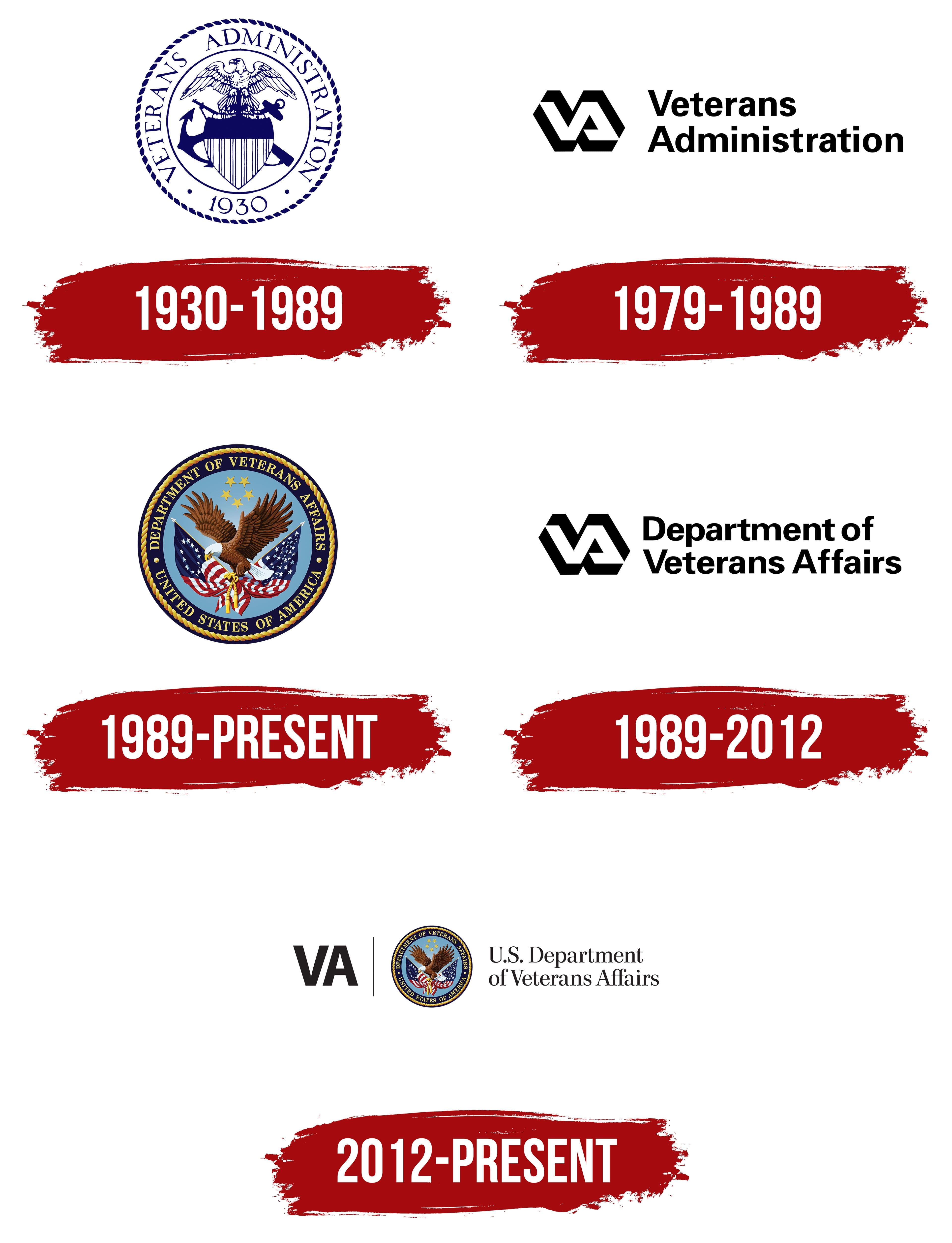
1930 – 1989

Work on the symbolism of the United States Veterans Administration began with the search for a balance between continuity and renewal. After President Herbert Hoover established the new organization, the department’s chief clerk, William K. Black, approved the seal’s design, which artist Nancy P. Davis finalized. The design was based on the symbolism of the Veterans Bureau, but several details were revised to reflect the administration’s evolution.
The emblem is circular, framed by a twisted rope contour. It represents the administration’s connection to the armed forces and its responsibility to veterans of all military branches. The upper half of the circle contains the institution’s name, “VETERANS ADMINISTRATION,” and the lower part shows the founding year, “1930.” The text is rendered in a serif font with strict proportions. The letter spacing is even, enhancing the monumentality of the composition. The lettering style is close to a Roman serif type.
At its center is a shield featuring vertical stripes. Above the shield is an eagle with spread wings, symbolizing power, protection, and national sovereignty. In its talons, the eagle holds two elements representing the main branches of the armed forces: a rifle for the Army and an anchor for the Navy. These attributes cross behind the shield, forming an image of unity among the military services.
The emblem underwent adjustments. The most significant change occurred in 1946 when additional decorative elements, including flags and a belt, were removed and the anchor was repositioned. The main symbols of the composition (the eagle, shield, rifle, anchor, and founding year) remained unchanged until 1989, when the Veterans Administration was reorganized into a department.
The color scheme uses a single dark blue shade. It is associated with U.S. national symbols and conveys authority and respect for tradition. The uniform color reinforces the emblem’s formal and dignified character.
The Veterans Administration logo reflects the agency’s mission by combining the national eagle, military attributes, and historical elements. The work of William K. Black and Nancy P. Davis preserved the connection to the predecessor bureau. It established a new identity based on responsibility to veterans and continuity of government institutions.
1979 – 1989
The “VA” monogram was created as an alternative symbol for the Veterans Administration and used alongside the organization’s circular emblem. The design was created by Malcolm Grear, an American designer known for his minimalist compositions for government institutions. The project was developed by Malcolm Grear Designers, his studio, based in Providence. The studio followed the style of late American modernism of the 1970s, emphasizing strict geometry and clarity of form. Malcolm Grear, born in 1931 and deceased in 2016, became known for creating visually balanced and functional designs for public and governmental organizations.
The emblem is based on the two letters in the agency’s name, “V” and “A,” which form the agency’s abbreviation. The “V” is composed of sharp, straight lines with angles, while the “A” is built on a broad base with an internal triangular opening resembling an upward-pointing arrow. The intersection of the right line of the “V” and the left line of the “A” creates a unified, indivisible silhouette. The entire composition is set within an abstract geometric structure.
The text to the right is set in the Univers typeface, a neo-grotesque family. The absence of serifs, straight stroke endings, uniform line thickness, and balanced proportions characterizes it. This emphasizes the symbol’s rational and utilitarian character. The words “Veterans” and “Administration” are written in lowercase with initial capital letters, which softens the formality and makes the inscription easier to read.
The “VA” monogram represents the modernist traits of American government design in the second half of the 20th century. In Malcolm Grear’s project, the Veterans Administration’s aspiration for a clear and balanced identity was realized, strengthening the agency’s image.
1989 – today

The development of the new logo of the United States Department of Veterans Affairs was connected to the agency’s transformation in 1989, when the Veterans Administration gained cabinet-level status. For the new symbol, an internal competition was held, and David E. Gregory, an employee of the VA Medical Center in Indianapolis, created the winning design. The author had experience serving in the Army Reserve, Navy, and National Guard, which enabled him to combine traditional government motifs with a focus on the renewed organization’s mission.
After the project was approved, it was refined by the Army Institute of Heraldry. In the final version, five gold stars forming a pentagon above the eagle were added, and the inscription “USA” was replaced with the full name “United States of America.”
The emblem is circular, with a gold braided cord around the perimeter. It symbolizes the remembrance of veterans and honors those who have made the ultimate sacrifice. Inside the dark blue field are two inscriptions: “DEPARTMENT OF VETERANS AFFAIRS” and “UNITED STATES OF AMERICA.” They are written in uppercase serif letters with balanced geometry, similar to those found in Times New Roman or Garamond. The inscriptions are arranged along the top and bottom of the circle, forming a symmetrical composition.
The emblem’s primary symbol is a bald eagle with its wings outstretched. The bird is depicted in natural brown and white tones. In its talons, the eagle holds two American flags, tied with a gold cord and adorned with tassels. The flags symbolize the country’s journey from the Thirteen Colonies to 50 states. The eagle in this form represents patriotism, strength, and the protection of citizens.
Above the eagle are five gold stars. They represent the key branches of the U.S. Armed Forces: the Army, Navy, Air Force, Marine Corps, and Coast Guard. The stars are arranged in a precise geometric figure, emphasizing coordination and unity.
The palette is based on traditional national colors. The blue background and gold border define the official character, while the red and white of the flags strengthen the national emphasis and connect the emblem to the historic symbolism of the United States.
Later, Gregory also designed the department’s flag. It features the same composition set against an “Old Glory Blue” background. The shade is associated with American heraldry and reinforces the emblem’s symbolic message, expressing respect and gratitude toward veterans.
1989 – 2012
The update of the visual logo of the United States Department of Veterans Affairs, following its transformation from the Veterans Administration, affected only the text portion. The main symbol, the “VA” monogram, was preserved unchanged.
The text portion of the Veterans Affairs logo is on the right and consists of two lines. The first contains the words “Department of,” with only the first letter capitalized. The second line is reserved for the name “Veterans Affairs,” where the capital letters “V” and “A” are highlighted.
The lettering uses a strict sans-serif font similar in characteristics to Helvetica or Arial. Its features include bold weight, uniform vertical stroke thickness, balanced proportions, and moderate character spacing. All of this gives the text an official appearance and aligns it with the monogram’s geometric structure.
2012 – today

The modernization of the United States Department of Veterans Affairs’ visual style in 2012 aimed to unify all elements of the visual system. The internal division of the Office of Public and Intergovernmental Affairs developed and approved a comprehensive standard, which included the updated logo. It combined the strict “VA” monogram, the traditional circular emblem, and the full name of the department written in a classical serif typeface.
The abbreviation “VA” is based on a modified version of Helvetica Neue Black. The font has large proportions, clear vertical and horizontal lines, and a dense geometric structure. It creates a strong accent, associating the symbol with the department’s reliability and stability.
Next to it is the circular emblem that retained the design approved back in 1989. Its dimensions were adjusted to achieve balance with the monogram.
To the right of the emblem is the organization’s full name, “U.S. Department of Veterans Affairs.” The inscription uses the Minion typeface, a serif typeface. Its typical features include moderate serifs, proportional and harmonious glyphs, and classical typographic form. The text is arranged in two lines and left-aligned, giving it an official, reserved appearance.
A vertical line between the abbreviation and the emblem serves as a divider, enhancing structure and emphasizing the independence of each element while maintaining a unified composition.
