


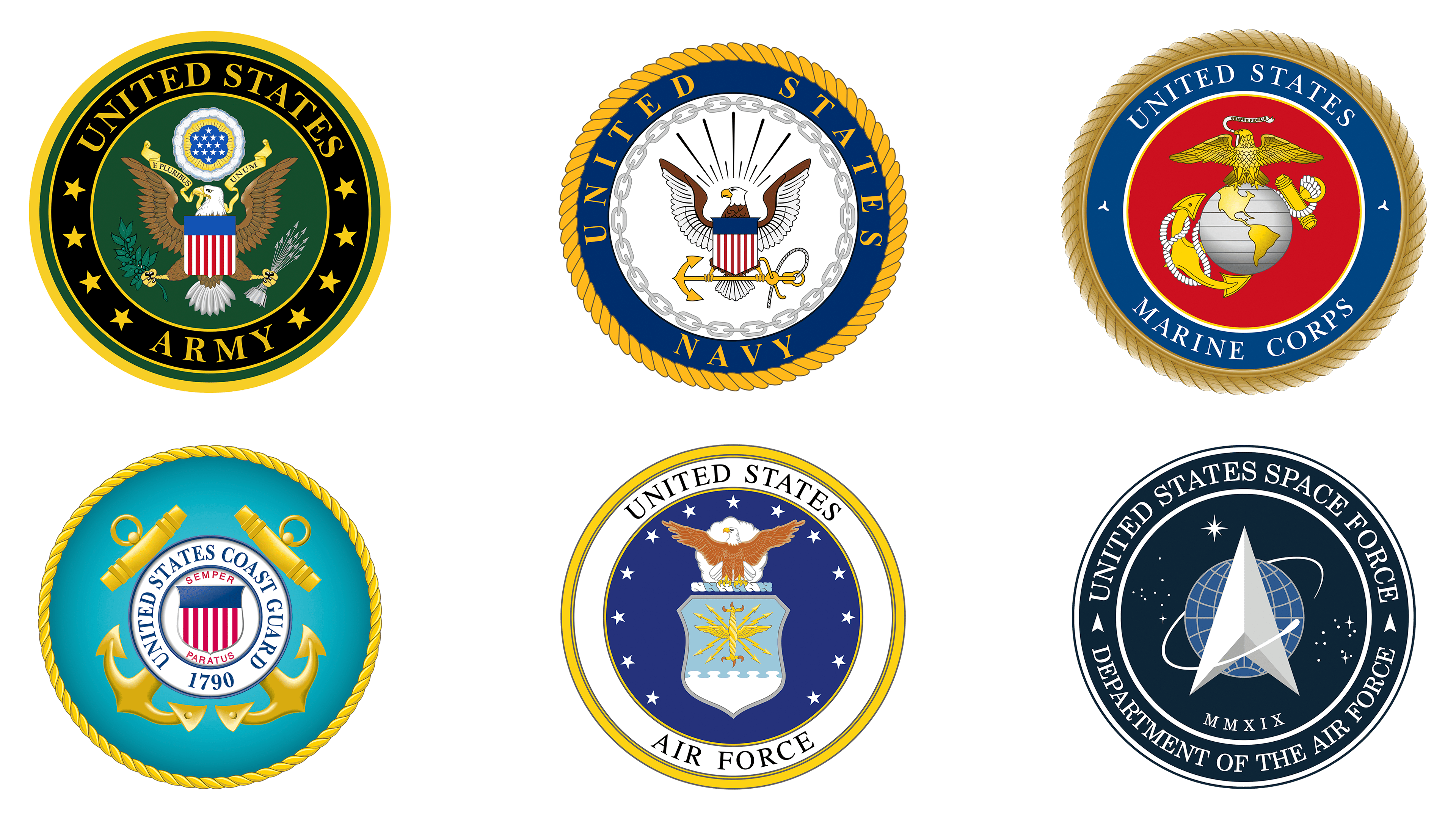
 United States Armed Forces Logo PNG
The United States Armed Forces logo represents the unity of various military branches working as a coordinated system. Each division has its mission: the Army defends the land, the Navy controls the seas, the Air Force dominates the skies, the Marine Corps operates at the intersection of domains, and the Space Force expands capabilities. Their coordination creates a formidable defense system ready to face any challenge.
The American military traces its origins to June 14, 1775, when the Continental Army was formed under the command of George Washington during the Revolutionary War. The same year, on November 10, the U.S. Marine Corps was established as a naval infantry force.
After the Constitution’s ratification in 1789, military authority transferred to Congress, and the president became commander-in-chief. The Coast Guard originated in 1790 within the Department of the Treasury, tasked initially with preventing smuggling and other illicit activities.
Significant growth occurred during the Civil War (1861–1865), reshaping army organization and strategies. The Spanish-American War of 1898 prompted further modernization of the U.S. Navy, laying the foundation for global military presence.
World War I (1917–1918) saw rapid military expansion and innovation, notably in aviation. The National Security Act of 1947 created the Department of Defense and officially established the Air Force as a separate branch.
During the Cold War (1947–1991), the U.S. military developed nuclear arsenals, aircraft carriers, and ballistic missiles. Transitioning to an all-volunteer force in the 1970s enhanced professionalism and capabilities.
Following the September 11 attacks, prolonged operations in Afghanistan and Iraq reshaped military tactics and equipment. In 2019, responding to new defense priorities, the U.S. Space Force was established to conduct space operations.
By 2023, continued investments in emerging technologies such as artificial intelligence, cybersecurity, and unmanned systems will remain critical elements in military strategy.
Meaning and History

What is United States Armed Forces?
This unified structure includes the Army, Navy, Air Force, Marine Corps, Space Force, and Coast Guard. These branches are responsible for national defense and carry out missions on land, at sea, in the air, and in space. All, except the Coast Guard, report to the Department of Defense and operate in close coordination, each with its own command structure and specialization. A vast network of military installations operates both domestically and internationally to ensure security and provide rapid responses to various threats.
1775 – today
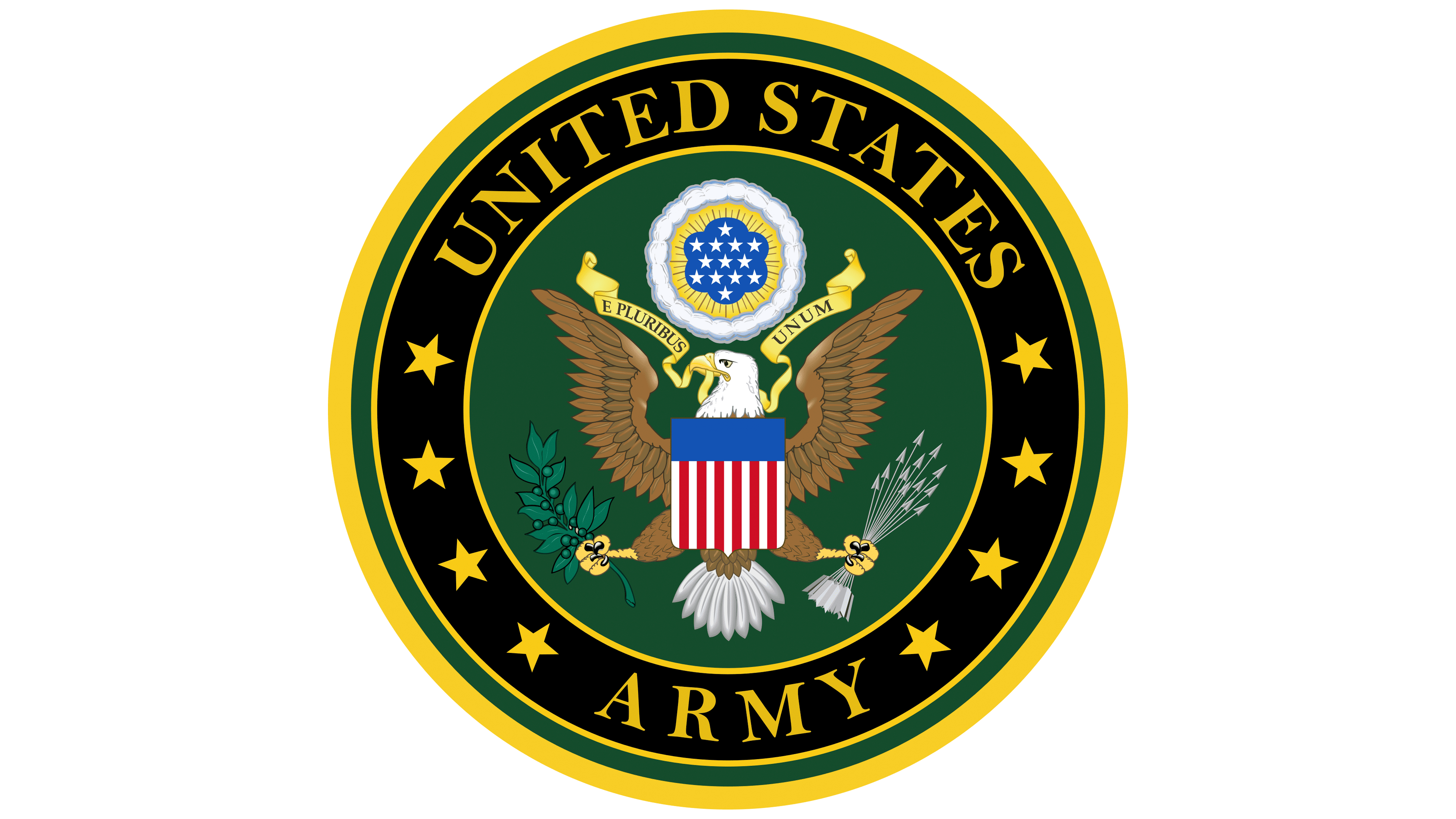
The foundation of the United States Army logo rests on a strict symbolic structure, in which the main element is the figure of a bald eagle with spread wings. The bird holds in its talons objects that define the emblem’s meaning. In the right talon is an olive branch as a sign of the pursuit of peace, and in the left talon is a bundle of thirteen arrows symbolizing readiness to defend the nation’s interests. In American heraldry, the eagle is interpreted as a sign of power and sovereignty, making its image the core of the entire composition.
On the eagle’s chest is a shield with vertical red and white stripes and a blue rectangle at the top. The shield reproduces the structure of the national flag, emphasizing continuity from the first colonies and the army’s connection to the country’s history.
Above the eagle’s head is a separate heraldic motif: a blue field with thirteen white five-pointed stars. They are enclosed within a white, cloud-shaped border, surrounded by golden rays. These elements refer to the colonies that laid the foundation of the nation.
In its beak, the eagle holds a yellow ribbon with the Latin motto “E Pluribus Unum.” The inscription is rendered in a strict serif typeface. The phrase expresses the idea of forming a single state from many territories.
The color palette of the emblem follows military tradition. The inner circle is painted in muted dark green tones associated with the army. The outer contour is black with golden stars, emphasizing the emblem’s formality and status. Gold symbolizes honor, dignity, and high rank within the military structure.
The inscriptions “UNITED STATES” and “ARMY” are done in large serif type. The uppercase letters feature vertical strokes and serifs.
The United States Army emblem continues the tradition of the national seal, demonstrating the military institution’s connection to national symbols. Its imagery unites aspirations for peace with readiness for defense, reinforcing the army’s authority as one of the country’s most important institutions.
1794 – today

The logo of the United States Navy was developed from the naval seal established in the mid-20th century and officially adopted as a symbol in 1959. Its stylistic origins go back to the traditions of American naval uniforms of the late 18th century and the broader system of national heraldry, combining historical continuity with modern attributes.
The emblem is circular, with a gold rope running along its border. It is rendered in relief with a realistic texture, referring to maritime themes and emphasizing the Navy’s connection to the ocean. The inner circle is dark blue and contains the inscription “UNITED STATES NAVY.” The lettering is set in a gold serif typeface, characterized by elongated forms and pointed serifs.
At the center of the emblem stands a bald eagle with its wings spread. In its talons, it holds a gold anchor wrapped with a rope. The anchor symbolizes the maritime sphere and the Navy’s role in national defense. On the eagle’s chest is a shield with vertical red and white stripes and a blue rectangle at the top. The shield’s design repeats the structure of the national flag, referencing the historical link to the original American colonies.
Behind the eagle’s figure are rays that create the impression of radiance or a rising sun. They are interpreted as a sign of greatness and renewal. An additional decorative element surrounding the bird is a silver chain with interlocked links. Its detailed depiction enhances the sense of order and symbolizes the unity of the Navy.
The dominant blue represents the maritime environment, gold symbolizes valor and tradition, and white symbolizes honor and pure intentions. The brown feathers of the eagle and the gray tone of the chain add realism and depth.
The typography is classical serif type with evenly proportioned letters, extended lines, and pronounced serifs. The circular arrangement of the inscriptions balances the composition and emphasizes its symmetry.
The symbol of the United States Navy reflects historical continuity with the 18th century, highlighting the traditions of naval strength and demonstrating the country’s status as a powerful nation with a well-established naval identity.
1798 – today

The logo of the United States Marine Corps originated from an initiative in the mid-19th century when General Jacob Zeilin proposed formalizing the unit’s symbolism. In 1868, the foundation of the future emblem was established, and by 1876, the composition of the eagle, globe, and anchor had become the official insignia. The last major modernization occurred in the mid-20th century. By order of General Lemuel Shepherd in 1954–1955, the emblem was revised to replace the eagle with the bald eagle, the national symbol of the United States. President Dwight Eisenhower approved the new version in 1955, and it became the basis of the modern image of the Corps.
The structure of the emblem is built around a circle framed by a decorative gold rope stylized as a marine twisted cord. It connects the Corps to its naval origins and recalls 18th-century British symbolism. The inner circle is colored deep red and outlined with a white-and-yellow border. A blue band around the perimeter contains the inscriptions “UNITED STATES” and “MARINE CORPS.” The text is rendered in white, using a classical serif typeface with balanced proportions, moderate serifs, and evenly weighted strokes. The inscriptions are arranged symmetrically along the top and bottom arcs.
The main composition features a gold eagle, a silver globe, and a gold anchor wrapped in a white rope. The eagle is shown with its wings spread horizontally, emphasizing the unit’s status and hierarchy. In its beak, the bird holds a ribbon bearing the Latin motto “Semper Fidelis” (“Always Faithful”). The motto expresses the Corps’s ethics and fundamental principles.
A detailed rendering distinguishes the globe and shows the outlines of the two Americas. The continents are gold against a silver background. The anchor traces its origin to British heraldic traditions, where the so-called “fouled anchor” represented naval service. The Marine Corps emblem underscores the connection with the Navy and the Corps’ presence in maritime operations.
Red conveys energy and strength, blue represents authority and connection with the sea, and gold is associated with honor, dignity, and historical continuity. White is used in the rope and text, enhancing contrast and structuring the composition. The metallic sheen of silver adds volume and realism to the image.
The emblem combines elements from British 18th-century symbols, American 19th-century heraldry, and 20th-century modernizations. It demonstrates continuity of tradition, embodies the Corps’ core values, and represents its role as a global military force operating on land and at sea.
1915 – today

The United States Coast Guard’s logo was formed by merging two historical agencies. In 1915, the Revenue Cutter Service and the Lifesaving Service were combined into a single organization, requiring a new official emblem. In January of that year, a seal was created to formalize the union, and it became the basis for the emblem that was later adopted as the service’s symbol.
The composition evolved through refinement of details. Its foundation inherited features of the earlier Revenue Cutter Service seal but was redesigned in 1927, achieving the final form that has been preserved for decades. Adjustments were made to align with naval and aviation standards, but the main design remained unchanged. In 1967, the design firm Raymond Loewy Associates introduced the “racing stripe” motif to the Coast Guard’s visual identity, featuring diagonal stripes of red, white, and blue.
The emblem is circular, combining maritime symbolism and military attributes. At the center is a shield with vertical red and white stripes and a blue upper section, accompanied by the motto “Semper Paratus” (“Always Ready”). Around the shield runs a ring with inscriptions and the date 1790, emphasizing the service’s historical origin. Above the circle are golden anchors and crossed naval guns. The outer contour is framed with a rope, symbolizing the maritime domain.
The font is classical. The serif letters are arranged along the circular path without slant and with moderate spacing. In character, they are similar to Times New Roman.
Blue represents tradition and authority, while a light blue or turquoise background emphasizes a connection to the maritime environment. The red stripes and inscriptions create contrast, and the gold elements in the anchors, weapons, and rope correspond to naval military tradition, reinforcing the sense of continuity.
The emblem directly parallels the official flag of the Coast Guard, approved on January 28, 1964. The white field, featuring a shield with red and white stripes and a blue upper section, along with the motto, founding year, and service name, arranged in a semicircle, repeats the emblem’s structure.
1947 – today

Work on the symbolism of the United States Air Force began with the search for an artistic image that could convey the new identity of this branch of the armed forces. The National Security Act, which took effect in July 1947, established the United States Air Force as an independent service. In connection with this, military heraldry specialist Arthur E. DuBois from the Office of the Army Quartermaster was assigned to prepare sketches for the future insignia. Robert E. Evan, representing the Department of Uniforms and Insignia of the Air Force, also participated in the development.
Among the first drafts was a version depicting the Wright brothers’ airplane on a green background. However, in further discussions, preference was given to ultramarine blue and a composition featuring Jupiter’s lightning bolt, which DuBois sketched by hand on the back of a draft sheet. The sketch was supported by more than thirty generals and, in November 1947, was approved by President Harry S. Truman as the official insignia of the new branch of the military.
The emblem is designed as a circle with several concentric layers. The inner field is framed by a white ring with a golden border, where the inscriptions “UNITED STATES” and “AIR FORCE” are placed at the top and bottom. The font is a strict serif style with thin strokes, close to Times New Roman or Garamond. The letters are evenly spaced and upright, giving the design a formal and restrained appearance.
Inside the circle is a shield with a wavy lower edge referring to the line of a clouded horizon. In the center of the shield are golden lightning bolts with wings and Mercury’s staff entwined with serpents. These attributes allude to speed, air superiority, and authority, combining military symbolism with mythological imagery. Above the shield, on a cloud base, stands an eagle with its wings spread, a traditional symbol of American sovereignty and strength.
The background is surrounded by thirteen white five-pointed stars representing the original colonies of the United States. The three stars at the top symbolize the unity of the three main branches of the armed forces: the Army, Navy, and Air Force.
Blue in the logo represents the sky and reflects the nature of the branch. White is used in the inscriptions and stars, symbolizing honesty and openness. Gold is used for the lightning bolts, staff, anchor-like elements, and ring border, emphasizing superiority in the air domain. The eagle is colored in brownish-red tones, corresponding to the national symbol of the United States and linking the Air Force’s image to national traditions.
Later, the emblem’s composition was adopted by the flag of the United States Air Force, designed by Dorothy G. Gatchell in 1951. Arthur DuBois worked on rendering the crest and the eagle for the flag, ensuring a unified visual language between the two symbols. Their connection reinforced the Air Force’s cohesive identity within the country’s military structure.
2019 – today

The delta, which became the centerpiece of the United States Space Force emblem, dates back to a military symbol used long before the new branch’s creation. The first recorded use of the symbol dates to 1942 in Army units, and since 1961, it has been part of the insignia of the Air Force’s space divisions. Thus, when, in early 2020, a special Pentagon group completed the development of the official emblem, the delta was not an invented symbol but part of a longstanding tradition inherited by the new organization. General John Raymond, who led the Space Force, noted that the emblem reflects the service’s internal culture.
The composition is based on strict geometry and a combination of space-related imagery. The dark blue background symbolizes the infinite expanse of space and serves as the foundation for perception. On it is placed a light blue globe with lines of latitude and longitude, emphasizing the Earth-based origin of missions and the global scale of operations. Around the globe runs an orbital diagonal line representing activity and presence in space.
At the top of the emblem is a white North Star, serving as a guiding point and symbolizing the stability of the course. Additional star groups in the background represent specific service assets. Three larger stars are interpreted as a symbol of the three main areas of activity: organizing, training, and equipping units.
Inscriptions are placed along the outer ring. They are written in a classical humanist serif typeface in strict uppercase letters with thin serifs. The symbols are evenly spaced. The upper part reads “UNITED STATES SPACE FORCE,” and the lower part “DEPARTMENT OF THE AIR FORCE.” Small arrows are placed between the inscriptions, completing the composition. The lower part of the emblem features the year of the service’s founding, “MMXIX,” written in Roman numerals, marking the establishment of the new military branch.
The emblem’s color system consists of four main tones. Dark blue is associated with the depth of space and the seriousness of missions. White is used for the stars and inscriptions, denoting clarity and integrity. Silver is used for the delta, emphasizing technological orientation and progress. The light blue of the globe refers to the planetary scale of operations.
The United States Space Force logo exhibits a systematic structure in which each symbol has a defined meaning.