


 Young Boys Logo PNG
The Young Boys’ logo reflects the Swiss football club’s athletic spirit and energy. It conveys the stadium atmosphere, crowd noise, and fan support, emphasizing the team’s connection with its hometown, Bern.
Football club Young Boys was founded in 1897 by four students from the University of Bern. The club’s name emerged after a game against Basel’s Old Boys, as did its traditional yellow-and-black colors, which it has worn since its inception. Young Boys won their first Swiss championship in 1903.
In 1925, the club received the Wankdorf Stadium, which was later expanded to 60,000 seats and is known for hosting the famous 1954 FIFA World Cup final. The club’s most successful period occurred in the late 1950s, when Young Boys won four consecutive national championships and reached the semifinals of the European Cup, where they defeated Reims of France.
Following several decades without major victories, the club faced financial difficulties but managed to return to Switzerland’s football elite. In 2005, the old stadium was replaced by the new Stade de Suisse, which was later renamed Wankdorf.
Starting from 2017, a successful period began under coach Adi Hütter, ending a streak of second-place finishes and securing the club’s first championship in 32 years. Since then, Young Boys have won several more titles and twice completed the domestic double, becoming Switzerland’s leading club in recent years.
Meaning and History
What is Young Boys?
A Swiss football club known for its victories and a strong youth academy. The team plays on artificial turf, which is unusual in European football. High school students founded the club, hence the youthful name. Its academy regularly supplies talented players to top European leagues. Because the players wear black-and-yellow uniforms, they are often nicknamed “bumblebees.”
1925 – 1957

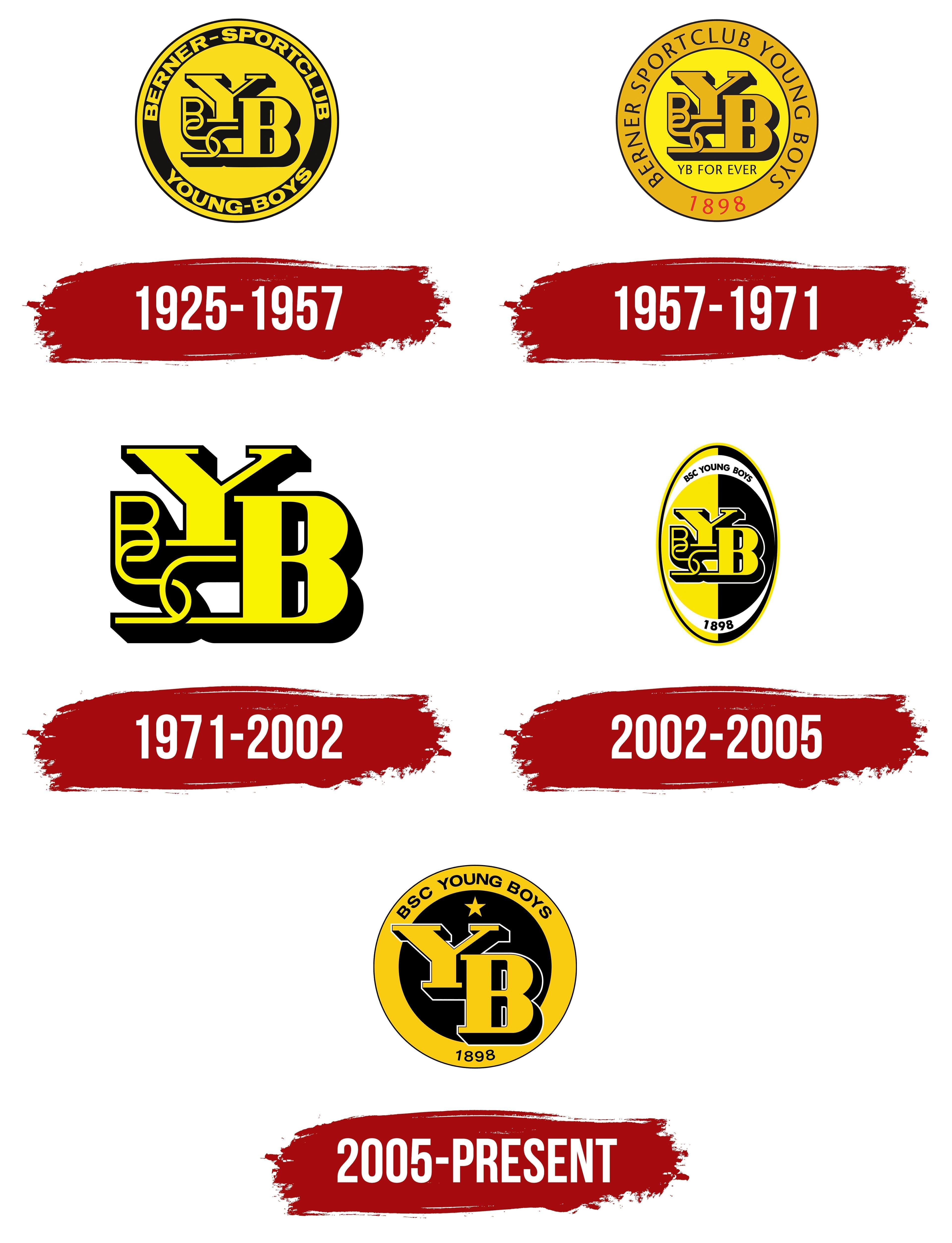
The appearance of its own visual symbol marked a significant moment for the Young Boys football club. In 1925, the team presented the first version of the logo based on the monogram “BSYB.” It gained recognition among fans and became a classic symbol of Swiss football.
The design was built around a combination of yellow and black, which became the club’s official color palette. In the center was the monogram, with large, solid letters outlined and shaded. The shadow created depth and emphasized the letterforms, giving the structure visual density.
Around the main symbol was a circular inscription reading “Berner-Sportclub Young-Boys.” It was done in a heavy geometric typeface that matched the energy of a sports symbol and the team’s character.
The logo became firmly rooted in the club’s identity and served as a recognizable attribute for players and fans. The 1925 version lasted for more than thirty years and established the visual tradition of Young Boys, forming the foundation for the further evolution of the club’s identity.
1957 – 1971

The update of the Young Boys logo gave the club’s symbolism a new tone. Designers changed the outer ring’s color to dark yellow, adding depth and volume to the overall appearance. The inner part of the circle was filled with a brighter yellow. The font of the circular inscription lost its serifs and became lighter.
Below the central monogram, the slogan “YB For Ever” appeared for the first time. It reflected the emotional bond between the team and its fans, emphasizing the continuity of generations of supporters. At the bottom was the club’s founding year, “1898.” The numbers were rendered in red, giving them emphasis and enhancing the contrast within the logo’s structure.
The monogram kept its original shape, but the outline softened, and the shadow thinned. The changes visually lightened the design. The color of the monogram became similar to that of the outer ring. The new design preserved the symbol’s historical foundation while updating it through color and typography.
1971 – 2002

The early 1970s marked Young Boys’ transition to a new visual strategy. In 1971, the team abandoned complex graphic elements, enclosed contours, and decorative inscriptions, choosing a minimalist format. For the first time, the logo featured a monogram without borders or mottos.
The design was built around letters. The upper and right parts featured larger letters “Y” and “B,” while the lower-left area featured a decorative link between “B” and “S.” The yellow color took on a more intense tone. Around the letters was a heavy black shadow adding volume.
The typographic part retained its earlier character. The letters were rendered in a serif style with thick lines and projections, giving the symbol a connection to classic European football aesthetics. The new minimalism gave the Young Boys a modern identity for their time, emphasizing the club’s professional level and image.
2002 – 2005

The redesign of the early 2000s marked a transition for BSC Young Boys to a new visual identity. For the first time, an oval emblem shape was introduced, setting the team apart from its competitors. In the center was the iconic “BSYB” monogram, rendered in a volumetric style with thick strokes and heavy shading. The structure of the letters was preserved but became more compact and balanced.
The oval background was divided into two halves. The left half was yellow and the right half black. These colors had been used by the club since 1898. To prevent the monogram from blending into the background, it was outlined with a thin white contour.
Along the upper and lower edges were white curved ribbons. The top ribbon contained the inscription “BSC YOUNG BOYS,” set in a black sans-serif font. At the bottom was the founding year, “1898.” The oval shape was enclosed in a double outline, giving the design a sense of completeness and precision.
The redesign served as a transitional stage, strengthening the club’s visual system without radical changes and maintaining continuity in the evolution of its symbolism.
2005 – today

The return to the circular form became a symbol of stability and continuity for the club. After experimenting with the oval shape, the team decided to return to the classic structure, giving it a modern sound. The new emblem became one of the most concise in Swiss football while preserving historical recognition.
The club returned to a circular logo background. It consists of a large, dark yellow outer ring, while the inner part is black.
On top of the circular background, the new “YB” monogram appears. The club abandoned the complex, intertwined lines of the previous abbreviation. The new abbreviation was created in a straightforward serif style. The letters are colored in rich yellow, enhanced with shadow detailing and a white outline. This creates the effect that they do not belong to the flat background but appear to hover above it.
Along the upper edge of the outer ring is an arched inscription “BSC YOUNG BOYS,” set in a geometric sans-serif font. In the lower part is the founding year “1898,” rendered in the same font. Above the monogram (inside the black inner circle) is a yellow five-pointed star symbolizing the team’s championship titles.
The modern version of the logo preserves the continuity of the Young Boys image, combining a restrained form with a saturated color accent and a nod to the club’s history.
