


 Above the Tie Logo PNG
The Above the Tie logo stands for quality and attention to detail. The brand is inspired by the idea of transforming shaving from a routine necessity into a pleasant ritual, offering tools designed for comfort and durability. The focus is not on trends but on reliable materials, precision craftsmanship, and thoughtful balance.
Stan Hickam founded Above the Tie in Maryville, Tennessee, in 2012. From the beginning, the company focused on stainless-steel wet-shaving razors and related accessories. While much of the market relied on plastic or inexpensive alloys, ATT used 303 and 316L steel, targeting a growing community reviving traditional shaving through forums, specialist blogs, and online discussions.
Production remained in the United States from 2012, with parts made and inspected in a small workshop. The company presented domestic manufacturing as a point of difference from lower-cost razors produced in Asia. Its products used all-metal construction without plastic components and were developed as durable tools rather than disposable goods.
In 2013, ATT introduced its first razor range with several heads offering different levels of blade exposure. Buyers could choose a plate based on beard density, skin sensitivity, and preferred shaving feel. The catalog expanded in 2014 with additional heads designed for different facial hair types and user needs.
During 2015 and 2016, the company concentrated on tighter machining tolerances, improved metal finishing, and stricter quality control. Above the Tie competed with Merkur, a long-established German maker of double-edge razors, and British brand Edwin Jagger. Its position rested on American production, stainless-steel construction, interchangeable heads, manual inspection, and precision machining for wet-shaving buyers.
Meaning and History
What is Above the Tie?
This American company produces premium razors made of titanium and stainless steel. The products are designed for those who appreciate classic shaving and are distinguished by high-quality manufacturing. The lineup includes models with varying levels of aggressiveness, allowing users to choose the best option for their skin type and facial hair. The products feature a modular system that enables head replacements for greater convenience and comfort. The manufacturing process is based on precise technology, ensuring durability and reliability in each item.
2011 – 2024

The company was founded in 2011 by Stan Hickam, who initially began by restoring old Gillette safety razors and reselling them on eBay. Later, his daughter, Mariah, and son-in-law, Matt, joined the project, taking over the development of the service and the online platform. The Above the Tie logo appeared in the same period.
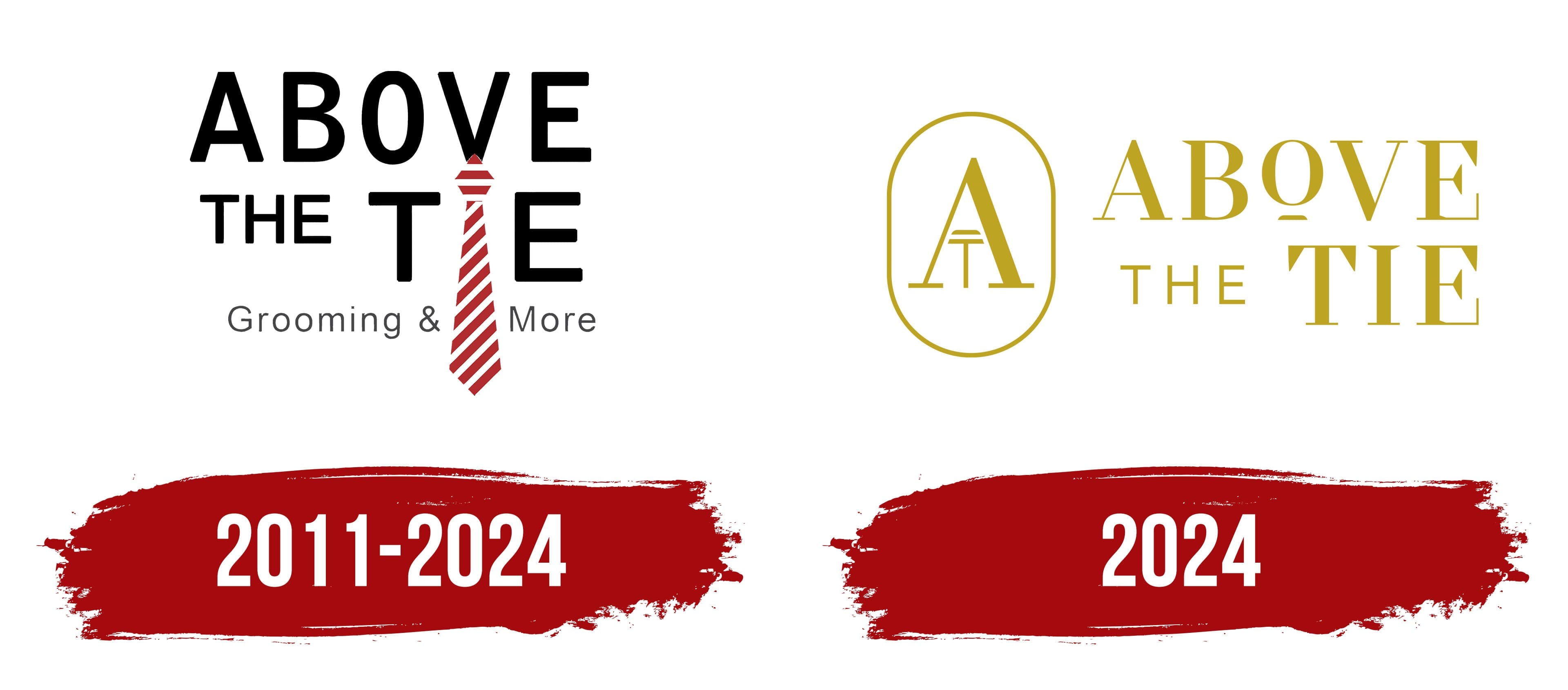
Its design was built on a horizontal structure. The main name was arranged in two lines. In the upper line, “ABOVE,” and in the lower line, “THE TIE.” The letter “I” was replaced with a stylized image of a necktie. In conclusion, the block was supplemented with the line “Grooming & More.” The upper part set the dominant emphasis, the middle level displayed the brand name, and the lower part provided informational clarification.
The construction of the sign was distinguished by integrating the symbol into the text row. The tie, designed with diagonal stripes of dark red and white, created the vertical axis of the composition and highlighted the word “TIE.” The symbol was associated with a business style and neatness, reflecting the brand’s specific characteristics.
The font system was organized into distinct levels. The upper line was set in a sans-serif bold typeface. “THE TIE” repeated the same style; however, the letters “THE” were reduced relative to the main ones. The lower line with the slogan was distinguished by lighter plasticity. For it, a thin font with soft rounded forms was used. In the main block, uppercase was applied; in the slogan, a mixed variant with capital initials was used. Letter spacing remained even, and the text’s proportions were preserved.
The palette used three dominant shades. Black as the main text color, dark red with white diagonals for the symbol, and gray for the slogan. Saturated elements formed emphasis, neutral ones softened perception.
The logo’s symbolism conveyed neatness and status. The tie served as a symbol of discipline and tidiness, connecting the brand with the culture of grooming and classic men’s style.
2024 – today

The departure from the previous facet with the tie became the main visual change in the update of Above the Tie. According to Michael Gauthier, who carried out the redesign, the previous emblem did not convey the classic character of the products. His approach embraced mid-20th-century aesthetics, enabling him to emphasize the brand’s premium status and link the logo to images of the “golden age” of traditional razors.
The updated brand system was officially presented in December 2024 and was consolidated in production for products in 2025. It is known that the new concept was being developed even before October 2023, when Above the Tie came under Blackland Razors’ management. Despite the change in ownership, the brand maintained its independence and continued to produce entirely in America, using stainless steel milling.
The composition of the Above the Tie logo is built horizontally. On the left is a symbol in the form of the letter “A” in an oval frame, inside which is integrated the silhouette of a razor, read both as an abstract form and as an intersection with the letter “T.” On the right is the text “ABOVE THE TIE.” Balance is achieved because the symbol and the inscription are on the same line and are perceived as a single block.
The font part is based on a serif typeface. The letters are large, and the spacing between characters is increased, which creates a sense of airiness and strictness. The accent in the word “ABOVE” is created by the letter “O,” executed in a reduced form with underlining below. In the block “THE TIE,” the word “THE” is set in a thinner, smaller type than the main part. The entire set is executed in uppercase, except for syllabic differentiation.
The color palette is reduced to a golden shade, applied equally to both the sign and the text. It forms an image associated with the premium segment.
