


 Americans with Disabilities ACT Logo PNG
The Americans with Disabilities Act logo stands for open doors for everyone, regardless of physical ability. It is associated with accessibility in cities, transportation, education, and workplaces, serving as a reminder of equal rights and opportunities for all.
The Americans with Disabilities Act (ADA) emerged from the broader civil rights movements of the 1960s. Its legislative roots trace back to the Rehabilitation Act of 1973, which prohibited discrimination in government-funded programs.
In the 1980s, efforts intensified with the publication of the National Council on the Disabled’s “Toward Independence” (1986), which recommended comprehensive civil rights legislation. In 1988, a preliminary version was introduced in Congress by Representatives Tony Coelho and Lowell Weicker, along with Senators Tom Harkin and others. Public hearings in 1989, notably the “Capitol Crawl,” dramatically underscored the urgent need for the law.
On July 26, 1990, President George H.W. Bush signed the ADA, marking a significant legal milestone for disability rights. The initial implementation regulations appeared in 1991, establishing standards for accessible design that transformed public infrastructure.
Throughout the 1990s, the ADA reshaped workplaces, public spaces, and transportation. However, a series of 1999 Supreme Court decisions narrowed the scope of the law. In response, Congress enacted the ADA Amendments Act (ADAAA) in 2008, restoring and broadening the original protections.
In 2010, the U.S. Department of Justice revised the ADA regulations to incorporate modern technological developments. Further digital accessibility guidelines emerged in 2015, coinciding with the ADA’s 25th anniversary, addressing online accessibility.
Between 2020 and 2023, federal policies increasingly focused on accessibility in new technologies, reflecting the ongoing evolution of disability rights legislation.
Meaning and History

What is Americans with Disabilities Act?
This is a law that protects the rights of people with disabilities and prohibits discrimination against them in all areas of life. It regulates employment, public transportation, government and commercial facilities, and telecommunications services. The law guarantees equal access to information and services, sets accessibility requirements for buildings, and mandates that employers create a comfortable work environment for employees with special needs. Protection extends to individuals with physical disabilities, chronic illnesses, or mental disorders.
Now
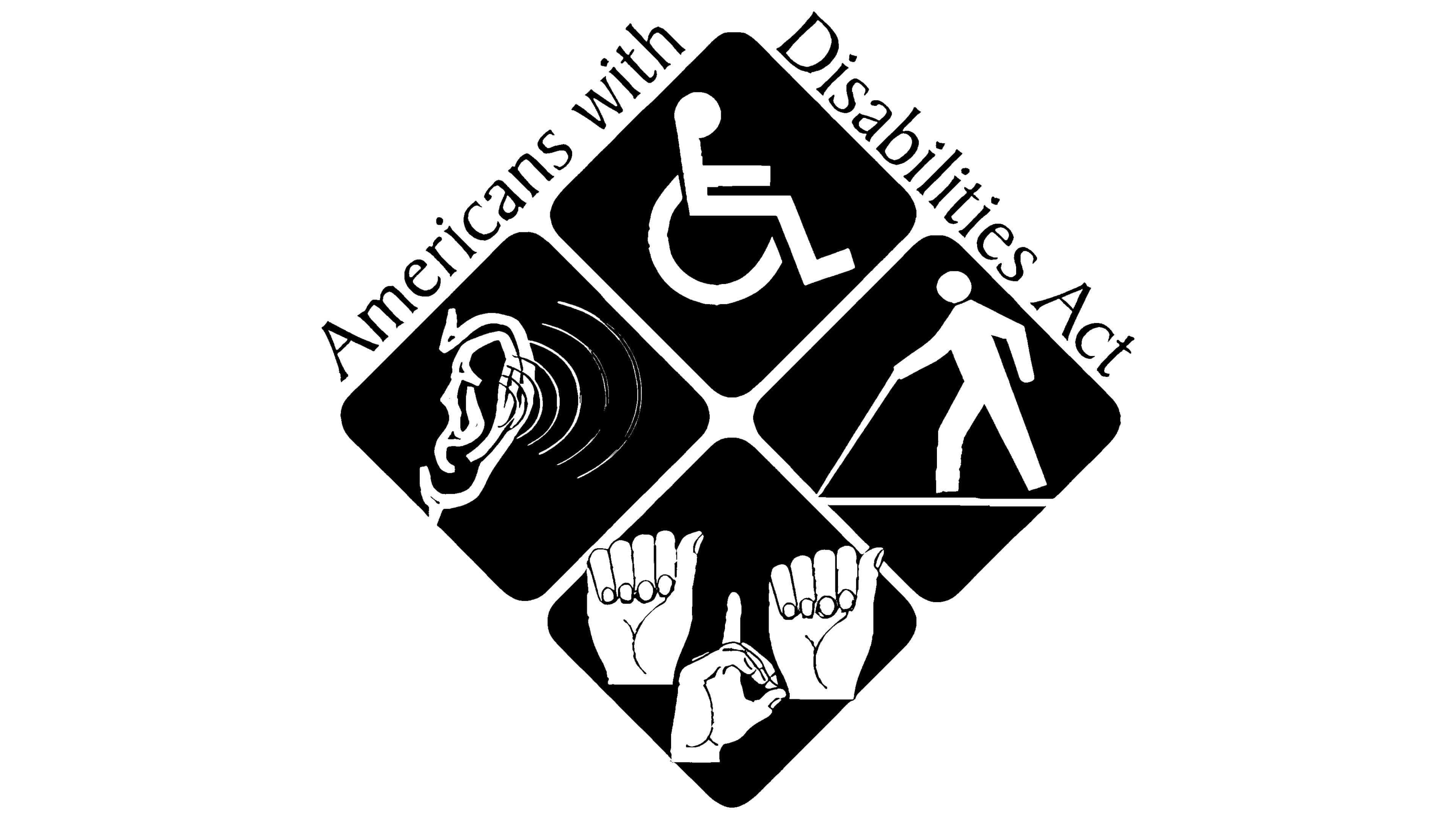
The Americans with Disabilities Act logo is rendered in a diamond shape. The main figure is a large square set on its corner and divided into four equal rhombic parts. The construction is symmetrical and strict.
Each of the four segments contains a pictogram representing different aspects of accessibility. The top segment features an image of a person in a wheelchair, serving as a universal symbol of physical accessibility. In the bottom segment, a hand forms a sign language gesture, referencing the community of people with hearing impairments. The left segment features an image of an ear emitting sound waves, linking the sign to the theme of hearing aids and hearing correction. In the right rhombus is a silhouette with a cane symbolizing support for people with visual impairments.
The text is placed along the outer contours of the large diamond and reads: “AMERICANS WITH DISABILITIES ACT.” All words are in uppercase letters in a sans-serif typeface with even proportions.
The visual concept is executed in a black-and-white palette. Black serves as the background for all four segments and is used in the outlines of the symbols. White is applied to the pictograms. The pictograms are simplified to minimal outlines. The concise stylization ensures their recognition and balance within the overall structure. The four symbols are distributed evenly, creating harmony and emphasizing the idea of multifaceted support.