


 Ariel Logo PNG
The Ariel logo is associated with the cleanliness and freshness of household laundry. It emphasizes the detergent’s quality, making everyday washing efficient and pleasant.
Procter & Gamble launched Ariel in the UK in 1967 with a detergent formula combining enzymes and bleach. The enzymes targeted organic stains such as food, blood and grass, while bleach handled more persistent marks. The formula was developed for washing at lower temperatures and was initially aimed at semi-automatic washing machines, then adapted as fully automatic machines became more common.
Competition with Unilever’s Persil shaped the European market as both brands expanded their product ranges. In 1980, Ariel added gels and liquid detergents, giving consumers alternatives to powder and improving use in low-temperature washes. In 1992, Ariel Color was introduced for colored fabrics, with a formula intended to reduce fading during repeated washing.
In 1993, production began in Russia at Procter & Gamble’s Novomoskovsk plant, supporting the brand’s expansion in the post-Soviet market. During the early 2000s, Ariel introduced Liquitabs, soluble capsules containing concentrated liquid detergent. The format removed the need for manual dosing and simplified handling.
In 2012, Ariel PODS appeared with three separate chambers containing detergent, stain-removing agents and conditioner components. Keeping the ingredients separate until washing let them remain separate before dissolving in water. In 2020, the range was updated with Ariel All-in-1 PODS, extending the capsule format while powders, gels and liquids remained part of the product line.
Meaning and History
What is Ariel?
A famous brand of laundry detergents that ensures high-quality washing even at low temperatures. Their green packaging and red lettering make products easily recognizable. The range includes classic powders, liquid concentrates, and multifunctional capsules combining detergent, stain remover, and fabric softener. Enzymes in the formula remove grease and protein stains, while optical additives enhance the fabric’s brightness.
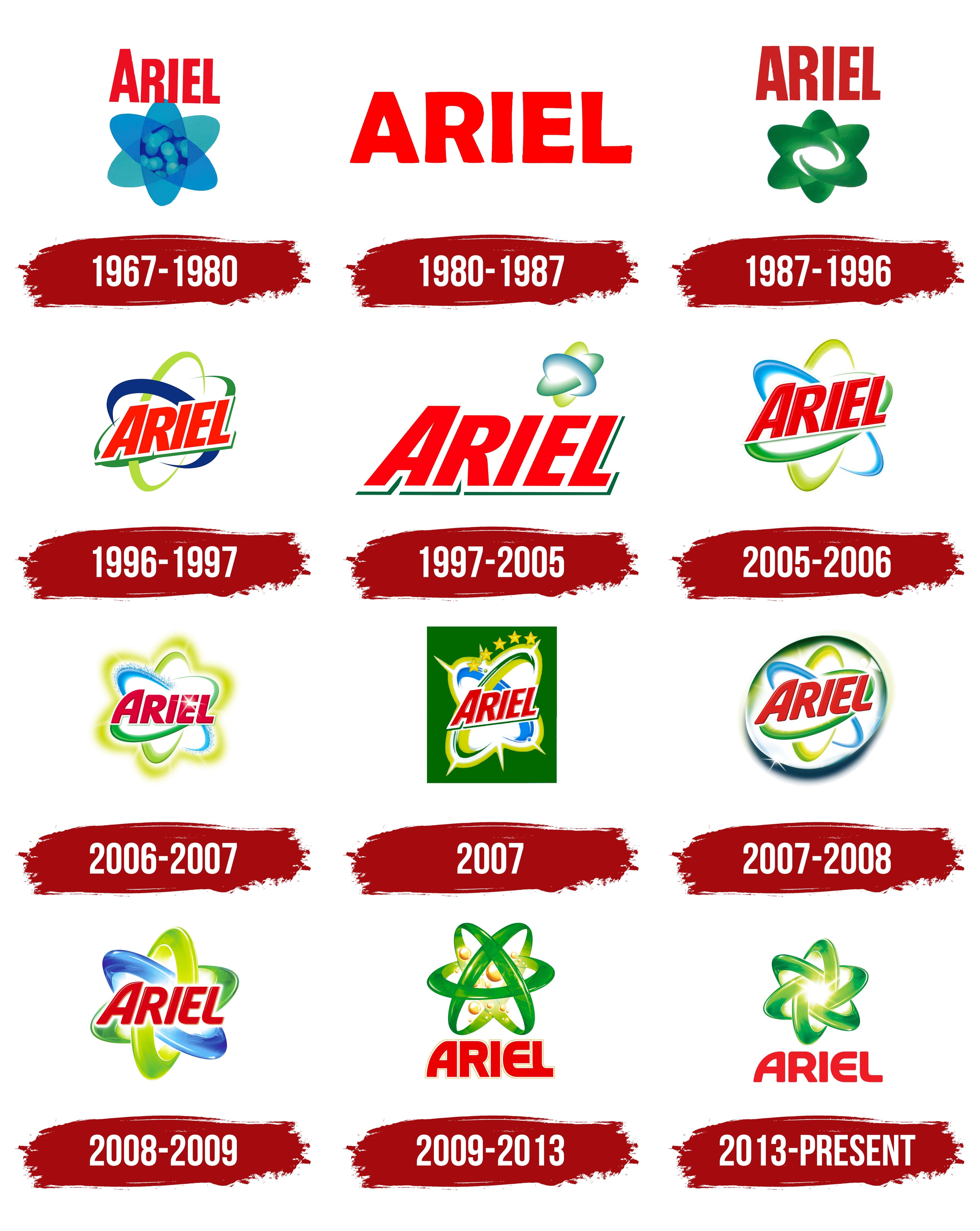
1967 – 1980
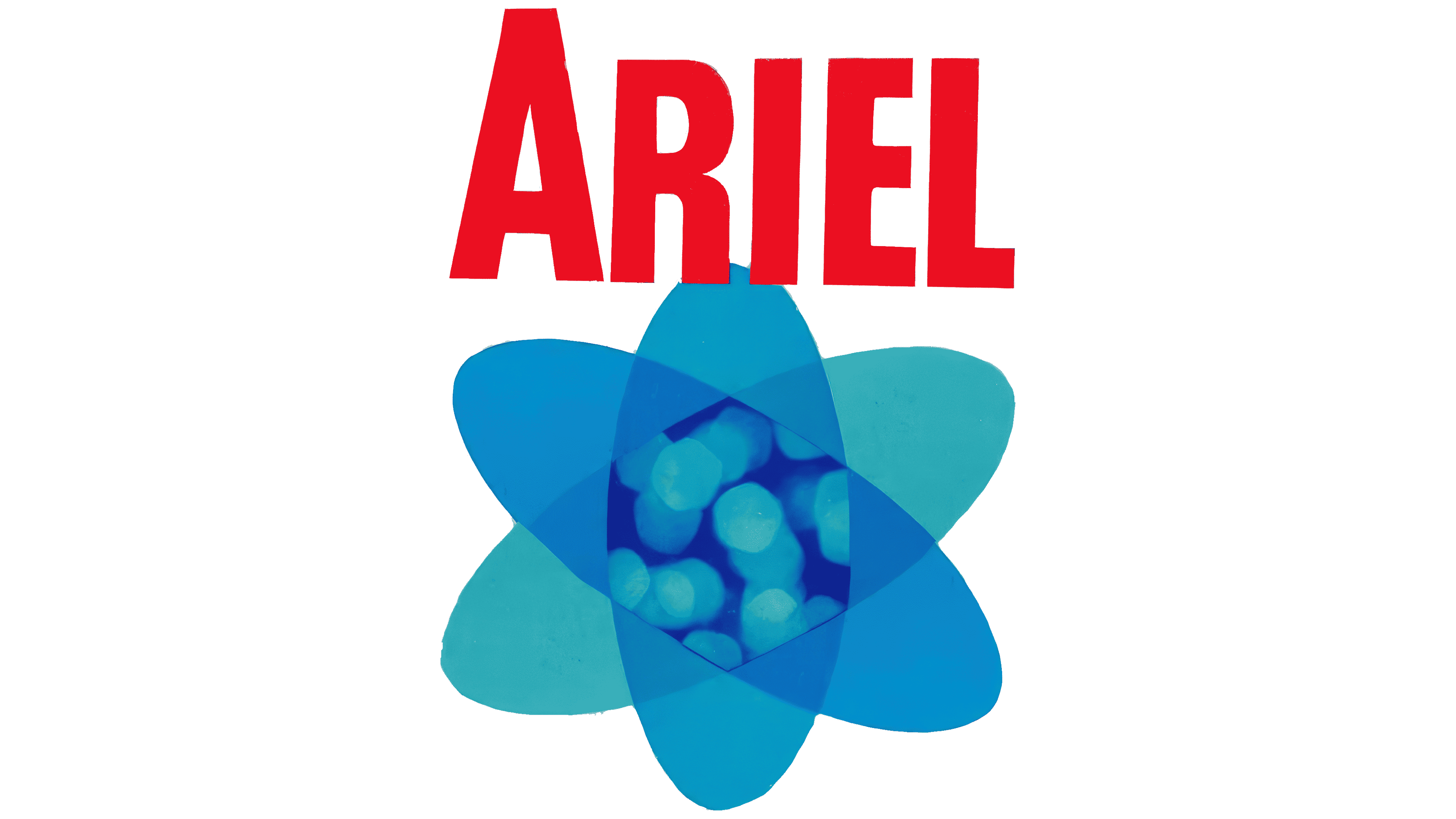
The Ariel brand’s history began with a visual image that emphasized its connection to science and progress. In 1967, the company introduced its first logo, combining cool tones with bright accents.
The word “ARIEL” was done in red, using a sans-serif font. A blue atomic symbol contrasted with it. Their combination looked energetic and stood out through the sharp color contrast.
The central part and the surrounding ellipses represented molecular activity. They demonstrated detergent action on fabric stains at the particle level.
The atomic imagery reflected the public interest in science during the 1960s. It expressed the company’s aspiration toward technical excellence and linked the product with the image of advanced technology. The color reinforced the sense of freshness and cleanliness, becoming the key visual message of Ariel’s first logo.
1980 – 1987

The brand’s transition to a new visual system was accompanied by the removal of the atomic image and all other metaphorical forms. The logo was based on a wordmark using a sans-serif font with dynamic lines. The plasticity of the letters emphasized the brand’s energetic, modern character, consistent with Ariel’s position as an innovative everyday product.
The color system relied on a deep red shade. It symbolized the performance of washing and confidence in the results. Rejecting additional elements enhanced the mark’s visual clarity, focusing the viewer’s attention on the name as the primary carrier of meaning.
The sans-serif font conveyed a sense of technology and clarity. Its structure supported the idea of practicality and a rational approach associated with the product’s household function.
1987 – 1996
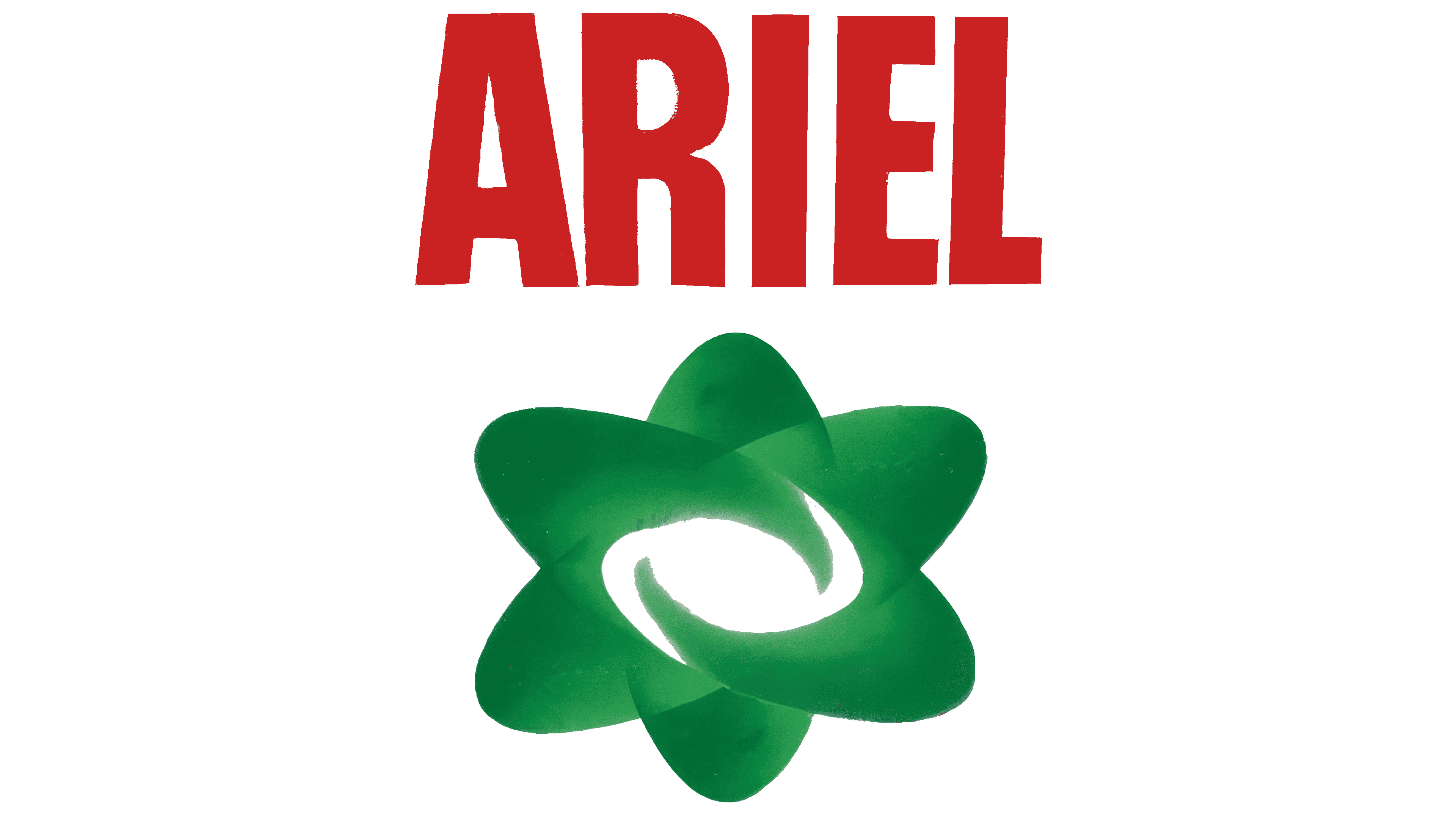
The Ariel logo was updated with new details. A green symbol appeared, resembling an atomic structure with a swirling center. The image linked the brand to science, washing, and a sense of freshness.
The green color emphasized the company’s environmentally oriented direction and was associated with the purity of its products. Smooth lines in the symbol’s structure enhanced the natural impression, bringing the brand closer to the image of nature.
The word “ARIEL” kept its large lettering. It remained red, and the letters were slightly stretched upward. The combination of the green symbol and the red text created a strong visual image that worked effectively on product packaging.
1996 – 1997
A complete redesign gave the logo a new level of visual complexity. The name was set in an italic typeface with a slight forward tilt and a diagonal rise. The red font maintained its brightness and contrast.
The main element became three-dimensional stripes surrounding the text. They were in shades of green, blue, and dark green. Their shapes evoked associations with natural water flows, linking the product with the theme of cleanliness and renewal.
The emblem was built on the contrast between color and typography, enhanced by the tilt. Visually, the brand image became more modern and youthful, aimed at an active consumer.
1997 – 2005

The design once again emphasized the brand’s scientific character. The name was rendered in bold red italics, reinforcing the association with the product’s energy and activity.
The main focus was a small atomic symbol placed above the letters. It was created in soft, gradient shades of blue and green, referring to the microscopic level of the detergent’s action and symbolizing cleaning at the molecular level.
The combination of the font and atomic graphics reflected the brand’s concept. The detergent works deeply, breaking down dirt within the fabric’s structure.
2005 – 2006

In the new version, a large swirl returned around the brand name, created with shades of blue, green, and yellow. They were associated with cleansing energy and the flow of water.
The brand’s text mark kept the red color and a slight forward tilt. The diagonal positioning emphasized movement, and the bold font enhanced the impression of strength and product performance.
The combination of green and blue in the swirl reinforced associations with nature and purity. Green symbolized naturalness, and blue indicated the freshness and clarity of water. Together, they shifted the focus to environmental awareness and gentle product care. The design combined natural imagery and the energy of action.
2006 – 2007

At this stage, the Ariel logo received an even stronger natural motif with additional details. In its center was the brand name in red. The diagonal layout disappeared, but the text was written in a new font. It was placed on a large, green, blue, and yellow shape made of stripes of varying thickness, resembling a flower that intertwines water and leaf imagery.
Additional elements included bubbles along the contour of the water motif (blue gradient stripes). They strengthened associations with cleanliness and gentle action, reflecting the detergent’s purpose.
The combination of bright shades and floral symbolism marked a new stage in the brand’s identity. The design appeared lively and created a strong contrast on the packaging, making the product stand out on store shelves.
2007
The update aimed to visually express high quality. The logo included five gold stars. They symbolized a high standard of washing and served as a sign of product reliability.
The main text design retained the red color, while the font changed, and the diagonal positioning with a tilt was reintroduced. Around the letters remained a stylized swirl of lines, but in a more simplified graphic form. It was associated with the detergent’s powerful cleaning force.
Green was linked with freshness, and blue conveyed the idea of clean water. Their combination complemented the symbolism of the stars, creating a harmonious brand image that united performance and reliability.
2007 – 2008
The logo received a new shape with a focus on volume. The central symbol became a circle resembling a water drop.
Inside the circle was the brand name, in large red letters, set in a bold sans-serif font. Around the text were green and blue swirls. They still symbolized freshness and were associated with the cleaning process. Additional light accents enhanced the glowing effect, evoking the idea of fabric brightness after washing.
The design combined several meanings. The circle referred to water, the swirls represented cleanliness, and the contrast between the red text and cool tones made it effective for brand communication.
2008 – 2009
The next version of the Ariel emblem introduced a new visual concept that emphasized spatial depth. The red brand name was positioned to appear to float above the background. The font became slightly rounded and visually softer.
Behind the text was a composition of intersecting green and blue swirls. Whereas they were once simpler in design, they were now rendered in semi-transparent, glass-like tones, forming a three-dimensional star. The overall image was linked to the product’s physical and chemical properties, thereby enhancing associations with cleaning energy.
The color palette included bright lime and sky-blue shades with transparency effects. They created a feeling of freshness and symbolized the purity achieved during washing. The design combined the product’s cleaning power with visual lightness.
2009 – 2013
This version combined the text and a symbol reminiscent of a scientific model. The name was highlighted in red and executed in a simple flat sans-serif font.
Above the text was a semi-transparent green structure. Its shape resembled molecular orbits rotating around a center. Inside the structure were yellow spheres. They symbolized the detergent’s active effect on dirt at a micro level.
The red name maintained the brand’s energy. At the same time, the orbital form, highlighted in yellow, underscored the product’s technological features and emphasized a scientific approach to fabric cleaning.
2013 – today
The agency Landor Associates, experienced in working with global brands, participated in the creation of the new logo. The redesigned symbol was based on a three-dimensional atom composed of interwoven light strands in a green gradient. Their form represented cleansing molecules and was associated with freshness and purity.
The composition also included the brand name, with red letters contrasting against the green atom and standing out through a rich tone. The font used was close to Handel Gothic, characterized by straight cuts and rounded outlines.
The atom’s inner glow added a flash-like effect, symbolizing the detergent’s power and its focus on removing dirt. The combination of bright red text and the volumetric green structure highlighted two key product qualities: strength and advanced technology.
