


 Burnley Logo PNG
The Burnley football club logo reflects the team’s historical traditions and athletic nature. Its formal style emphasizes stability, recognition, and the club’s importance to fans and the local community.
Burnley Football Club was founded on May 18, 1882, when the Burnley Rovers rugby team switched to soccer. Initially playing in blue-and-white kits, the club soon moved to Turf Moor stadium, their home ever since.
In 1888, Burnley became one of the twelve founding members of the Football League. A year later, the team won its first Lancashire Cup. In the 1920-21 season, Burnley won their first English championship, setting a national record of 30 consecutive unbeaten matches.
Burnley won their second English title in 1960 and reached the European Cup quarter-finals. Later, the club faced serious difficulties, nearly losing its professional status in 1987.
In 2009, after beating Sheffield United at Wembley, Burnley secured its first promotion to the Premier League. Under manager Sean Dyche, the club achieved a record seventh-place finish in the 2018 season, qualifying for European competition for the first time.
In December 2020, the American firm ALK Capital acquired Burnley, marking the beginning of a new chapter. Coach Vincent Kompany led the club back to the Premier League in the 2022-23 season, accumulating 101 Championship points. After Kompany’s departure in the summer of 2024, Scott Parker took charge, immediately bringing Burnley back to the top division.
Meaning and History
What is Burnley?
It is a soccer club from Burnley in Lancashire, England, competing in the Premier League. One of England’s oldest teams, it was among the founding clubs of the Football League. The club has won two league championships and the FA Cup. Home matches are at Turf Moor, one of England’s oldest active stadiums.
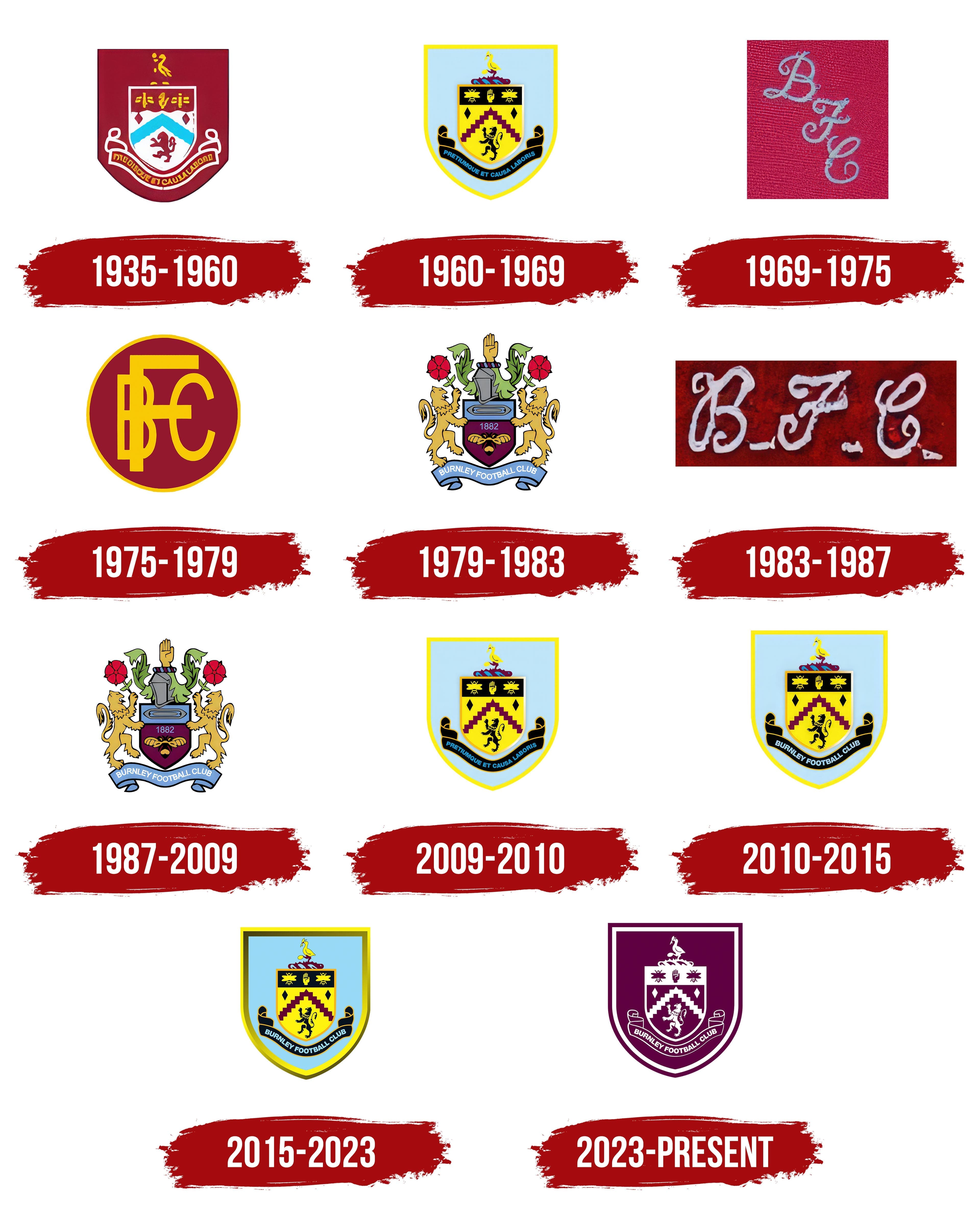
1935 – 1960

The first appearance of the town crest on Burnley’s kit is linked to the FA Cup semifinal of 1935. The official municipal symbol was permanently adopted by the club, with its use beginning in the 1935–36 season and continuing until the late 1950s. Before the transition to civic heraldry, the Prince of Wales’s feathers had been used between 1887 and 1895, and again in 1914. However, it was the coat of arms that proved to be the most enduring mark, remaining with the club for nearly a quarter of a century.
The visual composition was based on the canons of English heraldry. A shield was set against a claret background, its shape repeated. A white border around the inner shield defined the proportions and formed a closed silhouette. In the upper zone of the inner shield was a horizontal stripe with golden symbols, stylized as decorative script. In the lower part of the composition was a blue chevron pointing upward, beneath which was a claret silhouette of a lion. The figure of the lion referred to royal authority and to Prince Albert Victor’s visit to the town in 1886.
The crest’s broad iconography included numerous local images. Among the symbols were bees, representing the town’s industrious character and associated with the Bee Hole End terrace; depictions of cotton plants, a reminder of the region’s industrial base; and a hand bearing the Towneley family motto, “Hold to the Truth.” Additional elements included a stork associated with the Starkie family, the Lacy family’s lace knot, and a stylized hill marking the local landscape.
The inscription was placed on a ribbon beneath the shield. The golden letters were executed in a calligraphic style that gave the emblem a ceremonial and archaic character.
1960 – 1969

The new version of Burnley’s crest in the 1960s was also built on the principle of “a shield within a shield,” creating a layered effect and a ceremonial tone. The outer shield had a light blue field with a wide yellow border, and inside it was a golden shield bearing symbols associated with both the town and the club.
At the top of the inner shield was a black horizontal stripe. At its center was a raised hand, flanked by bees. The composition referred to the motto “Pretiumque et Causa Laboris” (“The Reward and Reason of Labor”). The hand symbolized truth and honesty, while the bees recalled the region’s industrious foundation and industrial character.
Below was a stepped, claret-colored chevron. Its form evoked a staircase or a heraldic chevron, a sign of advancement and achievement. Beneath it was a dark lion, representing courage and ties to monarchical authority.
On either side of the golden shield were two black lozenges that helped maintain visual balance. Above the entire composition stood the figure of a crane or stork. The bird was set on a stylized hilly base decorated with vegetal elements. This motif came from the symbolism of the Starkie family and was tied to local traditions.
The text element was placed in the lower segment. A black ribbon bore the inscription PRETIUMQUE ET CAUSA LABORIS, executed in light blue letters. The contrast between the dark background and the light type connected the text block to the emblem’s outer contour and emphasized the solemnity of the motto.
The color palette combined light blue, yellow, gold, claret, and black. The interaction of the shades created a hierarchy: the outer shield formed the frame, the inner shield drew attention to the symbols, and the ribbon with the motto completed the composition.
The crest embodied labor, honesty, local roots, and strength, remaining a link between the club and its town. Later, this version resurfaced in history. In the 2009–2010 season, it was used again to mark the league title’s 50th anniversary, with the original motto preserved on the ribbon.
1969 – 1975
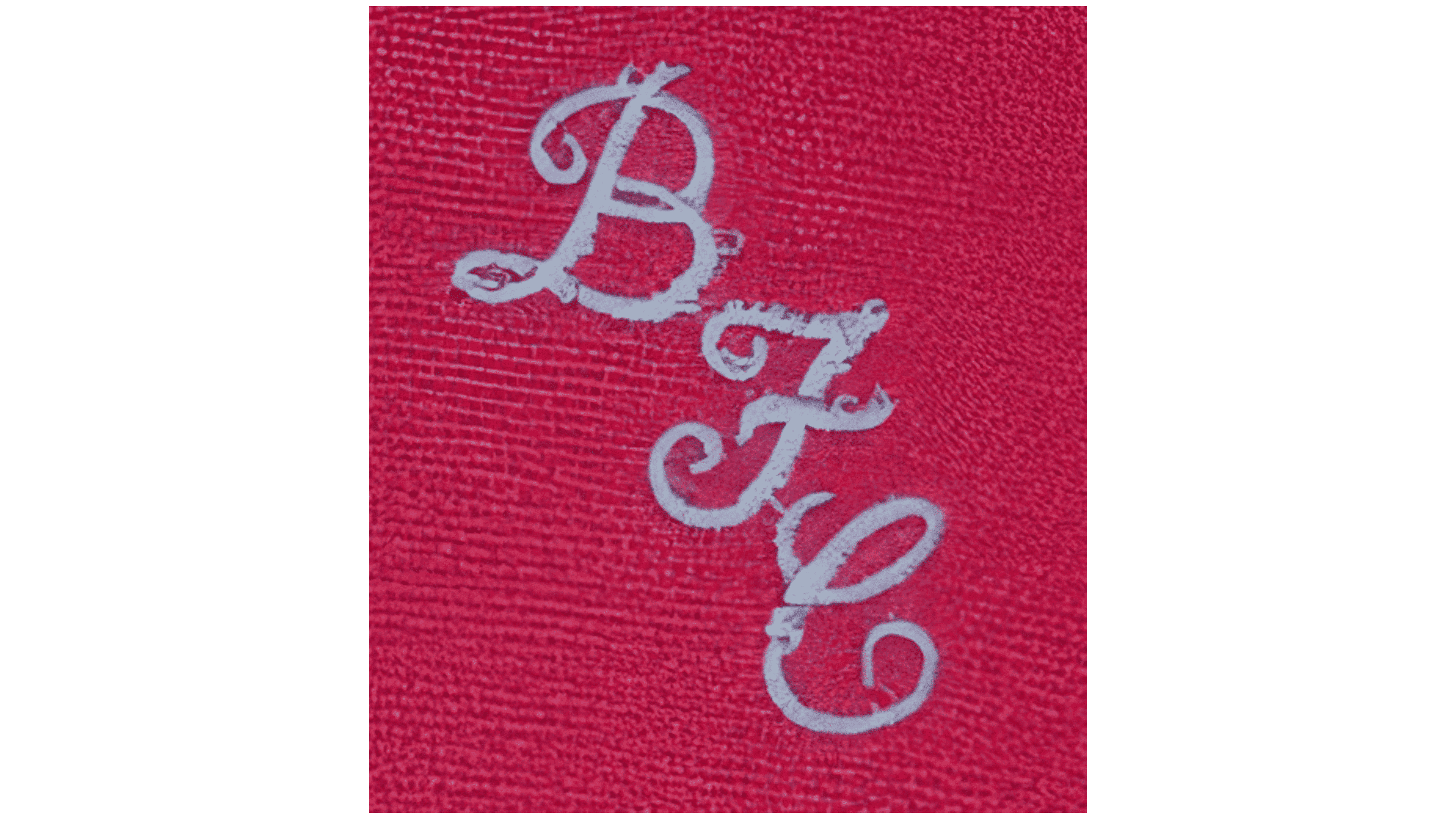
At the end of the 1960s, the club shifted from heraldry to minimalism. The complex coat of arms was replaced with a simpler monogram composed of three letters, “BFC.” The new form of identification reflected the spirit of the time: sports organizations were seeking more modern visual representations and moving away from elaborate heraldic structures.
The composition was built on a diagonal, with the letters arranged from the upper-left corner to the lower-right corner, creating a sense of dynamism and rhythm.
The typography featured decorative italics. The lines were thickened, and the strokes ended in flourishes, giving the symbol an ornate look that contrasted with the composition’s overall simplicity.
The palette relied on two main colors. Light blue was used for the monogram, while claret red served as the base of the kit fabric.
1975 – 1979

The rejection of heraldic forms and the turn toward minimalism became the main distinction of the club’s emblem in the late 1970s. Instead of traditional animals, ribbons, and mottos, the shirts displayed a circular emblem built on simple geometry and color contrast.
The base was a claret circle framed by a yellow border. Inside the circle was a large monogram, “BFC.” The letters were interconnected so that the verticals and horizontals formed a single ornament. The visual effect was built on a sense of balance and tight cohesion of the elements.
The typography was strict. All the letters were in uppercase, in a sans-serif typeface. The yellow monogram stood out against the claret background, ensuring high contrast and strong visual expression. The yellow outline around the edge supported the same effect, linking the inner and outer layers of the composition.
1979 – 1983

The beginning of this crest’s history is connected to a 1973 competition, won by Mr. Jolleys from Ashton-on-Ribble. Initially, the mark was used sparingly, appearing only on the away kit in the 1976–77 season. Only from 1979 did the club adopt it for the home kit as well, thereby establishing the project as the main emblem.
The design adhered to the canons of heraldry, incorporating numerous details. At the center was a claret shield featuring a large bee and the date “1882,” referring to the club’s founding year. The bee symbol emphasized the town’s industrious character and alluded to the Bee Hole End terrace.
The shield was supported by two golden lions standing on their hind legs. In their paws were red Lancashire roses, affirming the club’s regional identity. Above the shield was a knight’s helmet, flanked by green decorative leaves. The composition was topped by a raised hand, linked to the Towneley family motto “Hold to the Truth,” adding another layer of meaning and securing the tie to local history.
At the bottom of the composition was a blue ribbon. On it, the words “Burnley Football Club” were inscribed in white uppercase letters. This element completed the crest, uniting the rich symbolism with the club’s identity.
The color scheme was built on claret, gold, green, red, and blue. The interaction of shades created a hierarchy: the shield set the foundation, the supporting figures and roses enhanced the decorative character, and the ribbon emphasized the club’s name.
According to the researchers, each symbol had a clear reference: the bee represented persistence and hard work, the hand embodied truth and honesty, the lion was associated with the legacy of Prince Albert Victor’s visit, and the roses confirmed affiliation with Lancashire.
1983 – 1987
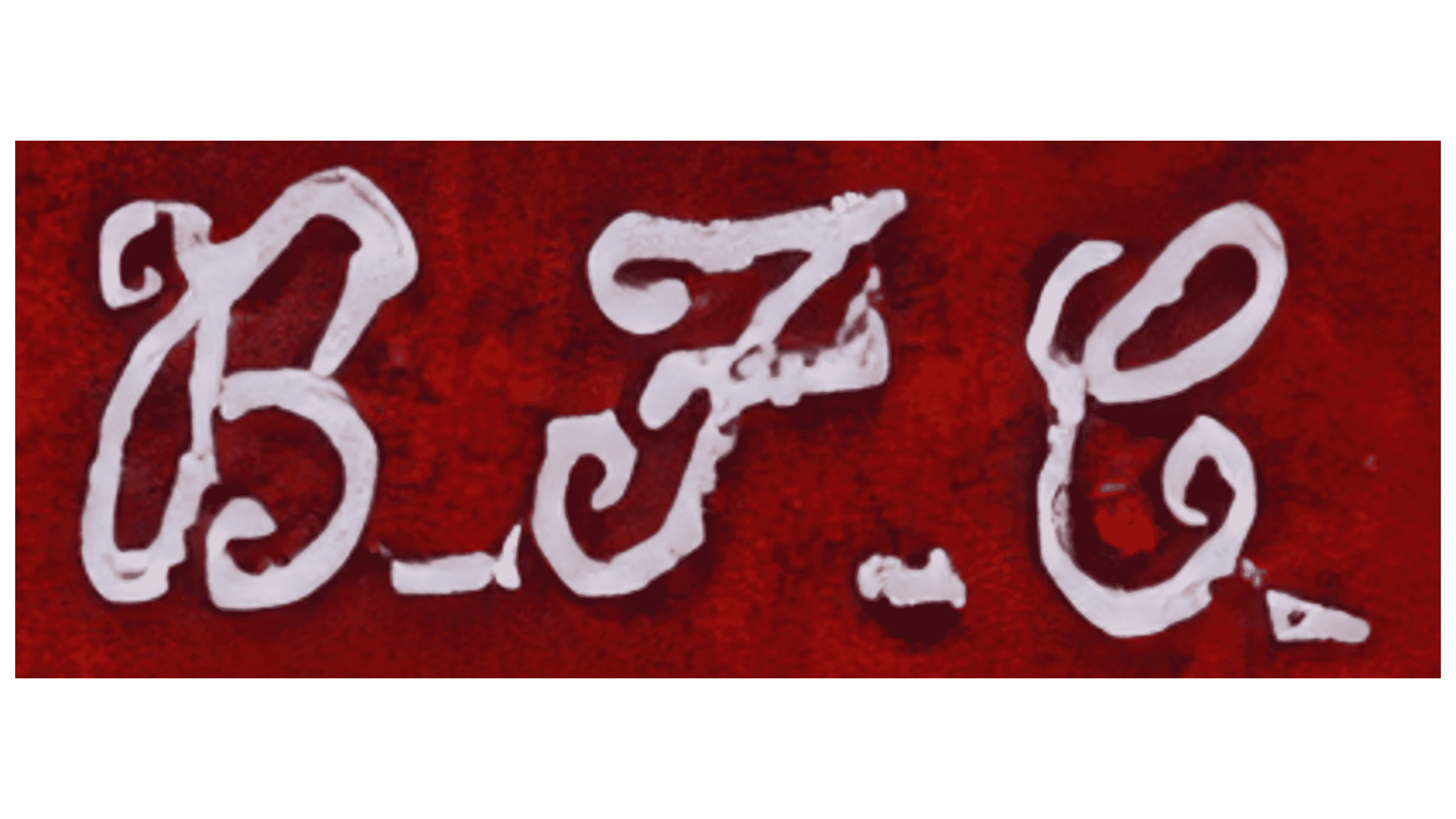
The emblem of the mid-1980s was maximally utilitarian and devoid of former ornamentation. The heraldic structure was abandoned. Burnley’s logo consisted of a horizontal monogram, “B.F.C.,” applied directly to the kit fabric without frames or shields. This step reflected the club’s situation, which at the time faced difficult sporting and financial conditions, requiring a restrained and practical symbol.
The composition was built on the linear arrangement of three letters separated by dots. The monogram was stretched horizontally to ensure ease of perception and make it convenient for use on the kit.
The typographic styling reflected the era’s features. The letters were italic, with smooth curves and light flourishes. Thick strokes gave way to thin ones, forming a handwritten character. This gave the minimalist structure individuality and prevented it from appearing dry.
1987 – 2009
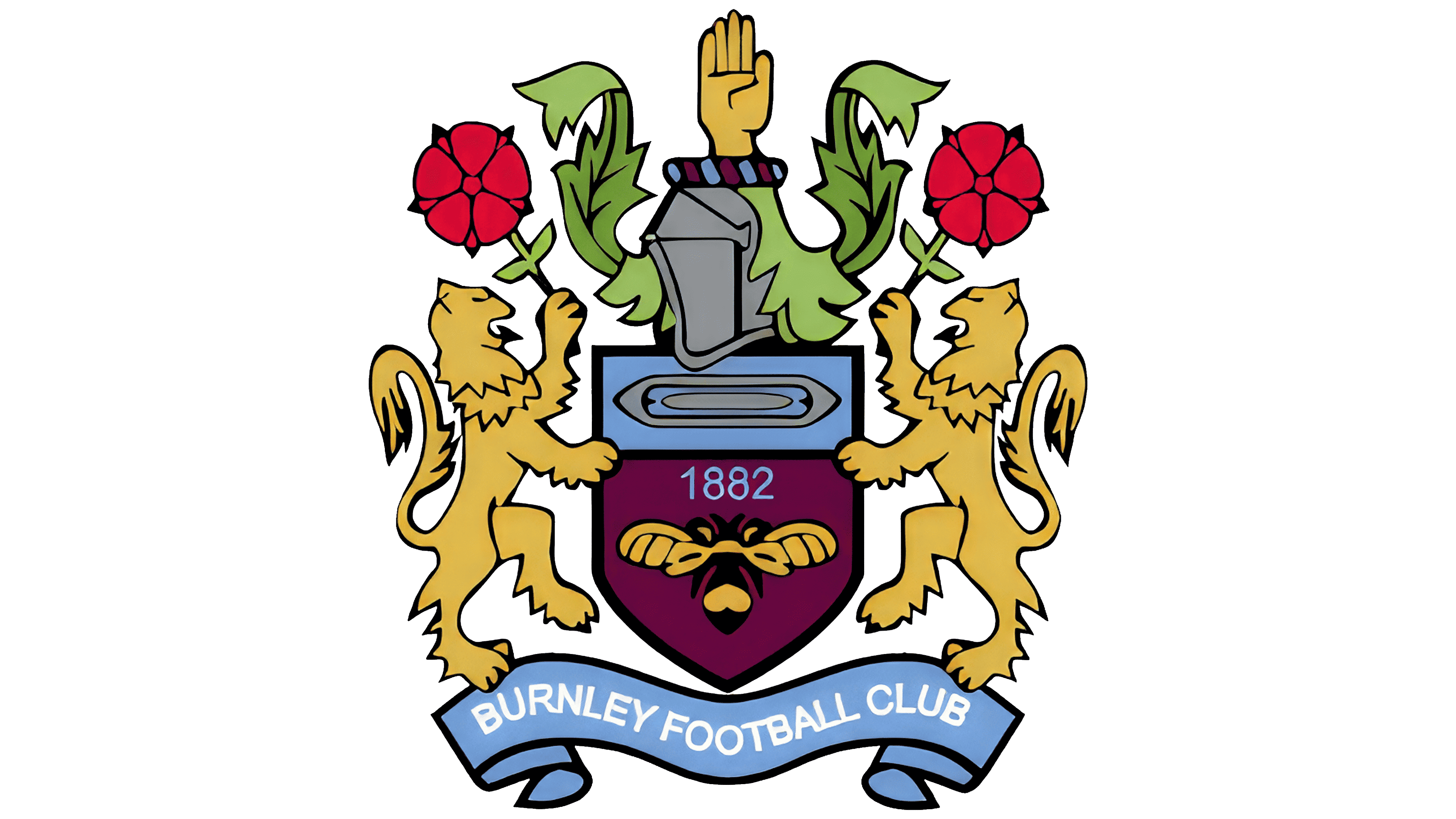
The 125th anniversary provided an opportunity to return to the heraldic composition familiar to supporters from the late 1970s and early 1980s. In creating the new version, the club preserved the structure of the former crest. Still, it intensified the palette and introduced a festive accent in the form of two stars, establishing its status as an anniversary mark.
At the center remained a shield of claret. On it, a bee appeared alongside the date “1882.” The shield was supported by two golden lions, each holding a red Lancashire rose. At the top of the composition was a knight’s helmet decorated with green ornamental leaves, crowned by a raised hand. The lower part of the crest was completed by a blue ribbon with the inscription “Burnley Football Club” in white uppercase letters.
The additions were two golden stars introduced in 1987. Their presence enhanced the emblem’s ceremonial character and reinforced the club’s historical depth.
2009 – 2010

The celebration of the championship title’s fiftieth anniversary prompted a return to the emblem used in the 1960s. The club reproduced it as an exact remake, integrating it into the anniversary kit concept: V-neck shirts with a claret base and light blue sleeves, repeating the style of the set in which the title was won.
The composition followed heraldic logic. The outer shield had a light blue field with a wide yellow border. Inside was a yellow shield filled with symbols. The upper part contained a horizontal stripe with a raised hand at the center, flanked by two bees. Below was a claret stepped chevron. Its form was perceived as a sign of strength and ascension. Beneath the chevron was a lion, associated with monarchical authority.
At the top of the shield, the composition was crowned by a yellow stork. The bird stood on a stylized hill with plant motifs, referring to the Starkie family and the region’s industrial past.
The structure was completed with a black ribbon. On it was the Latin motto “PRETIUMQUE ET CAUSA LABORIS,” executed in light blue letters, translated as “The Reward and Reason of Labor.” The text emphasized the importance of respect for work and its results.
The crest’s palette combined light blue, claret, yellow, and black. The anniversary revival of the emblem demonstrated that, for Burnley, the link between civic symbols and the memory of the championship season was inseparable.
2010 – 2015

At the start of the second decade of the 21st century, the club marked a renewal of its visual identity. The crest of the 1960s was taken as the basis, but the design was adapted to modern requirements. While preserving traditional symbolism, it was made easier to perceive and richer in color.
The composition remained classic. Externally, it did not differ from the previous version. The change was at the base of the ribbon. The black field was preserved, but the text was altered: instead of the Latin motto, the inscription “Burnley Football Club” was displayed. The letters were set in a strict, light-blue sans-serif typeface, which gave the composition a modern tone and made it easier to read.
2015 – 2023

The mid-2010s restyling refined the club’s traditions while introducing modern accents. While retaining the structure and symbolic content, the new crest looked more confident and gained visual depth through a light three-dimensional effect on the shield’s frame. The frame was the main change in the new identity.
The basis remained a light blue shield with a yellow border. The inner part of the shield was executed in yellow, over which ran a claret zigzag chevron. Beneath it was a black lion, symbolizing strength and royal connection. The upper stripe of the shield was black and contained three figures: two bees and a raised hand.
Above the shield stood a crane. In its claw, it held the Lacy knot and stood on a hill with cotton plants.
On the black ribbon at the bottom, the Latin text was replaced with the inscription “Burnley Football Club.” The light blue letters became larger and bolder, retaining the sans-serif form.
2023 – today
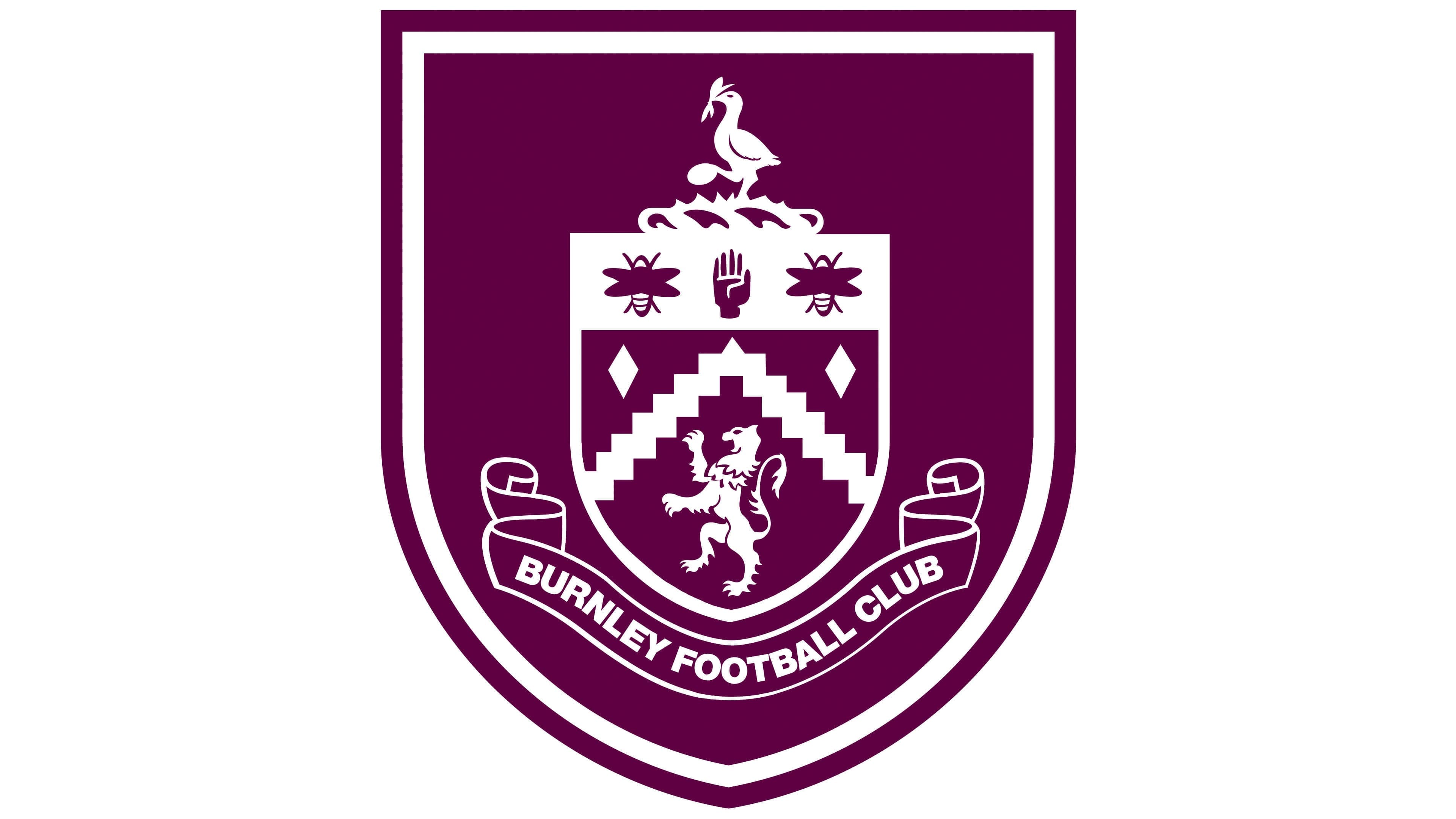
The updated Burnley logo, presented in the summer of 2023, represented a radical revision of the club’s symbolism in decades. Instead of the usual multicolored execution with complex heraldry, Burnley switched to a monochrome format: a claret shield with white depictions of traditional elements.
In simplified form, the key elements were preserved: the crane silhouette on a hill with the Lacy knot, the Towneley family’s raised hand, a pair of bees symbolizing industriousness, the claret zigzag chevron, the lion, and the decorative ribbon with the inscription “Burnley Football Club.” For the first time in the club’s history, the yellow, light blue, and gold accents disappeared.
The logo sparked mixed reactions among supporters. Some fans considered the simplification excessive, likening the mark to a stencil or print template and noting that it “does not work well on the international stage.” Others supported the change, noting that the absence of yellow and the dominance of claret created a sense of purity and severity that emphasized the club’s identity.
The identity marked Burnley’s first use of a monochrome crest as its main emblem. It reflected the modern trend toward simplifying visual systems and the desire to combine historical foundation with current design requirements in sport and media.
