


 Candy Man Logo PNG
The Candyman logo is steeped in fear and mystery, evoking an urban legend lurking in the darkness. The film reveals the story from a new perspective, showing how myths evolve while retaining power. Horror is the unsettling feeling that something is near, even if you don’t turn around.
The Candyman franchise began in 1992 with the release of Bernard Rose’s adaptation of Clive Barker’s short story “The Forbidden.” The film introduced audiences to the vengeful spirit Candyman, portrayed by Tony Todd, who was summoned by repeating his name five times in a mirror. Set in Chicago, the film explored urban legends intertwined with racial injustice through the story of a murdered 19th-century Black artist.
In 1995, the sequel, Farewell to the Flesh, shifted the action to New Orleans, adding layers to Candyman’s origins and deepening themes of historical trauma and racial inequality. Tony Todd’s return maintained continuity. A third film, Day of the Dead, followed in 1999. However, it was produced on a lower budget and released directly to video, further expanding the character’s mythology despite its reduced impact.
After nearly two decades, Jordan Peele reignited interest in the series in 2018, serving as producer and co-writer for a direct sequel to the original film. Directed by Nia DaCosta, the film began production in 2019 and was released in 2021, set in Chicago again. Yahya Abdul-Mateen II starred as Anthony McCoy, an artist whose life intertwined closely with Candyman’s legacy, while Tony Todd briefly reprised his iconic role.
The latest film received acclaim for its blend of horror and social commentary, reimagining Candyman as a collective symbol of historic suffering. By 2024, the franchise remained relevant in the horror genre, consistently blending contemporary social themes with enduring supernatural storytelling.
Meaning and History
What is Candyman?
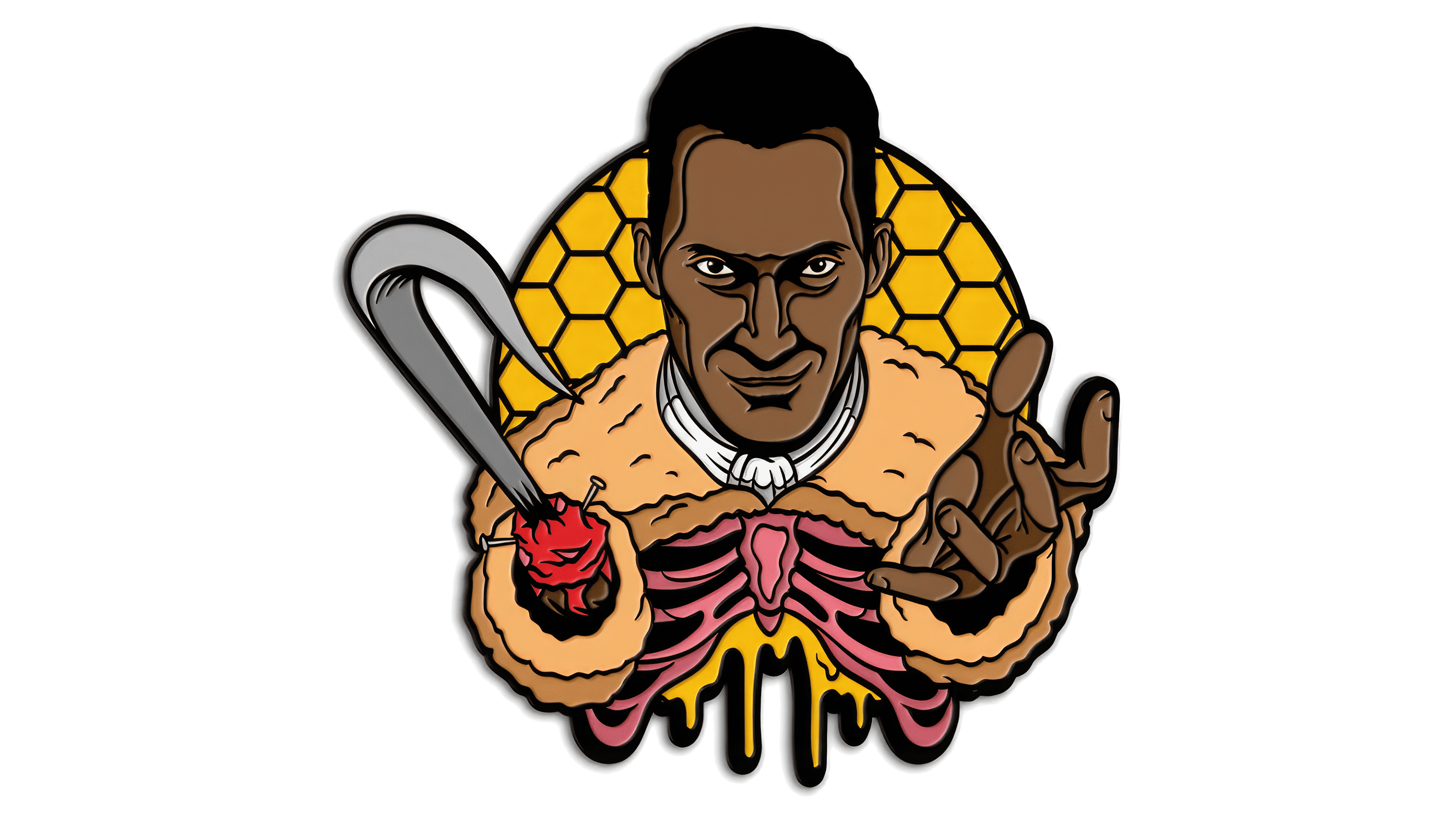
This cult horror film series is based on Clive Barker’s short story The Forbidden. The story follows a supernatural killer who appears if his name is said five times in front of a mirror. He has a hook for a hand and is linked to the tragic fate of artist Daniel Robitaille, who became a vengeful spirit after a brutal execution. The films intertwine themes of urban legends, prejudice, and social injustice. A distinctive feature is the combination of classic supernatural horror with deep meaning and striking visual imagery, urban landscapes, mirrors, and swarms of bees.
2021
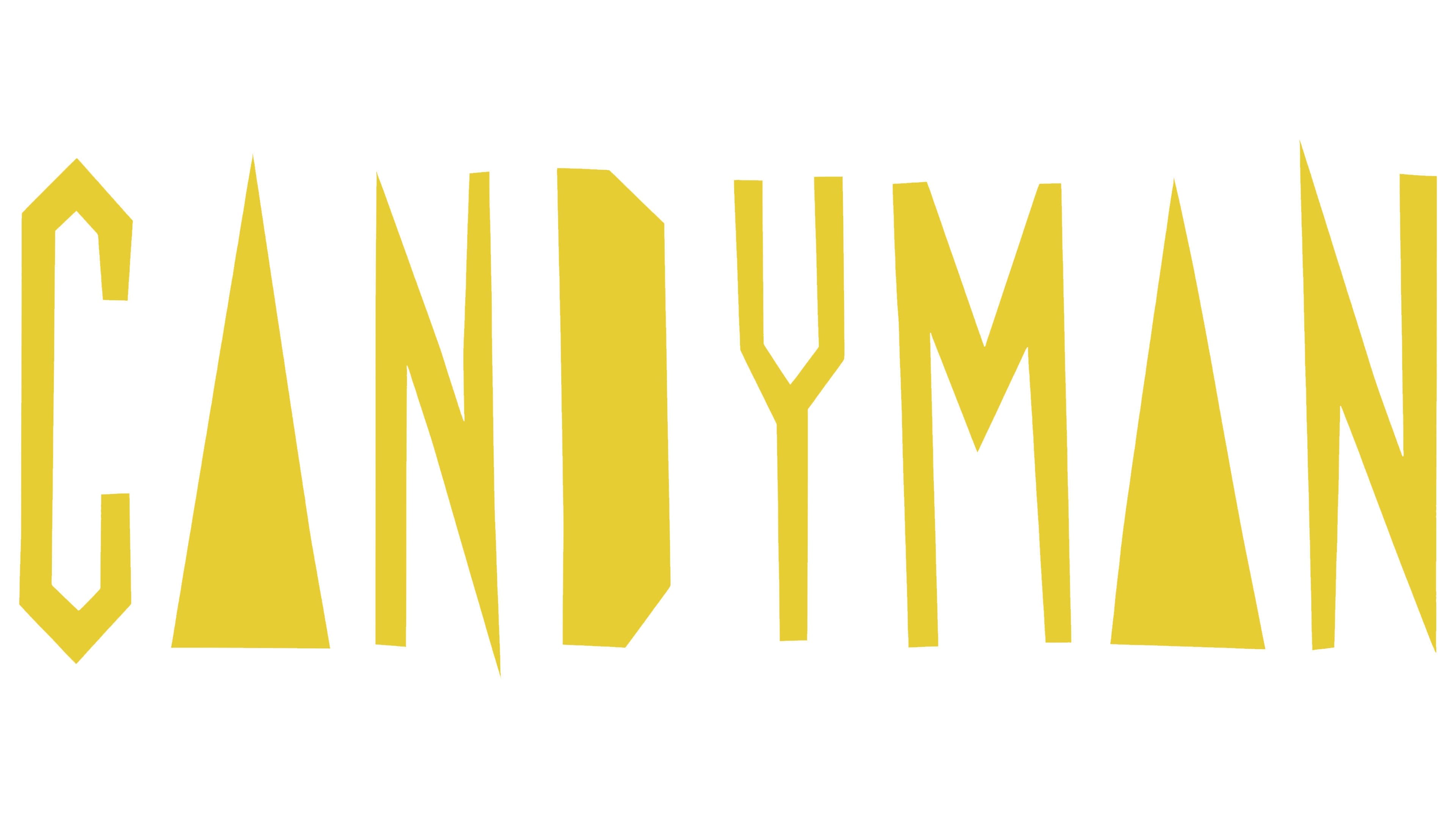
The emblem of the film “Candyman” does not feature typical horror imagery. The focus is on typography, through which the atmosphere is conveyed. Instead of direct illustrations, the designers used distorted letterforms, and the image acquired tension already at the level of the font.
The composition is arranged so that each letter has its own role, coming together to form a dynamic word. The symbols are deformed, resembling sharp blades or spiky structures. The letter “C” assumes an angular, cut-off appearance. The “A” s are designed as pointed pyramids. The “D” is turned into a closed figure with a filled interior. Their shapes evoke discomfort and a sense of hidden threat, contributing to the film’s overall mood.
The font is based on geometrically complex outlines that lack smoothness and symmetry. Elongated, sharpened proportions form a tense rhythm, provoking an anxious perception. Each letter appears as a separate object, but together they create harmony, where balance is maintained by the sharpness of the contours and the disrupted, yet familiar, structure.
The palette is bright yellow. The shade is associated with honey and bees, important details of the plot, but in contrast with the genre content, it evokes anxiety. Yellow becomes a provocative accent that, in another context, would be perceived as warm and calm, but in this case, it takes on an alarming undertone.
The Candyman logo relies on minimalist form and maximal typographic expressiveness, making it a carrier of atmosphere. It creates a tense image that conveys the film’s psychological nature without resorting to direct plot references.
