


 Chrysler Logo PNG
Brand products are created on a grand scale. The emblem emphasizes the car’s large size and the rich interior design. The Chrysler logo is an ode to respectability and comfort. In such a car, everyone gives way to the driver, and competitors remain far behind.
Chrysler grew out of the work of Walter P. Chrysler, a former railroad mechanic who later became a vice president at General Motors and head of Buick. After leaving GM in 1919, he focused on rescuing troubled automakers, including Maxwell Motor Company. In 1924, Maxwell introduced the Chrysler Six, a car with hydraulic brakes, aluminum pistons, and a high-compression six-cylinder engine priced at $1,565. Strong sales led to the creation of Chrysler Corporation in 1925.
The company expanded rapidly in 1928 after acquiring Dodge Brothers and launching Plymouth and DeSoto. During the same period, construction began on the Chrysler Building in New York, completed in 1930 as a major Art Deco skyscraper. By 1936, Chrysler had overtaken Ford Motor Company for second place in the American market.
A severe crisis hit in the late 1970s due to unreliable products, fuel shocks, and pressure from Japanese automakers. Former Ford executive Lee Iacocca became CEO in 1978 and secured $1.5 billion in federal loan guarantees signed by President Carter in 1980. Chrysler recovered through K-car models and the 1984 minivan boom, repaying government-backed loans years early.
In 1989, Chrysler acquired American Motors and gained the Jeep brand. The 1990s brought renewed momentum through the RAM pickup redesign and the Dodge Viper. A 1998 merger with Daimler-Benz created DaimlerChrysler, though the partnership collapsed by 2007. After its 2009 bankruptcy, Chrysler partnered with Fiat, later becoming part of Fiat Chrysler Automobiles and, in 2021, Stellantis.
Meaning and History
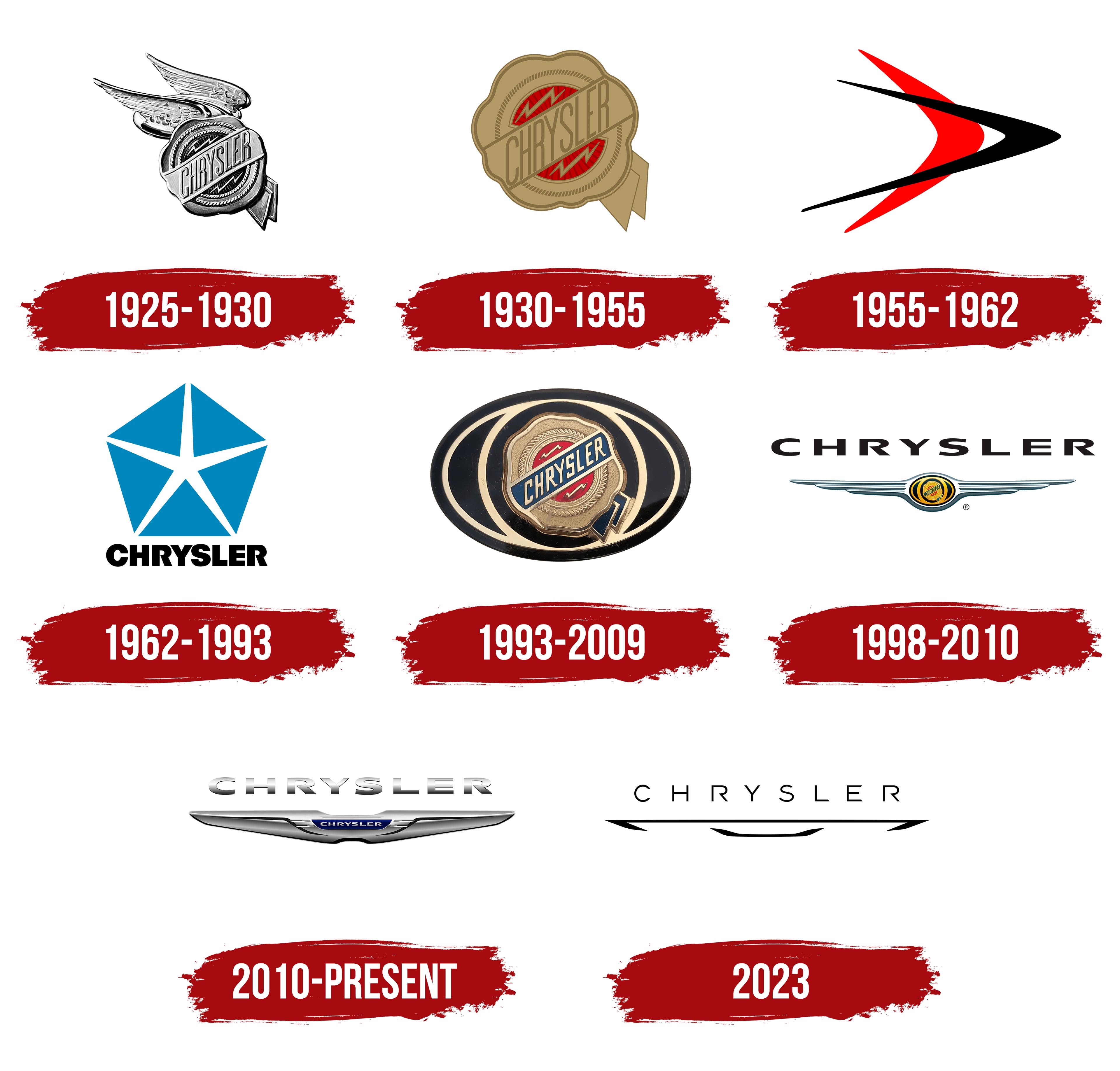
New cars compete with Lincoln, Ford, and Cadillac; GM has the best models in the luxury class. The manufacturer’s concept was to make inexpensive, luxurious, and innovative cars. At the same time, he needed a symbol that could be associated with a high-end brand. The old Chrysler identity has not been forgotten, even though this company has long been part of Fiat and is called FCA. Most past logos have been iconic, especially the famous Pentastar pentagon.
In the late 1990s, brand names were frequently updated, sometimes due to reorganizations (such as expansions and changes in ownership) and sometimes for marketing purposes. The automaker found its lettering style and stuck with it, experimenting only with minor details and graphic elements.
What is Chrysler?
This well-known American automaker, now part of the multinational corporation Stellantis, produces vehicles that combine high comfort with affordability. The company’s headquarters is located in Auburn Hills, Michigan. It specializes in models with unique design and practicality, exemplified by the flagship 300 sedan and the Pacifica minivan. The vehicles are focused on comfort and versatility, with competitive prices made possible by production facilities across North America.
1925 – 1930
The impromptu wax seal became Chrysler’s logo for years. It was a flower composition with semicircular elements protruding along the edges. In the middle was a diagonal inscription bearing the car brand’s name. The background was a wide ribbon, with the ends turned sideways. The design also featured two zippers: horizontal and resembling a double “Z.” Above them was a bird with large, raised wings, as if flying rapidly forward. The silver color made the emblem very refined.
1930 – 1955
When Walter Chrysler founded the car company, he asked an engineer to help him design the logo. Oliver Clark knew how to draw and understood design, so he enthusiastically took on the task. He created one of Chrysler’s most iconic marks: a wax seal that depicts the brand’s name across the transverse stripe.
The blue rectangle that contained the inscription was stylized as a ribbon. It wrapped around a golden circle, and its ends peeked out from the lower-right corner. Two lightning bolts sat at the top and bottom of the diagonal strip, one on each side. Few people know, but these zigzags were stylized “Z” letters. They represented the Zeder model car. Its prototype was expected to be the first Chrysler car, but the company was forced to sell its development due to unforeseen circumstances. According to another version, lightning personified engine power.
The logo mimicked a real wax seal used as an award at government fairs. It symbolizes the manufacturer’s reliability and honesty and confirms the quality of its vehicles. The original symbol fell out of use in 1954 and was forgotten for several decades until the company returned to its origins.
1955 – 1962

An emblem appeared in the mid-20th century: two “boomerangs” in red and black. They had different proportions: one was wider and shorter, and the other was narrower and longer. Based on the intersections, the black “boomerang” sat on top of the red one. The Dodge brand used the same logo.
1962 – 1993
In 1962, marketing firm Lippincott & Margulies designed Chrysler’s famous Pentastar symbol. It served as a corporate logo and, on rare occasions, adorned car hoods. It has never been used on radiator grilles. Chrysler chose this emblem from 800 others. Robert Stanley, a supporter of classics and stability, invented it. He wanted to create a sign that combined simplicity, style, and dynamism.
He captured all his ideas in a blue pentagon with a graceful star inside. The rays divided the large geometric figure into five small triangles toward the top corners. Many people mistakenly believe the Pentastar facets represent specific brands: Dodge Trucks, Dodge, Plymouth, Imperial, and Chrysler. This is not the case; the star was added to create a visual illusion of movement and soften the polygon’s strict shape. The company had many more brands.
Such misconceptions often trace back to Bob Hope’s corporate logo on his popular show, which placed a car brand name before each beam. This program was released in 1962, shortly after Pentastar’s emergence and its inclusion in promotional materials. The official version of the emblem was complemented only by the black “CHRYSLER” lettering at the bottom.
1993 – 2009
The original logo disappeared in 1955 and returned triumphantly in the early 1990s. The company again began using a wax seal with tape to confirm the machines’ high reliability and quality.
1998 – 2010
At the end of 1998, the famous seal was placed inside the long wings, with three “feathers” on the right and left. They have been outlined in gray. The word “CHRYSLER” was at the top. The developers changed the letter shapes to match the font under Pentastar.
2010 – today

The next redesign occurred when the Italian concern Fiat bought out part of Chrysler’s shares. The logo lost its traditional wax seal; the company name replaced it, written inside the blue nameplate. It has been integrated into the center of the sleeker fenders and features a metallic gradient. The emblem now resembles the Aston Martin brand name. The brand name is at the top, as in the previous version. The word turned light gray. The public learned of the identity change at the end of 2009 because the automaker applied to register a new trademark in the fall.
2023 (tentative)

The automotive company has removed clear images and settled on an outlined logo. Although the full image is fragmented, the contours add incredible chic and style to the emblem. Thin lines, exquisite glyphs, and sharp turns turn a banal sign into an elegant symbol, filling it with air, lightness, and simplicity. The main element is the inscription. It sits centrally above a horizontal line with curved ends. This abstraction is a modernized version of an old-style logo.
Font and Colors
The fenders featured on the latest logos and the wax seal are an important part of Chrysler’s historical legacy. Engineer Oliver Clark developed them. Previously, the winged element was used only as a radiator figurine and personified the ancient Roman god Mercury, who could attain great speed. It later became part of the logo when designers combined two original corporate symbols.
Most of the corporate wordmarks were created from individual fonts. In the latest version, the lettering “CHRYSLER” looks elegant, even though the letter proportions are off.
The emblem imitates a metal radiator figure. For this, the designers combined several shades of gray and silver using a gradient. The company name is inscribed on a dark blue background. This color connects the modern design with the ribbon depicted on the original logo.

FAQ
What makes Chrysler cars?
The company began operations in 1925 when Walter P. Chrysler transformed the Maxwell Motor Company into the Chrysler Corporation. Early on, it introduced cars with features such as high-compression engines and four-wheel hydraulic brakes, which were advanced for the time.
Over the years, the brand grew by acquiring Dodge in 1928 and creating new brands, such as Plymouth and DeSoto, offering a wider range of vehicles. In 2009, the company was reorganized under a government-backed plan and renamed Chrysler Group LLC. By 2014, it merged with Fiat SpA, and in 2021, it became part of Stellantis NV.
The company is known for producing luxury cars, with a focus on family-friendly models, such as the Chrysler Pacifica minivan. This car and others in its lineup feature the latest technology and safety features, making them attractive to today’s consumers. The brand continues to evolve to meet modern drivers’ needs and stay ahead in the market.
Who designed the Chrysler logo?
From 1924 to 1930, Oliver Clark, working on Walter Chrysler’s engineering team, designed the company’s first logos. He drew inspiration from Roman mythology, which was widely admired at the time. His original logo featured a wax seal with two wings to symbolize speed.
This logo quickly became a key part of the brand, making it prominent in the fast-paced early-20th-century automotive industry. Clark’s design communicated the brand’s values, creating a visual foundation that helped establish its strong identity. The logo’s theme of speed and progress resonated with clients.
What is the Chrysler logo?
The logo is easily recognized by the two inscriptions of the name “CHRYSLER.” A large inscription is at the top, and a smaller one is inside a blue plate in the center, surrounded by stylized silver wings. These silver wings give the logo a modern look. The blue center conveys sophistication and reliability, reflecting the brand’s reputation.
Is Chrysler a luxury brand?
Originally conceived as a luxury brand, Chrysler offers a range of cars. The line includes luxury vehicles with high performance and craftsmanship, as well as simpler, more affordable models that don’t meet traditional luxury standards.
Historically, the brand has been known for premium features, enhanced comfort, and stylish designs. The company also produces more affordable and practical vehicles that cater to a wider range of customers. These models retain good quality and comfort but are more competitively priced and lack some luxury features.
When did the new Chrysler logo come out?
In 2009, Chrysler introduced a new logo with silver wings. This update was part of a broader effort to refresh the brand’s image and better align it with current trends and future visions. This change marked a significant shift in the brand’s identity, representing a new stage in the automotive market.