


 Co-op Logo PNG
The Co-op logo represents the British cooperative retail store chain. Its simple, recognizable design highlights accessibility, everyday convenience, and community-oriented values.
Co-op traces its origins to 1844, when 28 weavers in Rochdale each contributed £1 to open a shop on Toad Lane. High food prices, low wages and adulterated goods had pushed them toward collective action. The Rochdale Society of Equitable Pioneers sold reliable products at fair prices, gave members one vote each and distributed profits according to purchases. The model spread through Britain’s industrial towns.
The shop gained members, expanded its range and became a model for workers, artisans and farmers across Britain. In 1863, local societies formed the Cooperative Wholesale Society, or CWS, to buy goods centrally at wholesale prices. By the early 20th century, CWS operated factories, trading ships and overseas offices, controlling production, imports and distribution.
In 1917, CWS joined with the Cooperative Insurance Society, extending the network into insurance and banking. After World War II, Co-op became an early British adopter of self-service stores, allowing customers to select goods from shelves and reducing operating costs. In 1972, it introduced free banking for members while competitors still charged for basic services.
A crisis struck the banking division in 2013 after risky lending and management failures. Co-op sold a large share of the bank to outside investors and restructured while retaining its main retail operations. In 2016, the organization restored the Co-op name and revived an earlier logo, reconnecting the brand with its cooperative history.
Meaning and History
What is Co-op?
It is a major British retail and services network directly owned by its customers. Members become co-owners, participate in decision-making, and receive profit shares. Products and services include groceries, legal advice, insurance, and funeral services. Stores are located in almost every British neighborhood, emphasizing convenience, affordability, and social responsibility.
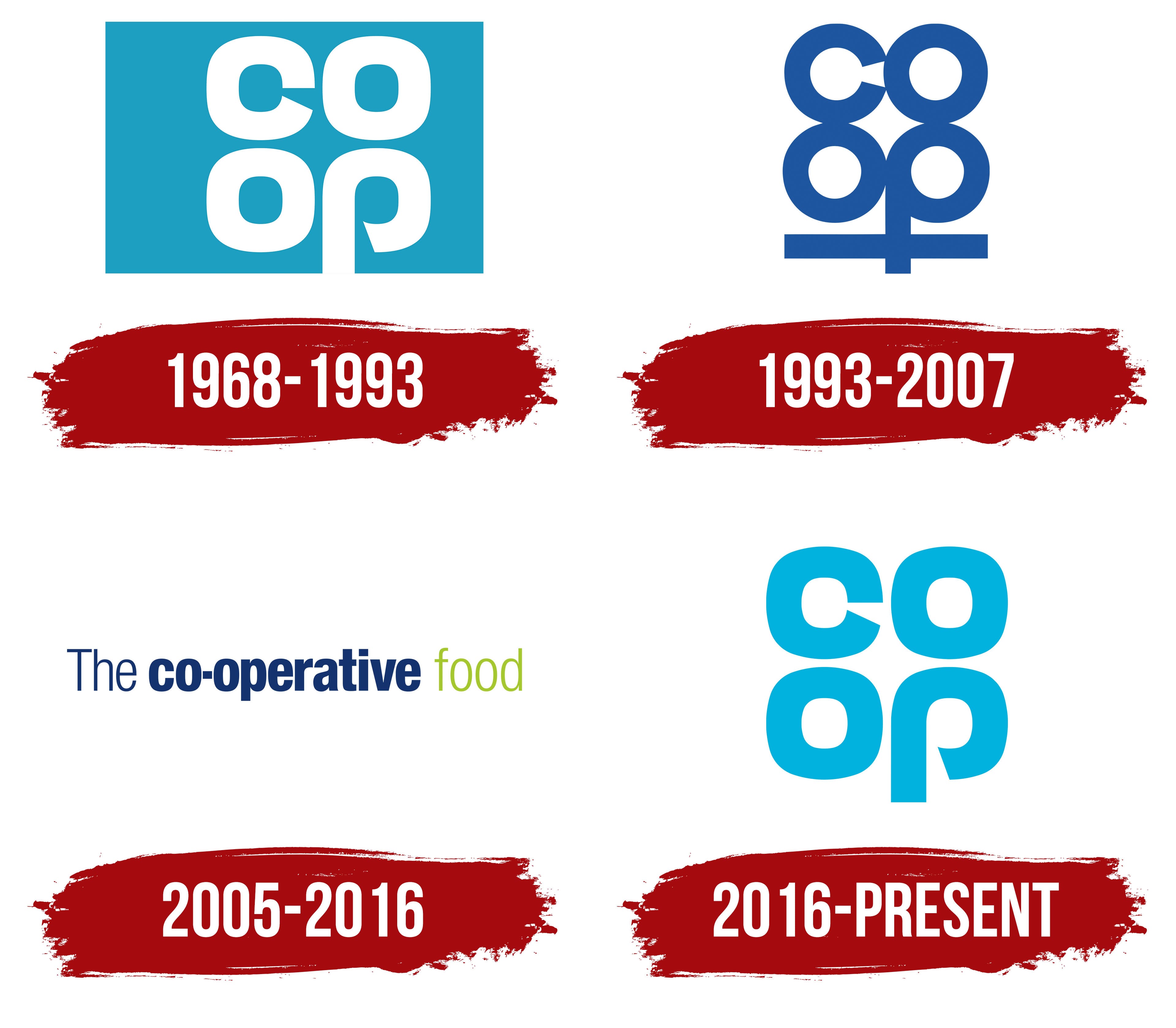
1968 – 1993

The Lippincott & Margulies agency developed the Co-op supermarket chain’s first logo in collaboration with the in-house design team of the Co-operative Wholesale Society (CWS). The introduction of this mark was part of a large-scale initiative called “Operation Facelift,” aimed at standardizing and modernizing the brand’s visual identity across all regions of the United Kingdom, including store design, packaging, transportation, and staff uniforms.
Visually, the logo is based on a square shape, with the letters “co” and “op” arranged in two rows. The letterforms are set symmetrically, creating a composition that resembles a four-leaf clover. This arrangement of letters was intended to symbolize unity, equality, and collaboration, reflecting the cooperative business model.
The typeface is based on a unique custom grotesque with an extremely bold, sans-serif design. The glyphs feature massive proportions, smoothly rounded corners, and wide counters. A distinctive feature of the typography is the use of diagonal cuts in the letters “c” and “o,” along with an open lower contour in the letter “p.” These details add a sense of dynamism, creating an internal rhythm and overall harmony in the composition.
The logo’s color scheme combines a sky-blue background with white letterforms. The choice of this palette reflects the brand’s desire to appear approachable, fresh, and friendly to a broad audience. The blue tone symbolizes trust, transparency, and openness, values naturally associated with the image of a company operating in the retail trade of everyday goods.
1993 – 2007
The Co-op logo, updated in 1993, reflects an evolutionary adjustment to the visual style originally set by Lippincott & Margulies in 1968. The redesign coincided with the active unification of cooperative networks under the new Co-operative Retail Trading Group (CRTG) structure. The update aimed to strengthen branding and maintain visual consistency across the network.
The composition retained the two-level square arrangement of letters: the upper row formed by “c” and “o,” and the lower row by “o” and “p.” However, the glyphs were reworked toward a more traditional, classic sans serif. Letter contours became rounder, with proportions more balanced, uniform stroke thickness, and wide, rounded counters. As a result, the letters resemble graphic rings, neatly aligned vertically and horizontally, forming a visually stable, symmetrical structure.
A significant innovation was the addition of a strong horizontal line beneath the letters. Positioned directly below the bottom row, this line matches the thickness of the main letter strokes. The stem of the “p” extends downward, crossing the line and visually resting on it. This design choice symbolically conveys reliability, emphasizing the brand’s solid foundation.
The color palette changed dramatically. Instead of the previous light blue-and-white contrast, the new mark was rendered in a rich dark blue on a transparent background. This shade of blue was deliberately chosen to convey seriousness, professionalism, and the solidity of an organization focused on large-scale retail and cooperative activities.
Visually, the logo evokes a seal or stamp, with the simplicity and clarity of its geometric forms underscoring the company’s stability and transparency. By using traditional, clearly legible sans serif forms, the logo appears concise, solid, and trustworthy.
The 1993 redesign maintained continuity with the previous style while successfully adapting the brand’s visual solutions to the new era of mergers and expansion, making the mark a strong symbol of the unified cooperative network.
2007 – 2016

In 2007, Co-op introduced a new visual identity, moving away from the familiar four-leaf arrangement of letters and adopting a clean typographic logo. The redesign was carried out by Co-operative Group’s in-house design team in collaboration with the well-known agency Pentagram, led by partners Harry Pearce and John McConnell.
The logo’s graphic structure is based on a horizontally stretched “The co-operative” wordmark. The text is set in two typographic levels, each with a different weight and visual density. “The” is set in lowercase letters, with a capital “T,” in a thin sans-serif (Regular weight), underscoring its introductory, secondary role. “co-operative” uses the same typeface (Neue Helvetica) but in an Extra Bold weight. The glyphs feature straight lines, vertical strokes, and a strict geometric composition.
This typographic treatment deliberately highlights “co-operative” as the primary brand identifier, visually underscoring the importance of a shared, cooperative approach to business.
To the right of the main text block appear descriptor words (“food,” “funeralcare,” “travel,” and others). This serves as an identifier for the company’s specific business division. It is set in a light sans serif (lightweight) with narrow lowercase glyphs. The descriptor appears in a bright lime green, contrasting with the dark blue of the main name. This color differentiation indicates the business category, improving customer navigation.
The core palette of the new logo is built around two dominant shades. Dark blue conveys the brand’s stability, trust, and seriousness, reinforcing its corporate reputation and recognition. Bright lime green symbolizes freshness, dynamism, and the specialization of a particular business sector, such as the food industry.
The shift to a new minimalist design was driven by the need to consolidate the brand and simplify its perception in an increasingly competitive retail market. According to internal company research, after introducing the updated identity in pilot stores between 2005 and 2007, sales increased by 15%. These results confirmed the effectiveness of the chosen visual approach, which emphasized the practicality and functionality of typographic branding, focusing on versatility and clear communication.
2016 – today
The modern Co-op logo (2016–present) was introduced in May 2016 at the company’s annual meeting, following two years of development by the UK agency North, in collaboration with the brand’s in-house team, led by Helen Carroll and design director Ben Terrett. The new visual solution is a reinterpretation and modernization of the historic 1968 mark created by Lippincott & Margulies.
The logo once again uses the arrangement of four lowercase letters (“co” and “op”) forming a stylized four-leaf clover. The glyphs, however, were redrawn from scratch and aligned to a precise geometric grid, ensuring balanced proportions and even letter spacing. The cloverleaf symbolism was intentionally restored to emphasize historical continuity, cooperative principles, and the company’s friendly image.
The type design is based on a custom, bold sans-serif font with smoothly rounded corners and uniform stroke thickness. The letterforms adhere to a geometric minimalist style, ensuring easy readability and versatility across various applications. A distinctive feature of the design is the diagonal internal cuts on the “c” and “o,” as well as the characteristic open lower loop of the “p,” which creates a visual focal point in the lower-right part of the composition.
The color palette is built around a single vibrant shade of blue (#19A8E0 or a close match). This tone is characterized by openness, clarity, and reliability, reflecting the brand’s transparency and accessibility to a wide audience. The logo is primarily used in a flat, unfilled version, placed on transparent or light surfaces to reinforce the design’s modern, minimalist character.
The initial implementation of the new identity began after the AGM announcement, with the rebranding of seven stores and three Funeralcare branches. Over the next three years (through 2019), the logo was gradually integrated into all elements of the network’s branding, including storefronts, product packaging, staff uniforms, vehicles, and digital communications.
The choice of this design reflects the brand’s intention to move away from the strict corporate image of the previous period and return to a more emotional, approachable, and democratic identity. The professional community warmly received the logo as a skillful return to a time-tested design that, thanks to its simple form and well-chosen colors, remains relevant regardless of changing trends.
Font and Colors

The current Co-op logo’s typeface is a custom, bold lowercase sans serif. The letters feature heavy strokes with uniform thickness and smooth, rounded corners, creating a sense of friendliness and approachability. Distinctive structural features include diagonal internal cuts on the “c” and “p,” angled toward the composition’s geometric center, and the open lower descender on the “p,” which completes the lower-right segment of the logo. The font is similar in proportion and character to Versus Ultra but incorporates individually modified contours developed specifically by North.
The color scheme uses a single base tone, a bright sky blue (#19A8E0 or a close equivalent). This color was chosen to highlight openness, transparency, and positive brand perception. The logo is presented in flat design on a white or transparent background, ensuring visual clarity and a clean overall appearance.