


 Columbus Clippers Logo PNG
The Columbus Clippers baseball club logo reflects the team’s sports tradition and regional affiliation. Its design emphasizes the club’s connection to the city and its significance within the league.
Professional baseball in Columbus dates to 1877, but the modern franchise emerged after the Columbus Jets, a Pittsburgh Pirates affiliate, moved to Charleston in 1971. The city went six years without a team before the Columbus Clippers joined Triple-A in 1977 and opened at Cooper Stadium. Their first season ended 65-75, and the Pirates affiliation lasted through 1978.
In 1979, the Clippers became affiliated with the New York Yankees. The partnership lasted 28 years and produced International League titles in 1979, 1980, 1981, 1987, 1991, 1992 and 1996. The 1992 team finished 95-49, the best record in franchise history. Derek Jeter, Mariano Rivera, Jorge Posada, Andy Pettitte, Don Mattingly and Robinson Canó all passed through Columbus before establishing major-league careers.
The Yankees era ended in 2006. Columbus spent 2007 and 2008 with the Washington Nationals, then entered the Cleveland Indians system in 2009 and moved from Cooper Stadium to Huntington Park in the Arena District. The club won league championships in 2010, 2011, 2015 and 2019, along with two Triple-A National Championships. The 2010 title came in the second season at the new ballpark.
Carlos Santana, Francisco Lindor, José Ramírez and Shane Bieber later developed in Columbus before reaching MLB. Across its history, the franchise has won 11 International League championships, second only to the Rochester Red Wings. It continues in Minor League Baseball’s Triple-A structure.
Meaning and History
What is Columbus Clippers?
It is a Triple-A baseball club based in Columbus, Ohio, competing in the International League as the Cleveland Guardians’ farm team. Previously, the team partnered with the New York Yankees and Washington Nationals. Its name reflects the region’s shipping history at the confluence of the Scioto and Olentangy rivers. Home games are held at Huntington Park. The club has won several International League championships.
1977 – 1982

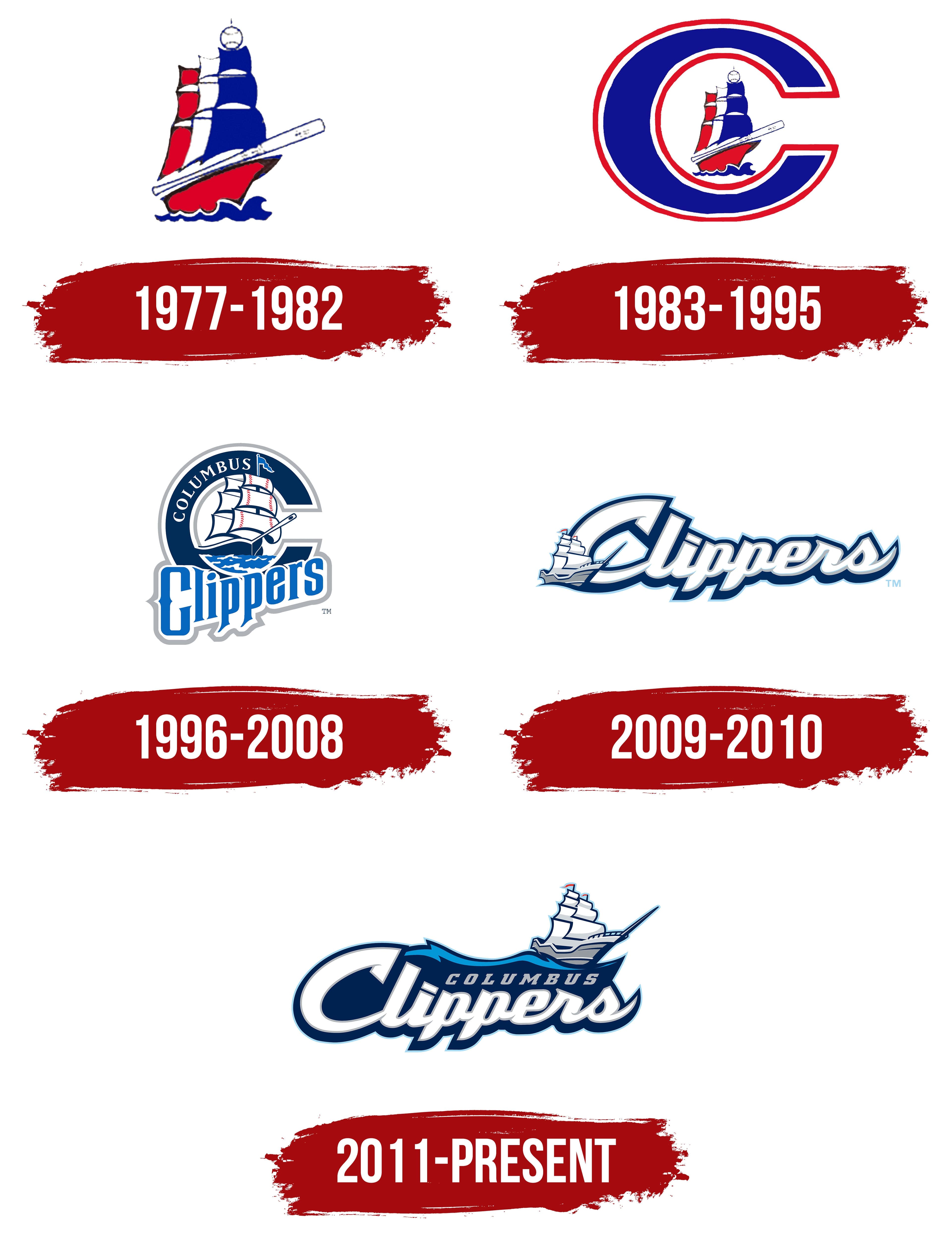
In 1977, after the franchise returned to Columbus from Charleston and adopted the name Clippers, a new logo was introduced to reflect the team’s identity. The visual composition featured a stylized clipper ship with red, white, and blue sails. The bowsprit was depicted as a baseball bat, with a wave-like element at its base. The imagery conveyed dynamism and associations with maritime traditions.
The emblem’s debut coincided with the club’s successful start. In their very first season, the team earned the Larry MacPhail Award for excellence in marketing and promotions. In 1979, the club began an affiliation with the New York Yankees, keeping the logo unchanged until 1982. During this period, the team secured three consecutive Governors’ Cup championships in 1979, 1980, and 1981.
Structurally, the emblem featured a vertical composition that emphasized masts and sails. The ship’s outline and wave featured contrasting colors, with geometric forms that highlighted verticality, balanced by the diagonal bowsprit. The proportions of the colored sections were carefully arranged to ensure visual stability.
This version lacked typographic elements, emphasizing the emblem’s strength as a standalone symbol without accompanying text.
The palette featured vibrant shades of blue and red, with white segments that created rhythm and visual spacing between the bright areas.
The clipper imagery conveyed speed and forward momentum, while the baseball bat explicitly referenced the sport. The wave element enhanced the maritime theme and provided visual closure.
Versions of the emblem included the original color scheme and monochromatic adaptations suitable for various print limitations.
1983 – 1995

After six seasons with the previous emblem, the club decided to revise its visual concept. The new design retained the recognizable clipper from the 1977 version but changed its surrounding frame. The ship’s silhouette was placed within a large letter “C,” creating a distinct outlined framework. Inside the letter, the ship had red, white, and blue sails, a wave at the base, and a baseball bat diagonally passing through its hull.
This structure enhanced the symbol’s readability in abbreviated form, enabling it to function independently without explanatory text. The letter and ship were balanced vertically and horizontally, and the circular framing enhanced recognition from a distance. Visual emphasis was evenly distributed between the prominent letter and the detailed ship interior, creating a layered effect.
The color palette remained unchanged, featuring saturated blue, muted red, and white used in balanced proportions, ensuring strong contrast and consistent reproduction on printed and fabric surfaces.
The symbolism continued to emphasize speed and distance, with the baseball bat remaining connected to the sport. Integrating the ship into the letter “C” could also be read as a reference to the first letter of both the city’s and the team’s names. Waves beneath the ship reinforced the maritime imagery.
1996 – 2008

In the mid-1990s, the club unveiled a new visual concept, marking its first significant update. The clipper ship, already firmly established in the team’s identity over the previous two decades, was retained but re-styled and rearranged. The ship, depicted with simplified geometry, was positioned inside a large letter “C,” with the team name placed beneath the composition.
At the emblem’s core was a massive dark-blue letter outlined in gray and white. Within this inner contour, the clipper featured baseball-inspired sails: the white sails bore red stitching reminiscent of baseball seams. The bowsprit remained styled as a bat, while the ship’s lower section visually sank into stylized waves formed by sharply angled lines. Elements were arranged so the ship and lettering aligned along a single axis, resulting in a unified design.
The typographic portion, “Clippers,” was rendered in light blue serif letters with gentle curves.
The palette included four primary colors: dark blue for major elements, light blue for accents, white for sails and interior spacing, and gray for the outer border.
Symbolically, the ship continued to represent movement and speed while incorporating baseball elements, such as the bat and stitching, to strengthen its connection to the sport. The letter “C” linked the graphic emblem with the city’s initial, creating a concise visual identity.
Beginning in 2001, a simplified variant without the “Clippers” inscription was used, containing only the letter with the ship inside. This allowed flexibility depending on the application. The emblem accompanied the club for twelve seasons, including their 1996 championship year, when the team won the International League Governors’ Cup.
2009 – 2010

In spring 2009, the club marked its relocation to Huntington Park with a refreshed visual identity. The previous design, in which the clipper ship was enclosed within the letter “C,” gave way to a composition in which the ship shifted left and was reduced in size. The primary visual element became the stylized team name. The initial letter “C” was integrated into the word “Clippers,” with unique styling that allowed it to serve as both a logo and a typographic element.
The ship maintained its appearance as a three-masted clipper, with wave details at its base becoming part of the lettering. However, the ship now functioned as a supporting accent rather than the main subject. The composition visually connected the typography and imagery.
The wordmark appeared in a cursive, handwritten style with smooth curves and elongated strokes. White letters were outlined in silver and enhanced with a pale blue inner shading, providing depth. A dark blue shadow further intensified this three-dimensional effect.
The color palette combined dark blue, pale blue, silver-gray, and white. Contrast emerged from alternating cool tones, with balance achieved by distributing dark shadows, outlined accents, and light inner fills of the typography.
An alternative adaptation existed alongside the primary version, placing the clipper above the complete team name.
Introducing this design coincided with the opening of the new ballpark and a change in affiliations; starting in 2009, the club became affiliated with the Cleveland Indians. The updated style drove a surge in popularity, with ticket sales during Huntington Park’s inaugural season nearly tripling the prior year’s total. This logo was used during the team’s 2010 International League championship season, solidifying its association with on-field success.
2011 – today

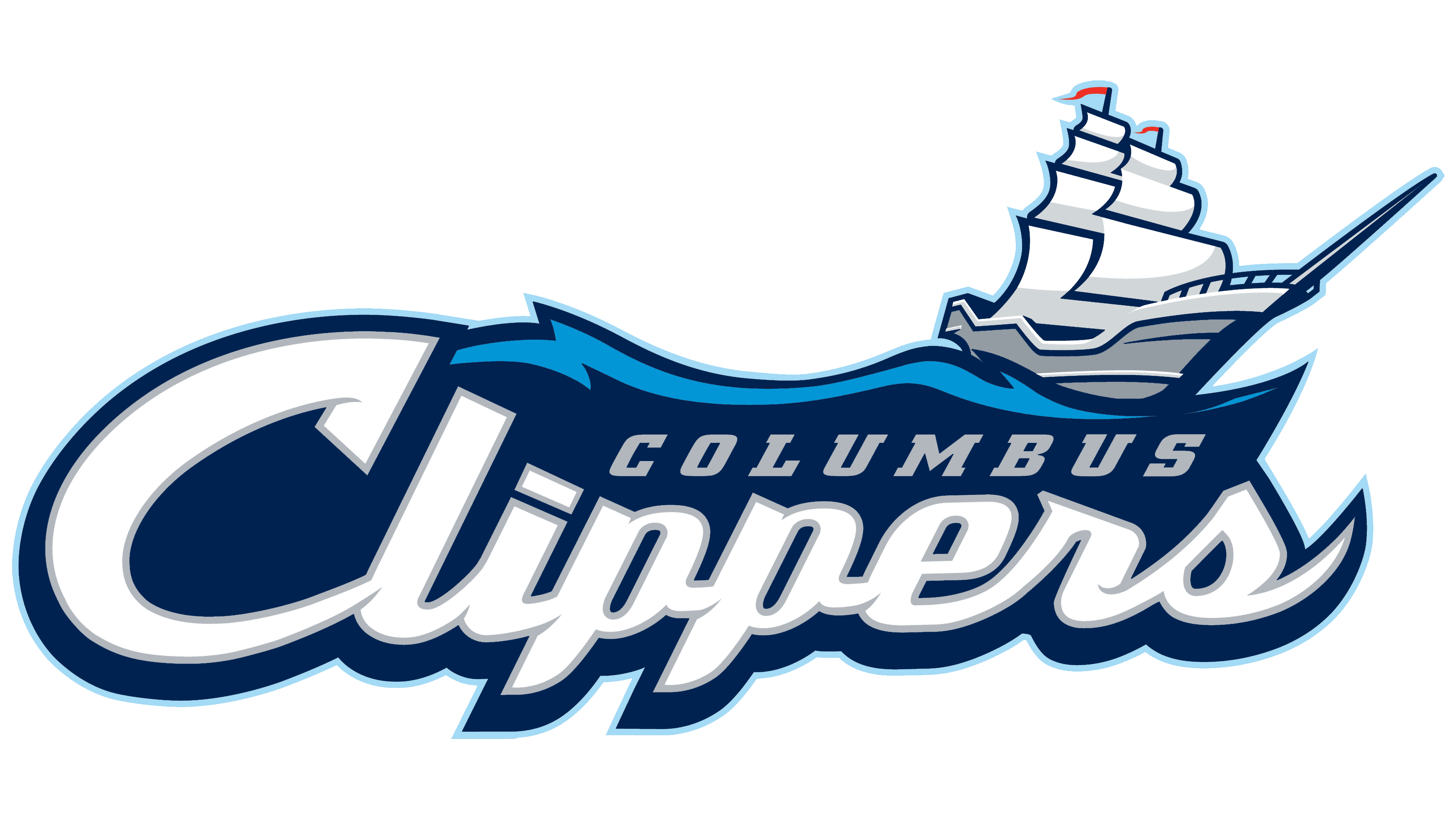
The new composition prominently features the word “Clippers” in cursive. The initial letter “C” transitions seamlessly into the outline of a clipper ship. Positioned to the right, the ship rests upon a wave-like line integrated into the top of the lettering, suggesting forward motion.
Above “Clippers,” the word “COLUMBUS” appears in capital letters using a clean sans-serif typeface, creating contrast with the fluid curves of the primary text. The design integrates image and text as a unified block, with the ship concluding the composition.
Typography for “Clippers” imitates cursive, with a controlled variation in stroke thickness and elongated diagonal strokes. Letter proportions are optimized to maintain legibility across sizes, and dynamic linework enhances the visual rhythm.
The color palette features a dark blue base tone, accented by pale blue highlights, white fills, and silver outlines. The interplay of cool shades reinforces the maritime theme.
Symbolically, the clipper honors the team’s tradition by referencing its name and underscoring its movement. The emblem has been associated with International League championships, including the 2011 season, when the club reaffirmed its competitive status, and the new identity has since become integral to its current branding.
Variants include full-color executions, monochromatic adaptations, and isolated use of the ship image for compact formats.
Font and Colors
The visual composition relies on contrasting cool shades. Deep navy forms the primary visual mass and serves as the dominant color. At the same time, pale blue outlines the letters and waves, creating a sense of depth. Silver-gray highlights appear on ship details, enhancing dimensionality and separating them from the background. White fills within the letters reinforce readability. These tones are proportioned so darker areas anchor attention, and lighter sections provide visual accents.
The word “Clippers” is set in cursive with a fluid, flowing rhythm. Initial and terminal strokes are elongated to emphasize movement, while glyph interiors exhibit gentle transitions between stroke thicknesses. Letter spacing ensures optical balance even at large sizes. The “COLUMBUS” inscription at the top uses a straightforward sans-serif font with uniform strokes and balanced weight, contrasting the fluidity of the primary wordmark.