Crystal Palace Logo PNG
The Crystal Palace football club logo demonstrates the team’s connection to the history and culture of its London district. The classic design highlights stability, tradition, and the club’s significance to the local community.
Crystal Palace Football Club was founded on 10 September 1905 and entered the Southern League. It took its name from the Crystal Palace exhibition complex, where an earlier amateur side played in the 1860s. The new club initially wore claret and blue, colors associated with Aston Villa’s team, before later adopting the red and blue identity now linked with Palace.
In 1920, Palace joined the Football League and entered the Third Division. Four years later, the club moved to Selhurst Park, which has remained its home ever since. For much of the following decades, the team moved between the lower divisions, before reaching England’s top flight for the first time in 1969. The club struggled to establish a long-term place at that level.
Steve Coppell led a stronger period. Palace returned to the First Division in 1989 and reached the FA Cup final in 1990, drawing 3-3 with Manchester United before losing the replay 1-0. In 1992, the club became a founding member of the Premier League. However, relegation followed after the inaugural season, with further promotions and relegations to follow.
Financial problems later became a major threat. Palace entered administration in 2010, and the CPFC 2010 consortium rescued the club. In 2013, the club returned to the top division through the Championship play-offs and then established a longer stay in the elite. A historic breakthrough came in 2025, when Palace won the FA Cup and secured its first major trophy.
Meaning and History
What is Crystal Palace?
It is a soccer club from South London, founded by workers from the famous glass pavilion built for the mid-19th-century World Exhibition. For many years, the club competed in lower English divisions before establishing itself in the Premier League. Home matches are played at historic Selhurst Park Stadium. The team’s greatest achievement was reaching the FA Cup final and consistently competing in England’s top division.
1935 – 1955

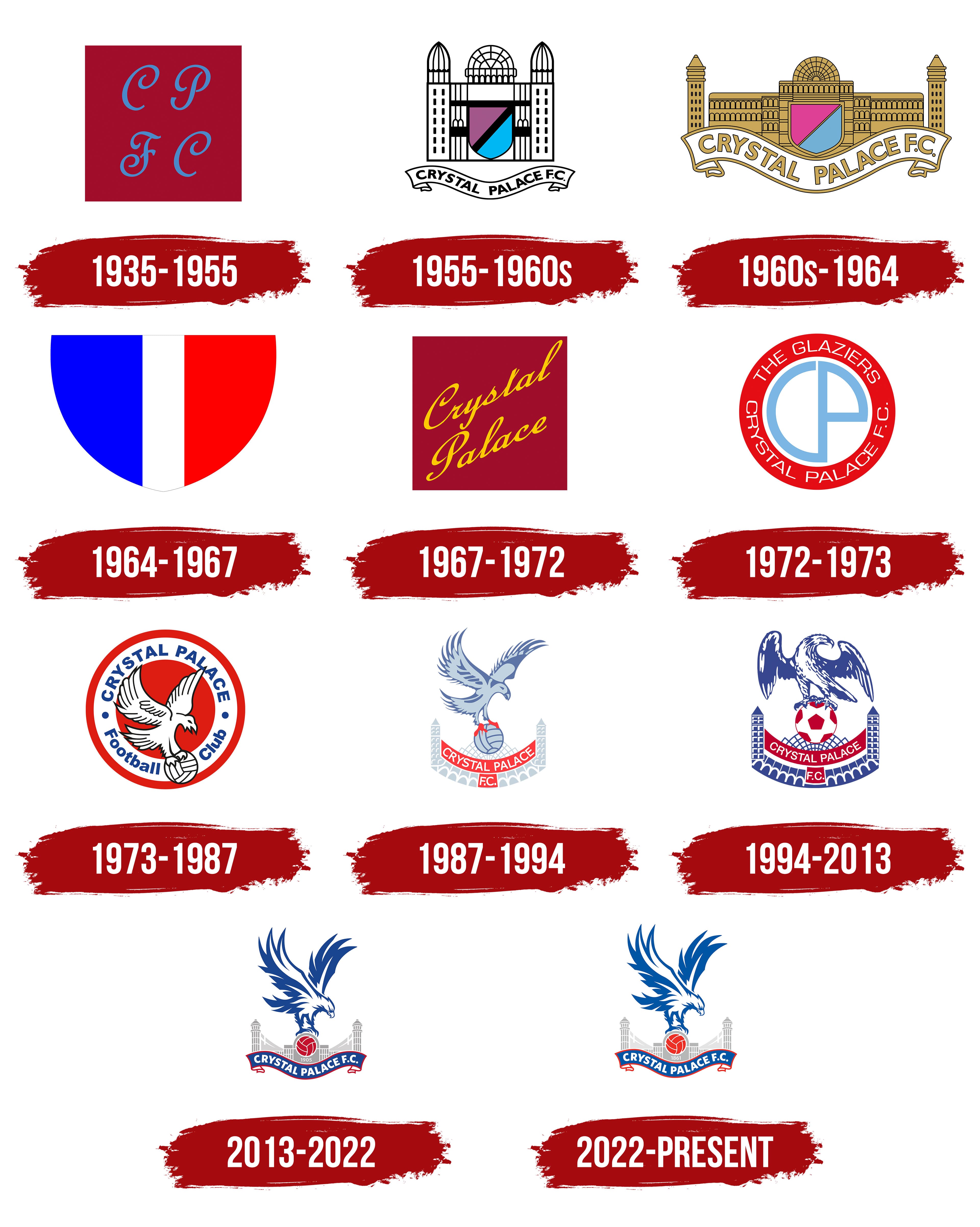
In the mid-1930s, the Crystal Palace kit first featured a logo represented by the club’s initials. It was used as the official symbol and served as a visual marker of the team. At the core was a square shape in claret color with four letters: “C” and “P” in the top row, which stood for Crystal Palace, and “F” and “C” in the bottom row, denoting Football Club.
The composition was built on strict symmetry: the letters were evenly distributed across the grid, which gave the construction a balanced appearance. Nothing extra, only the field and the monogram. At that time, many clubs relied on a lettered mark rather than figurative imagery.
The typeface had a script nature with smooth flourishes. The light blue lettering stood out against the rich claret background, creating contrast and evoking associations with the aesthetics of classic early-20th-century monograms. The curves of the strokes added a subtle decorative effect without unnecessary complexity.
For the audience, the emblem appeared as an elegant confirmation of club affiliation.
1955 – 1960s
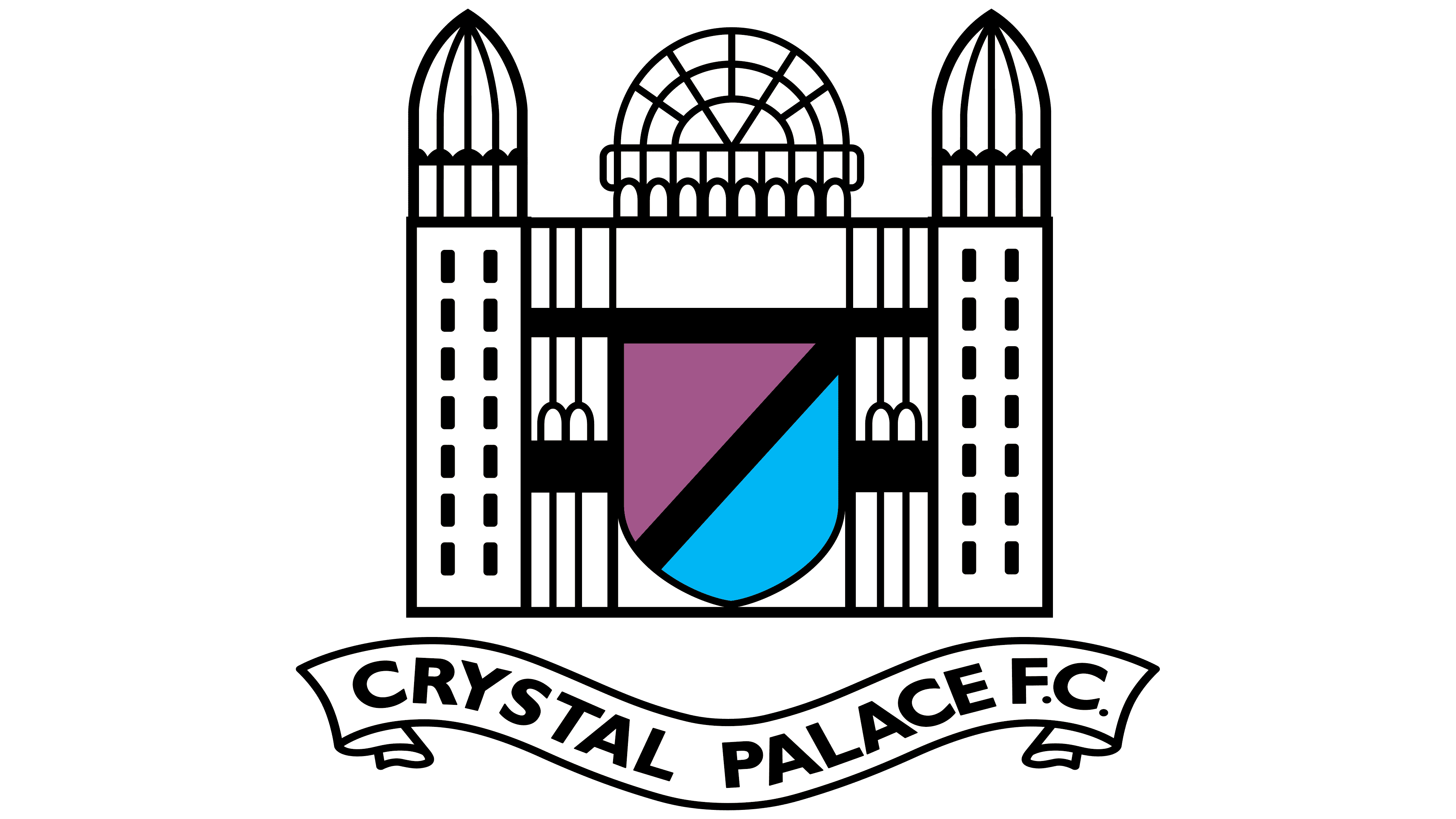
In the mid-1950s, the club abandoned its practice of using embroidered initials and, for the first time, introduced a heraldic design. The visual concept became more formal and symbolically rich, with the central element being the depiction of the architectural palace that gave the team its name. The composition was executed in black-and-white stylization, dominated by two towers on the sides and an arched dome with a glass grid.
Inside the architectural structure, a shield was integrated. Its field was crossed by a diagonal line, dividing the space into two parts: the left painted in claret and the right in blue.
The final accent was created by a ribbon-shaped banner at the base. The white, curved fabric served as the background for the inscription Crystal Palace F.C. The letters were applied in black, in a sans-serif style, aligned along a smooth arc. The strictness of the font contrasted with the decorativeness of the architectural outlines and the ribbon’s own dynamics.
Structurally, the sign consisted of three levels: the monumental architectural part, the integrated shield with the club’s palette, and the text block on the ribbon. The hierarchy ensured the integrity of perception and established a balance between the city’s image and the football team’s.
The color composition rested on three contrasts: claret and blue inside the shield, and the black-and-white graphics of the palace and font. Compared with the early initials, the new sign became an iconographic emblem tied to the place of origin. Altogether, the construction set the foundation on which the club’s identity would be built in the future.
1960s – 1964
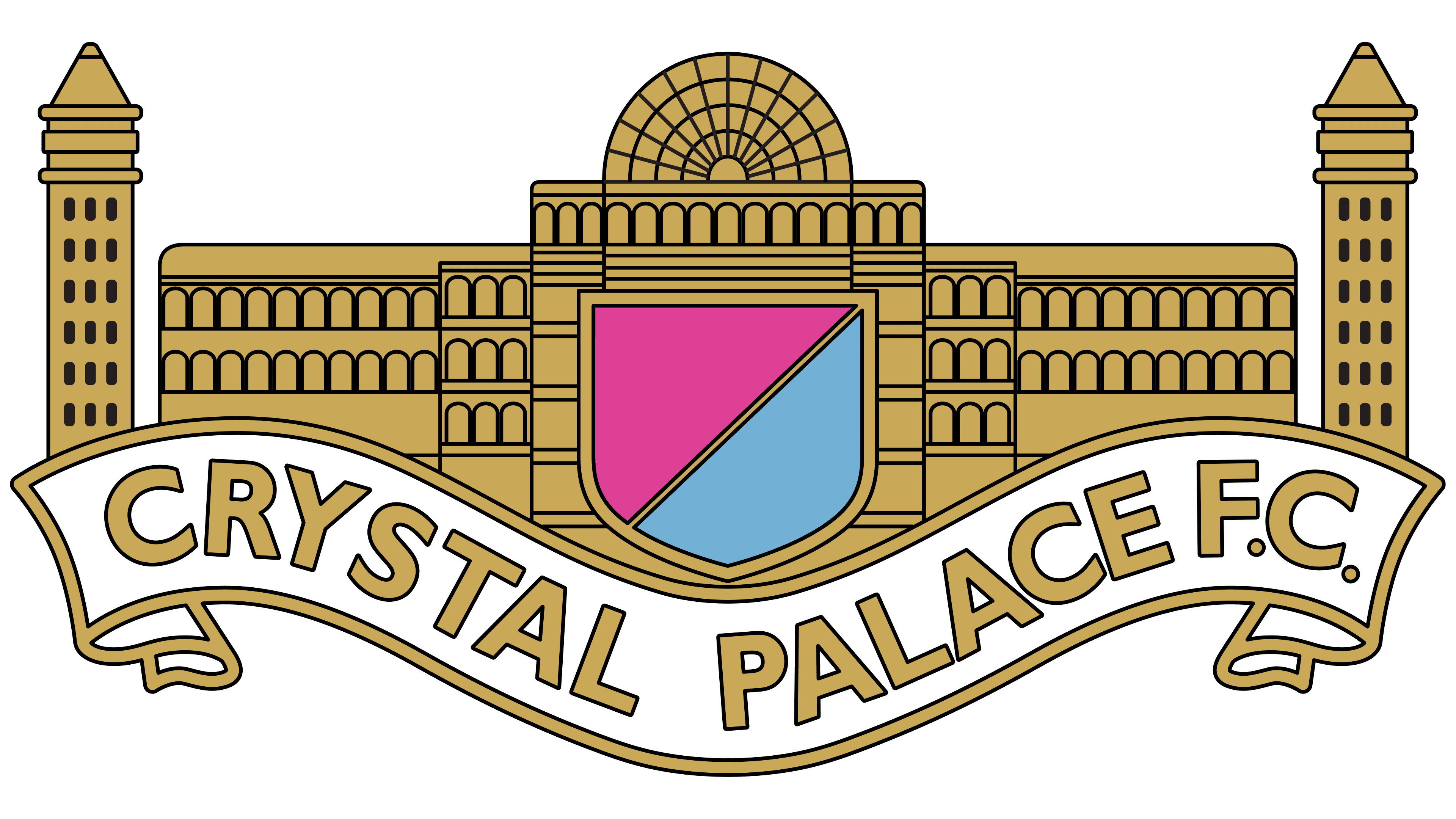
Unlike the restrained version of the mid-1950s, the new crest acquired decorative richness. The architectural silhouette of the palace was depicted with greater attention to detail: multiple arches, symmetrical towers on the sides, and a dome with a semicircular glass grid. The lines were drawn in a golden outline, which gave the entire composition a solemn and elevated character.
The core remained the shield, divided diagonally into claret and blue sections. Unlike the previous monochrome variant, the element became a color accent, emphasizing the football component of the emblem. A thick golden border heightened the shield’s visual importance and linked it to the crest’s overall decorative logic.
A white ribbon occupied the lower level with a smooth curve. On its surface was inscribed “Crystal Palace F.C.” The letters were executed in gold with a black outline, set in a dense and straight font. The mass of the glyphs created a sense of solidity and balanced the refined contours of the architectural silhouette.
The palette was built on three dominants: gold, the club’s claret and blue. The contrast with the white field of the ribbon and the black outline of the text created a clear hierarchy, helping to distinguish all levels of the composition. Together, the color and typographic elements reinforced the sense of officiality, giving the crest the character of a ceremonial symbol.
The sign demonstrated the union of two foundations: the architectural heritage represented by the palace, and the sporting identity anchored in the shield and inscription.
1964 – 1967

The rejection of architectural themes became one of the key features of the new Crystal Palace emblem. In the mid-1960s, the club introduced a shield divided vertically into three stripes. The left area was filled with blue, the right with bright red, and a narrow white line separated them. The simple geometry emphasized the course toward minimalism, distinguishing the sign from the more decorative crests of the previous decade.
The shield appeared expressive on the white kit, which the team chose in reference to Real Madrid. In visual perception, the new symbol was often compared to the French tricolor, but its meaning differed, underscoring the club’s identity as Crystal Palace.
The contrast of red and blue gradually became fixed as part of the club code. In the kit, they were used in diagonal elements, whereas in the emblem, they were rendered concisely. The white stripe served as a divider, increasing the tension between the two saturated tones.
Since 1967, the club had another version of the emblem, but the tricolor shield continued to be used in parallel and remained in circulation until 1974. This duality illustrated a transitional stage: the search for a more modern style while preserving the traditional palette.
Symbolically, the shield reflected a bold shift. The rejection of architectural allusions in favor of an abstract form showed the desire for renewal.
1967 – 1972
The sharp departure from architectural themes was a bold step for Crystal Palace. Instead of towers and domes, the club introduced a purely typographic composition. At the core of the sign was a claret square, across which the inscription “Crystal Palace” ran diagonally from the lower left to the upper right.
The main emphasis shifted to the text, turning the name into an independent symbol of identity. Italics with smooth flourishes were used to imitate a handwritten style. The yellow lettering contrasted with the rich claret field, creating a slight glowing effect. The curves of the lines added refinement, while the diagonal arrangement’s dynamics increased visual tension.
The structure was based on a simple division: a monotone background and a highlighted textual element. The typography featured italic lettering with emphasized curves, lending the letters elegance and evoking associations with calligraphic traditions. The thickness of the strokes was carefully adjusted to ensure the text remained legible yet decorative.
1972 – 1973
A new stage in Crystal Palace’s identity began with fans’ participation. A competition among supporters determined the sign that became the official emblem, gaining significance precisely as an expression of the audience’s collective taste. The winning option proposed a different visual language: instead of architectural structures or ornamental forms, a concise circle with a monogram appeared.
The composition was built on two rings. In the center was a white circle containing an abstract combination of the letters C and P. Blue lines formed a smooth arc for the letter C, while the letter P was integrated through a vertical stroke and a semicircle on the right.
The red outer ring created contrast and included a textual band. On the upper and lower arcs were two inscriptions: “CRYSTAL PALACE F.C.” and “THE GLAZIERS.” The nickname “The Glaziers” linked the team to Crystal Palace’s history and emphasized local roots.
The font was set in uppercase geometric grotesque. Even symmetry and strict proportions ensured restraint in the visual concept, aligning with the aesthetics of the 1970s, when clarity and minimalism were highly valued.
The palette combined a white background, a blue monogram, and a red outer ring. This triptych established a clear hierarchy: the center remained neutral, the monogram’s lines created an accent, and the ring with inscriptions completed the composition.
1973 – 1987
The initiator of the breakthrough in Crystal Palace’s visual identity was manager Malcolm Allison. His rebranding program in the early 1970s included changing the kit and developing a new club symbol. The team received the nickname “The Eagles,” which is now a part of their speech and their emblem.
The sign was built on a circular form. The outer ring was painted red. Inside was a smaller ring, and on its white band ran the inscription “Crystal Palace Football Club.” The text was set in blue capital letters and divided by dots, which gave the composition symmetry and strict rhythm.
The central part featured a circular red field. On it stood the silhouette of a white eagle with its wings spread. The bird was depicted in an attacking pose: its sharp beak pointed downward, its claws clutching a football, and its wings raised. The image became the visual embodiment of ambition and aggression, reflecting the club’s drive for strength and struggle.
The typography was based on a geometric grotesque. Straight outlines and a lack of ornamentation emphasized modernity and aligned with the aesthetics of sports design of the time.
The color system was based on a triad: red, white, and blue. Red dominated the center, white formed the eagle figure, and blue was used for the inscriptions.
The image of the bird was stylistically reminiscent of a phoenix, emphasizing rebirth and the beginning of a new stage of development. The change to a red-and-blue kit palette, modeled after Barcelona’s, firmly established the renewed course.
1987 – 1994
The new version of the crest retained the eagle figure, but the composition gained richness and layering. The bird grew larger, depicted in flight with spread wings and a predatory, focused expression. It sits on a football, with claws highlighted by a red accent that reinforces the sense of aggression and physical power.
Behind the eagle, a stylized image of the Crystal Palace rose. The architecture was rendered in a gray-and-white palette, featuring towers on the sides and an arched structure at the center. Light shades created contrast with the bird’s deeper blue silhouette, adding depth and volume to the entire composition.
In the foreground was a curved red ribbon. White capital letters formed the inscription “Crystal Palace F.C.” Integrating the text into the composition emphasized the club’s name and ensured identification. The typography appeared strict, with an emphasis on the contrast between the saturated background and the light characters.
The color palette was based on blue, red, and gray-white. The eagle and ball were executed in blue, while the claws and ribbon were in red. The architectural background and other elements were rendered in light tones.
In the Crystal Palace logo, for the first time, a balance was achieved between the architectural tradition and the predatory bird’s image, combining the monumentality of the palace with the eagle’s energy.
1994 – 2013
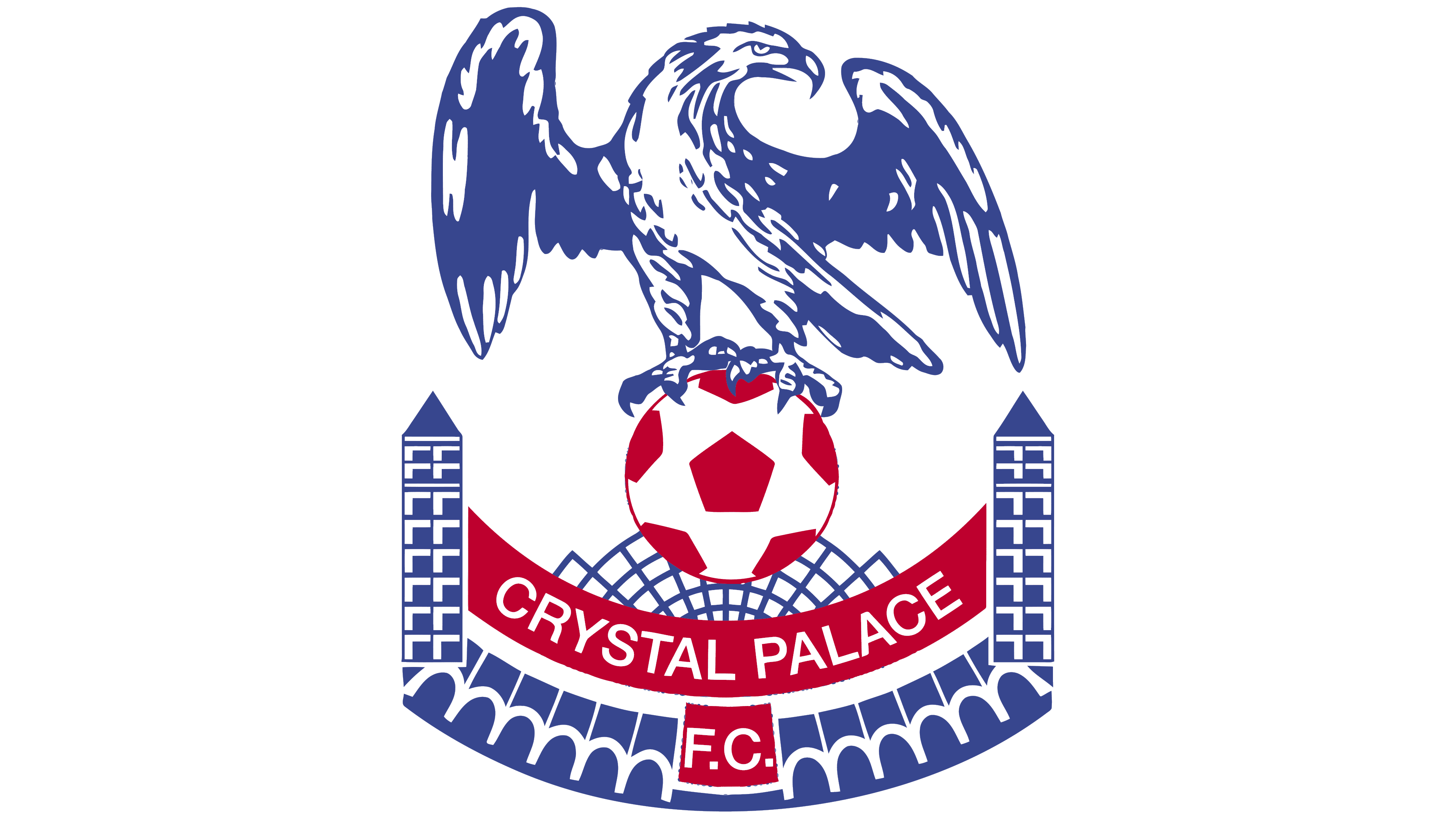
The next redesign reinforced the club symbol’s aggressiveness. The management considered the previous eagle silhouette too soft, resembling a phoenix, so the bird received new contours: elongated lines, dark blue wings, and a rigid form that emphasized its predatory character. The silhouette became more dramatic, which distinguished it from earlier versions.
The football under the eagle had previously been executed in a blue-and-white palette. Now its segments were given a red color. The contrast made the composition more dynamic and heightened the sense of sharpness. Beneath the ball, the depiction of the Crystal Palace remained. The architectural motif was simplified, the details reduced to a minimum, and the form became more monolithic, creating a solid foundation for the entire structure.
The base of the crest was a red ribbon integrated into the architectural part. On it, in white capital letters, was written “CRYSTAL PALACE F.C.” The text appeared harsher and more expressive than before, thereby emphasizing the club’s identity.
The palette was based on three key shades: deep blue used for the eagle and architecture, red for the ribbon and ball segments, and white for the text and outline accents. The combination of colors created a strong visual contrast, making the sign recognizable across various media.
2013 – 2022

The launch of the new emblem resulted from a lengthy discussion between management and fans. The first redesign projects appeared as early as 2010, but the supporters rejected them. The final version evolved from a concept proposed by a participant on a fan forum and was refined by the agency CHI, in collaboration with designer Dan Mallahi. The presentation took place on May 7, 2013, at the club’s awards ceremony, which emphasized its official status and the community’s involvement in the process.
The composition combined several layers of symbolism. The architectural part was represented by the silhouette of the palace and two towers, executed in a restrained gray-and-white palette. In the central part, there was a retro-style football, and below it was the date 1905, marking the founding year of the professional team. Above the architectural base was placed an eagle: its figure was rendered with sharp lines, its pose conveyed aggression, and its wings and beak suggested a predator ready to attack. Unlike earlier versions, the bird no longer stood on the ball but dominated above the building, strengthening the impression of threat and power.
At the bottom of the crest was a blue ribbon with a red border. In white letters, the inscription “CRYSTAL PALACE F.C.” appeared. A geometric sans-serif font was used, featuring strict proportions and even letter spacing, creating a modern tone.
The color palette was built on the relationship of three groups: blue and red provided accents, white formed the text and details, and gray-white served as the architectural base. This system of shades established a hierarchy of past and present, in which the historical part receded into the background, while the bird and the text occupied the foreground.
2022 – today

The change in the current version of the Crystal Palace emblem was not about graphics but about historical correction. Research by Peter Manning revealed a connection between the Crystal Palace Company cricket club and the founding of the amateur football team in 1861. This was confirmed by football historian Guy Oliver, who allowed the club to officially establish an earlier date. Under the football on the crest, a new date, 1861, was added to replace 1905.
All other elements repeat the 2013 composition. At the top remains the eagle, depicted in blue and white tones, above the red ball. Its wings and sharp beak form an impression of strength and aggression. Behind it stands the silhouette of the palace with two towers. A blue ribbon with a red border completes the lower level. In white letters, the inscription “CRYSTAL PALACE F.C.” is visible.
The meaning was expanded by adding the date 1861. The sign now unites three elements: the aggressive image of the eagle, which embodies the team’s character; the architectural motif, indicating the historical connection to the palace; and the numerical mark, establishing the club’s place among the world’s oldest football organizations.