


 Destiny 2 Logo PNG
The Destiny 2 logo is simple and clear. The emblem announces the release of the second part of the popular game and invites viewers to put on their helmets and protective suits and embark on another mission to save humanity.
Destiny 2 grew out of Bungie’s post-Halo period. The studio was founded in Chicago in 1991 by Jason Jones and Alex Seropian. In 2000, Microsoft acquired the team during the development of Halo: Combat Evolved to support the Xbox launch. Halo became the console’s flagship exclusive, earning $300 million in its first week. Still, the rights stayed with Microsoft after the studio’s 2007 split.
On October 5, 2007, the developers became independent again and began work on a new universe. In April 2010, after nine months of talks, they signed a ten-year publishing deal with Activision, which invested about $500 million in production, distribution, and marketing. The first Destiny launched on September 9, 2014, earning $325 million in its first five days.
Destiny 2 was released on September 6, 2017, for PlayStation 4 and Xbox One, followed by a Windows version on October 24 through Blizzard’s Battle.net. Vicarious Visions and High Moon Studios helped expand the content pipeline. In the live-shooter market, the game competed with Warframe by Digital Extremes. On January 10, 2019, the split with Activision was announced, and franchise rights returned to Bungie. On October 1, 2019, Destiny 2 moved to Steam and became free-to-play under the New Light model.
Sony Interactive Entertainment announced a $3.6 billion acquisition of the studio on January 31, 2022. The team kept operating across platforms, but layoffs followed in 2023 and 2024. The Final Shape moved from February to June 2024 and beat internal sales forecasts. In May 2026, the studio announced the end of Destiny 2 support. The final update, Monument of Triumph, was released on June 9, 2026.
Meaning and History
What is Destiny 2?
It is a multiplayer space shooter compatible with all operating systems and gaming consoles. Developed in 2017 by Bungie employees Luke Smith and Christopher Barrett. The game has seven expansions.
2017
The logo has one main version and several variations. The primary emblem differs slightly from the one presented on the game’s Twitter on March 27. Initially, players were met with a very epic scene: the dead Traveler hanging above Earth, sacrificing himself to save humanity, and smoke columns rising from the battle for the Last City. Amid the devastation on a hill, a huge number 2 was placed, shining with the Traveler’s supernatural light. In the center of the picture are inscriptions.
The epic ambiance disappears in the constantly used version, leaving only the inscriptions.
The large number 2 is located in the background of the emblem. It has a pale gray color and sets the background, indicating that the game presented is a sequel, the second part. Its scale hints at the many versions and expansions (Expansion I: Curse of Osiris, Warmind, Forsaken, Shadowkeep, Beyond Light) that it brings together.
The title is placed above the number 2 in thin capital letters. In translation, Destiny means fate. The project was called Project Tiger during development because of the engine used. The choice of the final name is related to the shooter’s world history. The game determines the fate of the Solar System and the Last City, where the remaining humans hide from the attacking representatives of other worlds. Being a Guardian is also fate. Becoming a defender of planets once belonging to the human race, the player is given a specific mission: a duty to fight the attacking evil. Overall, the game decides humanity’s fate, so the name is apt.
The capital letters convey the importance of the mission, upon which successful completion depends for survival. The thin font shows that success always hangs by a thread.
Next to the title is a special three-pointed element with rounded ends. It is also present in the logo of the first Destiny game. However, on the triangle, a star map is visible, suggesting that the events occur in space and that the plot involves interplanetary travel. In Destiny 2, the element has a black-and-white color scheme. In shape, it resembles the following:
- An unusual joystick with a control wheel. The association links the logo with a computer game.
- A spaceship is transporting the player from planet to planet.
- One of the masks worn by the Guardians.
The three rays may hint at various triads of related characters, such as humans, Awoken, and Exos; humans, AI, and extraterrestrial beings; Cabal, Titans, and Guardians; and Osiris, Vex, and Guardians. The inscription and the symbol seem to hang in the air, hinting at constant space flights.
In other emblem variations, the number 2 is moved to the right, reduced to the size of the inscription, or placed below.
Font and Colors
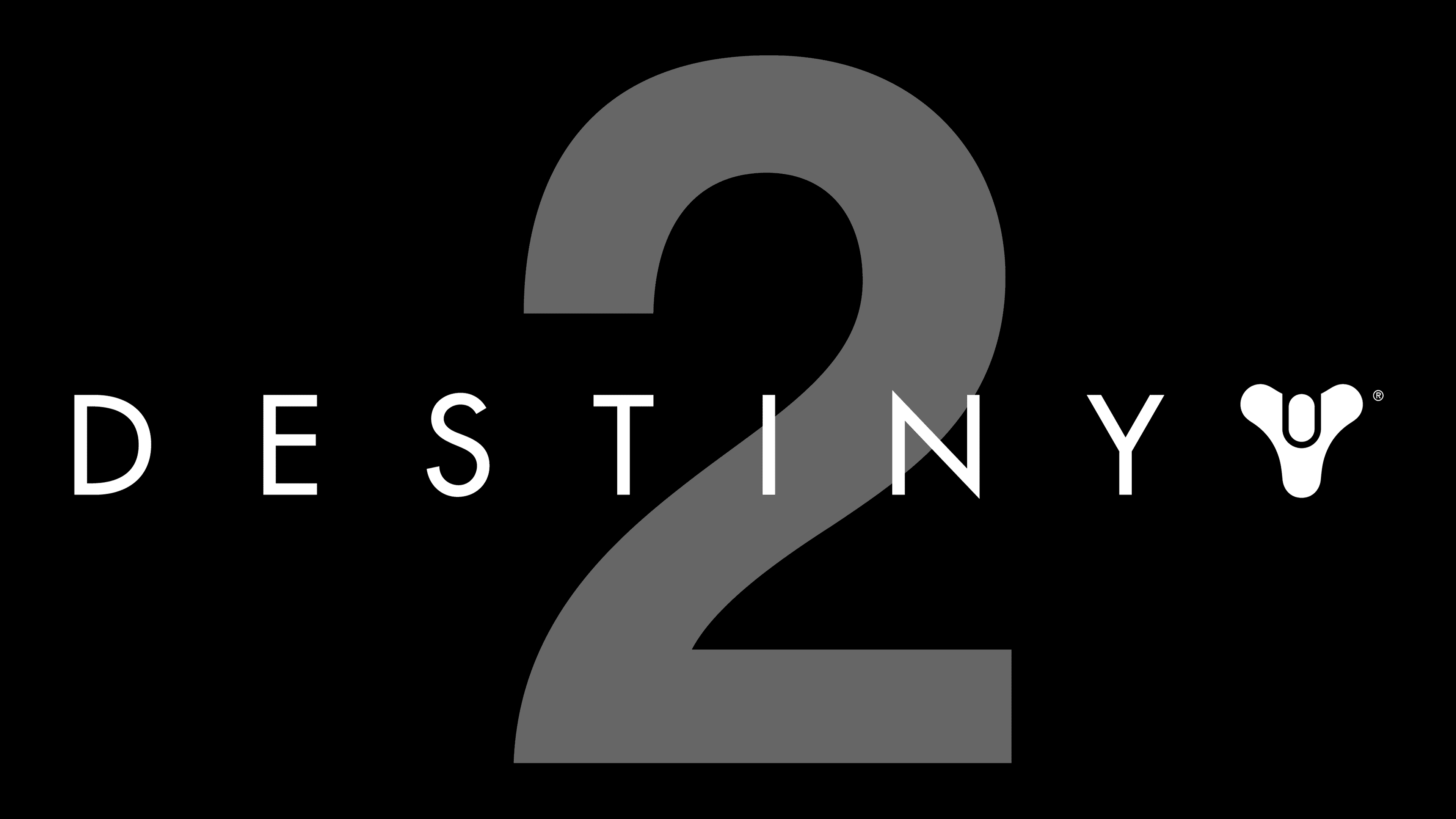
The Destiny logo features a typeface defined by strict geometry and minimalism. The letterforms are thin and evenly weighted, with clean-cut ends and subtle points that convey a sense of technology and futurism. Similar stylistic elements appear in fonts such as Josefin Sans and Exo, though the original design retains a distinctive character.
The color palette is built on the contrast between deep black and light white tones. Black represents darkness and the looming threat that emerged after the fall of the Traveler, humanity’s guardian. White symbolizes hope and the power of the Light, wielded by the Guardians, who protect humanity. These bright lines and shapes embody the mystical energy that enables the Guardians to stand against the forces of darkness and chaos.