 FCC (Federal Communications Commission) Logo PNG
Communications and broadcasting regulation covers radio, television, the internet, and devices that transmit signals. Oversight includes issuing permits, setting standards, and testing equipment before it enters the market. The FCC logo represents the U.S. government agency that regulates the communications sector and ensures compliance with technical and legal standards.
The U.S. Congress established the Federal Communications Commission in 1934. Its purpose was to regulate all forms of communication after the Communications Act was adopted. The new agency combined the functions of the Federal Radio Commission and the Interstate Commerce Commission. It assumed oversight of radio, television, and telephone services.
In its early decades, the agency developed rules for broadcasting and frequency allocation. These measures helped prevent monopolization of the media market. In 1941, the FCC approved technical standards for television. After World War II, television became a mass phenomenon. The FCC expanded the station-licensing system and established VHF and UHF channel allocations.
In 1949, the FCC introduced the Fairness Doctrine. It required broadcasters to present different viewpoints on public issues. In the 1960s and 1970s, the commission regulated telephone company rates. Its main focus was AT&T, which operated as a natural monopoly.
After the 1982 antitrust case, the government broke up AT&T. The FCC oversaw the industry’s transition from monopoly to competition. In 1987, the FCC repealed the Fairness Doctrine, reflecting changes in the media environment and communication policy.
The 1996 Telecommunications Act reform opened the communications market to new participants. Cable and internet companies entered the field. In the 2000s, the FCC oversaw the transition to digital television. The process was completed in 2009. The FCC transferred the freed frequencies to mobile operators.
In 2010, the commission approved net neutrality rules that guaranteed users equal access to internet content. In 2015, the commission strengthened these rules. In 2017, they repealed them, and in 2024, the Biden administration reinstated them.
The Federal Communications Commission regulates radio, television, the internet, and wireless communication. The agency balances technological progress with the need to protect user interests.
Meaning and History
What is the FCC?
It is a federal agency of the United States, authorized by Congress, that regulates all types of communications: radio, television, cable networks, the internet, mobile, and satellite communications. It issues licenses, allocates the radio frequency spectrum, sets standards, and monitors compliance with the law. The Commission consists of 5 members appointed by the President and confirmed by the Senate. The agency oversees competition, reviews mergers, protects consumers, and regulates net neutrality. It certifies equipment for the U.S. market and manages a fund that provides communication services in rural areas. It also oversees censorship, decency, and political advertising.
1934 – 2005
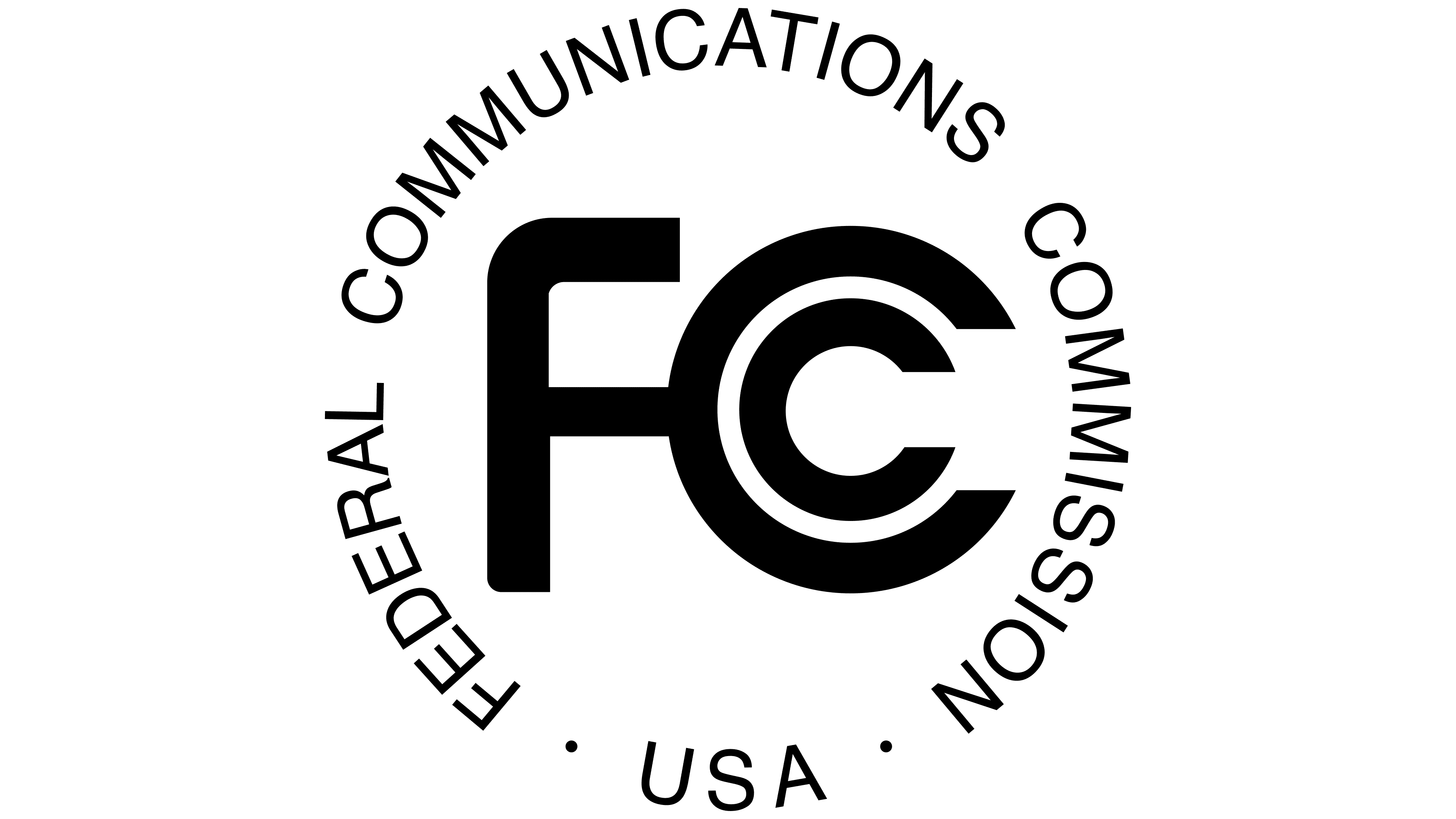
The FCC lettermark was part of the agency’s identification system, alongside its official seal and the markings used on electronic equipment. Each served a different purpose. The seal represented the federal commission, the monogram appeared on its materials, and the product marking indicated compliance with technical requirements. FCC stands for Federal Communications Commission.
Congress established the commission under the Communications Act of 1934. It assumed the Federal Radio Commission’s authority and oversight of telephone, telegraph, and cable communications previously handled by the Interstate Commerce Commission. The word “Communications” encompassed different methods of transmitting information. The abbreviation came from the first letter of each word in the agency’s name.
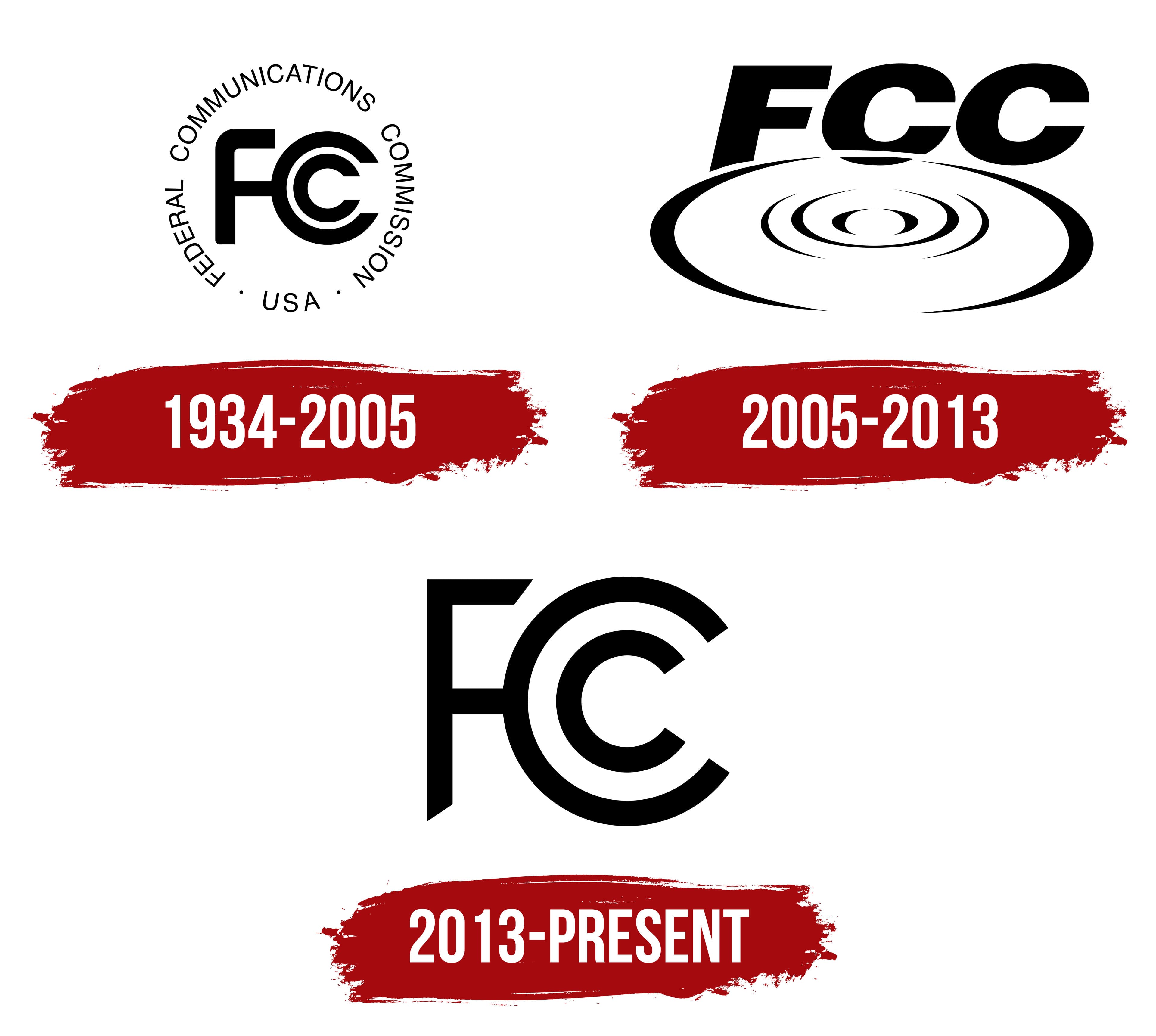
The black monogram connected an “F” to a large “C” through the middle crossbar. A second, smaller “C” sat inside the larger curve. The two rounded letters shared a center and opened to the right, while the “F” straight strokes formed the emblem’s left side. In the version used on commission materials, the full name curved around the monogram in thin uppercase sans-serif letters resembling Helvetica or Arial. USA appeared at the bottom, with a small dot on either side. The text formed a circle without an outer border.
The old official seal used a different design and color scheme. A dark blue circle was surrounded by a gold border resembling twisted cord. The commission’s name ran around the edge in red uppercase sans-serif letters, accompanied by “U,” “S,” and four white five-pointed stars. A ring of white dots separated the outer text from the central illustration. A gold eagle appeared above intersecting white lightning bolts. Below it, two lattice towers, wires, and communication lines appeared. A vertical line rose between spreading telephone lines toward horizontal wires. The seal used recognizable equipment to represent radio transmission and wired communication.
In 1996, the FCC introduced a Declaration of Conformity procedure for personal computers and peripheral devices. The marking included the monogram and product identification information, indicating compliance with radio-frequency emission requirements. The compact version contained only the “F” and two nested “C” letters. The bottom of the “F” stem had a diagonal cut, its upper crossbar ended at an angle, and the main straight and curved strokes were uniformly thick. In 1998, use of the logo was extended to equipment declared compliant under Part 18 of the FCC rules.
2005 – 2013
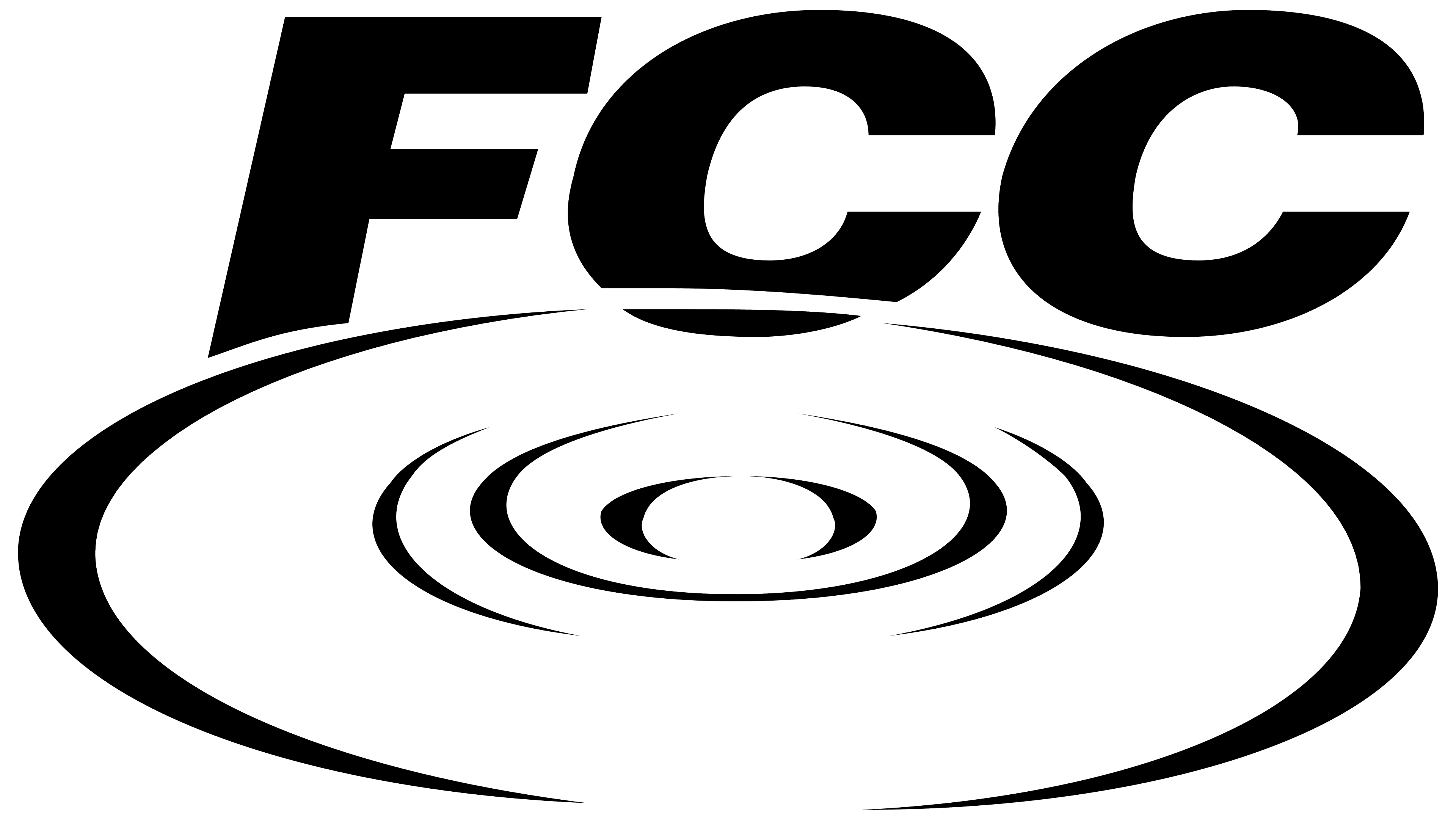
During the 2000s, the Federal Communications Commission used a horizontal logo with FCC above a pattern of spreading arcs. Compared with the circular emblem bearing the full name Federal Communications Commission, the lettering was shorter, and the space beneath it was filled with lines resembling a spreading signal.
The three large black letters had heavy sans-serif strokes and a slight rightward slant, resembling Helvetica Rounded Bold. Beneath them sat a small white oval, encircled by three open rings. The inner arcs clustered around the oval, while the outer ones extended across almost the full width of the composition. The lines were interrupted and ended in sharp points. The all-black treatment united the lettering and wave pattern in a single emblem.
2013 – today
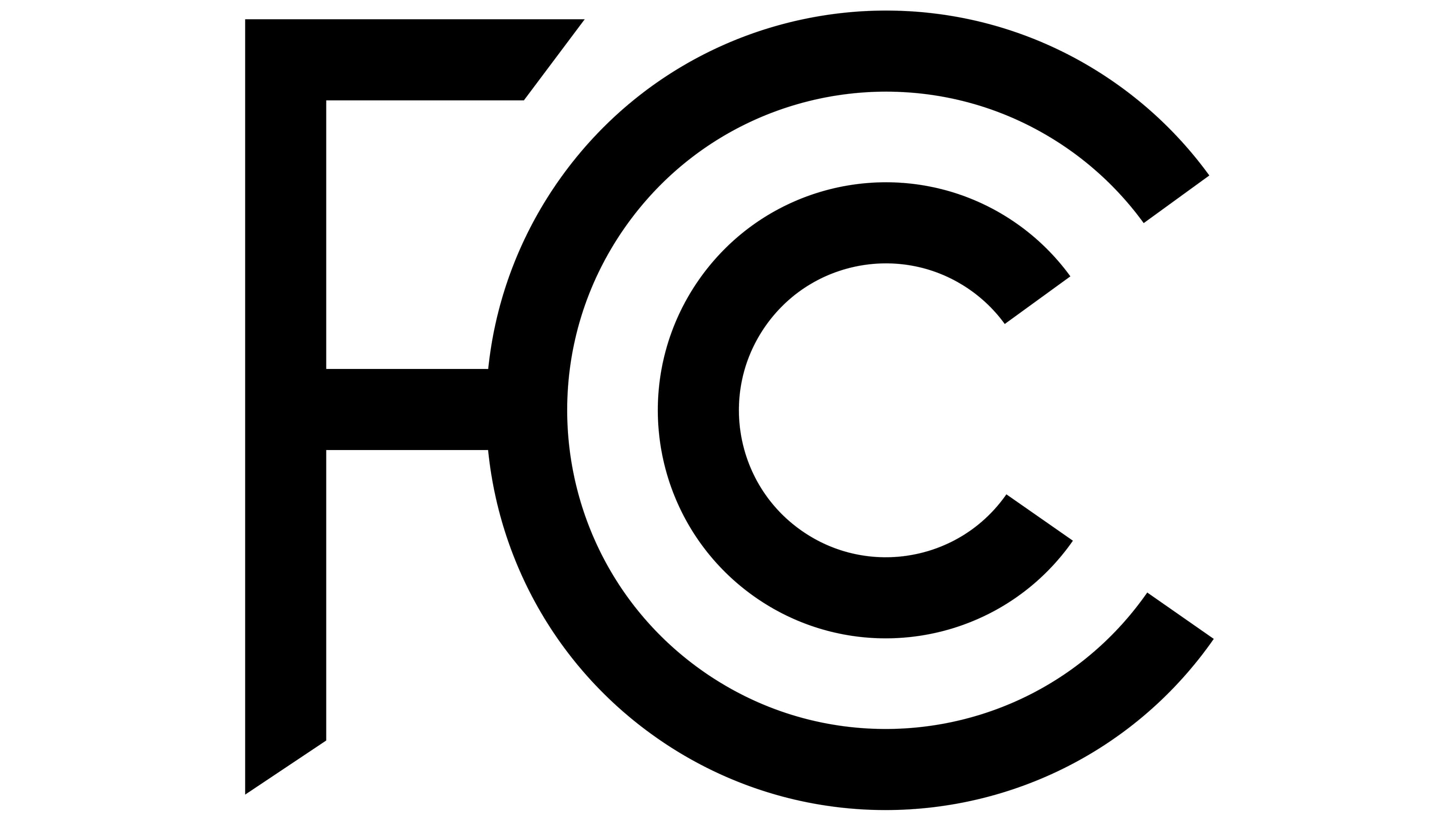
The modernized version of the Federal Communications Commission’s longstanding emblem retained only the abbreviation FCC. The full name, Federal Communications Commission, was represented by a monogram of three structurally connected letters. Black coloring and uniform stroke thickness united the straight lines of the “F” with the rounded forms of the two “C” letters.
On the left, the “F” has a straight vertical stem and two short crossbars. Its upper edge angles up to the right, and the stem tapers to a point at the bottom. A large “C,” a thick open ring with a gap on the right, sits beside it. A smaller “C” inside follows the same curve. Nesting the arcs allows all three initials to fit into one compact shape.
Seal Logo
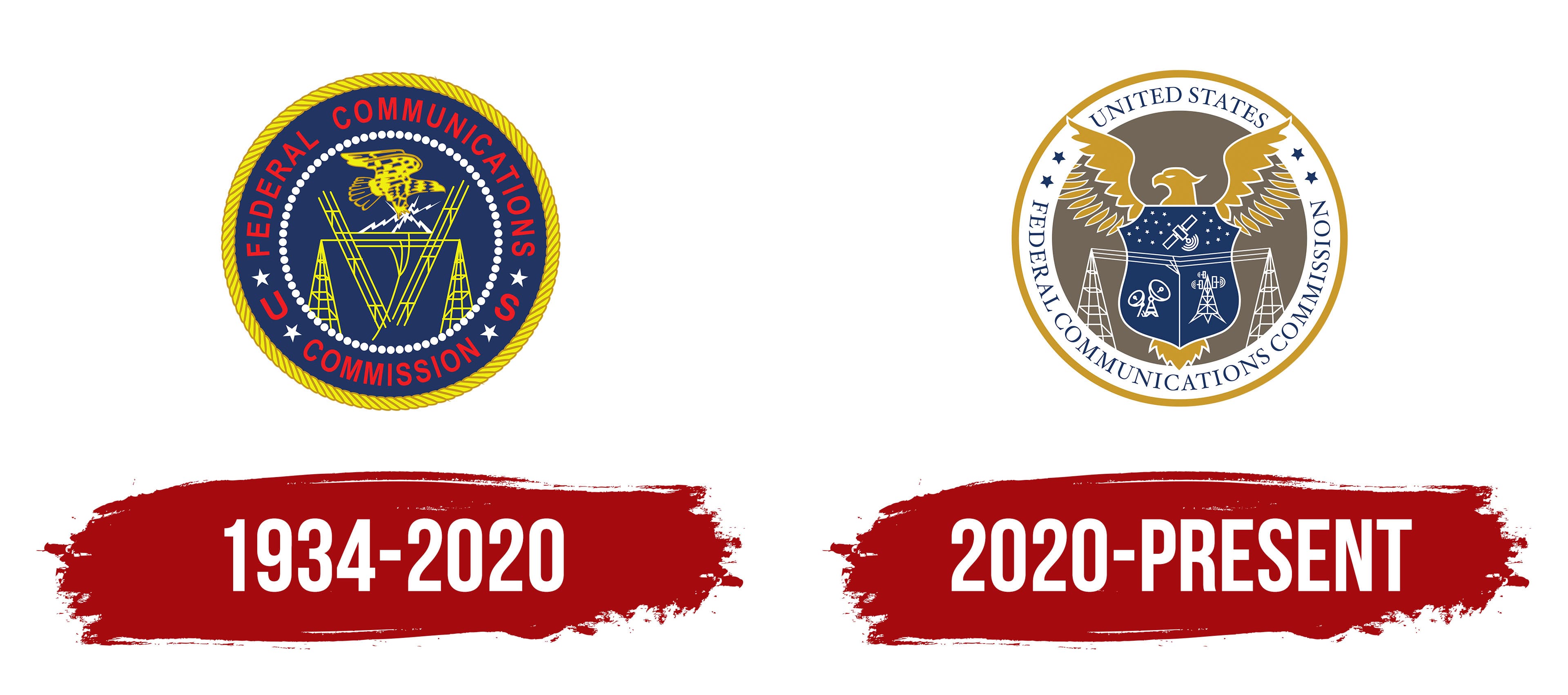
1934 – 2020
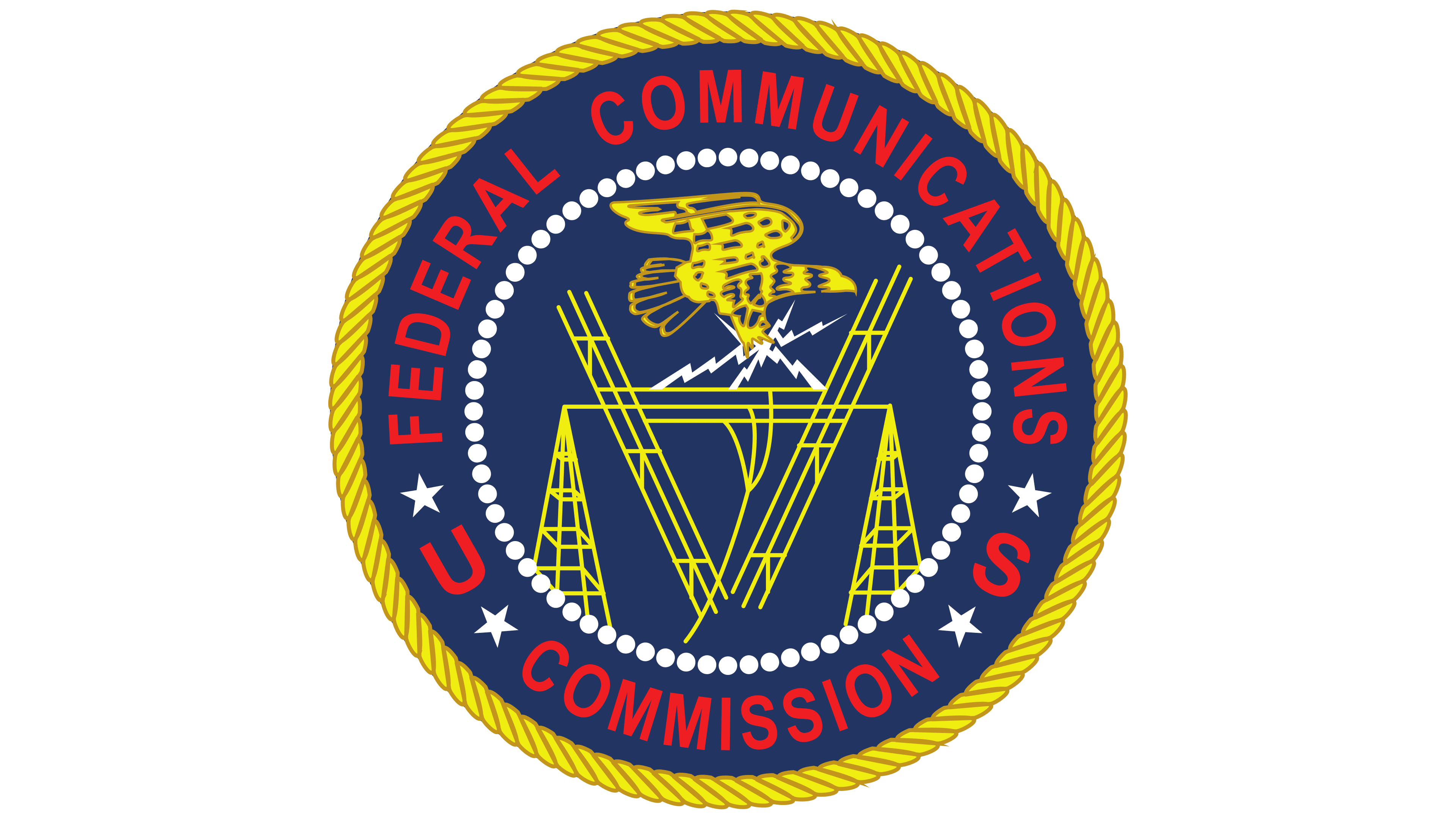
The Federal Communications Commission’s first seal represented the agency through circular lettering and images of signal transmission. The full name, Federal Communications Commission, surrounded a dark blue field with a purple undertone. A golden-yellow border resembling twisted rope encircled the outside. This concentric arrangement separated the commission’s name from the central scene.
FEDERAL COMMUNICATIONS ran along the upper arc in red uppercase letters, with COMMISSION along the bottom. The broad sans-serif letters resembled Franklin Gothic Heavy. Two white five-pointed stars appeared on each side between the upper and lower portions of the name. The letter “U” sat between the stars on the left, with “S” in the corresponding position on the right. A ring of evenly sized white dots separated the lettering from the illustrations.
A yellow eagle outlined in black occupied the upper part of the central field. The bird flew right, its head and beak facing right. White lightning bolts spread behind it to represent signal transmission. Below, yellow lines depicted antennas, masts, and guy wires. Intersecting vertical and diagonal lines formed a broad trapezoidal structure resembling radio towers. Two slanted elements rose from it to form a “V” shape.
2020 – today
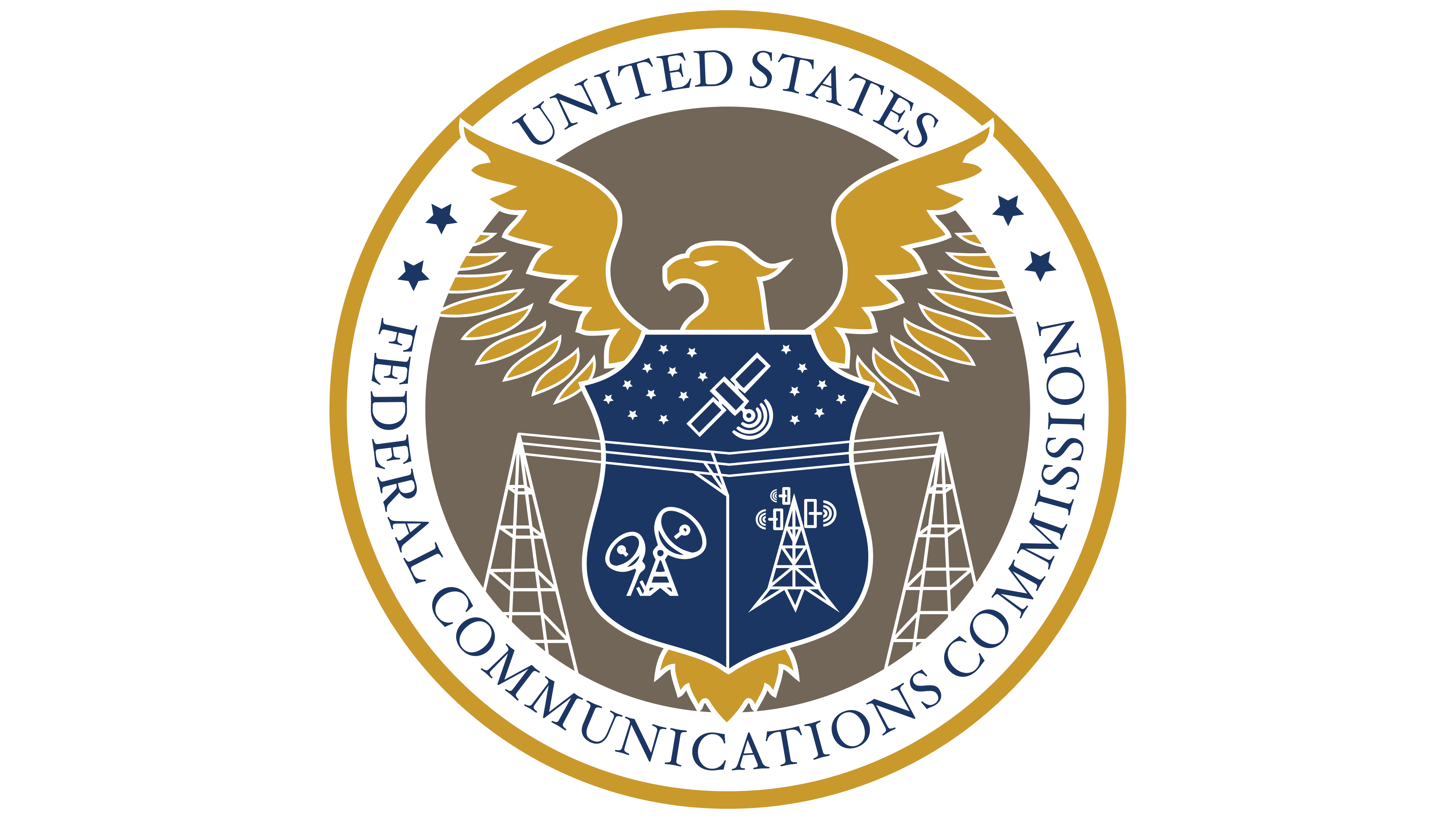
The FCC’s headquarters relocation prompted an update to its official seal. The commission unveiled it in April 2020 and planned to begin using it when the move was completed later that year. The commission selected the design through an internal competition open to employees and contractors. Umasankar Arumugam won the vote. He kept the circle, eagle, and communication equipment but changed their arrangement and appearance.
An eagle with raised golden-brown wings occupies the upper portion of a gray-brown field. Its head faces right, and its feathers are shown in several layers. White outlines and dark blue accents define the wings, head, and tail. A blue shield partially covers the bird’s body. The upper section contains 18 white stars, plus a satellite with antennas and radiating waves. The lower sections show upward-facing dish antennas and a communications tower. Blue areas separate the white illustrations. Lattice structures with wires and guy wires stand on either side of the shield.
The agency’s name appears in a white outer ring. UNITED STATES runs across the top in blue uppercase letters, with FEDERAL COMMUNICATIONS COMMISSION along the bottom. The serif lettering resembles Times New Roman. Four blue five-pointed stars, two on each side, separate the phrases. A smooth, thin gold circle replaces the earlier twisted border.
The four stars in the outer ring reference the seal of the Federal Radio Commission, the FCC’s predecessor. The 18 stars on the shield represent the commission’s 18 bureaus and offices at the time of the update. The eagle and shield identify it as a federal agency, while the satellite, ground antennas, and towers represent communication technologies.