Foster Farms Logo PNG
The Foster Farms logo symbolizes the company’s reliability and quality, and it specializes in poultry products. Its simple, recognizable design emphasizes everyday accessibility and the brand’s established reputation.
Foster Farms began in 1939, when Max and Verda Foster bought an eight-hectare dairy farm in Stockton, California. They soon shifted toward poultry, starting with turkeys and handling feeding, cleaning, deliveries, and sales themselves. They added chickens in the late 1940s, and they later became the company’s main product. In 1950, Foster Farms purchased a feed mill, giving it control over feed quality, supply, and production costs.
The first processing and packaging plant opened in Livingston in 1959. From that point, the company managed the chain from raising birds to supplying packaged meat. After Max Foster’s death, his son Paul led further expansion. By 1987, Foster Farms had become California’s largest poultry producer, competing with Tyson Foods and Perdue while concentrating its business on the West Coast.
During the 1990s, the company acquired more processing plants and added marinated poultry, prepared foods, and ready-to-cook products. Distribution expanded across Oregon, Washington, and parts of Nevada. In 2013 and 2014, products were linked to a multistate salmonella outbreak. CDC investigators traced cases to Central Valley facilities, and federal regulators considered closing the Fresno plant. Foster Farms upgraded production controls and retained its operating licenses.
In 2022, Atlas Holdings acquired Foster Farms, ending 83 years of family ownership. The buyer said existing plants and jobs would remain in place across its network after the sale.
Meaning and History

What is Foster Farms?
It is a major American poultry producer with products distributed on the U.S. West Coast from California to Alaska. The company raises poultry independently, controlling the production steps and avoiding deep freezing. The range includes fresh meat, semi-finished products, and ready-to-eat meals. The brand gained popularity through humorous ads featuring puppet chickens hoping to join the production.
1974 – 1985
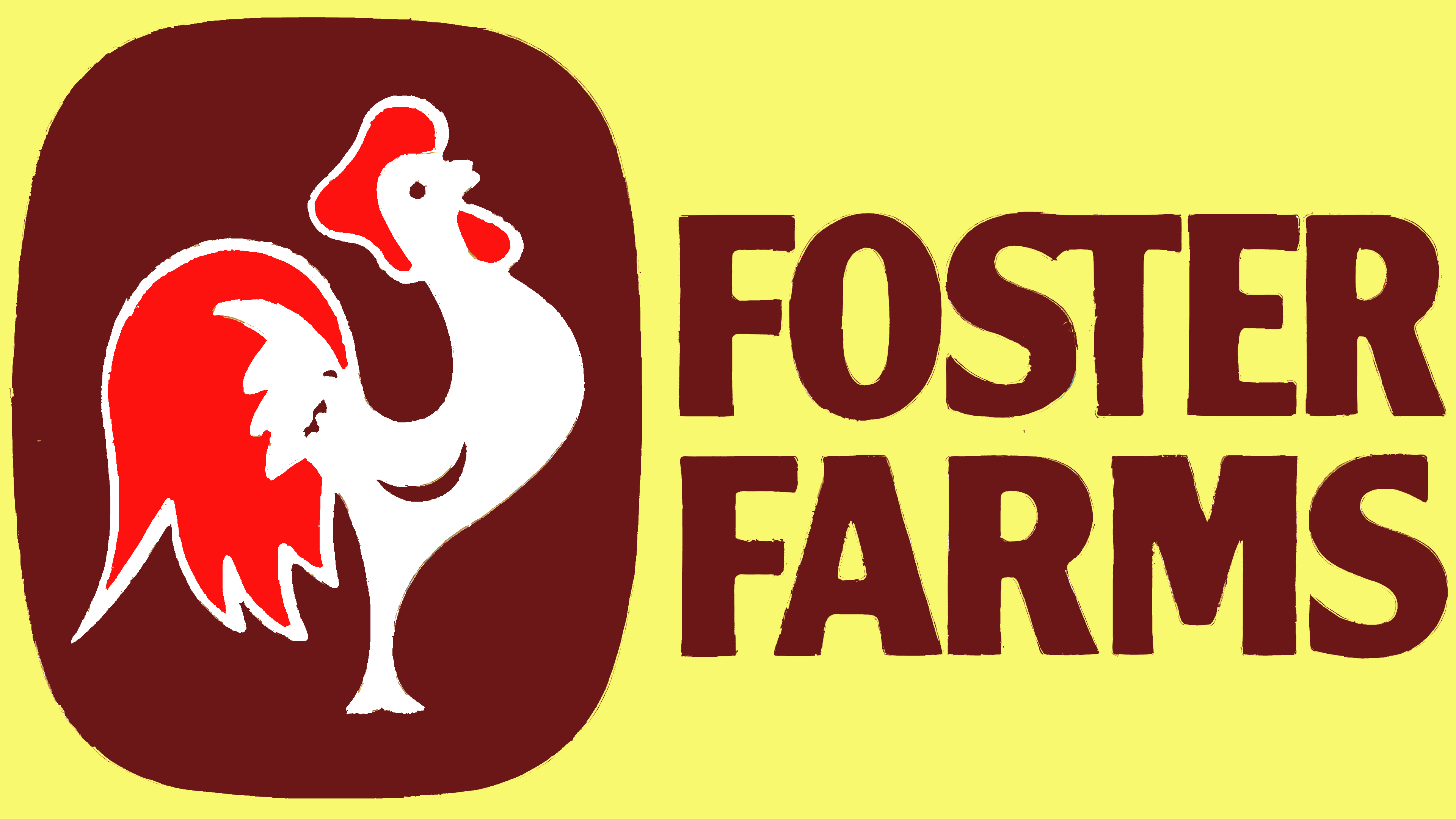
In 1974, Foster Farms introduced a new logo as part of its visual identity; this is now considered the earliest preserved version. The company, founded in 1939, had by then established a recognizable name in the agribusiness sector, and updating its logo was a step toward creating a more distinctive market identity. The logo combined a simplified rooster illustration with the name, creating a cohesive visual impression.
The rooster was depicted in a flat style, featuring large areas of color and minimal detailing. A red accent highlighted the tail and comb, while white defined the body and neck silhouette. A dark burgundy (almost brown) background, in the shape of a rounded rectangle, enclosed the composition. Smooth lines and generalized forms gave the symbol decorative expressiveness.
To the right of the symbol was the company name “Foster Farms,” rendered in bold uppercase sans-serif letters. The large font size and tight spacing ensured easy readability against a bright yellow background.
The contrast among vivid red, white, and dark burgundy was balanced by the yellow background, creating an energetic visual rhythm. This palette enhanced readability and strongly associated the brand with poultry products.
The visual style reflected the aesthetics of the 1970s, when agribusiness brands sought simple, memorable marks. The logo was used in a unified horizontal layout, with symbol and text balanced proportionally.
1985 – 1996
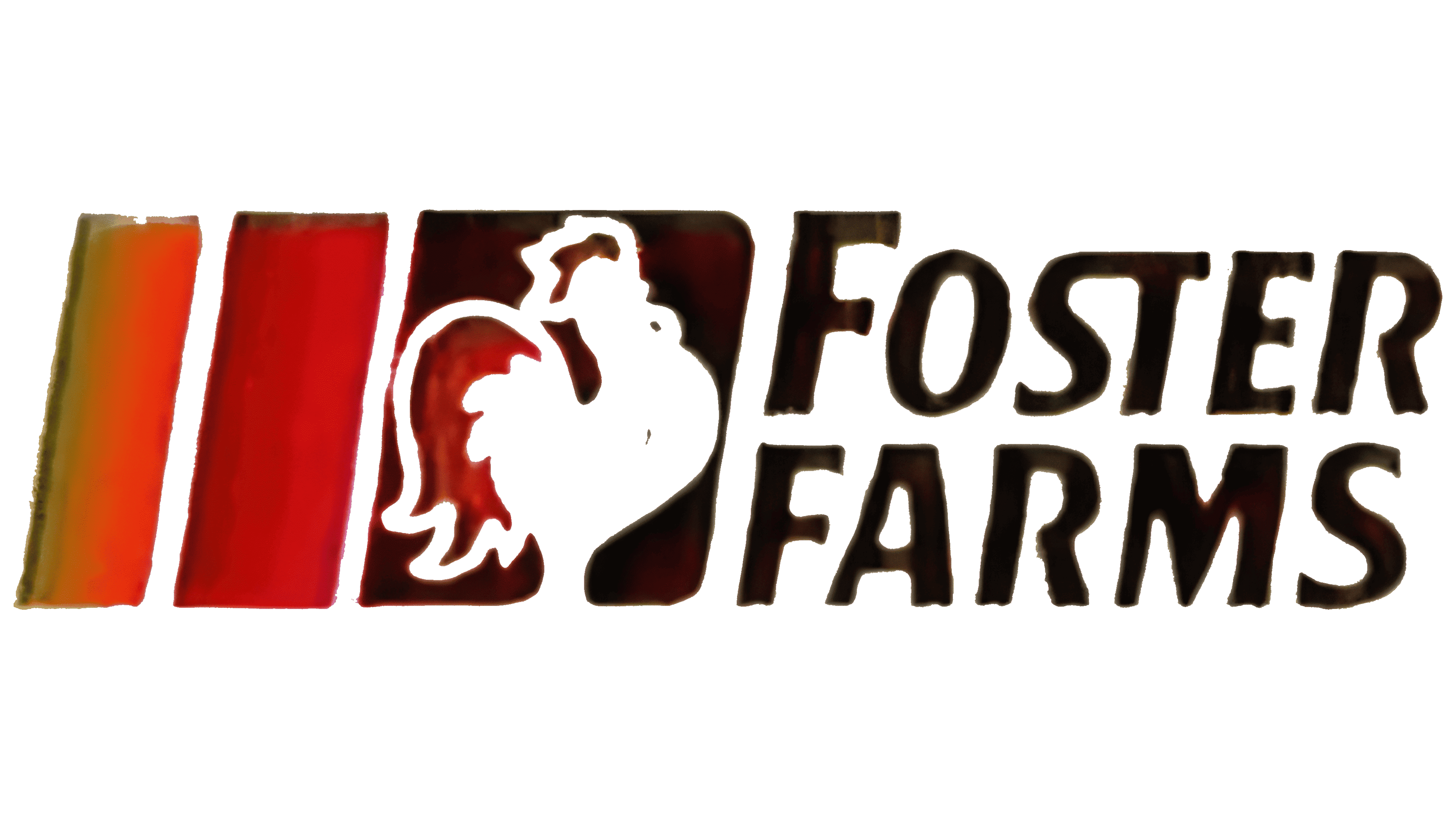
In the second half of the 1980s, Foster Farms updated its visual identity with a new layout that was distinct from the previous one. The visual block was structured with modularity, typical of that period’s design, emphasizing large areas of color and organized composition.
On the left side, two vertical stripes featured a smooth gradient from yellow to scarlet, followed by a rounded rectangle containing the silhouette of a rooster. The bird appeared in red and white against a deep, dark-brown background, intensifying the contrast. To the right of the symbol, the textual element featured the name “FOSTER FARMS,” set in uppercase, sans-serif letters.
The letters were vertically elongated, with reduced spacing between them, and their heights differed between the upper and lower lines. This structure formed a dense, stable textual section. The optical balance between the elongated typography and the compact modules on the left created an overall sense of unity.
The color palette combined warm tones, predominantly red and yellow, complemented by dark burgundy in the rooster’s block. The color contrast provided strong readability while creating a warm association closely tied to agriculture and poultry products.
1996 – 2014
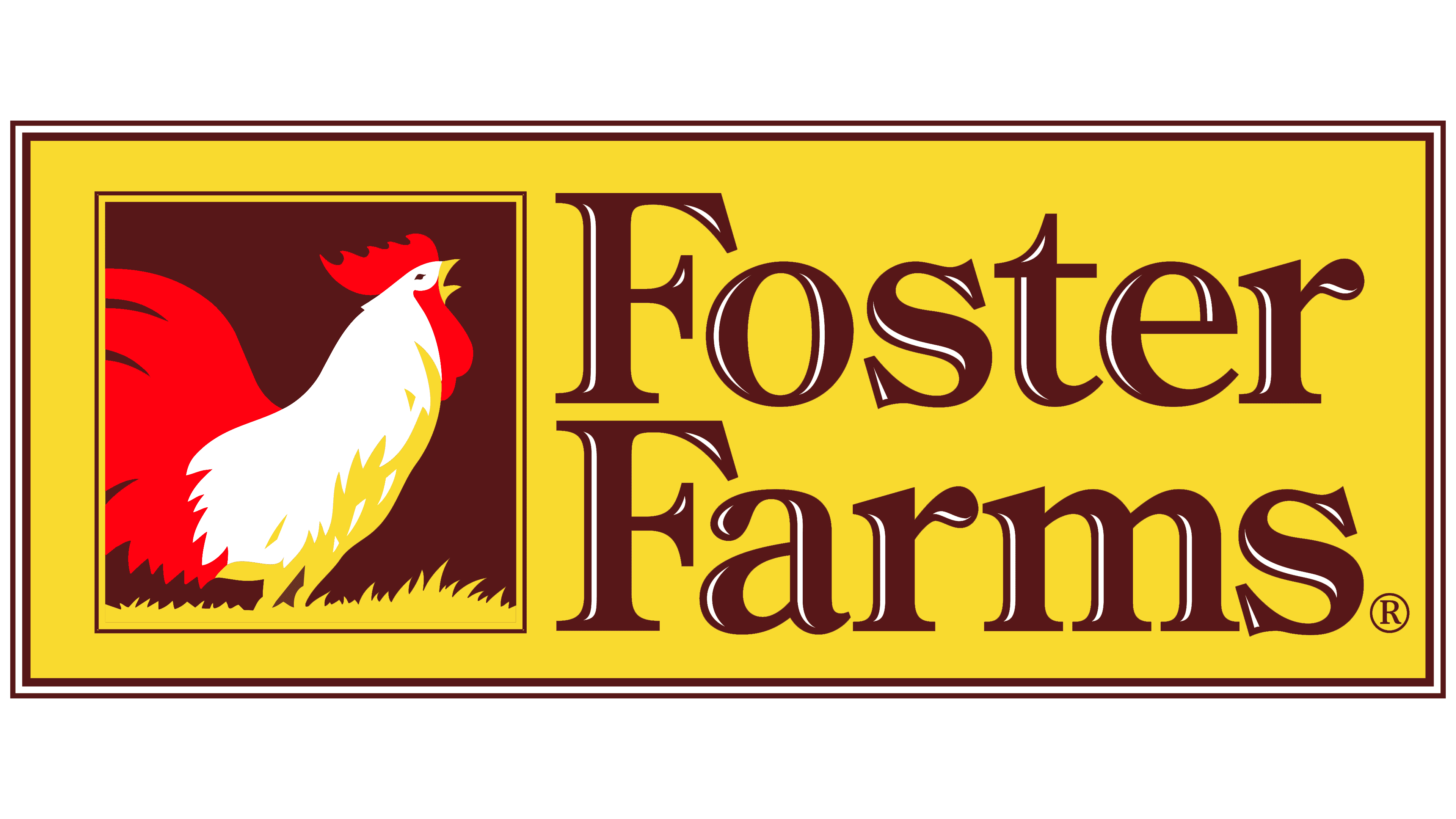
In 1996, Foster Farms’ corporate branding received an updated design, featuring a composition within a horizontally elongated rectangle filled with vibrant yellow. The left section was dedicated to a square block depicting a rooster against a dark burgundy background. The bird’s silhouette was accented with white and red highlights, and the lower edge of the square featured a yellow stripe styled as grass.
Compared to previous versions, the rooster image became more naturalistic, with smoother contours, softer color transitions, and an overall form that appeared more dimensional. To the right of the image was the two-line text “Foster Farms,” set in a serif typeface with proportionally large letters. Inside the glyphs, lighter highlights added subtle texture and a sense of volume.
The palette combined yellow, dark burgundy, white, and vivid red. These tones amplified the warmth of the visual identity and reinforced brand recognition. The contrast between the background color, the dark framing tone, and the lighter bird details establishes a clear visual hierarchy.
2014 – 2021

In 2014, the Foster Farms logo was redesigned into a more complex, three-dimensional composition, maintaining bright yellow as the dominant color. The frame acquired softly rounded top and bottom edges, resembling a plaque, with an additional inner outline in darker and lighter shades, creating an embossed effect.
At the top of the logo is an illustration of a rooster standing on a strip of green grass. Detailed feathers, volumetric body and head shapes, and accurate anatomical rendering give the image a naturalistic appearance. The bird is depicted in a dynamic pose, with its head raised and beak open, which enhances a sense of activity.
Below the illustration, the brand’s name appears in two lines. The serif typeface is characterized by its high-contrast, large, and dark burgundy appearance. White highlights along the glyph contours, combined with subtle shadows, create depth and a sense of volume. Beneath this, on a separate line, the phrase “Family Owned Since 1939” is set in a thinner, medium-weight font, emphasizing the company’s heritage and family history.
In 2016, as part of a packaging update, Foster Farms collaborated with Murray Brand Communications. The goal was to maintain the distinctive yellow as the brand color while modernizing banner shapes, fonts, and decorative elements. Templates were created for numerous SKUs, unifying and strengthening visual identity on retail shelves.
The color palette features a warm yellow background, complemented by burgundy, white, bright red, and a new green hue. These contrasting combinations enhance readability and draw visual emphasis to the brand name and rooster image, while staying within the brand’s traditional color scheme.
2021 – today
The current version of the Foster Farms logo is more minimalist compared to the previous design. The visual composition retained the rounded rectangular shape. Still, the inner frame lost its gradient shades (now white) and decorative transitions, giving the logo a flat, simplified character.
At the top is an image of a rooster standing on a narrow strip of stylized grass. The bird remains detailed, but the overall style became cleaner and less textured. Its dynamic pose remains: the head is raised, the beak is open, suggesting sound.
Below is the two-line inscription “Foster Farms,” rendered in black to enhance contrast against the background. The serif font remained, but highlights, shadows, and other volumetric effects were removed, visually aligning the typography with the overall flat design concept. Omitting the slogan “Family Owned Since 1939” made the layout more compact, shifting attention to the main symbol and brand name.
The background retained its yellow tone, but without complex color gradients. The rooster continues to symbolize the industry affiliation, while the simplified palette and geometry reflect current branding trends.