 GAME Logo PNG
The GAME logo conveys the company’s affiliation with the gaming industry and retail video game sales. Its simple and recognizable design emphasizes its consumer orientation and brand recognition among gamers.
GAME began in 1990, when Peter Wickins and Neil Taylor founded a small British video game retail chain. The market was expanding as Sega and Nintendo competed for console buyers, while specialist game shops were becoming a distinct retail category. In 1992, Bev Ripley and Terry Norris launched Future Zone, another chain in the same growing sector.
Consolidation accelerated in 1993, when Rhino acquired Virgin Games and expanded to 77 stores. Electronics Boutique bought a 25% stake in Rhino in 1995 and rebranded the shops under its own name. In 1999, the company acquired Game, and by 2002 all stores had been unified under the GAME name across the British retail network.
During the 2000s, GAME expanded through acquisitions, including Australia’s Gameswizards and Britain’s Gamestation, a retailer known for new and pre-owned games. The group operated hundreds of stores across several markets. Still, digital distribution gradually weakened demand for physical game retail as console owners increasingly downloaded titles directly.
The crisis peaked in 2012, when financial problems forced GAME to close around half its stores and cost thousands of jobs. OpCapita bought the business and restructured its operations. In June 2019, Frasers Group acquired GAME. It began placing its outlets inside Sports Direct and House of Fraser locations, reducing reliance on standalone stores as the company adapted to a market increasingly shaped by digital sales.
Meaning and History
What is GAME?
It is the largest British retail chain specializing in video games and gaming accessories. Stores sell games, consoles, collectible editions, and gaming peripherals. It offers trade-in programs, midnight launches, tournaments, and gaming events.
1984 – 1993

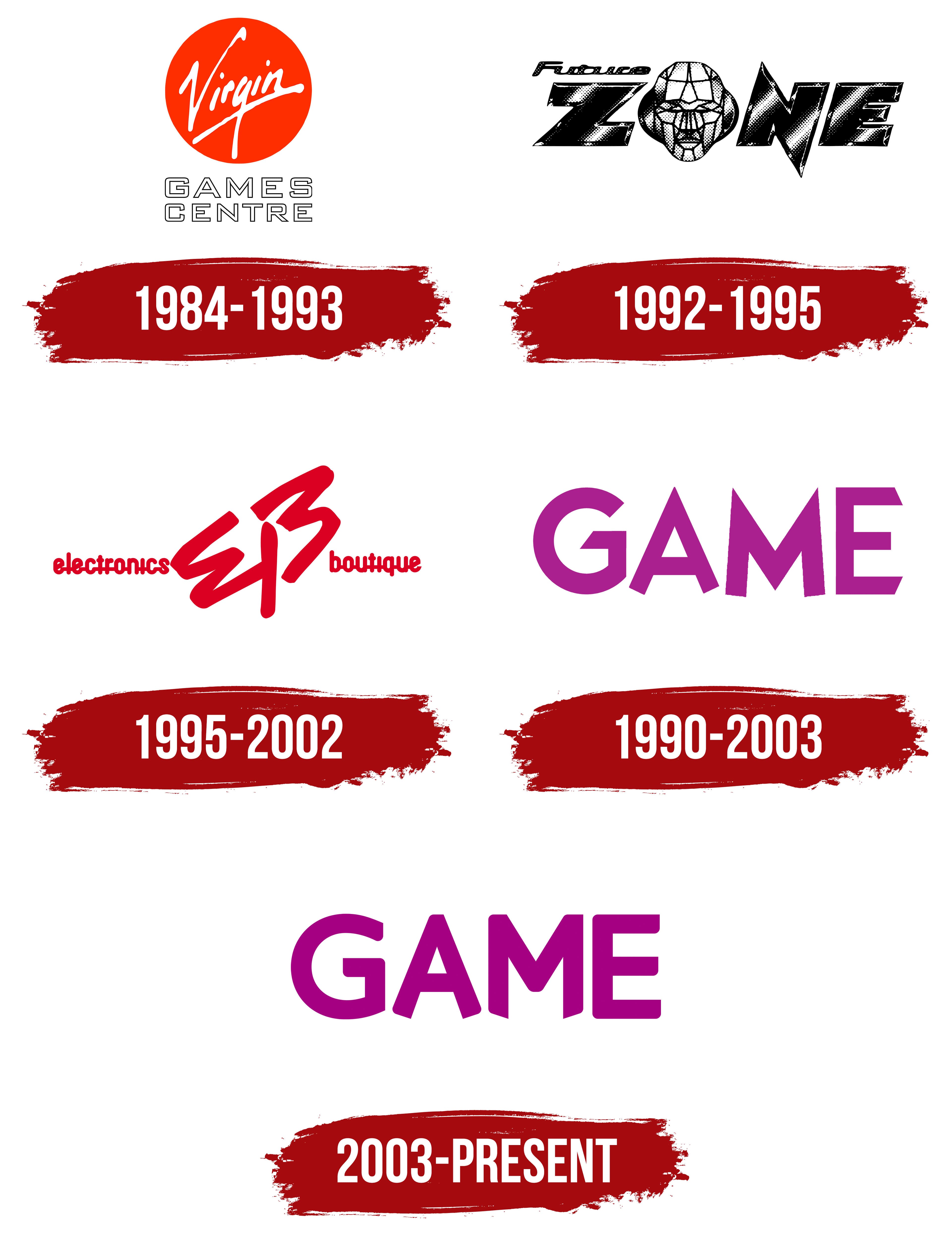
The core of “Virgin Games Centre’s” visual identity was a combination of the expressive handwritten Virgin logo and a strict text block indicating the chain’s specialization. The white “Virgin” inscription, rendered in dynamic cursive, was placed within a bright red circle, maintaining continuity with the corporate style developed by Ray Kyte for Virgin Group in the late 1970s. Beneath the circle, on a separate line, was “GAMES CENTRE”: large uppercase letters in a sans-serif typeface similar in character to Helvetica, with balanced proportions and even spacing between letters.
The emblem appeared in 1984 as the corporate logo for specialized video game stores that operated independently of the larger Virgin Megastores. The vertical composition, with its emotional upper part and rational lower part, balanced brand charisma with the straightforward function of the retail operation.
The color palette was dominated by saturated red and white. In some instances, the inscription “GAMES CENTRE” could appear in black or white with a black outline, allowing the emblem to adapt to various applications. This version appeared in advertisements, store interiors, and specialized publications, including the magazine White Dwarf, where ads featuring the network’s emblem were published during the 1980s.
The logo was in use until the early 1990s, when most “Virgin Games Centre” stores were acquired and converted first into Future Zone and later into GAME. An exception was the Oxford Street location, where the corporate style lasted longer, until integration with Virgin Megastore, retaining the recognizable combination of dynamic handwriting and strict textual emphasis.
1992 – 1995

The establishment of Future Zone was linked to the acquisition of Rhino Group by entrepreneurs Terry Norris and Bev Ripley at the end of 1992. The first store under the new brand opened the same year, and by the end of 1993, the total number of stores had reached approximately 46. In November 1993, Future Zone acquired the Virgin Games chain from W. H. Smith, increasing the number of stores to 77 and positioning the brand among prominent players in the British video game market.
The logo’s visual concept reflected the aesthetic of the early 1990s. Its basis was the large and clean wordmark “Future Zone,” emphasizing straightforwardness and modernity. Letter proportions were evenly balanced, possibly referencing a futuristic sans-serif style. The austere simplicity reinforced the chain’s dynamic and technological orientation. It highlighted its aspiration to associate with emerging industry trends.
The letter “O” in the word “Zone” deserved special attention: it was styled as an electronic face composed of multiple fragments. This face gave the logo a unique look and visually evoked a “digital” association. Judging by the texture and gradient, this stylization may have resembled metallic surfaces, further strengthening the connection to technology and electronics.
The version with “ZONE” written entirely in uppercase created a sense of importance and conveyed the brand’s confidence in its position across the entertainment, retail, and technology sectors.
1995 – 2002

After acquiring Rhino Group in 1995, the owners of the Electronics Boutique brand rebranded Future Zone stores, adopting an updated corporate emblem. The design was based on a strong visual interaction between an energetic monogram and calm textual elements, reflecting the desire to combine dynamism and technological spirit in a single visual identity.
At the center of the composition was the symbol “EB,” large and drawn as if with a loose marker stroke. The lines were noticeably thick and irregular, giving the sign a handmade, dynamic feel. In the mid-1990s, brands targeting youthful, technology-oriented audiences often employed expressive calligraphy to convey energy and a contemporary rhythm. The vivid red color enhanced this effect, making the logo visually dominant.
On each side of the monogram were the lowercase words “electronics” and “boutique.” The sans-serif font, with rounded stroke endings and uniform line thickness, softened the contrast with the dynamic center and ensured readability. The softness of forms visually balanced the aggressive tempo of the monogram, while the symmetrical structure provided cohesiveness.
1990 – 2003

The initial visual style of GAME took shape in the early 1990s, as the brand was entering the market as an independent company. This logo persisted through several stages of corporate evolution. In 1999, Rhino Group acquired Game, and the logo was adopted network-wide. However, its origin dates back to early stores that opened in 1990.
The word “GAME” is set in uppercase letters and colored in a rich purple-violet shade. Within the electronics and video game retail market at the time, this color distinctly set the brand apart from competitors, who typically preferred more neutral or darker palettes. The typeface was sans-serif, yet possessed individuality, as some characters featured slightly asymmetric lines and angled or expanded corners.
The letters were closely spaced, forming a compact, visually cohesive block. Slight irregularities in angles and variations in stroke thickness prevented the perception of excessive rigidity.
2003 – today

In 2003, the GAME brand introduced its current corporate emblem, completing the rebranding process after a change in ownership. The rebranding was prompted by the acquisition of the British retail chain Electronics Boutique (later renamed EB Games), which in 2002 changed the names of its stores in the United Kingdom and Ireland to GAME. One year later, the current logo was approved, and the company was renamed The Game Group, later becoming Game Retail Limited.
The emblem consists of the word “GAME” in uppercase letters, rendered in magenta. The typography is a slightly rounded, modified sans-serif. The softness of the contours helps position the brand as approachable and friendly. At the same time, the versatile shape allows the logo to fit harmoniously across various media formats.
The color lends the logo energy and visual expressiveness, helping it stand out against the heavier, more conservative retail identities prevalent in the early 2000s. A single-color palette strengthens memorability and facilitates easy adaptation to both print and digital media.