


 Grant Thornton Logo PNG
The Grant Thornton logo symbolizes the business-oriented approach of the international audit and consulting firm. Its restrained design reflects professionalism, reliability, and a commitment to effective business solutions.
Grant Thornton began in Chicago in 1924, when accountant Alexander Grant founded Alexander Grant & Company. He focused on mid-sized businesses, a market larger audit firms often overlooked in favor of major industrial corporations. After Grant died in 1938, the practice kept his name, opened offices across the United States, and continued working mainly with medium-sized companies and regional clients.
International growth began in 1969 through cooperation with firms in Australia, Canada, and the United Kingdom. In 1980, Alexander Grant & Company, Thornton Baker, and 49 other national partnerships formed Grant Thornton International. The network operated as an association of independent firms that used common professional standards and a single brand. The American and British businesses formally adopted the Grant Thornton name in 1986.
During the 1990s, the network added firms across new markets and positioned itself against PwC, Deloitte, Ernst & Young, and KPMG. The collapse of Arthur Andersen after the 2002 Enron scandal opened access to former clients, offices, and experienced staff in several markets. New regulation under the Sarbanes-Oxley Act increased scrutiny of audit independence, reporting, and corporate governance.
In 2024, New Mountain Capital invested in the U.S. business as private equity entered professional services. Grant Thornton UK was later acquired by Cinven for about £1.3 billion, marking another ownership change within the wider international network.
Meaning and History
What is Grant Thornton?
It is a mid-sized global consulting firm offering audit, tax, and business advisory services. Globally, it ranks sixth among professional-services firms. The firm specializes in mergers and acquisitions, restructuring, and IPO consulting.
Before 2008
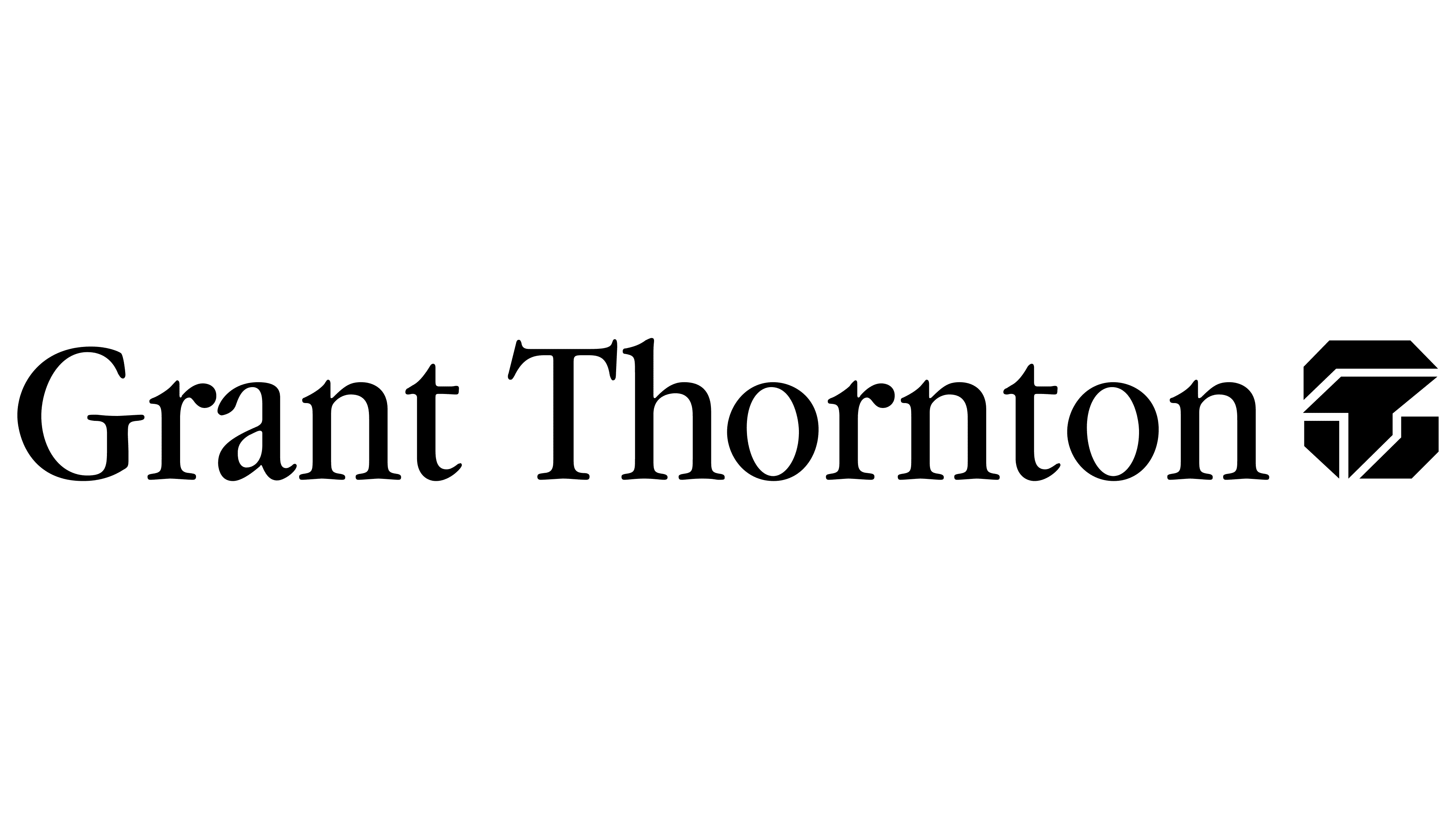
The Grant Thornton logo before 2008 was based on a monogram formed by the interlacing of the capital letters “G” and “T”, accompanied by a corporate wordmark in a formal serif typeface. The color palette was monochrome, dominated by black, symbolizing the conservatism, authority, and restraint of the auditing practice at that time.
The GT monogram featured a composition in which the letter T was placed inside a bold, angular letter G outlined in white. The letterforms were geometrically structured, with clearly defined contours, lines, and sharp corners. Visually, the mark appeared solid and monumental, akin to an architectural structure, metaphorically reflecting the company’s reliability and trustworthiness.
The typeface of the wordmark was a classic serif, with precise serifs, consistent stroke weight, proportional balance, and moderate glyph width. The letter G in the company name was enlarged, dominating the word “Grant” and emphasizing the brand’s status and authority. This approach aligned with the professional identity standards of auditing and legal firms in the early 2000s, comparable to those of firms such as Deloitte or Arthur Andersen. The formality and precision of the lettering reflected conservatism and dependability as key brand attributes, meeting the expectations of corporate clients.
The logo was used in two primary variations: the standard version (black mark and lettering on a white background) and the reverse version (white mark and lettering on a dark background). This allowed the company to adapt the image for various business materials, including printed reports, official stationery, presentations, and corporate correspondence. The black color conveyed the company’s business formality, official tone, and authority in the auditing services sector.
2008 – today

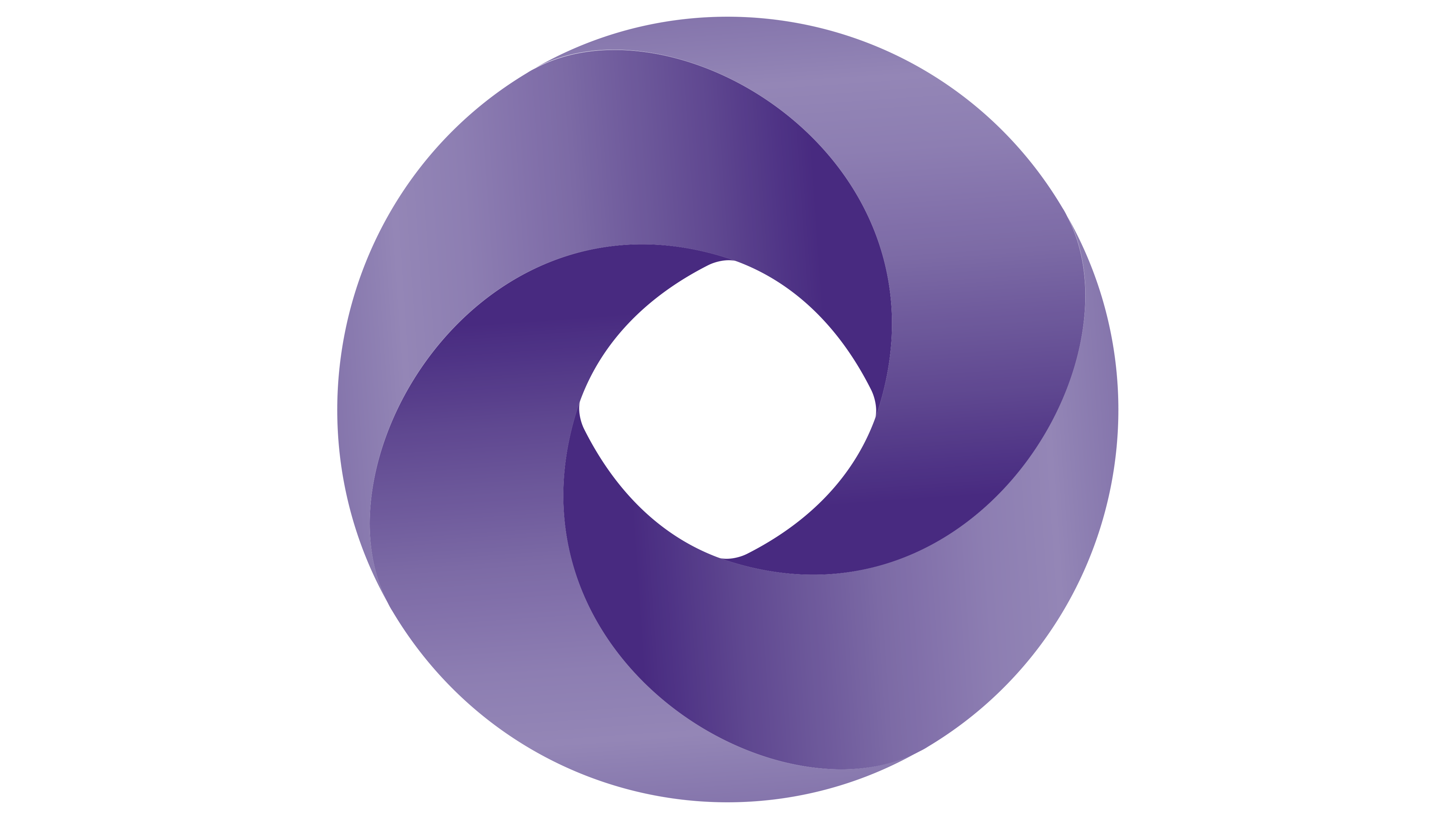
The current Grant Thornton logo consists of an emblem and a typographic element that reads “Grant Thornton.” The emblem is a three-dimensional Möbius strip with a gradient in shades of purple. The Möbius strip, a topological object with a single surface and a continuous edge, is depicted to convey the idea of infinity and the continuous flow of knowledge, experience, and professional collaboration across the firm’s network spanning 140 countries.
The design was created by the renowned agency Pentagram under the direction of partner Angus Hyland. Pentagram was chosen after an analysis and a series of interviews with partners from Grant Thornton’s global network. Five agencies reached the final stage, with their concepts discussed at an international marketing meeting where the winner was selected. A key factor in the decision was the balance between the symbol’s abstract nature, its global comprehensibility, and its ability to reflect the company’s core ideas of flexibility, growth, and international cooperation.
The purple gradient of the emblem serves as a marker of individuality, setting the company apart from competitors that do not use this color palette. The color’s symbolism is linked to qualities such as dignity, leadership, and a creative approach to solving professional challenges. Visually, purple conveys a sense of wisdom and innovation.
The typographic element uses a clean geometric sans-serif typeface. The letters have precise forms, moderately rounded stroke endings, and balanced proportions. The typeface is restrained, designed to support brand recognition without overshadowing the primary symbol, the Möbius strip. The black lettering adds the necessary professionalism and authority, reinforcing the company’s global stability and reliability.
The updated brand was launched on February 19, 2008, alongside the simultaneous rollout of the company website, advertising materials, and new printed products across all international offices. The identity change was implemented in stages, coordinated by the central office with active participation from local marketing teams across more than 80 national offices.
The visual update gave the company a brighter, more expressive, and geometrically engaging logo. The Möbius strip has become a metaphor for the endless exchange of experiences and collaboration between divisions, underscoring the company’s global focus and openness to innovation. The symbol combines mathematical precision, depth of meaning, and aesthetic appeal, while the clean typeface adds solidity and professionalism to the brand’s overall impression.
Font and Colors
The typeface is a modern sans serif with strict forms and moderately weighted strokes. Visually, it is similar to the Zurich Trade and Remora Corp families, but features certain custom modifications, including slightly rounded stroke ends and slightly increased letter spacing. This choice of typeface creates an image of restrained professionalism, precision, and reliability, supporting the association with the accuracy of the company’s financial work.
The color palette consists of two shades: the emblem’s purple gradient and the solid black of the lettering. Black emphasizes business style, professionalism, and the company’s serious approach to operations. The purple is presented in a unique gradient, ranging from lighter to deeper tones, and expresses creativity, wisdom, and leadership.