


 Hot Heels Logo PNG
The Hot Heels logo emphasizes the brand’s association with high craftsmanship and meticulous attention to detail. The brand has grown out of a passion for challenging sports, evolving into a platform that prioritizes practicality and precision in every detail.
Hot Heels began in Iowa around 1999 as a family-owned manufacturer of training equipment for team roping. The company focused on mechanical steer dummies that reproduced a running animal’s stride, body position, and rear-leg action. The equipment allowed riders to practice rope timing and placement while training with a horse on an arena surface.
The development of the early Hot Heels machine is associated with Alan R. Copenhaver. A US patent issued on May 18, 2004, described a mechanical steer with a front support, animal-shaped body, movable rear legs, and a drive system activated during towing. Unlike earlier dummies with legs suspended above the ground, the Hot Heels design allowed the hooves to contact the surface. A horse, ATV, or other vehicle could pull the machine.
One early product line was the Original Moving Body series. Its body rose and fell together with the moving legs. In contrast, the head, flexible legs, releasable horns, and skid base supported different training exercises. A later Springer Hitch version reduced the distance between the towing vehicle and the dummy, helping the machine turn inside smaller arenas.
Hot Heels later developed the CrossFire range. CrossFire Supreme used two-part legs, an extra hip joint, a moving head, and a two-speed pulley. The Jen-Stick mechanism released the loop when a rider threw too late. The company later added JakeSteer, replacement parts, smaller ground-practice dummies, and the self-propelled QuickFire model promoted in 2024. Its main competitors included Smarty, developed by rodeo champion Allen Bach, and Heel-O-Matic. By 2026, Hot Heels Inc. remained a family business led by Jennifer Howe.
Meaning and History
What is Hot Heels?
This company develops training equipment for practicing lasso skills in rodeo. Its assortment includes specialized simulators that help improve the technique for grabbing the bull’s hind legs and head. The equipment is suitable for both individual and group training, creating a safe environment that increases movement accuracy and speed. The variety of models allows you to choose the right difficulty level for both beginners and experienced rodeo participants.
1998 – today
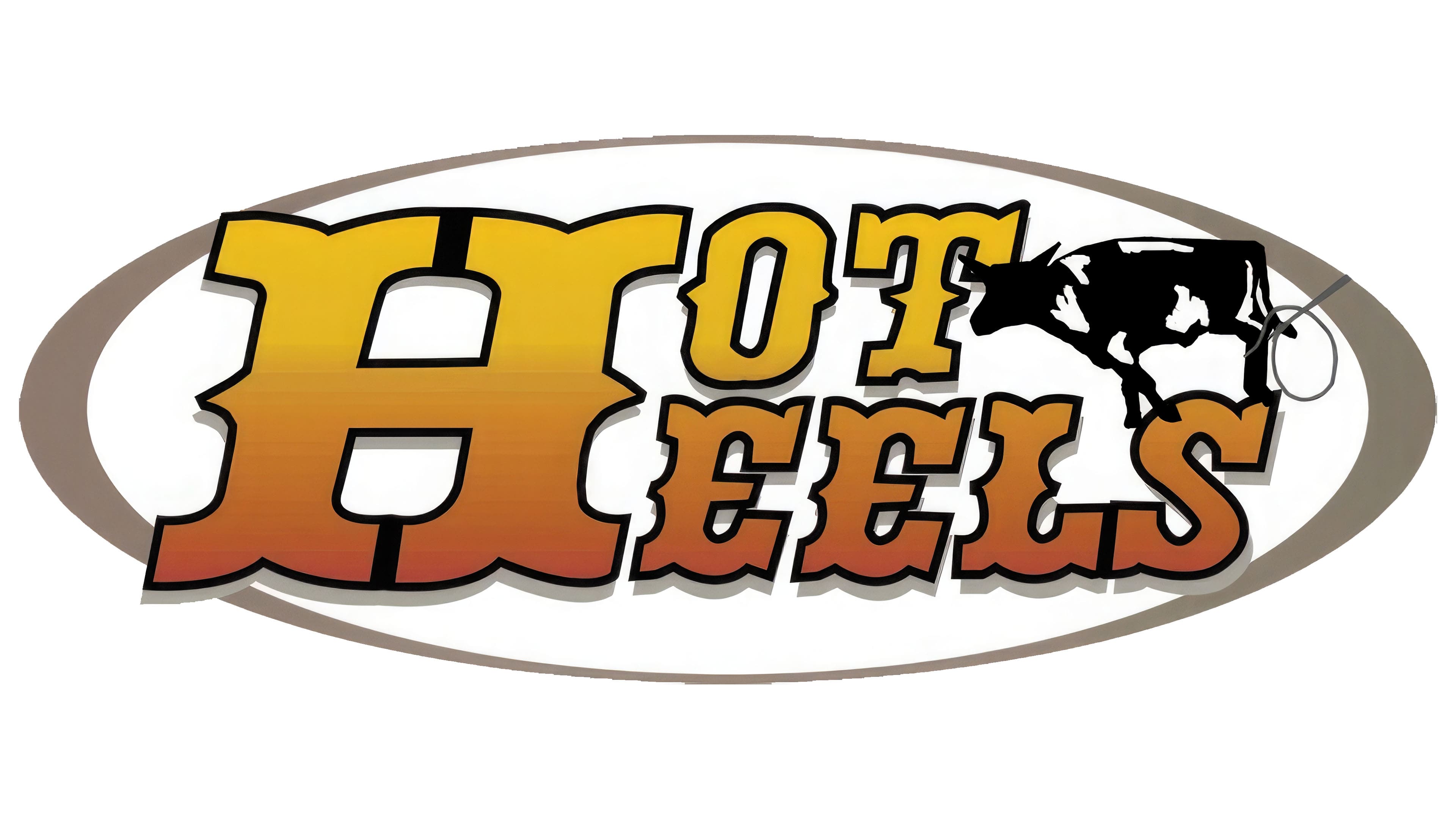
The Hot Heels logo embodies the rodeo style and the atmosphere of true cowboy traditions. From the very first details, it’s clear where the brand draws its inspiration: the American Wild West is evident. The design feels lively, authentically American, and fun, without any pretentious elements, resembling a sign on an old ranch.
The foundation of the emblem is slightly irregular and oval. The oval is outlined with a thin, brownish contour of varying thickness, reminiscent of the earth or sand of a rodeo arena. The white background inside keeps the composition clean and simple, ensuring nothing distracts from the main idea.
The company’s large name, “HOT HEELS,” is in a distinctive font reminiscent of cowboy show posters or Western-style signs. The first letter, “H,” is oversized and serves both words, setting the overall tone of the inscription. The bold, three-dimensional font with black outlines creates a shadow effect for added depth. The color palette of the letters transitions from yellow at the top to orange and reddish hues at the bottom, resembling a blazing sun or fire.
A key detail in the logo that directly illustrates the company’s focus is the silhouette of a bull positioned to the right of the name. The bull is black and white, in a simple, recognizable form, and has a lasso attached. This element directly relates to the company’s products and training equipment designed to help cowboys hone their bull-roping skills. These trainers allow athletes to practice teamwork and refine their roping techniques, including heading and heeling.