IC Bus Logo PNG
The IC Bus logo highlights the functionality and reliability of the company’s buses. Its restrained, utilitarian design symbolizes the practicality and everyday use of products operated on urban and school routes across North America.
IC Bus traces its history to 1933, when David Ward founded Ward Body Works in Arkansas to manufacture bus bodies. Within three years, the company introduced fully metal school bus bodies in the United States, replacing wooden construction. Production expanded as specialized school transportation became more standardized.
By the 1960s, Ward was using IBM computers to improve production planning, inventory management, and quality control. Economic pressure, rising material costs, and stronger competition created financial problems during the 1970s. The company entered bankruptcy in 1979, and its operations were reorganized as American Transportation Corporation, known as AmTran.
Navistar International acquired AmTran in 1995, giving the bus manufacturer access to truck chassis, engines and engineering resources. The business increasingly integrated body and chassis development within one organization. Its vehicles began appearing under the IC name in the early 2000s, and the company formally adopted the name IC Bus in 2008. Production was concentrated in Tulsa, Oklahoma, while Blue Bird remained a competitor.
In 2017, IC Bus presented an electric CE Series model based on Volkswagen’s platform. The third generation of the CE debuted in July 2023 with diesel and fully electric versions, improved driver visibility, and safety systems. The CE3402 was designed for up to 76 passengers, while its electric configuration included adjustable regenerative braking.
Meaning and History
What is IC Bus?
It is a prominent American bus manufacturer that mainly produces school and commercial buses. The company builds models seating between 30 and 90 passengers. Modular body and chassis construction allows customization for specific customer needs. Its Oklahoma plant produces dozens of vehicles daily, featuring reinforced structures and reliable diesel engines. Buses feature advanced safety systems that ensure passenger protection. It is a market leader in specialized transportation in the U.S.
1933 – 1980

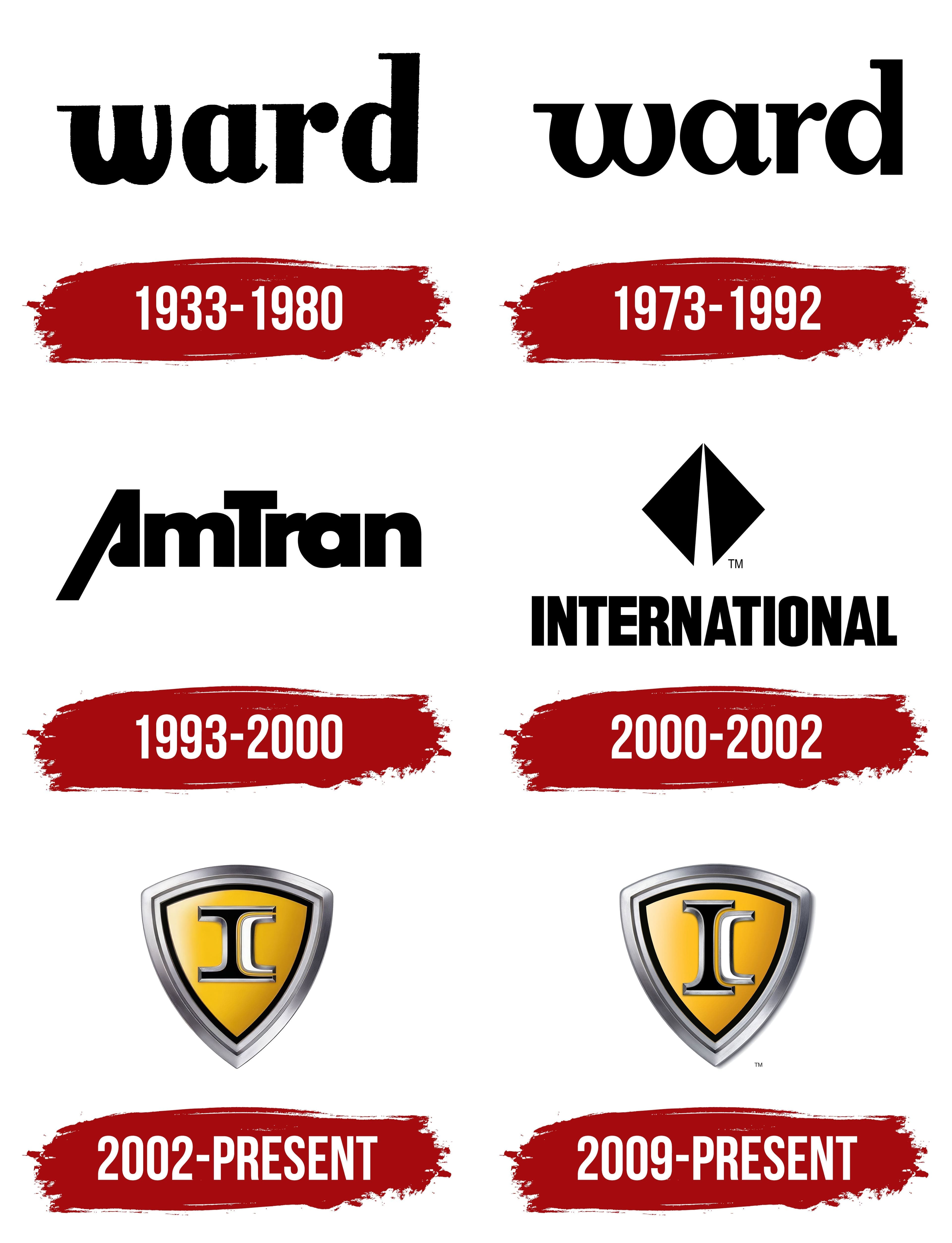
This period was marked by the introduction of the Ward Body Works logo, which signified the transition to mass production of all-metal bus bodies. The introduction of the mark coincided with changes in American industrial design that reflected the harsh realities of the Great Depression. In conditions of economic upheaval, industrial enterprises were expected to provide reliability, durability, and restrained product design that matched the pragmatic expectations of customers and the market.
Visually, the Ward Body Works logo was presented as a simple inscription in a strict geometric typeface, in capital letters closely resembling early sans-serif Gothic. The glyphs had a rectangular structure, uniform thicknesses of the vertical and horizontal strokes, and no serifs, typical of commercial typography from the 1930s to the 1950s. This design style was characteristic of the American industrial aesthetic, subordinating decoration to the functional requirements of production and to the positioning of industrial goods at that time. The appearance of the letters evoked associations with cut metal plates, conveying a sense of solidity, longevity, and technical rigor. Line thickness, spacing, and proportions of the mark varied depending on the application.
The logo’s color scheme remained primarily monochrome, emphasizing austerity and practicality. The absence of bright colors or decorative elements reflected the branding’s utilitarian, industrial style. At the same time, the simplicity of the forms was associated with technical precision and product reliability.
The logo was applied extensively and featured a limited series of Carpenter-Ward buses, serving as a visual symbol of continuity and brand unity, highlighting the integration of sub-brands into the company’s main line. This allowed Ward to preserve customer trust and loyalty, as the mark was perceived as a guarantee of consistent quality and production stability.
1973 – 1992

In 1973, Ward Body Works modernized its logo, connecting the update to changes in brand positioning and the new demands of the US school transportation market. The former industrial character, reminiscent of the heaviness and solidity of the 1930s, gave way to a lighter and more balanced image that reflected contemporary standards and customer expectations.
The logo was rendered as a horizontal inscription with reduced vertical stroke thickness and tighter kerning, giving the letters a sense of cohesion and compactness. The letters “a,” “r,” and “d” lost their former geometric solidity and acquired refined contours, smooth stroke endings, and softly rounded lines. These changes symbolized the brand’s effort to associate itself less with the strength of metal and more with precision and refinement in product execution, in line with the rising standards of school transportation.
The typography of the new mark featured a nonstandard typeface that reflected the modernist techno-grotesque trends of the period. Although the inscription resembled commercial typefaces such as Microgramma or Eurostile, its forms were adapted to the brand’s specificity, creating a stable visual identity that distinguished it from competitors. This customized solution allowed the company to stand out within the broader typographic environment of school transportation.
Although Ward Body Works ceased to exist in 1980 when Navistar Corporation absorbed it, the brand retained its name and market presence for another twelve years, until December 1992. Preserving the logo during the transition period served as a sign of continuity. It confirmed the value of the brand’s accumulated authority among American schools and public institutions.
The updated inscription was perceived as less utilitarian, evoking associations with the flow and lightness of modern vehicles rather than the heavy industrial machinery of the earlier era. The color palette remained strict and minimalist, reinforcing the brand’s perception as a stable, time-tested school bus supplier.
1993 – 2000

The appearance of the AmTran logo in 1993 coincided with the complete renaming of Ward Body Works to the American Transportation Corporation. This marked a new era for the brand, which began after the crisis and bankruptcy. Since the late 1970s, Ward had faced serious economic difficulties, which culminated in a collapse in 1980. The event catalyzed the formation of a new structure, MBH Inc., which soon evolved into AmTran and successfully restored bus production while preserving key jobs.
The logo marked a full departure from the previous corporate typography, allowing the brand to create its own identity independent of Ward. In the new inscription, the connection of the first two letters, “A” and “m”, was emphasized, forming a single visual block. The letter “A” received a distinctive slant on its left stroke, serving as a metaphor for moving forward, progress, and company development. The letters “mTran” were bold with geometrically confident forms, creating a reliable visual impression relevant to a bus manufacturer whose primary focus was always safety and product dependability.
The typography was based on a modernized version of Futura, with custom modifications that highlight the brand’s individuality. The geometric sans serif was associated with clarity, technological quality, and rigor, aligning with the theme of bus manufacturing and the company’s perception by government institutions and schools as a responsible partner.
The logo’s color palette was reduced to monochrome, reinforcing the brand’s focus on austerity and strict functionality. The absence of superfluous elements emphasized rationalism and practicality, contrasting with the former Ward brand, which, for many years, had been forced to balance old industrial traditions with the market’s new expectations.
The AmTran logo was used on all official company materials and on its Volunteer and CS bus models, becoming a symbol of a new chapter in its history. Its application continued until the company was acquired by Navistar International in 2000, after which the logo gradually gave way to the IC and International brands. However, despite the replacement, the AmTran emblem remained in use for some time, confirming recognition and the resilience of the company’s visual identity.
2000 – 2002

In 2000, the AmTran brand ceased to exist, giving way to International, the corporate name of its parent company. This event resulted from Navistar International’s strategy to unify the names of all its transportation divisions. From that point on, bus production was integrated into the overall corporate brand, emphasizing the connection between bus products and Navistar’s trucks.
The “INTERNATIONAL” logo, appearing on buses from 2000 to 2002, was a strict typographic mark composed of capital letters. The symbols were horizontally elongated and spaced farther apart, creating a visual impression of solidity and brand scale. The letters’ geometry reflected the company’s industrial strength, underscoring its association with heavy equipment and the production of vehicles designed for intensive use.
The typographic basis of the logo was a modified geometric sans serif with proportions and details similar to those of well-known typefaces such as Bank Gothic or Eurostile Extended. The typography featured wide glyphs with uniform stroke thickness, sharp edges, and only slightly softened corners, conveying a sense of technological quality, precision, and engineering discipline.
The monochrome execution of the logo supported the austerity of the corporate style, emphasizing functionalism and technological discipline.
On a conceptual level, the new International logo was perceived as a visual integration of bus production into the broader Navistar family, evoking a corporate flag that unites the company’s different industry segments. The name INTERNATIONAL on buses reflected the new brand philosophy, which subordinated individual marks to a unified style.
2002 – today
The bus division of Navistar Corporation transformed its identity, abandoning the name International in favor of the new brand, IC Bus. The American Transportation Corporation was renamed IC Corporation, emphasizing the transition to a unified production system designated as Integrated Coach. The transition was accompanied by a fundamentally new emblem design that differed from all previous company brands.
The logo design featured a metallic shield on a bright yellow background with a three-dimensional outline, inside which was a stylized letter “I” with the letter “C” integrated to its right. The shield shape was chosen to associate with protection and safety, essential qualities in the school transportation industry. The shield form referenced automotive emblems from the early 2000s, which often focused on metallic textures and three-dimensional imagery.
The letters were executed in an industrial style, with three-dimensional effects that imitate a metallic surface. The glyph constructions were vertically elongated and symmetrical, symbolizing technical strength, stability, and the brand’s confidence in the reliability of its products. The letters’ design did not adhere to standard typographic conventions, and their form emphasized the exclusivity of the company’s bus production.
The yellow background of the emblem, associated with the traditional color of school buses in the United States, reflected the profile and main purpose of IC Bus products. The metallic outline and three-dimensional style added a sense of technological sophistication and modern production, underscoring the company’s full vertical integration of bus manufacturing and component production.
The emblem was used across the entire IC Bus product line, appearing on grilles, steering wheels, technical plates, official documentation, and promotional materials.
2009 – today

In 2009, IC Bus introduced a partial redesign of its logo, coinciding with another change in the company’s official name, from IC Corporation to IC Bus. The update did not replace the previous mark. Still, it became an additional version used in parallel on different models and within various elements of corporate design.
The key difference in the new emblem was the change in the proportions of the letters “I” and “C”: their forms became taller than in the earlier version. The letter “C,” integrated from the side and visually intertwined with the “I” in a single composition, symbolizes the close connection and interaction among the company’s internal production processes. The interwoven letters IC stood for Integrated Coach, representing the concept of full-cycle bus production within a single brand. The CE and RE bus series produced after 2009 became the main carriers of this emblem variant.
The emblem retained its shield-like shape, but designers enhanced its visual depth by adding a thickened metallic border around the perimeter that smoothly transitioned into a dark outline, creating a three-dimensional effect. This visual depth evoked associations with premium automotive emblems, reinforcing the perception of IC Bus vehicles as high-quality, technologically advanced products.
The yellow field within the shield maintained a symbolic link to the traditional school bus, reinforcing the company’s industry specialization. At the same time, the metallic tone of the outer elements emphasized the product’s technical strength and reliability.